BMW M4: The Complete Review, Specs, and Buying Guide
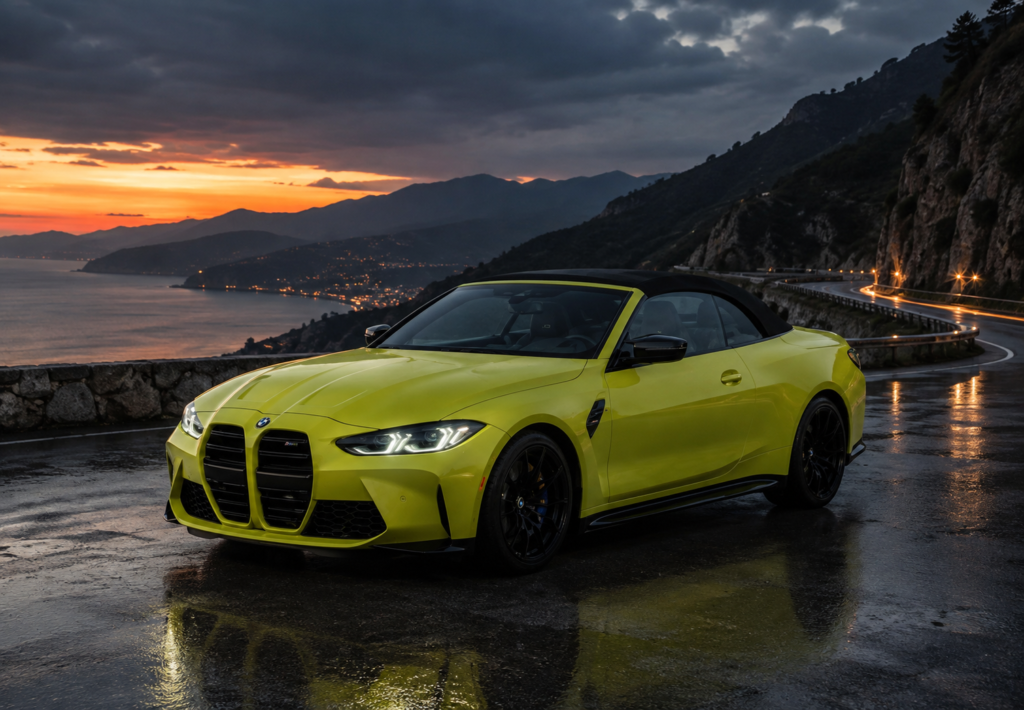
If you’ve spent any time around a BMW dealership or scrolling through car forums, you’ve probably noticed the BMW M4 gets talked about differently than most performance coupes. It’s not just fast. It’s got a personality that either wins people over instantly or takes a minute to grow on them—especially once you see that grille in person.
BMW offers everything from luxury sedans and SUVs to high-performance M models. To learn more about the brand, explore our complete BMW guide.
I’ve driven several generations of BMW’s M cars, sat through test drives with owners who track their M4s on weekends, and watched this car evolve from a niche enthusiast pick into one of the most talked-about performance coupes on the market. This guide breaks down everything you actually need to know before considering one, from the engine under the hood to how it compares against its own siblings like the BMW M3 and BMW M2.
Whether you’re a first-time BMW shopper or someone who’s owned three M cars already, this article aims to give you a clear, honest picture—no fluff, no marketing spin.
For the latest specifications, performance details, and available configurations, visit the Official BMW M4 Overview page on the BMW website.
What is the BMW M4?
The BMW M4 is BMW’s high-performance two-door coupe, built on the same underlying platform as the BMW M3 sedan but wrapped in a shorter, more aggressive two-door body.
Think of it as the M3’s sportier sibling. Same heart, tighter package. BMW’s M division takes the standard 4 Series, reworks the engine, suspension, brakes, and aerodynamics, and turns it into something built for both daily driving and serious back-road (or track) fun.
It sits in a crowded field of performance coupes, but the BMW M4 has carved out its own identity thanks to BMW’s straight-six engine heritage and a chassis tuned by engineers who’ve been refining this recipe for decades.
For context, if you’re cross-shopping BMW’s broader lineup—things like the BMW X3, BMW X5, or even electric options like the BMW i4—the BMW M4 represents the performance-first end of the spectrum, not the practicality-first end.
History and Background
The BMW M4 nameplate is actually younger than you might think. Before 2014, this car was simply called the BMW M3 Coupe. BMW split the 3 Series lineup that year, renaming two-door variants as the “4 Series” and giving the performance coupe its own M4 badge.
The first-generation BMW M4 (F82 chassis) launched with a twin-turbo inline-six, a notable shift after the previous M3’s high-revving V8. Purists grumbled about turbocharging at first, but the extra torque and real-world drivability won most people over.
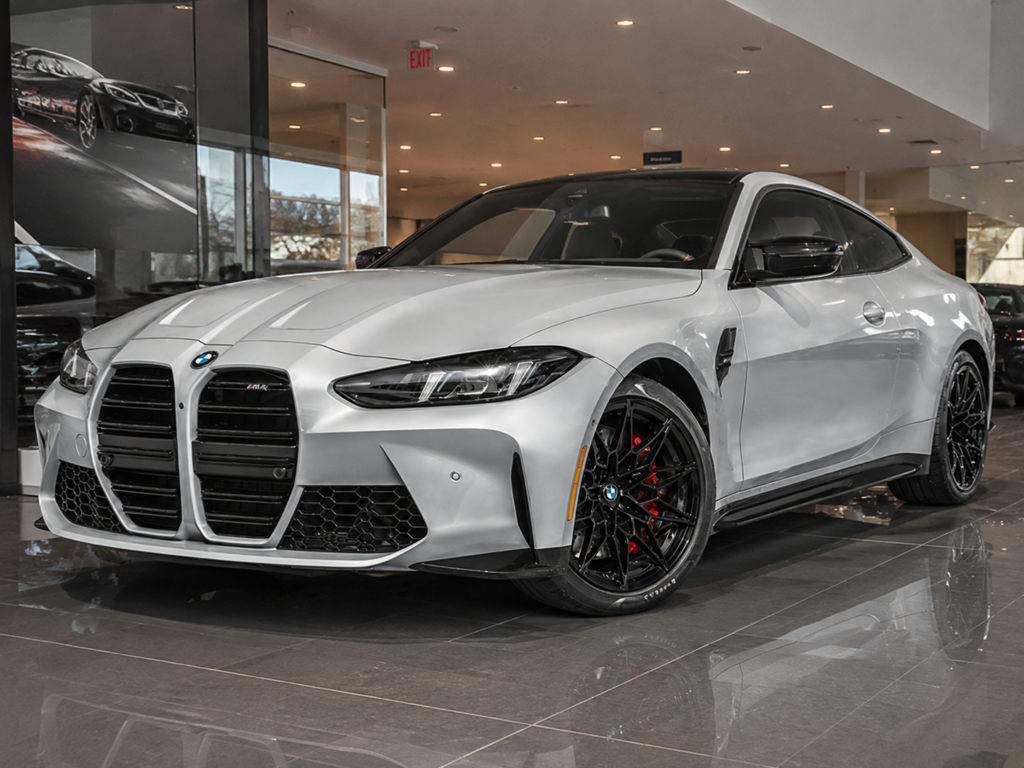
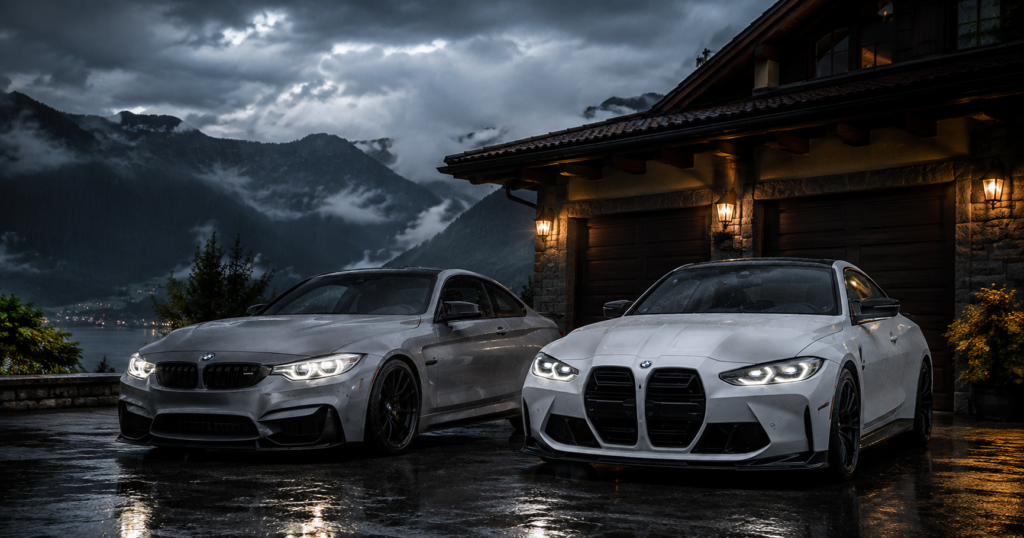
Then came the G82 generation in 2020, which brought the styling that’s impossible to miss—the large vertical kidney grille. Love it or hate it, it made the M4 one of the most recognizable performance cars on the road.
Today’s BMW M4 continues that lineage while adding more power, sharper technology, and an available all-wheel-drive system, something earlier M4s never offered.
BMW’s M division itself dates back to 1972, originally formed to manage the brand’s motorsport program before evolving into the performance arm we know today. That racing DNA still shows up in how the M4 handles corners.
Design and Exterior
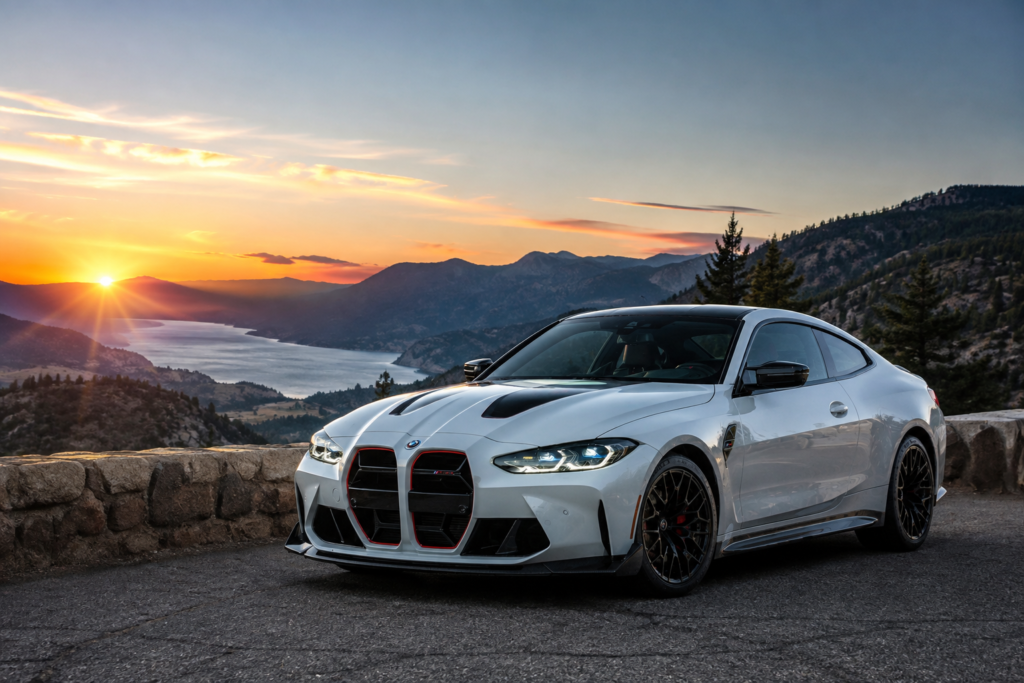
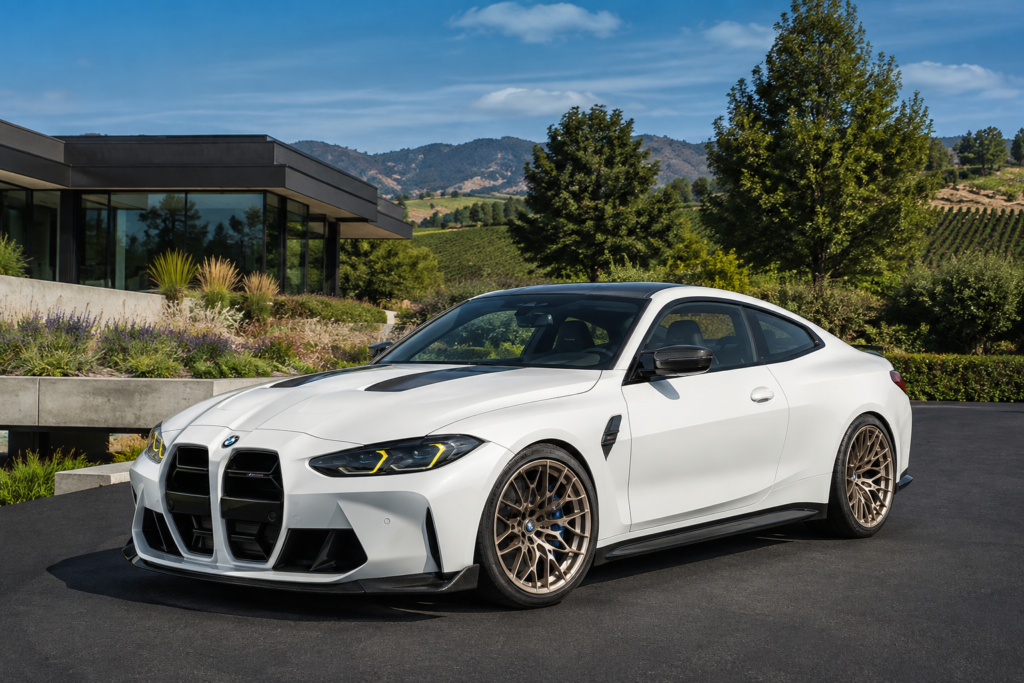
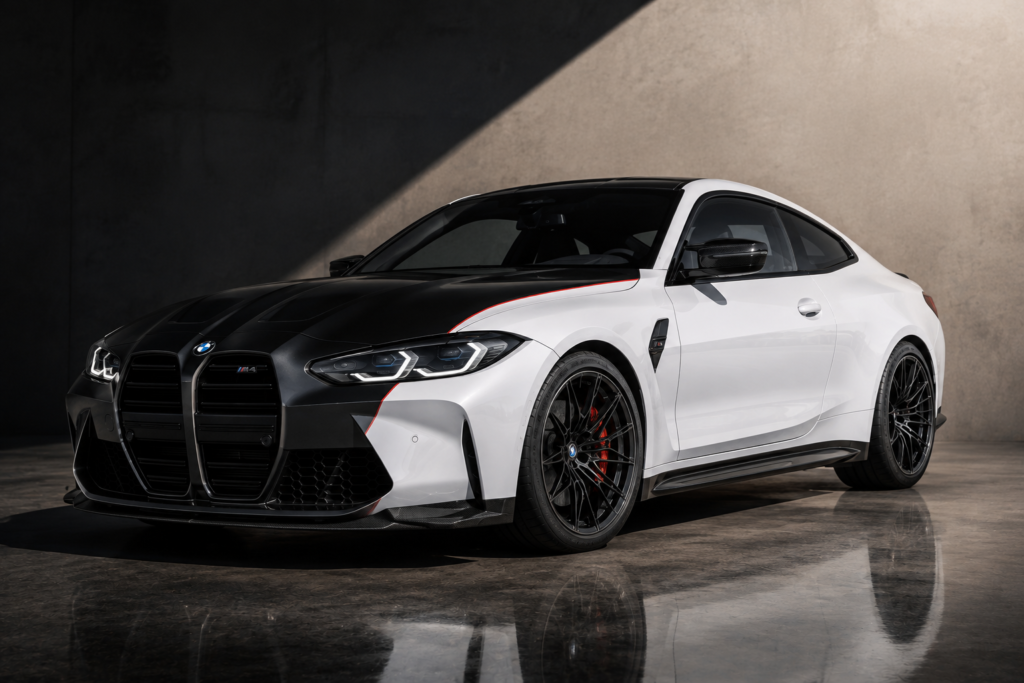
There’s no way around it—the M4’s design is polarizing, and that’s largely because of the grille. BMW made it significantly larger starting with the current generation, and it’s become one of the most debated styling choices in the industry.
Beyond the grille, though, the rest of the design does a lot of things right:
- Wide, muscular fenders that hint at the performance underneath
- A low, aggressive stance that looks planted even standing still
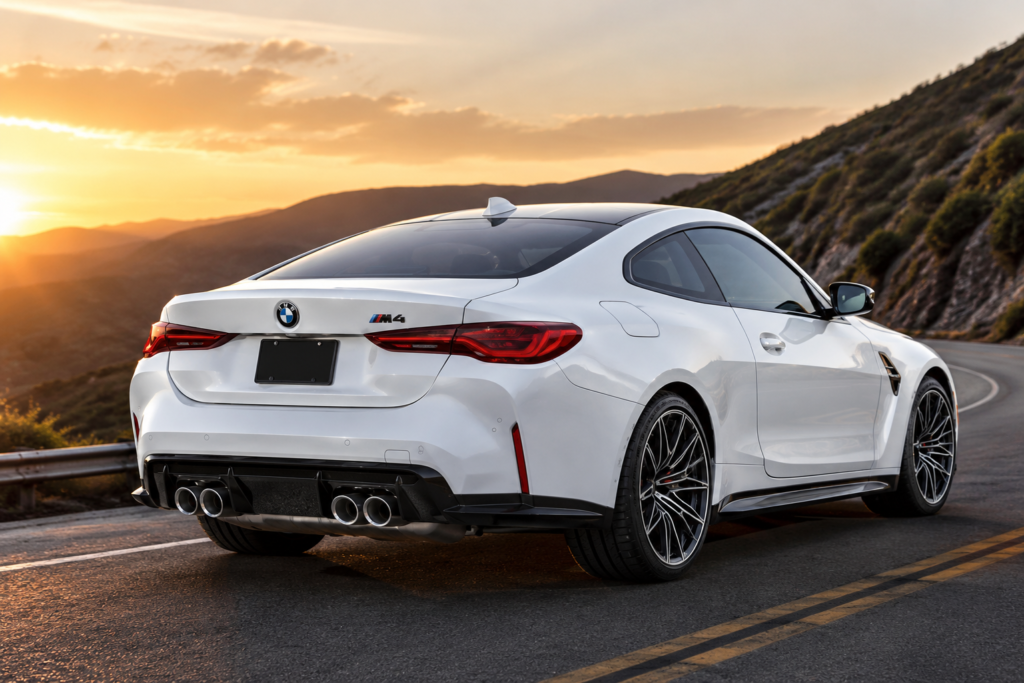
- Quad exhaust tips that signal serious output
- Optional carbon fiber roof to reduce weight and lower the center of gravity
- Sharp character lines that give it a more athletic silhouette than the standard 4 Series
In person, photos genuinely don’t do it justice. The proportions work better in real life, and the width of the car—especially in Competition trim—gives it real road presence.
If you compare it side by side with something like the BMW M2, the M4 feels noticeably larger and more substantial, while the M2 leans smaller and scrappier.
Interior and Technology
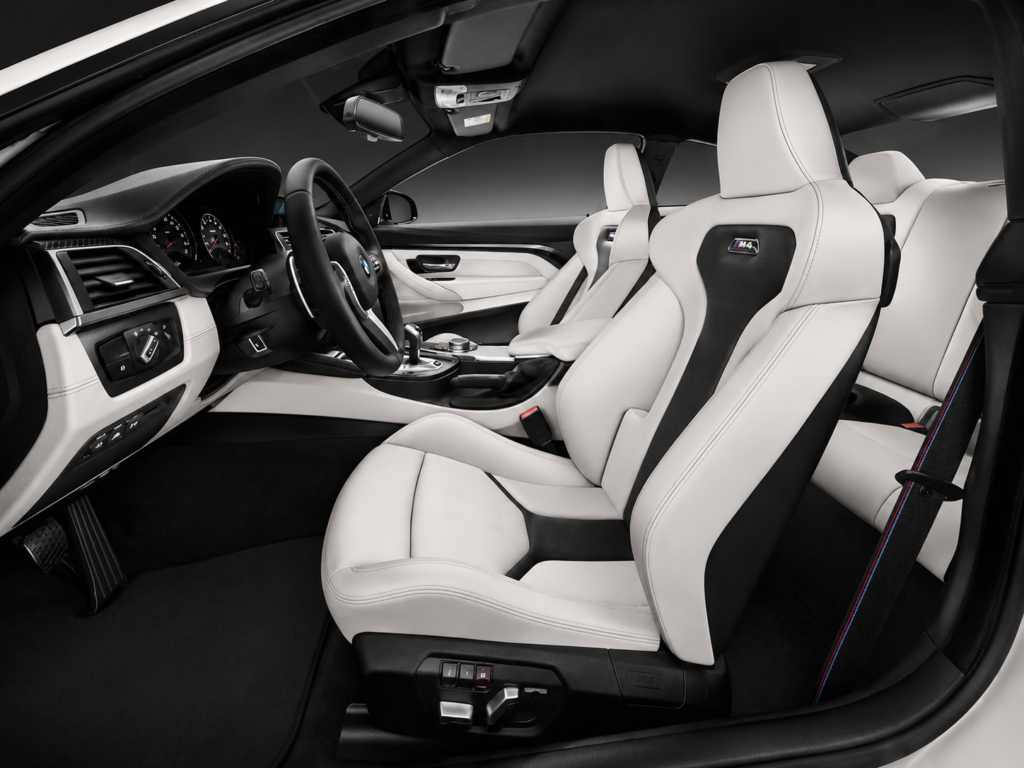
Step inside, and the M4 shifts from “look at me” to “let’s get to work.” The cabin is driver-focused, with BMW’s curved display setup combining the digital gauge cluster and infotainment screen into one sweeping unit.
Standout interior features include:
- M-specific sport seats with adjustable bolstering (great for track days, still comfortable for commuting)
- A flat-bottom steering wheel with dedicated M1 and M2 shortcut buttons for saved drive settings
- Carbon fiber trim options that keep things lightweight and visually sporty
- BMW’s latest iDrive software, which is intuitive once you spend a week with it
- Wireless Apple CarPlay and Android Auto, standard on most trims
Material quality is genuinely excellent. Stitched leather, real metal accents, and tight panel gaps make it feel like a proper premium car, not just a fast one.
Rear seats exist, technically, but they’re tight. This is a car built primarily for driver and front passenger, with rear seating as a bonus rather than a priority—something to keep in mind if you’re comparing it against family-friendly options like the BMW X3 or BMW X5.
Engine and Performance
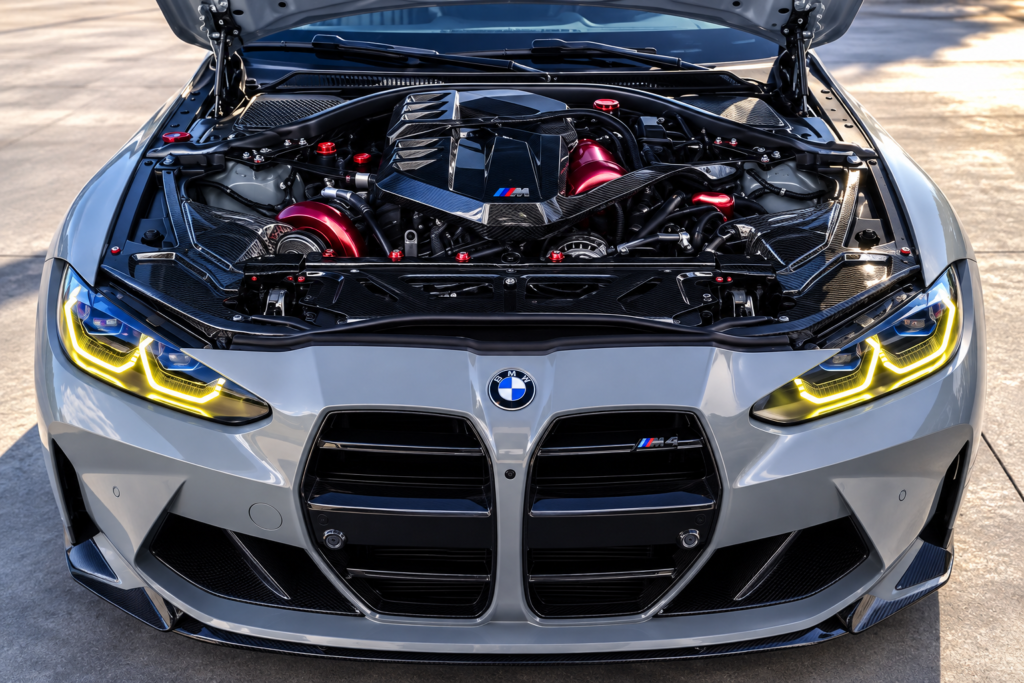
This is where the M4 earns its reputation. Under the hood sits BMW’s S58 twin-turbocharged 3.0-liter inline-six engine, an evolution of the engine also found in the X3 M and X4 M.
In standard M4 trim, you’re looking at around 473 horsepower. Step up to the M4 Competition, and output climbs to roughly 503 horsepower, paired with a meaner exhaust note and sharper throttle response.
What makes this engine special isn’t just the number on paper—it’s how it delivers power. Torque hits early and stays flat across a wide range, so you get strong pull whether you’re merging onto a highway or exiting a tight corner.
BMW offers the M4 with either a six-speed manual (a rarity these days, and enthusiasts love it for that reason) or an eight-speed automatic in Competition models. There’s also an M xDrive all-wheel-drive option, which noticeably improves traction in wet or cold conditions without dulling the rear-drive feel too much.
Compared to the BMW M5’s twin-turbo V8, the M4’s inline-six feels more eager to rev and slightly more playful at the limit, even if it can’t match the M5’s outright power ceiling.
Specifications
Quick Specifications Table
| Spec | Detail |
|---|---|
| Engine | 3.0L Twin-Turbo Inline-6 (S58) |
| Horsepower | 473–503 hp |
| Torque | 406–479 lb-ft |
| Transmission | 6-speed manual or 8-speed automatic |
| Drivetrain | RWD or optional M xDrive AWD |
| 0–60 mph | 3.8–4.1 seconds (varies by trim) |
| Top Speed | 155–180 mph (with M Driver’s Package) |
| Seating | 4 (2+2 configuration) |
| Fuel Economy | Approx. 16 city / 23 highway mpg |
Full Specifications Breakdown
| Category | M4 Standard | M4 Competition |
|---|---|---|
| Horsepower | 473 hp | 503 hp |
| Torque | 406 lb-ft | 479 lb-ft |
| 0–60 mph | ~4.1 sec | ~3.8 sec (AWD: ~3.4 sec) |
| Transmission | 6-speed manual | 8-speed automatic |
| Curb Weight | ~3,830 lbs | ~3,900–4,050 lbs |
| Brakes | M Sport brakes standard | Optional M Carbon Ceramic |
These numbers put the M4 solidly in the same performance bracket as the BMW M3, since the two cars share nearly identical mechanical underpinnings.
Top Speed and Acceleration
Straight-line performance is genuinely impressive. The M4 Competition with M xDrive can hit 60 mph in roughly 3.4 seconds, which is supercar territory that would’ve seemed unbelievable for a “normal” coupe a decade ago.
Top speed is electronically limited to 155 mph out of the box, but opting for the M Driver’s Package bumps that limiter up to 180 mph—something worth considering if you plan on track days.
What’s more impressive than the raw numbers, honestly, is how usable that speed feels. The chassis stays composed, the steering stays communicative, and the car doesn’t feel nervous even when you’re pushing it hard. That’s the result of decades of BMW M engineering, not just a bigger turbo.
For comparison, the BMW M8 is quicker in a straight line thanks to its V8 and higher price bracket, but the M4 gives up surprisingly little for a car that costs significantly less.
Price
Pricing varies by trim, options, and region, but here’s a general breakdown based on U.S. market pricing:
| Trim | Estimated Starting Price |
|---|---|
| BMW M4 (base) | ~$76,000 |
| BMW M4 Competition | ~$81,000 |
| BMW M4 Competition xDrive | ~$83,500 |
| BMW M4 CS (limited, higher performance) | ~$70,000+ (varies widely due to scarcity) |
Optional packages—carbon ceramic brakes, carbon fiber trim, the M Driver’s Package—can push a well-equipped M4 north of $90,000 fairly quickly.
For context, that positions it above a well-equipped BMW 330i or BMW M340i, but below flagship performance models like the BMW M5 or BMW M8.
BMW M4 Ownership Costs: Fuel, Insurance, Maintenance & Resale Value
Buying a BMW M4 is one decision. Living with it for the next five years is a different conversation entirely, and it’s one most buyers don’t think through until the first bill shows up.
Let’s start with fuel. Real-world owners typically see somewhere around 16–18 mpg in city driving and closer to 22–24 mpg on the highway. That’s not shocking for a twin-turbo performance coupe, but if you’re coming from a regular sedan, expect noticeably more frequent trips to the pump, especially if you enjoy using that throttle.
Maintenance is where the BMW M4 starts to separate itself from everyday cars. Annual service costs typically range from $1,200 to $2,000, depending on whether you’re doing routine oil changes or bigger jobs like brake pads, rotors, or coolant service. Once the factory warranty expires, costs tend to climb further, so budgeting ahead matters.
Insurance is another area where the BMW M4 sits above average, though the exact number depends heavily on your location, driving record, age, and coverage level. High-performance coupes generally carry higher premiums than family sedans, so it’s worth getting a real quote before signing anything.
On reliability, the BMW M4 has generally held up well when maintained properly. The S58 engine has proven fairly robust, though like any turbocharged performance engine, skipping maintenance or using low-quality fuel tends to catch up with owners eventually.
Resale value is a genuine bright spot. The BMW M4 tends to depreciate slower than many rivals, particularly manual-transmission models and well-optioned Competition trims, which enthusiasts actively seek out on the used market.
If you’re comfortable with premium fuel, moderate service costs, and insurance that reflects its performance status, the BMW M4 rewards you with strong resale value and a genuinely satisfying ownership experience—not just a fast car, but a smart long-term one too.
Pros and Cons
Pros
- Genuinely thrilling engine with strong mid-range torque
- Manual transmission still available for purists
- Excellent build quality and interior materials
- Sharp, planted handling that inspires confidence
- Strong resale value compared to many performance rivals
Cons
- Polarizing exterior design, especially the front grille
- Rear seats are cramped for taller adults
- Fuel economy isn’t great for daily commuting
- Options and packages add up quickly
- Ride can feel firm on rough roads, even in Comfort mode
Comparison with Competitors
| Model | Horsepower | 0–60 mph | Starting Price | Best For |
|---|---|---|---|---|
| BMW M4 Competition | 503 hp | ~3.8 sec | ~$81,000 | Balanced daily/track performance |
| BMW M3 | 473–503 hp | ~3.8–4.1 sec | ~$76,000 | Same performance, more practicality |
| BMW M2 | 453 hp | ~4.1 sec | ~$63,000 | Smaller, scrappier, more affordable |
| BMW M5 | 617 hp | ~3.1 sec | ~$110,000 | Sedan practicality with supercar power |
| Audi RS5 | 444 hp | ~3.7 sec | ~$78,000 | Smoother, more understated styling |
| Mercedes-AMG C63 | 402 hp (hybrid) | ~3.4 sec | ~$85,000 | Tech-heavy, hybrid-assisted performance |
The M4’s closest rival within BMW’s own lineup is the M3—same platform, same engine, mostly a question of two doors versus four. If you’re weighing that decision, ask yourself whether rear-seat practicality matters more than the M4’s sportier proportions.
Outside the BMW family, the Audi RS5 and Mercedes-AMG C63 are the most direct cross-shop options, though both take a slightly different approach—Audi leans toward refinement, while Mercedes has gone all-in on hybrid tech for its latest C63.
Who Should Buy It?
The M4 makes the most sense for a specific type of buyer: someone who wants genuine performance credibility without stepping up to supercar pricing or supercar impracticality.
It’s a strong fit if you:
- Want a daily driver that’s also genuinely fun on a weekend backroad or track day
- Value engine character and driving feel over raw straight-line numbers alone
- Don’t need more than occasional rear-seat use
- Appreciate BMW’s M heritage and want a car with real motorsport lineage
It’s probably not the right fit if you need regular rear-seat space (look at the M3 or even a performance SUV like the BMW X3 M), or if you want something with lower running costs for daily commuting.
Families cross-shopping BMW’s SUV lineup—the BMW X1, BMW X3, BMW X6, or BMW X7—will find very different priorities in those vehicles, since they’re built around space and versatility rather than outright driving thrills.
Why the BMW M4 Still Rules the Performance Coupe Game
After going through the design, the engine, the numbers, and everything in between, one thing becomes clear—the BMW M4 isn’t just another fast coupe chasing spec-sheet bragging rights.
It’s a car built by people who genuinely love driving, for people who feel the same way. That’s rare in a market increasingly obsessed with screens, silence, and straight-line numbers alone.
Yes, the grille will keep dividing opinion at every car meet for years to come. But spend ten minutes behind the wheel, and most people stop talking about the front end entirely.
If you’re serious about performance coupes and want something that backs up its looks with real driving substance, the BMW M4 earns its spot at the top of the conversation—and it’s not giving that spot up anytime soon.
Conclusion
The BMW M4 isn’t trying to be everything to everyone, and that’s honestly its biggest strength. It’s built for people who care about how a car feels from behind the wheel—not just how it looks on a spec sheet.
Yes, the styling divides opinion, and yes, it’s not the most practical choice in BMW’s lineup. But once you’re actually driving one, those concerns tend to fade into the background pretty quickly.
If you’re cross-shopping within BMW’s range—maybe considering an M3, an M2, or even stepping up to an M5—the M4 sits in a genuinely appealing middle ground: serious performance, real everyday usability, and a driving experience that still feels special after the novelty wears off.
For enthusiasts who want a coupe with real motorsport DNA, the BMW M4 remains one of the strongest choices on the market today.
Frequently Asked Questions (FAQs)
Yes, for buyers who prioritize driving engagement. It remains one of the most complete performance coupes in its price range, especially with the manual transmission still available.
They share the same engine and platform. The M3 is a four-door sedan with more rear-seat room, while the M4 is a two-door coupe with sportier proportions.
The Competition trim with M xDrive can hit 60 mph in around 3.4 seconds, with a top speed of up to 180 mph with the M Driver’s Package.
Yes, BMW offers an M xDrive all-wheel-drive option on Competition trims, in addition to the standard rear-wheel-drive setup.
Overall reliability has been solid, though as with any high-performance turbocharged engine, regular maintenance and quality fuel matter more than on a standard 4 Series.
The M2 is smaller, lighter, and less expensive, while the M4 offers more power and a larger, more substantial footprint. Some enthusiasts actually prefer the M2’s scrappier feel.
Yes, it’s comfortable enough for daily use, though the firm ride and lower fuel economy are worth considering if you have a long commute.
Expect roughly 16 mpg in the city and 23 mpg on the highway, which is typical for a twin-turbo performance coupe in this class.