Bugatti Bolide: The $4.7 Million Track Monster That Says Goodbye to the W16 in the Most Epic Way Possible
Introduction: What Is the Bugatti Bolide?
The Bugatti Bolide is a track-only hypercar produced by the French automaker Bugatti Automobiles S.A.S. Unveiled as a concept in October 2020 and confirmed for production in April 2023, the Bugatti Bolide represents the final chapter of Bugatti’s legendary W16 engine era. Limited to just 40 units worldwide, each priced at approximately $4.68 million USD (with total costs exceeding $5.4 million), it is not street-legal and exists solely for closed-circuit track use.
What makes Bugatti Bolide car special is not merely its extreme performance figures—though those are staggering—but rather the philosophy behind its creation. While most track-only hypercars prioritize raw lap times above all else, Bugatti took a different approach. They built a vehicle that delivers motorsport-level performance while maintaining the refinement, quality, and usability that define the Bugatti brand.
In this comprehensive guide, we examine every aspect of this extraordinary machine: its origins and development, technical specifications, real-world driving impressions, ownership experience, and how it compares to rival track-only hypercars. Whether you are a potential buyer, an automotive enthusiast, or simply curious about one of the most extreme vehicles ever built, this article provides the detailed information you need.
For the latest Bugatti models, specifications, and official information, visit the Bugatti Official Website.
The Origins of the Bugatti Bolide: From Concept to Production
The 2020 Concept Reveal
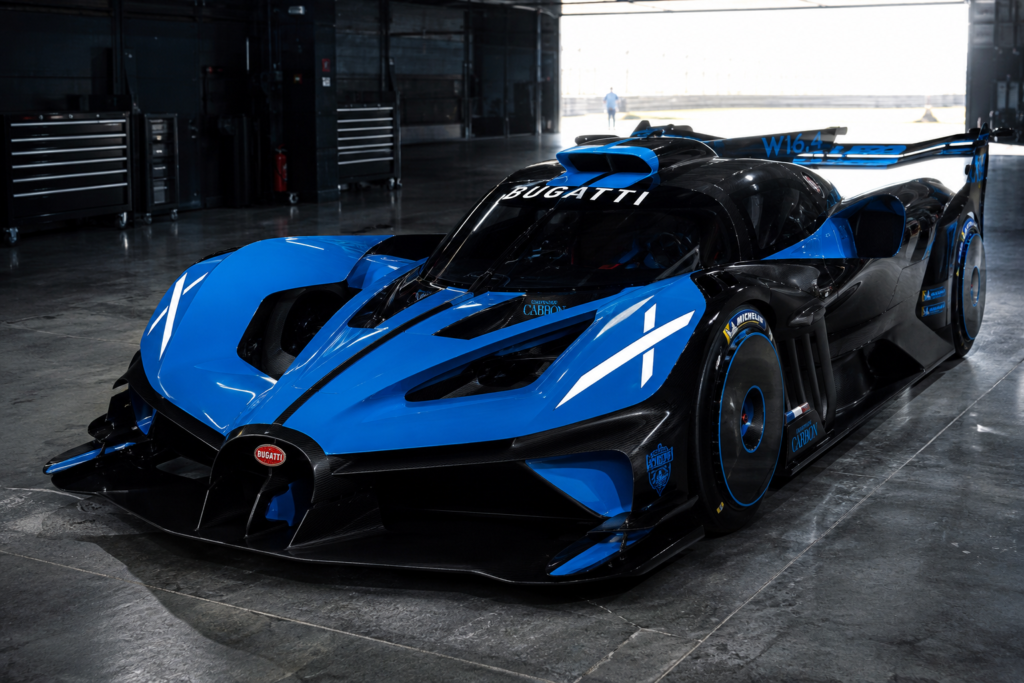
In October 2020, during the height of global pandemic uncertainty, Bugatti surprised the automotive world by revealing the Bolide concept. The initial presentation was striking: the company claimed the concept would weigh just 1,240 kg (2,734 lbs) and achieve a top speed exceeding 500 km/h (310 mph). These figures were so extreme that many dismissed it as a design exercise that would never reach production.
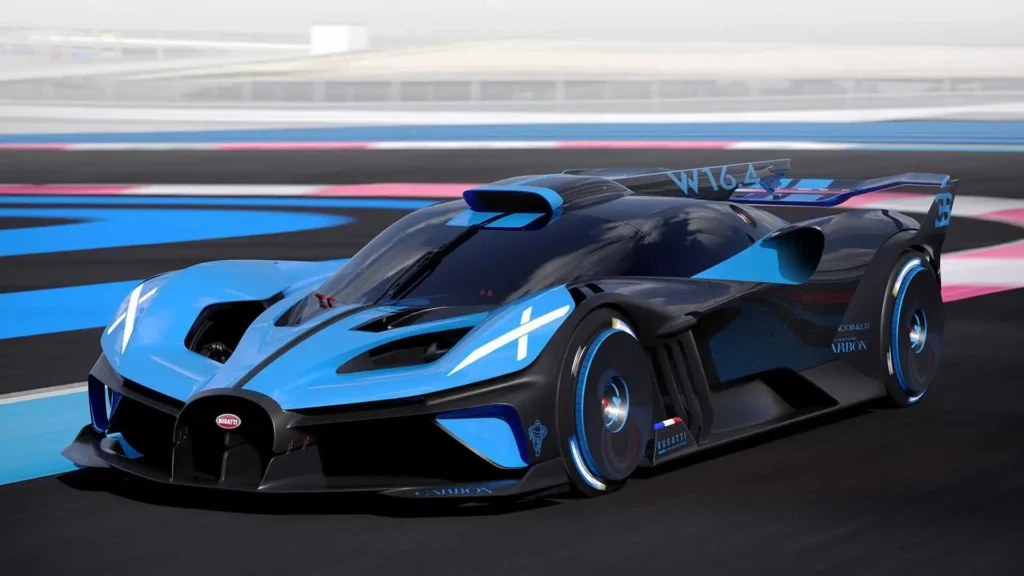
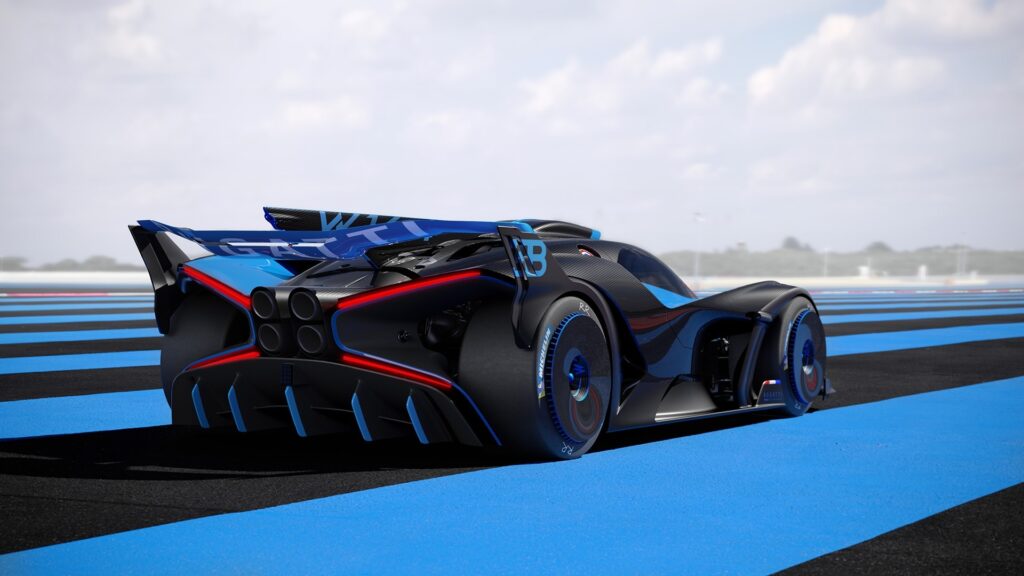
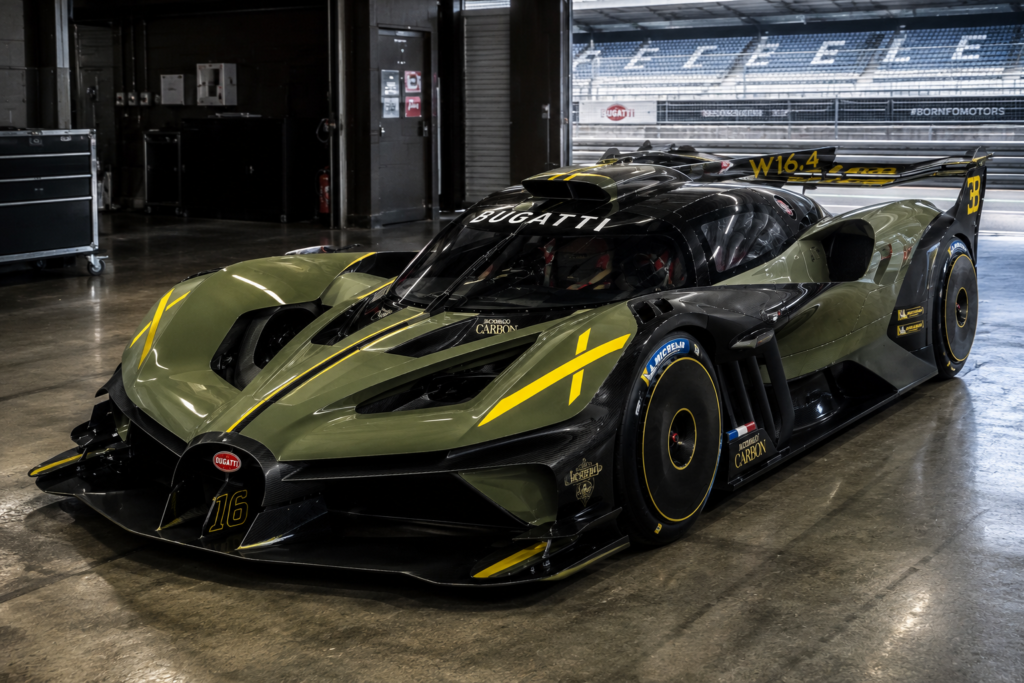
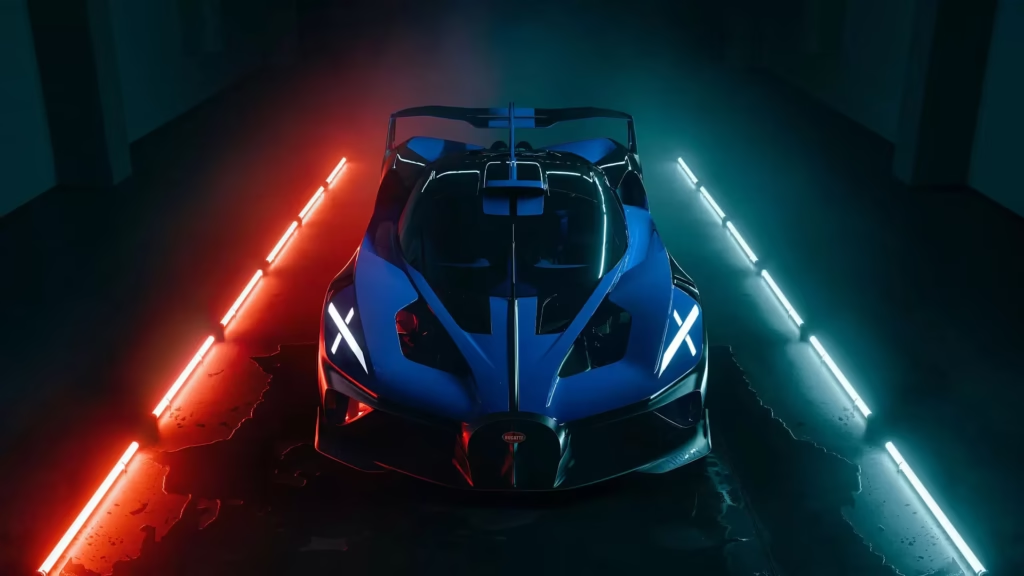
The concept featured a radically different design language from the Chiron. Where the Chiron is smooth and elegant, the Bolide is angular, aggressive, and unmistakably motorsport-inspired. The horseshoe grille remained, but everything else was reimagined for maximum aerodynamic efficiency. The X-shaped taillights referenced the Bell X-1 supersonic aircraft, and the overall proportions were dictated entirely by aerodynamic and cooling requirements.
Production Confirmation and Changes
In April 2023, Bugatti announced that the vehicle would indeed enter production. However, the production version differed significantly from the concept in several key areas:
| Specification | Concept (2020) | Production (2024–2025) |
|---|---|---|
| Dry Weight | 1,240 kg | 1,450 kg |
| Top Speed | 500+ km/h (claimed) | 380 km/h (236 mph) |
| Production Run | Not specified | 40 units |
| Price | Not disclosed | $4.68 million base |
| Safety Standards | Not applicable | FIA LMH/LMDh compliant |
The weight increase and top speed reduction were direct results of Bugatti’s decision to prioritize safety, quality, and drivability over absolute performance numbers. As Mate Rimac, Bugatti’s CEO, explained: “The hardest thing for this project was to make it a Bugatti in terms of detail and quality. Race cars are fascinating things, but they’re not Bugattis.”
Production Timeline and Delivery
Production of the 40 units began in 2024 at Bugatti’s Molsheim Atelier in France. The manufacturing process was highly labor-intensive, with each car requiring approximately six months to complete. By late 2025, all 40 units had been delivered to their owners.
The final example produced was delivered to a collector who also owns an original Bugatti Type 35—a fitting bookend to nearly a century of Bugatti racing heritage. The Type 35, designed by Ettore Bugatti in the 1920s, won over 1,000 races and established the brand’s motorsport credentials. That the final W16-powered Bugatti went to someone who appreciates this history is, in its own way, perfect.
The W16’s Final Bow
The Bugatti Bolide track machine exists primarily as a farewell to the W16 engine. This 8.0-liter quad-turbo powerplant first appeared in the 2005 Veyron, producing 1,001 horsepower—a figure that seemed absurd at the time. Over two decades, Bugatti continuously developed the W16, increasing output to 1,578 bhp in the Chiron Super Sport and, ultimately, 1,824 bhp in this final edition on racing fuel.
With the introduction of the Tourbillon in 2026, Bugatti transitions to a hybrid V16 powertrain. The W16 will never be built again. The Bolide is its retirement party, and Bugatti made sure it was a party worth remembering.

Technical Specifications: The Numbers Behind the Machine
Engine and Powertrain
The heart of the Bugatti Bolide hypercar is Bugatti’s 8.0-liter W16 engine. The “W” configuration is unique in production automobiles, essentially combining two narrow-angle V8 engines on a common crankshaft. This compact arrangement allows sixteen cylinders to fit in a space not much larger than a conventional V12.
Engine Specifications:
| Parameter | Value |
|---|---|
| Configuration | W16 (two V8 banks at 15° angle, combined at 90°) |
| Displacement | 7,993 cc (8.0 liters) |
| Valves | 64 (4 per cylinder) |
| Turbochargers | 4 (sequential, with upgraded blades vs. Chiron) |
| Power (98-octane) | 1,578 bhp at 7,050 RPM |
| Power (110-octane racing fuel) | 1,824 bhp |
| Torque | 1,180 lb-ft (1,600 Nm) |
| Fuel System | Stock Chiron pumps (upgraded for track cooling) |
| Lubrication | Upgraded oil cooling for sustained track use |
The engine is mounted approximately 2.3 inches (58 mm) closer to the vehicle’s center than in the Chiron. This centralization improves weight distribution and rotational dynamics, helping the car change direction more responsively.
Notably, the fuel and oil pumps are carried over from the Chiron Super Sport without modification. This speaks to the over-engineering of the original components—they are robust enough to handle the extreme demands of this track car without reinforcement.
Transmission and Drivetrain
The vehicle uses a modified version of the Chiron’s 7-speed dual-clutch automatic transmission. Key changes include:
- New gear ratios: Optimized for track use rather than top speed
- Revised final drive: Better suited to acceleration out of corners
- Permanent all-wheel drive: Front axle differential with controlled longitudinal differential lock (BorgWarner type)
The all-wheel-drive system is crucial to the approachable character of this machine. Unlike rear-wheel-drive rivals such as the Koenigsegg Jesko, it can deploy its full power without overwhelming the rear tires. This is why Andy Wallace could confidently tell journalists to floor the throttle in first gear from a rolling start—the four Michelin slicks share the load.
Chassis and Safety Structure
The chassis is entirely unique. It does not share its carbon monocoque with the Chiron.
Chassis Details:
| Feature | Specification |
|---|---|
| Monocoque Material | Carbon fiber |
| Builder | Dallara (Italian motorsport engineering firm) |
| Safety Standard | FIA LMH/LMDh regulations |
| Length | 4,835 mm |
| Width (with mirrors) | 2,400 mm |
| Width (without mirrors) | 2,100 mm |
| Height | 1,047 mm |
| Wheelbase | 2,750 mm |
| Ground Clearance (underbody) | 68 mm front, 88 mm rear |
| Ground Clearance (skirts) | 70 mm |
The FIA compliance is significant. It means this vehicle meets the same crash protection standards as cars competing in the 24 Hours of Le Mans. Specific test results include:
- A-pillar rollover: >16,500 lbs load, <2 inches deflection
- B-pillar rollover: ~26,500 lbs load
- Rear impact: ~13,200 lbs longitudinal load
- Headrest brackets: 3D-printed aluminum, >1,500 lbs capacity, weigh just over 0.5 lbs each
Additional safety equipment includes a fire suppression system, 6-point racing harness, HANS device compatibility, electronic stability control, traction control, and a five-stage ABS system tuned by Andy Wallace.
Suspension System
The Bugatti Bolide hypercar employs a pushrod suspension architecture derived from Le Mans prototype racing:
- Front: Double wishbone with pushrod linkage and horizontal spring/damper units
- Rear: Double wishbone with direct linkage and standing spring/damper units
- Anti-heave damping: Prevents nose dive under heavy braking
This setup allows the suspension components to be mounted inboard, reducing unsprung weight and improving aerodynamic packaging. The horizontal front dampers, in particular, are a hallmark of top-tier motorsport engineering.
Braking System
The Bugatti Bolide features the largest carbon-carbon braking system ever fitted to a production-derived vehicle:
| Component | Specification |
|---|---|
| Front Discs | 390 mm × 34 mm, carbon-carbon |
| Rear Discs | 390 mm × 38 mm, carbon-carbon |
| Front Calipers | 8-piston monobloc |
| Rear Calipers | 6-piston |
| Materials | Formula 1-grade carbon-carbon |
| ABS | 5-stage, tuned by Andy Wallace |
| Operating Temperature | >800°C |
The Brembo-supplied brakes must dissipate more energy per lap than any racing car in existence. This is a direct consequence of the weight (approximately 1,625 kg with fluids and driver) combined with extreme entry speeds into braking zones. At Paul Ricard, journalists reported brake disc temperatures exceeding 800°C, with visible glowing rotors after hard laps.
Wheels and Tires
| Component | Specification |
|---|---|
| Wheels | BBS Racing 18-inch forged aluminum |
| Front Tires | Michelin Racing Slicks 30/68-18 |
| Rear Tires | Michelin Racing Slicks 34/71-18 |
| Tire Pressure | 2.4–2.6 bar (relatively hard due to aero load) |
| Estimated Tire Life | ~37 miles per set |
| Tire Warmers | Required (included with car) |
The Michelin slicks are not street-legal and require warming with tire blankets before use. The relatively high operating pressure is necessitated by the extreme aerodynamic loads pressing down on the tires at high speed.
Aerodynamics
The aerodynamic package is the defining technical feature of this vehicle.
| Parameter | Value |
|---|---|
| Downforce at 200 mph (320 km/h) | 2,900 kg (6,393 lbs) |
| Downforce at 236 mph (380 km/h) | ~5,800 lbs (estimated) |
| cW × A (high downforce mode) | 1.30 |
| cW × A (high speed mode) | 1.22 |
| Adjustable Aero | Yes (chassis-dependent airflow and aero-balance) |
To put 2,900 kg of downforce in perspective: that is approximately the weight of a Toyota Land Cruiser pressing down on the car at speed. At top speed, the downforce roughly equals the car’s own weight, meaning this machine could theoretically drive on the ceiling of a tunnel.
The aerodynamic elements include:
- Front diffuser and air curtains: Create suction effect while minimizing drag
- Underfloor: Carefully shaped to manage airflow beneath the car
- Massive rear wing: Primary downforce generator
- Central exhaust configuration: Integrated into rear aerodynamic package
- X-shaped taillights: Frame the exhaust and reference the Bell X-1 aircraft
Bugatti deliberately limited maximum downforce to 2,900 kg. Higher figures would have made the car overly sensitive to pitch changes, making it difficult to drive for non-professional racers. The adjustable aero-balance allows owners to tune the car for different circuits and conditions.
Performance Figures
Acceleration:
| Speed | Time | Distance |
|---|---|---|
| 0–62 mph (0–100 km/h) | 2.2 seconds | 44 meters |
| 0–124 mph (0–200 km/h) | 5.4 seconds | 180 meters |
| 0–186 mph (0–300 km/h) | 11.5 seconds | 604 meters |
In-Gear Acceleration (Elasticity):
| Speed Range | Time |
|---|---|
| 37–62 mph (60–100 km/h) | 3.2 seconds |
| 50–75 mph (80–120 km/h) | 2.2 seconds |
| 93–155 mph (150–250 km/h) | 4.1 seconds |
Braking:
| Speed | Time | Distance |
|---|---|---|
| 62–0 mph (100–0 km/h) | 2.5 seconds | 30 meters |
| 124–0 mph (200–0 km/h) | 4.2 seconds | 105 meters |
| 186–0 mph (300–0 km/h) | 6.0 seconds | 228 meters |
Combined Acceleration and Braking:
| Test | Time | Distance |
|---|---|---|
| 0–62–0 mph | 4.7 seconds | 74 meters |
| 0–124–0 mph | 9.7 seconds | 285 meters |
| 0–186–0 mph | 17.5 seconds | 832 meters |
Dynamic Limits:
- Lateral acceleration: 2.5 G
- Longitudinal acceleration: -2.5 G (braking) to +1.5 G (acceleration)
Design and Styling: Form Follows Performance
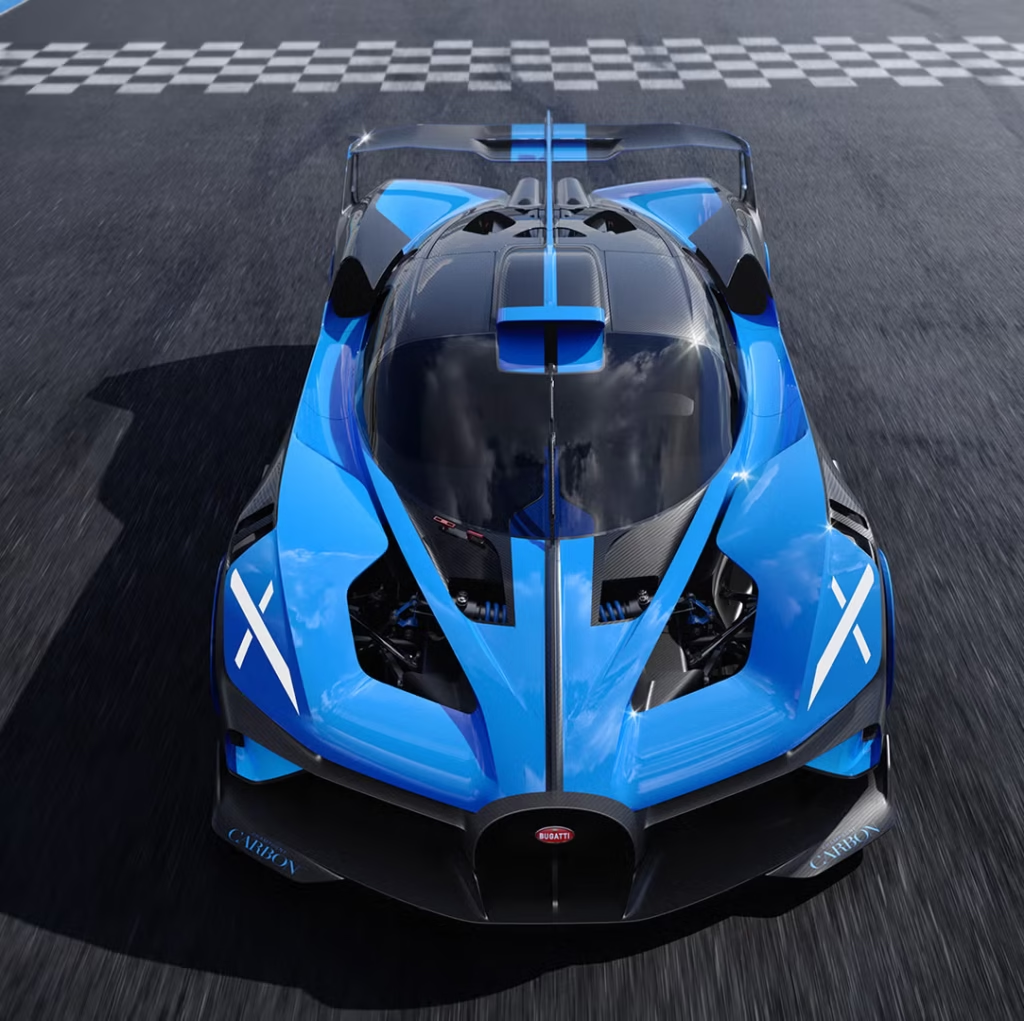
The design of the Bugatti Bolide car is governed entirely by aerodynamic and cooling requirements. Bugatti’s design ethos for this project was “Form follows performance”—a deliberate twist on the traditional “form follows function.”
Exterior Design Elements
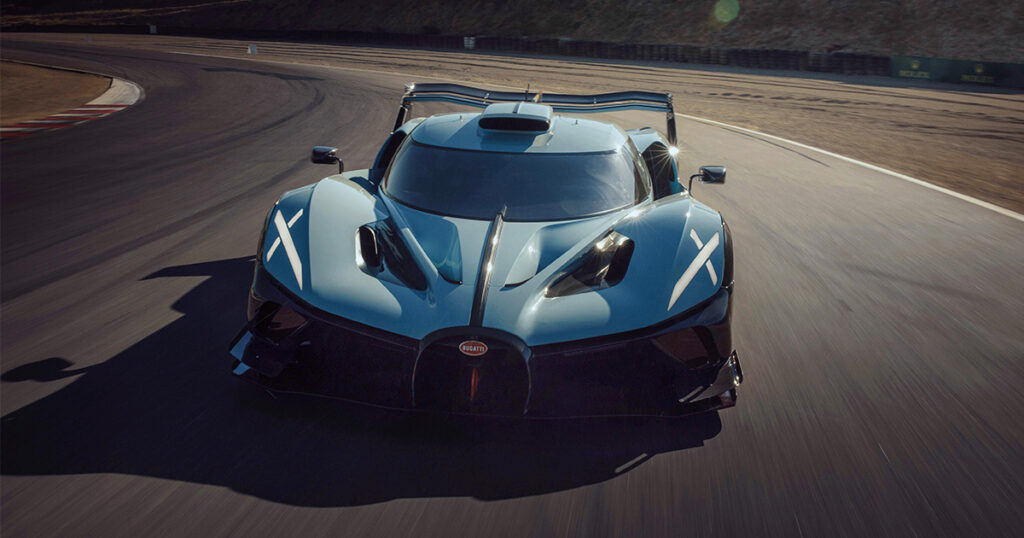
The Horseshoe Grille: The iconic Bugatti horseshoe grille remains, but it now serves structural and aerodynamic purposes in addition to its traditional role as a brand identifier. It channels air to the radiators and front brakes while maintaining the visual DNA that connects this machine to every Bugatti since the Type 35.
X-Shaped Graphics: The X motif appears throughout the design, from the taillights to the body graphics. This references the Bell X-1, the first aircraft to break the sound barrier, and symbolizes the extreme performance aspirations of this project.
Air Intakes and Ducts: Every surface feature serves a purpose. The massive roof scoop feeds air to the engine and transmission coolers. The side intakes channel air to the rear brakes and oil coolers. Even the shape of the wheel arches is optimized to extract turbulent air from around the tires.
Central Exhaust: Unlike the Chiron’s quad exhausts, this vehicle uses a single central exhaust configuration. This reduces rear aerodynamic interference and contributes to the distinctive rear-end design.
Interior Design
The cockpit is minimal by Bugatti standards but still reflects the brand’s attention to detail:
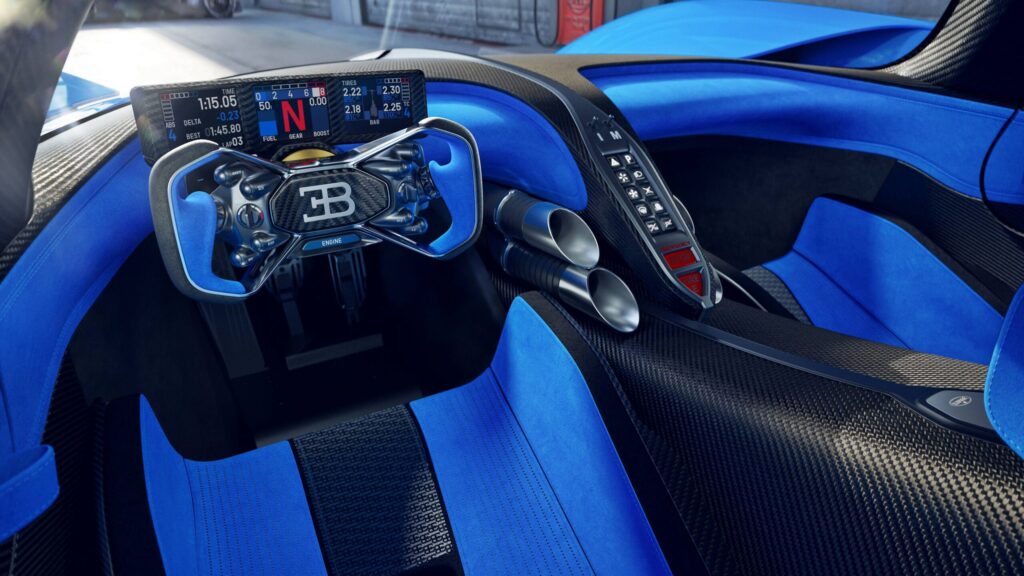
- Fixed racing seat: Mounted far forward for weight distribution; the seat and pedal box adjust to fit the driver
- Shoulder support: Mounted on the door itself, clamping the driver in place when closed
- 3D-printed steering wheel: Compact yoke design with integrated controls
- Three-screen dashboard: Small square displays showing essential data
- Flexible air conditioning ducts: Aimable plumbing pipes for cockpit cooling
- Minimal insulation: Engine heat and noise are very present in the cabin
The interior is not luxurious in the traditional sense. There is no leather upholstery, no wood trim, no infotainment system. But the quality of materials and construction remains exceptional—carbon fiber surfaces are perfectly finished, controls operate with precision, and everything feels expensive even if it looks sparse.
Driving Impressions: What the Bugatti Bolide Feels Like on Track
First Encounters
Journalists who have driven the Bugatti Bolide consistently report the same initial reaction: surprise at how approachable it is. Given the extreme power output and racing pedigree, most expect a car that demands total commitment and punishes mistakes severely. The reality is quite different.
Top Gear’s reviewer described the experience as “less menacing to drive than it is to look at.” Car Magazine noted that it drives off from the pits “as if you were going to Sainsbury’s”—until you cross the pit exit line and unleash the full power.
Acceleration Experience
The acceleration is the defining characteristic of the driving experience. With 1,578 bhp (or 1,824 bhp on racing fuel) and four-wheel drive, the car simply squats and launches. There is no wheelspin, no drama, no fighting for traction. Just relentless, linear acceleration that builds speed with shocking efficiency.
Andy Wallace’s demonstration—engaging the pit limiter, holding wide-open throttle in first gear, then releasing the limiter—reveals the vehicle’s traction capabilities. Most drivers initially refuse, convinced the car will spin all four wheels and spear into the barriers. It doesn’t. The Michelin slicks, properly warmed, hook up without slip.
The sensation of speed is somewhat muted by the car’s stability. Because the chassis is so capable and the power delivery so linear, you don’t get the visceral thrill of fighting the car. Instead, you feel “immense pressure and force pushing you smoothly back into the seat,” as one journalist put it. The speed readouts are small and hard to read, so you often don’t realize how fast you’re going until you reach the braking zone.
Cornering and Handling
The Bugatti Bolide hypercar generates 2.5 G of lateral acceleration—enough to make most drivers physically uncomfortable after sustained cornering. The pushrod suspension and massive downforce create a planted, confidence-inspiring feel.
However, the vehicle does not feel light. Despite weighing 545 kg less than a Chiron, it retains a sense of heft. It prefers to be driven smoothly, flowing through corners rather than being thrown around. The steering is fast but not nervous, and while there isn’t abundant feedback through the wheel, the chassis communicates clearly through the seat.
The differentials are particularly impressive, distributing torque precisely to maximize traction without disturbing the car’s trajectory. You can apply full power early in corner exit and the car simply drives forward, occasionally with a hint of four-wheel drift that flatters the driver.
Braking Performance
The Brembo carbon-carbon brakes are extraordinary. Journalists compared the braking force to the sensation of a parachute opening during a skydive—your body is thrown forward against the harness with violent force.
The pedal feel is exceptional for carbon brakes, which often feel wooden or inconsistent in road cars. The five-stage ABS, tuned by Andy Wallace, allows precise threshold braking without lock-up. Operating temperatures exceed 800°C, and the glowing discs are visible from outside the car after hard laps.
The Sound
The unsilenced W16 produces a unique soundtrack. It is not the high-pitched shriek of a Ferrari V12 or the raw bark of an American V8. It is a deep, bass-heavy thunder—”like the best hard-charging V8 you’ve ever heard, but turned up to eleven.” The engine uses the track surface as a resonating platform, so you feel the sound waves as much as hear them.
Limitations and Quirks
No car is perfect, and this track machine has its compromises:
- Narrow tire operating window: Michelin insists on relatively high pressures (2.4–2.6 bar), and grip drops significantly if pressures rise above this range
- Restricted visibility: High front arches block sightlines through left-handers
- Cockpit heat: With minimal insulation and a massive engine behind you, the cabin gets very warm
- Limited laps per session: Cooling requirements mean the car needs frequent cool-down periods
- Tire life: At approximately 37 miles per set, tire costs add up quickly
The “Feeling The Track” Ownership Program
Bugatti includes a comprehensive track day program with every purchase. Called “Feeling The Track,” this program addresses the practical reality that most owners are not professional racing drivers and need support to safely enjoy their cars.
Program Components
Personal Instruction: Owners receive one-on-one coaching from Bugatti’s team of instructors, often including Andy Wallace himself. Wallace holds the official world speed record for production cars (304.77 mph in a Chiron Super Sport 300+) and has been Bugatti’s chief test driver since 2005.
Race Crew and Mechanics: A dedicated team of four to five mechanics accompanies each car to track events. They handle setup, tire changes, fueling, cooling, and any mechanical issues. The owner simply arrives and drives.
Telemetry and Data Analysis: Every session is recorded with full telemetry data. Post-session reviews analyze braking points, throttle application, steering inputs, and lap times. This data-driven approach helps owners improve their driving technique systematically.
Logistics Management: Bugatti handles all transportation, accommodation, and event coordination. Owners do not need to arrange transporters, book hotels, or coordinate with circuits.
Notable Track Events
Circuit of the Americas (January 2025): The first US customer track day for this vehicle took place at COTA in Austin, Texas. Despite wet track conditions, owners reached 333 km/h (207 mph) on the back straight. The event demonstrated the car’s all-weather capabilities and the effectiveness of its traction systems.
Miami “Feeling The Track” (March 2026): Bugatti hosted a second US event in Miami, expanding the program’s geographic reach and introducing new owners to their cars in a controlled environment.
Nürburgring GP Track (May 2025): YouTuber Gercollector and Nürburgring expert Misha Charoudin lapped this machine on the Nürburgring GP circuit, reaching 300 km/h on the Döttinger Höhe straight. Bugatti claims the car could lap the full Nordschleife “well into the five-minute range,” which would place it in elite company.
Nürburgring Lap Time Estimates
Bugatti has not released an official Nordschleife lap time. However, based on simulation data and the car’s performance characteristics, estimates suggest a time in the low 5:50s to mid-5:40s range. For comparison:
| Vehicle | Nordschleife Time | Notes |
|---|---|---|
| Porsche 919 Hybrid Evo | 5:19.05 | Unofficial record, non-homologated |
| Volkswagen ID.R | 6:05.33 | Electric prototype |
| Porsche 911 GT2 RS MR | 6:43.30 | Road-legal with modifications |
| Lamborghini Aventador SVJ | 6:44.97 | Road-legal production car |
| Estimated Bugatti Bolide | ~5:40–5:55 | Track-only, based on simulations |
Even the conservative end of this estimate would make this vehicle one of the fastest production-derived machines ever to lap the Nordschleife.
Ownership Reality: Costs, Maintenance, and Practical Considerations
Purchase Price and Total Cost of Ownership
| Cost Component | Amount (USD) |
|---|---|
| Base Price | $4,680,000 |
| Taxes and Duties | Variable by jurisdiction |
| Options and Customization | $200,000+ typical |
| Track Program (included) | Part of purchase price |
| Estimated Total | $5,400,000+ |
Running Costs
Tires:
- Cost per set: $10,000–$15,000
- Estimated life: ~37 miles per set
- Annual cost (assuming 10 track days, 100 miles each): $27,000–$40,500
Brakes:
- Carbon-carbon discs last longer than tires but require inspection after every event
- Replacement cost: $50,000–$80,000 for full set
- Typical replacement interval: Every 2–3 years with moderate use
Fuel:
- 98-octane minimum; 110-octane recommended for maximum power
- 110-octane racing fuel is not available at standard gas stations
- Fuel consumption during track use: approximately 5–8 mpg
Insurance:
- Specialized collector car insurance required
- Estimated annual premium: $100,000–$200,000
Transportation:
- Bugatti covers logistics for official “Feeling The Track” events
- Private track days require owner-arranged transport (race transporter recommended)
- Estimated transport cost per event: $10,000–$25,000
Storage and Maintenance
This vehicle requires climate-controlled storage when not in use. Bugatti recommends:
- Temperature-controlled environment (15–25°C)
- Humidity control (50–60%)
- Battery maintenance system
- Tire pressure monitoring
- Annual inspection by Bugatti-certified technicians
Bugatti provides a maintenance schedule and can dispatch technicians to the owner’s location for routine service.
Resale Value and Collectibility
With only 40 units produced and the W16 engine now discontinued, the Bugatti Bolide is expected to appreciate significantly. Comparable limited-production track cars (Ferrari FXX K, Aston Martin Vulcan) have doubled or tripled in value within five years of production ending.
However, the track-only status limits the buyer pool. Unlike road-legal hypercars that can be driven and displayed regularly, this machine requires track access and support infrastructure. This may moderate appreciation compared to road-legal equivalents.
Competitor Comparison: How the Bugatti Bolide Stacks Up
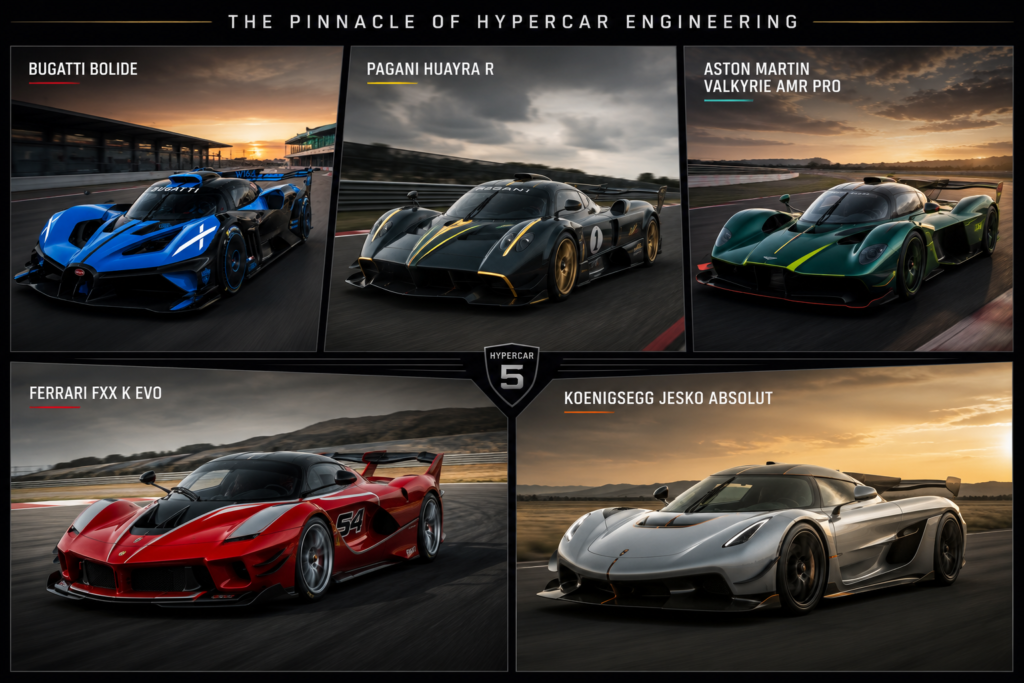
The track-only Bugatti Bolide hypercar segment is small but fiercely competitive. Here is how this machine compares to its primary rivals:
Detailed Comparison Table
| Specification | Bugatti Bolide | Pagani Huayra R | Aston Martin Valkyrie AMR Pro | Ferrari FXX K Evo | Koenigsegg Jesko Absolut |
|---|---|---|---|---|---|
| Engine | 8.0L W16 quad-turbo | 6.0L V12 nat-asp | 6.5L V12 nat-asp + hybrid | 6.3L V12 + hybrid | 5.0L V8 twin-turbo |
| Power | 1,578 bhp (1,824 on race fuel) | ~850 bhp | ~1,000 bhp | ~1,050 bhp | ~1,600 bhp |
| Torque | 1,600 Nm | ~750 Nm | ~1,000 Nm | ~900 Nm | ~1,500 Nm |
| Weight | 1,450 kg dry | ~1,050 kg | ~1,000 kg | ~1,165 kg | ~1,400 kg |
| Power-to-Weight | 0.91 kg/hp | ~1.24 kg/hp | ~1.00 kg/hp | ~1.11 kg/hp | ~0.88 kg/hp |
| Top Speed | 236 mph | ~240 mph | ~225 mph | ~217 mph | ~330+ mph |
| Drivetrain | AWD | RWD | RWD | RWD | RWD |
| Production | 40 units | 30 units | ~40 units | ~40 units | 125 units |
| Price | $4.68M base | ~$3.5M | ~$4.0M | ~$3.0M+ | ~$3.0M |
| Track Program | Included | Available | Available | Included | Available |
| Street Legal | No | No | No | No | Yes (Jesko) |
Analysis by Competitor
Pagani Huayra R: The Huayra R is the closest spiritual rival. Both cars exist primarily to celebrate their engines. The Huayra R’s naturally aspirated V12 produces a screaming 140 dB soundtrack that contrasts sharply with the thunderous W16 of the Bugatti Bolide. The Pagani is lighter and more raw, with a more intimate, mechanical driving experience. The Bugatti is faster, more powerful, and more refined. Choosing between them is largely a matter of personal preference—Italian opera versus German symphony.
Aston Martin Valkyrie AMR Pro: The Valkyrie AMR Pro is more extreme in its track focus. Designed with input from Adrian Newey (Red Bull Racing’s chief technical officer), it prioritizes lap times above all else. It is lighter and more aerodynamically aggressive than the Bugatti Bolide but lacks the Bugatti’s polish and usability. The Valkyrie is a race car with a license to exist; the Bolide is a Bugatti that happens to be track-only.
Ferrari FXX K Evo: Ferrari’s XX program has long been the benchmark for manufacturer-supported track experiences. The FXX K Evo uses hybrid technology (unlike the pure internal combustion of the Bugatti Bolide) and offers Ferrari’s legendary racing pedigree. However, it is less powerful and significantly heavier. The Ferrari excels in brand cachet and racing heritage; the Bugatti wins on raw numbers and engine uniqueness.
Koenigsegg Jesko Absolut: The Jesko Absolut is a different proposition entirely. While the Bugatti Bolide focuses on cornering speed and drivability, the Jesko chases top speed records. Its rear-wheel-drive layout means it cannot deploy power as effectively as the all-wheel-drive Bugatti Bolide at lower speeds. Above 150 mph, however, the Jesko’s aerodynamic efficiency and relentless acceleration make it a formidable straight-line weapon. The Jesko is also street-legal (in Absolut form), giving it broader usability.
Unique Selling Points of the Bugatti Bolide
- The W16 engine: No other car has or will have this powerplant. Its 16-cylinder configuration is unique in automotive history.
- All-wheel drive: Superior traction and approachability compared to rear-wheel-drive rivals
- Bugatti quality: Race-car performance with road-car refinement
- Comprehensive program: “Feeling The Track” includes everything an owner needs
- Historical significance: Final W16-powered Bugatti, connecting to nearly a century of heritage
The Legacy of the W16 Engine
To fully appreciate the Bugatti Bolide, one must understand the W16 engine’s place in automotive history.
The Veyron Era (2005–2011)
The W16 debuted in the 2005 Bugatti Veyron 16.4, producing 1,001 metric horsepower. At the time, this was unprecedented. The Veyron was the first production car to exceed 1,000 hp, the first to exceed 250 mph, and the first to cost over €1 million. It established Bugatti as the ultimate expression of automotive excess.
The Chiron Era (2016–2025)
The Chiron increased output to 1,500 hp (later 1,578 hp in the Super Sport). It refined the Veyron’s formula with better handling, more luxury, and even higher top speeds. Special editions like the Divo, Centodieci, and La Voiture Noire explored different aspects of the platform.
The Bolide: The Final Chapter
The Bugatti Bolide represents the W16’s maximum expression. With 1,824 hp on racing fuel, it extracts more power from the architecture than anyone thought possible in 2005. The engine’s retirement marks the end of an era in which Bugatti proved that internal combustion could still surprise us, even as the industry pivoted to electrification.
The Tourbillon, Bugatti’s next model, uses a naturally aspirated V16 paired with electric motors. While impressive in its own right, it will not replicate the W16’s unique character—the four turbochargers, the complex plumbing, the sheer improbability of fitting sixteen cylinders into a car.
Final Thoughts: The Bugatti Bolide in Perspective
The Bugatti Bolide is not the fastest car in the world. It is not the lightest. It is not the most extreme track car ever built. What it is, however, is perhaps the most complete expression of a singular automotive philosophy: that engineering excellence, historical significance, and driver accessibility can coexist at the highest level of performance.
In an era when electrification is rendering traditional internal combustion engines obsolete, the Bugatti Bolide stands as a monument to what was possible when cost, regulations, and practicality were set aside in pursuit of something extraordinary. The W16 engine will never be built again. The Bugatti Bolide ensures it will not be forgotten.
For the 40 individuals who own one, the Bugatti Bolide represents more than a car. It is a ticket to an exclusive world of track days, personal instruction, and the company of like-minded enthusiasts. It is a piece of automotive history that can still be driven, experienced, and enjoyed—not merely displayed behind glass.
If you ever have the opportunity to see a Bugatti Bolide in person, take it. Stand close when the engine starts. Feel the sixteen cylinders firing in that unique W configuration. Watch the carbon-carbon brakes glow cherry-red after a hard lap. And appreciate that you are witnessing the end of an era—one that began with Ettore Bugatti’s Type 35 and concluded, nearly a century later, with a machine that would have seemed like science fiction to its creator.
They don’t make them like this anymore. Literally.
Frequently Asked Questions (FAQs)
No. The Bugatti Bolide is a track-only vehicle and cannot be registered for road use in any jurisdiction. It lacks the necessary homologation for road use, including lighting, emissions compliance, and crash standards for public roads.
Exactly 40 units were produced between 2024 and 2025. All were sold before production began. The final car was delivered to a collector who also owns an original Bugatti Type 35.
The electronically limited top speed is 380 km/h (236 mph). This is lower than the Chiron Super Sport 300+ (304 mph) because the Bugatti Bolide prioritizes downforce and cornering speed over outright velocity.
The base price was $4.68 million USD. With taxes, options, and the included track program, total costs typically exceed $5.4 million. Running costs (tires, brakes, fuel, transport) add approximately $150,000–$300,000 per year for active owners.
The 8.0-liter quad-turbo W16, producing 1,578 bhp on 98-octane fuel and 1,824 bhp on 110-octane racing fuel. Torque is 1,600 Nm (1,180 lb-ft). This is the final evolution of the W16 before Bugatti transitions to the V16-powered Tourbillon.
0–62 mph (0–100 km/h) takes 2.2 seconds. 0–124 mph (0–200 km/h) takes 5.4 seconds. 0–186 mph (0–300 km/h) takes 11.5 seconds.
In a straight-line drag race, the Bugatti Bolide’s four-wheel-drive traction and massive torque might give it an advantage off the line. However, around a race circuit, a modern F1 car would be significantly faster due to its lighter weight, more sophisticated aerodynamics, and greater downforce. Bugatti claims the Bolide could lap the Nürburgring Nordschleife in the low five-minute range—impressive, but still slower than an F1 car.
Every purchase includes the “Feeling The Track” program: personal instruction (often by Andy Wallace), a dedicated race crew and mechanic, full telemetry analysis, data review sessions, and logistics management for official Bugatti events. Owners also receive tire warmers, a car cover, and access to Bugatti’s global support network.
A set of Michelin Racing Slicks costs approximately $10,000–$15,000 and lasts roughly 37 miles under track conditions. This means tire costs alone can reach $40,000+ per year for active owners.
Bugatti’s next model is the Tourbillon, introduced in 2026. It features a naturally aspirated 8.3-liter V16 engine paired with three electric motors, producing a combined output of approximately 1,800 hp. Unlike the Bugatti Bolide, the Tourbillon is road-legal.
The Bugatti Bolide serves three purposes: (1) to provide a fitting farewell to the W16 engine, (2) to demonstrate what the W16 is capable of when freed from road-car constraints, and (3) to offer Bugatti’s most dedicated customers an exclusive, motorsport-level experience that no other brand can match.
With only 40 units produced and the W16 engine now discontinued, the Bugatti Bolide is expected to appreciate in value. However, its track-only status limits the pool of potential buyers compared to road-legal hypercars. Prospective buyers should consider it a passion purchase first and an investment second.