Ferrari Purosangue: The V12 SUV That Refuses to Act Like One
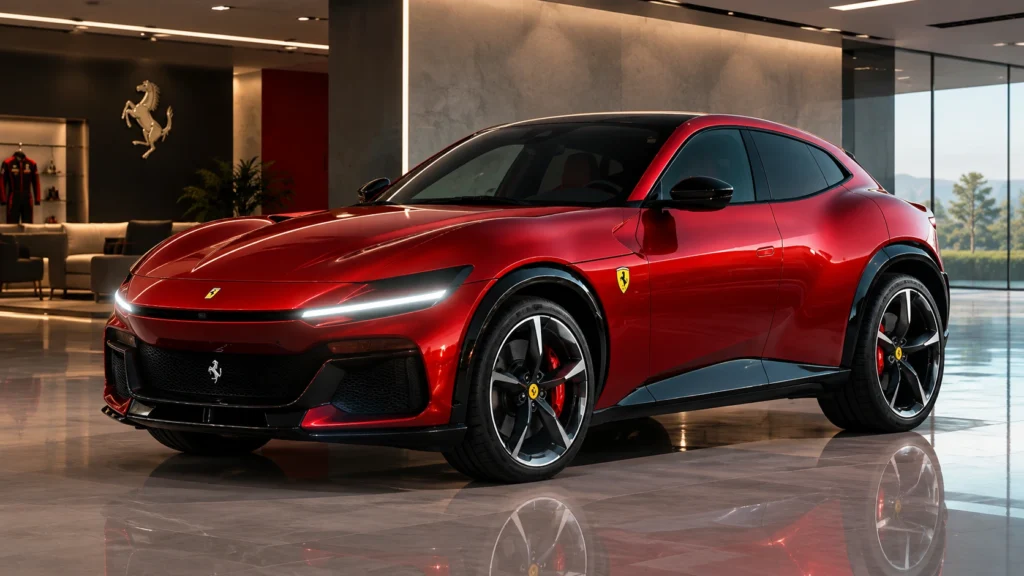
For nearly eight decades, Ferrari built its reputation by refusing to build an SUV. That changed with the Ferrari Purosangue, a four-door, four-seat vehicle that Maranello insists is not really an SUV at all — and after spending time with its specifications, engineering, and driving character, it’s easy to understand why the company draws that distinction.
This is a car with a naturally aspirated V12 up front, a chassis borrowed from decades of front-engine GT development, and a design language that traces directly back to Ferrari’s coupes rather than any conventional crossover playbook. Whether you’re researching it as a potential purchase, comparing it against rival luxury performance SUVs, or simply curious how Ferrari approached a segment it avoided for so long, this guide covers everything that matters: performance, pricing, interior features, and how it stacks up against the competition.
Quick Specifications
| Specification | Ferrari Purosangue |
|---|---|
| Engine | 6.5L naturally aspirated V12 (F140IA) |
| Displacement | 6,496 cc |
| Power | 715 hp (725 PS) at 7,750 rpm |
| Torque | 528 lb-ft at 6,250 rpm |
| Transmission | 8-speed dual-clutch (rear-mounted transaxle) |
| Drivetrain | All-wheel drive |
| Seating Capacity | 4 |
| 0–60 mph | 3.3 seconds (Ferrari claim) |
| Top Speed | 193 mph |
| Body Style | 4-door, 4-seat performance vehicle |
What Is Ferrari Purosangue?
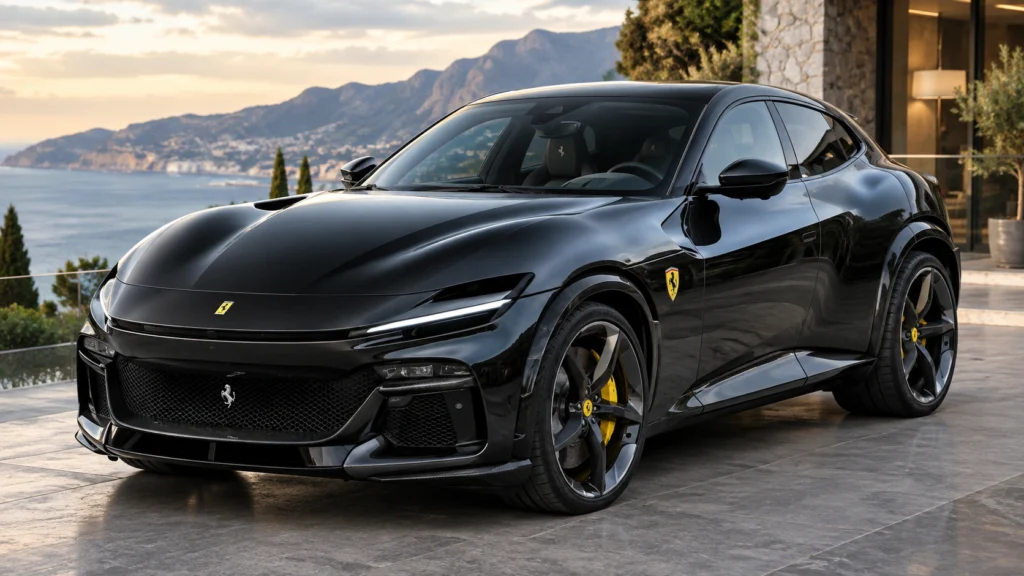
The Ferrari Purosangue is the brand’s first production four-door, four-seat vehicle — and, depending on who at Ferrari you ask, its first “FUV,” or Ferrari Utility Vehicle. That distinction isn’t just marketing spin. Ferrari has gone out of its way to avoid calling the Ferrari Purosangue an SUV, largely because the engineering priorities behind it are different from what defines a traditional SUV.
Conventional luxury SUVs are typically built around ride height, cargo volume, and all-terrain versatility first, with performance added on top. The Ferrari Purosangue inverts that formula. It starts from Ferrari’s front-mid-engine GT architecture — related to the Roma coupe — and adapts it to accommodate four doors, four seats, and a taller ride height, without abandoning the low center of gravity and weight distribution that define Ferrari’s driving character.
The result sits in its own category: a high-performance luxury vehicle with genuine four-seat practicality, all-wheel drive for security in poor conditions, and usable cargo space, but with a naturally aspirated V12, double-wishbone-style suspension logic, and steering feel drawn directly from Ferrari’s sports car lineup. It’s a four-door Ferrari built for owners who want everyday usability without giving up the driving experience the brand is known for.
History and Background
Ferrari’s road-car lineage stretches back to 1947, built almost entirely around two-door coupes and convertibles powered by V8 and V12 engines. For most of that history, the closest the company came to practicality was the 2+2 grand tourer — cars like the 456 GT and GTC4Lusso, which offered rear seats but never abandoned the two-door coupe format.
The pressure to build something more spacious came from the broader luxury market. Bentley, Lamborghini, Aston Martin, Rolls-Royce, and Porsche had all entered the performance SUV segment years earlier, and each found significant commercial success doing so. Ferrari resisted longer than any of its rivals, wary of diluting a brand built on two-seat and 2+2 sports cars.
When the Ferrari Purosangue was officially unveiled in September 2022, Ferrari framed it carefully — not as a pivot into SUVs, but as an expansion of what a Ferrari could be while keeping the driving dynamics non-negotiable. The engineering team, led under the direction of Ferrari’s Centro Stile design house, built the car around a V12 engine rather than a turbocharged unit, a decision that separated it immediately from nearly every competitor in the segment, most of which rely on twin-turbo V8 or hybrid powertrains.
The Purosangue’s arrival mattered for Ferrari commercially and symbolically. It opened the brand to buyers who needed a car that could handle a family, a road trip, or daily errands, while still carrying the Prancing Horse badge and the driving feel that comes with it — all without Ferrari fully surrendering to the term “SUV.”
Design and Exterior
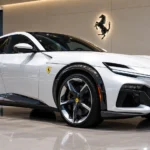
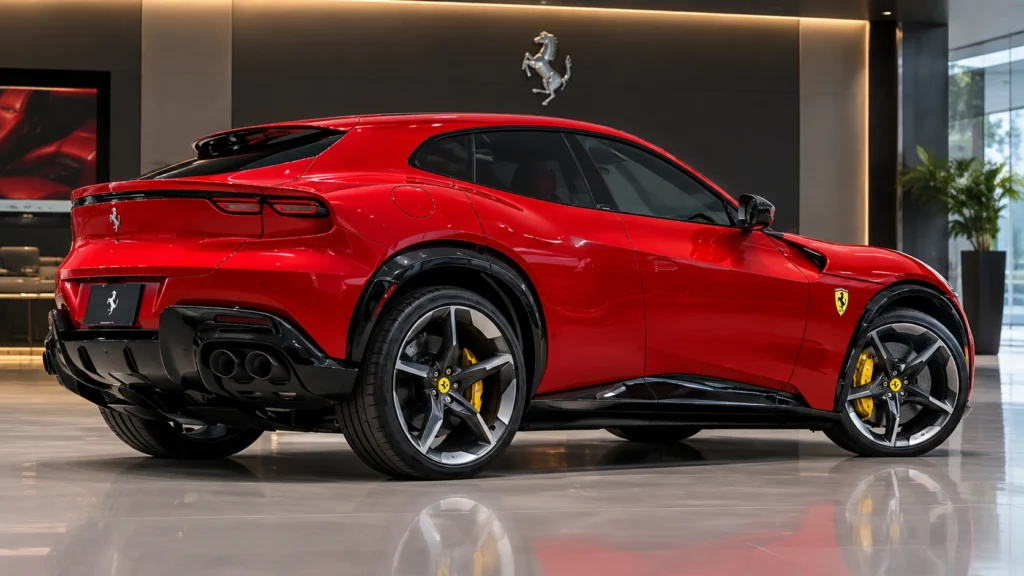
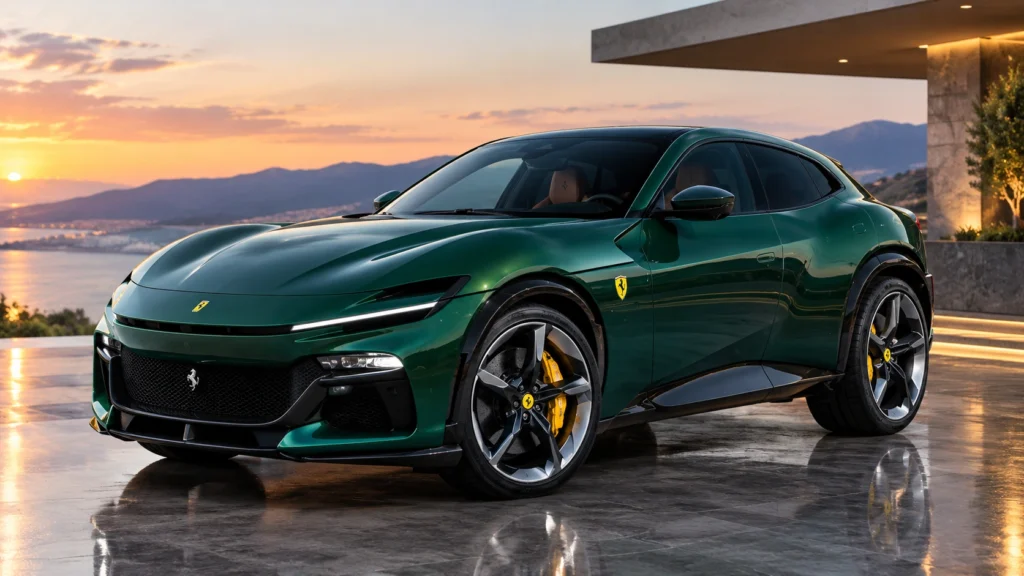
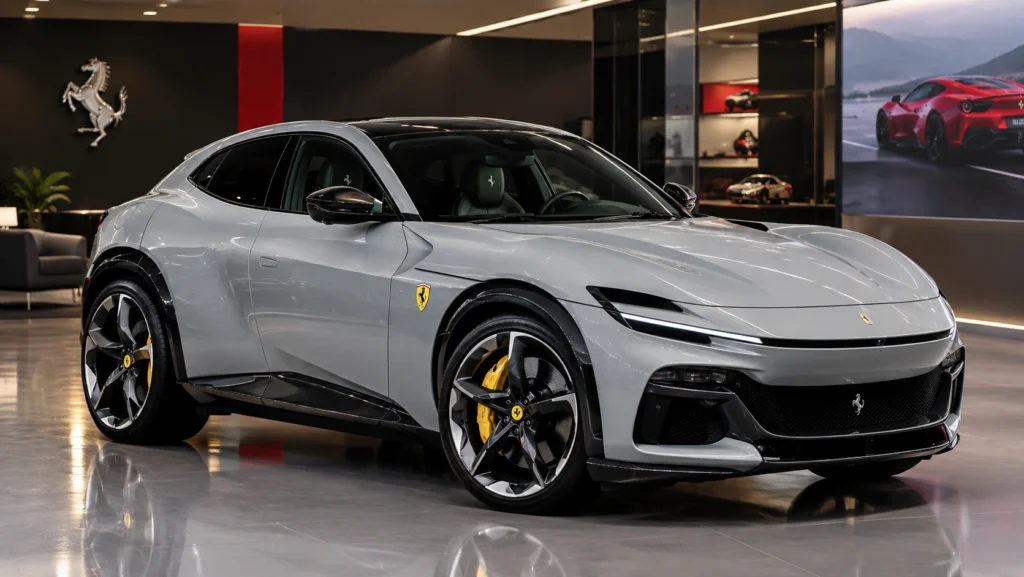
The Ferrari Purosangue exterior design makes a deliberate effort to look like nothing else in the segment. The front end carries a long, sculpted hood — proportionally closer to a front-engine GT car than a crossover — with slim, angular headlights integrated into a face that echoes Ferrari’s current design language rather than adopting the tall, upright grilles common on rival SUVs.
The grille itself is functional rather than decorative, feeding cooling to the naturally aspirated V12 mounted behind the front axle. Aerodynamic detailing runs throughout the body: vertical vents behind the front wheel arches help manage airflow and reduce lift, while the roofline tapers into a fastback-style profile at the rear, a shape more associated with Ferrari’s coupes than any traditional SUV.
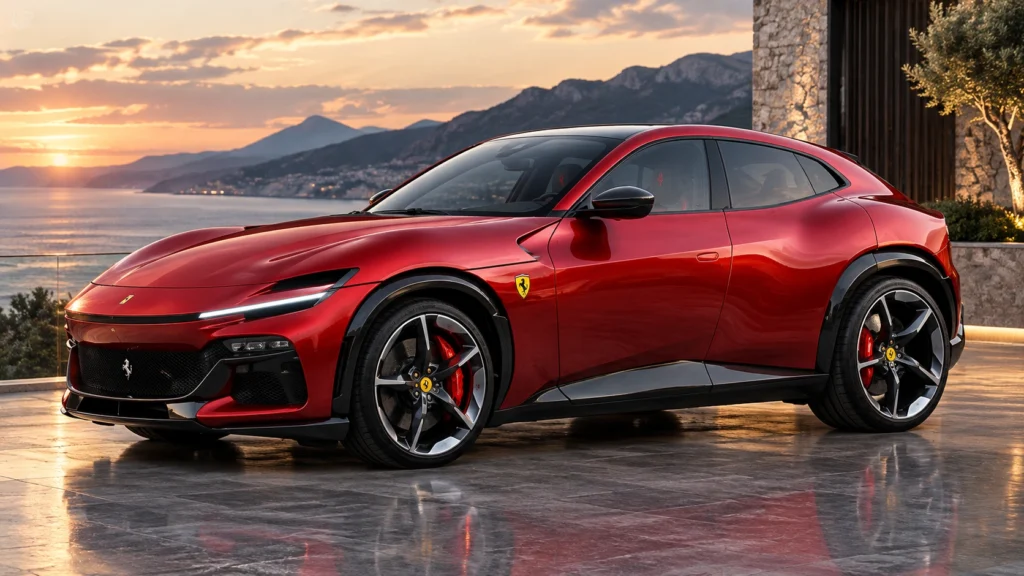
The side profile is where the car’s identity becomes clearest. Short overhangs, a low beltline for the segment, and a wheelbase-to-body ratio that favors handling over sheer interior volume all point back to Ferrari’s sports car roots. The four-door configuration uses conventional front doors and rear-hinged coach doors at the back — sometimes referred to as suicide doors — which open toward the rear of the car rather than the front. This layout was chosen specifically to improve access to the rear seats without requiring a B-pillar-mounted handle that would disrupt the exterior lines.
At the back, Ferrari kept the design restrained relative to the front, with slim taillights, an integrated spoiler lip, and a rear diffuser that plays a functional role in managing airflow underneath the car at speed. Wheel sizes run large — up to 22 inches at the front and 23 inches at the rear on some configurations — filling out the wheel arches without appearing disproportionate to the body.
Ground clearance is higher than any other current Ferrari model, a necessary compromise for everyday usability, but the active suspension system (covered in more detail in the performance section) allows the ride height to lower automatically at speed, restoring some of the aerodynamic and handling benefits of a lower stance when performance driving is the priority.
Interior and Technology
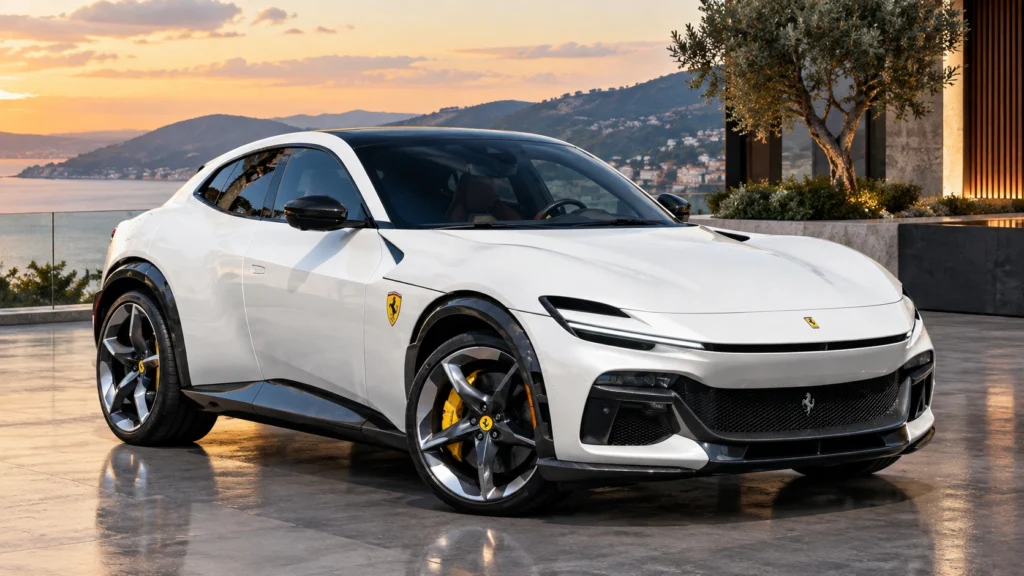
Inside, the Ferrari Purosangue commits fully to its four-seat identity — a genuine departure from the token rear seating found in many 2+2 sports cars. The rear seats are fully shaped, individually bolstered thrones rather than a shared bench, reflecting Ferrari’s decision to prioritize comfort for two rear passengers over accommodating a third.
The dashboard layout follows Ferrari’s modern driver-focused philosophy, built around a digital instrument cluster ahead of the driver and a curved main display integrated into the center of the cabin. A distinguishing feature is the available passenger display, positioned on the dashboard ahead of the front passenger seat, allowing the passenger to view speed, media, and other information independently of the driver’s controls — a feature shared with other recent Ferrari models rather than unique to the Ferrari Purosangue.
Materials throughout the cabin lean heavily on leather, Alcantara, and optional carbon-fiber trim, with a high degree of personalization available through Ferrari’s Tailor Made program. Buyers can specify interior color combinations, stitching patterns, and trim finishes well beyond the standard configurator options, which is typical of Ferrari’s approach to bespoke customization across its lineup.
Rear-seat access benefits directly from the rear-hinged coach doors, which open wide and create a clear path into the cabin without requiring passengers to duck under a conventional door frame. Once seated, rear passengers get their own climate controls and, depending on configuration, additional connectivity and charging provisions.
Cargo practicality is one of the more genuine functional upgrades over a traditional Ferrari. The rear cargo area is accessible through a powered tailgate and offers usable volume for luggage, sports equipment, or daily errands — a first for the brand in a production vehicle. It won’t match the outright cargo capacity of a full-size luxury SUV, but it represents real, usable space Ferrari has never offered before.
Technology and connectivity follow Ferrari’s current infotainment architecture, including smartphone integration, navigation, and voice control, wrapped in an interface designed to keep the driver’s hands on the steering wheel as much as possible — controls for indicators, wipers, and drive modes are integrated directly onto the wheel itself, consistent with Ferrari’s broader cockpit philosophy.
Engine and Performance
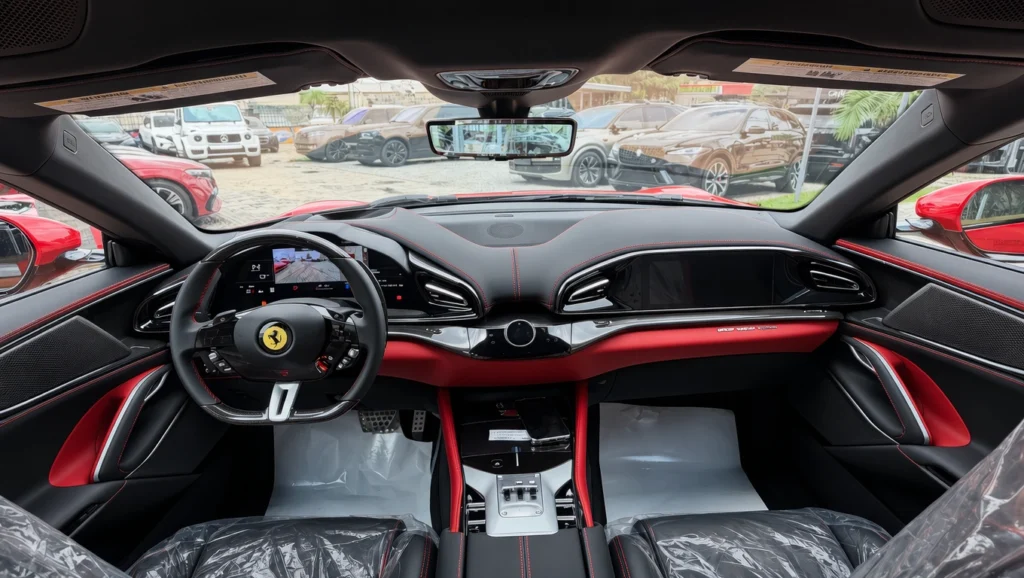
This is where the Ferrari Purosangue distinguishes itself most clearly from nearly every rival in its segment. Under the long hood sits a 6.5-liter naturally aspirated V12 — codenamed F140IA — producing 715 horsepower at 7,750 rpm and 528 lb-ft of torque at 6,250 rpm. Ferrari notes that 80% of that peak torque is already available by 2,100 rpm, which matters more than the headline numbers suggest.
A naturally aspirated engine builds power differently than a turbocharged one. Turbo engines, which power virtually every rival in this segment, rely on forced induction to generate torque early and often deliver a surge of power once boost builds. A naturally aspirated V12 like the one in the Purosangue has no turbo lag to manage — throttle response is immediate and linear, and power builds progressively all the way to a high 8,250 rpm redline. The tradeoff is that naturally aspirated engines typically produce less peak torque than a similarly sized turbocharged unit, which is why Ferrari’s engineers focused on making that torque accessible low in the rev range rather than chasing bigger numbers.
Power reaches all four wheels through an 8-speed dual-clutch transmission mounted at the rear axle in a transaxle layout, paired with a separate two-speed gearbox at the front to enable all-wheel drive — a system carried over conceptually from Ferrari’s earlier GTC4Lusso, refined for the Purosangue’s specific demands. This layout helps balance weight distribution between the front and rear axles, a priority for Ferrari’s chassis engineers even in a taller, heavier vehicle.
The suspension is arguably as significant an engineering achievement as the engine itself. Ferrari developed a proprietary active suspension system for the Purosangue that replaces traditional anti-roll bars with electric motors mounted at each corner, actively controlling damping forces in real time. In practical terms, this allows the car to stay flatter through corners than a conventional suspension setup would allow, without sacrificing ride comfort over rough pavement — a difficult balance for any tall vehicle, let alone one weighing over two tons.
Braking comes from large carbon-ceramic discs at all four corners, providing the stopping power necessary to match the car’s acceleration and top-speed capability. Steering is quick and precise by segment standards, tuned to feel familiar to anyone stepping out of a Ferrari sports car, even though the Purosangue sits noticeably taller.
High-speed stability benefits from the same aerodynamic detailing discussed in the design section — active elements and the car’s automatically lowering ride height help keep airflow managed as speeds climb, something that matters considerably more in a taller vehicle than in a low-slung supercar.
Specifications
| Category | Ferrari Purosangue |
|---|---|
| Engine | F140IA, front-mid mounted |
| Engine Type | Naturally aspirated V12 |
| Displacement | 6,496 cc (6.5L) |
| Horsepower | 715 hp (725 PS) at 7,750 rpm |
| Torque | 528 lb-ft at 6,250 rpm |
| Transmission | 8-speed dual-clutch |
| Drivetrain | All-wheel drive |
| Seating | 4 |
| Doors | 4 (rear coach doors) |
| Length | 195.8 in (4,973 mm) |
| Width | 79.8 in (2,028 mm) |
| Height | 62.6 in (1,589 mm) |
| Wheelbase | 118.8 in (3,018 mm) |
| Curb Weight | Approx. 4,480–4,780 lb (2,033–2,170 kg), varies by measurement standard |
| Fuel Capacity | Approx. 24 gallons (90 liters), varies by market |
| Cargo Capacity | Varies by configuration; Ferrari does not publish a single global figure |
| 0–60 mph | 3.3 seconds (manufacturer claim) |
| Top Speed | 193 mph |
Curb weight figures vary depending on whether they reflect Ferrari’s official dry weight or a fully fueled curb weight measurement, which is worth keeping in mind when comparing sources. For the most current and market-specific technical data, Ferrari publishes official figures on its Purosangue model page.
Top Speed and Acceleration
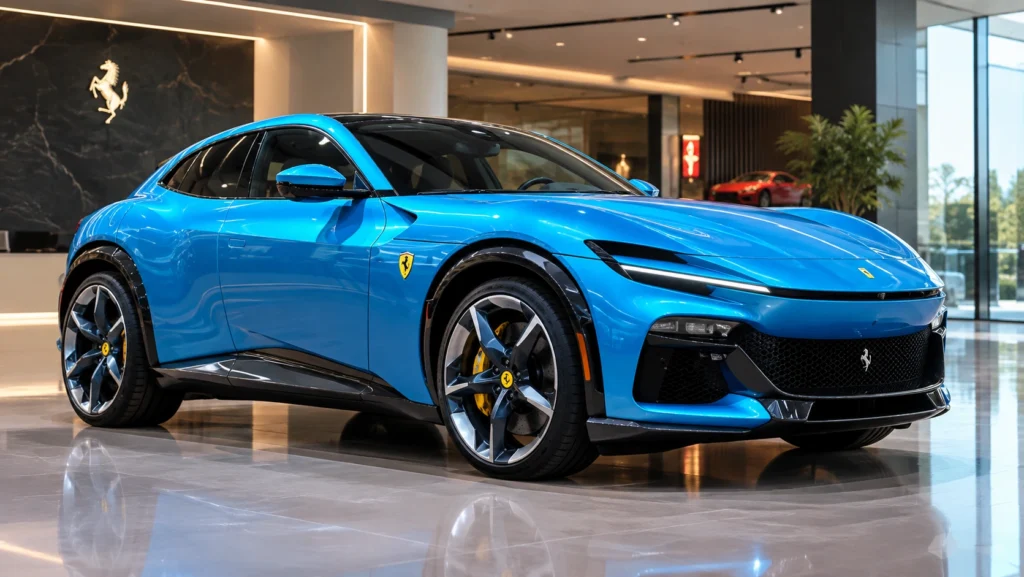
Ferrari quotes a 0–60 mph time of 3.3 seconds for the Ferrari Purosangue, with a top speed of 193 mph. Independent testing has generally landed close to that claim, occasionally slightly quicker under ideal conditions.
Those numbers matter more in context than in isolation. A 3.3-second sprint to 60 mph would have been supercar territory a decade ago; in a four-seat vehicle with genuine cargo space and all-weather capability, it puts the Ferrari Purosangue ahead of most conventional luxury SUVs and on par with — or ahead of — many purpose-built performance SUVs running turbocharged V8 power.
Several factors combine to make that acceleration possible. The all-wheel-drive system distributes torque to maximize traction off the line, minimizing wheelspin that would otherwise waste the V12’s power. Ferrari’s 8-speed dual-clutch transmission shifts in roughly 50 milliseconds, keeping the engine within its power band through each gear change. And while the Ferrari Purosangue is heavier than any two-door Ferrari, its front-mid-engine layout and low-mounted components keep the center of gravity lower than a typical SUV, aiding both acceleration traction and mid-corner stability.
What separates the Ferrari Purosangue performance character from most rivals is how that power is delivered. Because the engine is naturally aspirated, throttle response stays consistent and predictable from idle to redline, rather than building in a rush once turbo boost arrives. For enthusiasts, that translates into a more analog, engaging feel under acceleration — closer to a traditional sports car than to a boosted SUV, even while posting numbers that few conventional SUVs can match.
Price
Ferrari’s official starting MSRP for the Ferrari Purosangue in the United States has moved over the course of the model’s production run, and current listings place base pricing in the neighborhood of the low-to-mid $400,000s before options — though buyers should confirm current figures directly with a Ferrari dealer, since pricing is adjusted periodically and varies by market and model year.
That starting figure rarely reflects what most buyers actually pay. Ferrari’s personalization program, along with options like upgraded interior trims, carbon-fiber packages, wheel choices, and bespoke color combinations, routinely pushes transaction prices well above the base MSRP — often into the $500,000-plus range once a car is configured the way most owners want it. Market data on recently sold examples reflects that pattern clearly, with real-world transaction prices frequently landing well above where the car started.
Availability adds another layer to the ownership conversation. Ferrari has deliberately restricted Purosangue production, reportedly capping it at a percentage of the brand’s total annual output to preserve exclusivity and avoid diluting the value of its sports car lineup. That scarcity, combined with strong demand, means waiting lists remain common in many markets, and used examples have at times sold above their original purchase price.
Ownership costs extend beyond the purchase price. Like any Ferrari, routine maintenance, tires, and insurance carry premium costs relative to mainstream luxury vehicles, and the V12’s complexity means service work is best handled through Ferrari’s authorized dealer network. Fuel economy is also modest by design — Ferrari’s own figures point to city and highway numbers in the low double digits, a reasonable tradeoff given the performance on offer, but a real consideration for prospective buyers weighing running costs.
Pros and Cons
| Pros | Cons |
|---|---|
| Naturally aspirated V12 with genuine Ferrari character | Extremely expensive, both to purchase and to run |
| Real four-seat practicality with usable cargo space | Limited production and long waiting lists in many markets |
| Advanced active suspension balances comfort and handling | Modest fuel economy for the segment |
| Strong straight-line performance for a four-door vehicle | Not as spacious as full-size luxury SUV rivals |
| Distinctive design that avoids typical SUV proportions | Options and personalization add significantly to the final price |
Comparison With Competitors
The Ferrari Purosangue competes in a segment now crowded with high-performance luxury SUVs, but its engineering philosophy separates it from most rivals in meaningful ways.
| Model | Engine | Power | Seating | Character |
|---|---|---|---|---|
| Ferrari Purosangue | 6.5L naturally aspirated V12 | 715 hp | 4 | Driver-focused, GT-derived dynamics |
| Lamborghini Urus (S/Performante/SE) | 4.0L twin-turbo V8 (hybrid on SE) | Approx. 650–789 hp | 5 | Aggressive, track-oriented performance SUV |
| Bentley Bentayga Speed | 6.0L twin-turbo W12 | 626 hp | 5 | Grand luxury with strong performance |
| Aston Martin DBX707 | 4.0L twin-turbo V8 | 697 hp | 5 | Sporty handling with British luxury |
| Rolls-Royce Cullinan | 6.75L twin-turbo V12 | 563–591 hp | 5 | Ultimate comfort and refinement |
| Porsche Cayenne Turbo GT | 4.0L twin-turbo V8 | 631 hp | 5 | Track-capable everyday performance |
Each of these vehicles approaches the same broad segment from a different philosophy. The Ferrari Purosangue prioritizes driving engagement and Ferrari’s traditional performance DNA over outright cabin space, positioning itself as a performance SUV in function while resisting the label in name. The Lamborghini Urus leans into aggressive styling and track-focused dynamics, making it the most overtly sporting of the mainstream rivals.
Bentley’s Bentayga trades outright speed for a more opulent, comfort-focused experience, while the Rolls-Royce Cullinan goes furthest in that direction, prioritizing ride quality and cabin isolation above outright performance. The Aston Martin DBX707 sits closer to the sporting end of the spectrum, and the Porsche Cayenne Turbo GT remains the most track-capable and comparatively accessible option of the group, without matching the exclusivity or engine character of the others.
None of these vehicles are direct mechanical equivalents to the Ferrari Purosangue — their platforms, engine layouts, and target buyers differ meaningfully, even where their price points overlap.
Who Should Buy It?
The Ferrari Purosangue makes the most sense for buyers who already value what Ferrari represents and want that experience in a more usable, everyday format. Existing Ferrari owners looking for a vehicle that can handle family duties, road trips, or daily driving without stepping away from the brand’s driving character are the clearest fit. It also appeals to buyers who want genuine supercar-level acceleration paired with four real seats — a combination few vehicles in any segment can offer.
Luxury buyers who prioritize exclusivity will find the Purosangue’s restricted production and waiting lists appealing rather than frustrating, since scarcity is part of the ownership experience Ferrari has built around the model.
That said, the Ferrari Purosangue isn’t the right choice for everyone cross-shopping this segment. Buyers who need maximum cargo capacity, serious off-road capability, or the lowest possible running costs are better served by a conventional luxury SUV. Those prioritizing rear-seat comfort above all else may find more room and a smoother ride in a Bentley Bentayga or Rolls-Royce Cullinan. And anyone put off by long waiting periods, premium maintenance costs, or a purchase price that regularly exceeds half a million dollars once optioned should look toward more accessible alternatives like the Porsche Cayenne Turbo GT.
Conclusion
The Ferrari Purosangue succeeds by refusing to compromise on what makes a Ferrari a Ferrari, even while expanding into a segment the brand avoided for decades. Its naturally aspirated V12, active suspension, and GT-derived chassis give it a driving character that stands apart from turbocharged rivals, while its four-seat layout and genuine cargo space make it usable in ways no previous Ferrari has been.
It isn’t the most spacious option in its class, nor the least expensive to buy or run, but it wasn’t designed to win on those terms. For buyers who want supercar performance without abandoning everyday practicality, the Ferrari Purosangue occupies a position few other vehicles can claim — a high-performance luxury vehicle that drives like a Ferrari first and a utility vehicle second.
Frequently Asked Questions (FAQs)
The Ferrari Purosangue is Ferrari’s first production four-door, four-seat vehicle, built around a naturally aspirated V12 engine and all-wheel drive. Ferrari refers to it as an FUV, or Ferrari Utility Vehicle, distinguishing it from conventional SUVs due to its GT-derived platform and performance-focused engineering priorities.
US pricing currently starts in the low-to-mid $400,000s before options, though figures vary by market and model year. Most buyers configure their cars with additional personalization, which typically pushes the final transaction price well above the base MSRP.
Functionally, it competes directly with luxury performance SUVs, but Ferrari avoids labeling it an SUV. The company positions it instead as a four-door Ferrari built on GT-derived architecture, prioritizing driving dynamics over the off-road or cargo-focused priorities typical of traditional SUVs.
The Purosangue’s 6.5-liter naturally aspirated V12 produces 715 horsepower (725 PS) at 7,750 rpm, along with 528 lb-ft of torque at 6,250 rpm, figures that place it among the most powerful naturally aspirated engines currently in production.
Ferrari claims a 0–60 mph time of 3.3 seconds and a top speed of 193 mph, figures that put it ahead of most conventional luxury SUVs and competitive with dedicated performance SUV rivals running turbocharged engines.
The Purosangue seats four occupants, with individually shaped front and rear seats rather than a rear bench, reflecting Ferrari’s focus on comfort over maximum passenger count.
It uses the F140IA, a 6.5-liter naturally aspirated V12 mounted in a front-mid-engine layout, paired with an 8-speed dual-clutch transmission and an all-wheel-drive system for power delivery to all four wheels.
For buyers who value Ferrari’s driving character, want genuine four-seat practicality, and can accommodate the price, waiting lists, and running costs involved, the Purosangue delivers a driving experience few rivals in the luxury performance SUV segment can match. Buyers prioritizing space or value are better served elsewhere.