Bugatti La Voiture Noire: Inside Bugatti’s Most Exclusive One-Off Hypercar
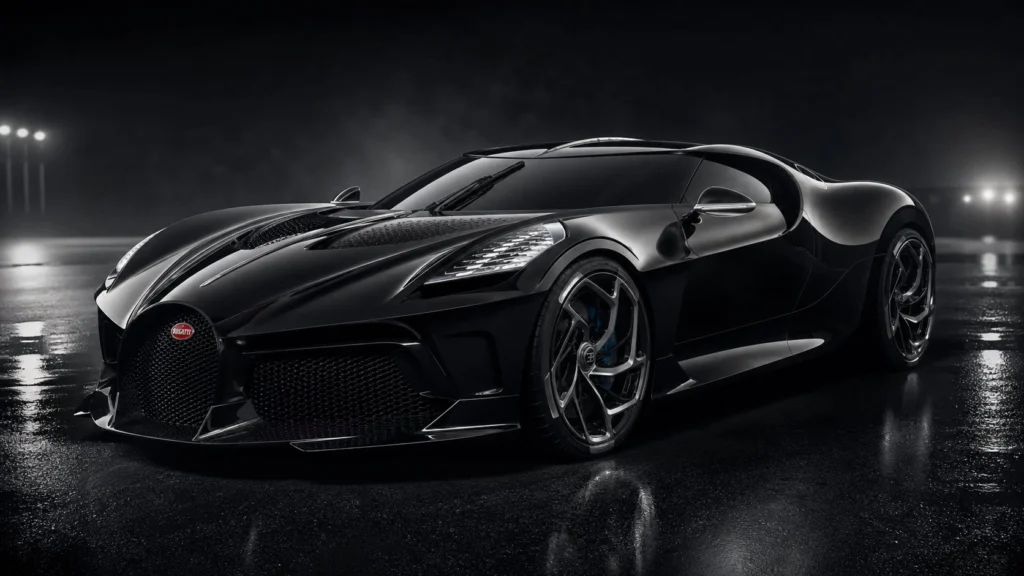
Few cars generate the kind of hushed, reverent conversation that follows the Bugatti La Voiture Noire. Unveiled at the 2019 Geneva Motor Show, it wasn’t just another Bugatti reveal — it was the moment the brand quietly confirmed it had built, and sold, the most expensive new car in history. Behind the glossy carbon-fiber body sits a story that reaches back nearly 90 years, to a lost car that automotive historians still search for today.
This guide breaks down everything that’s actually known about the Bugatti La Voiture Noire — its design, its engineering, its price, and its place in Bugatti’s history — while being upfront about which figures are officially confirmed and which are simply widely reported. If you’ve searched for how much it costs, how fast it goes, or who actually owns it, you’ll find honest answers here, not inflated ones.
Quick Specifications
| Specification | Bugatti La Voiture Noire |
|---|---|
| Type | One-off hypercar / modern coachbuilt grand tourer |
| Engine | 8.0-liter quad-turbocharged W16 |
| Power | 1,500 PS (1,479 hp / 1,103 kW) — officially confirmed |
| Torque | 1,600 Nm (1,180 lb-ft) — officially confirmed |
| Transmission | 7-speed dual-clutch automatic |
| Drivetrain | All-wheel drive |
| Body | Carbon fiber, hand-finished |
| Top speed | Reported/estimated at 420 km/h (261 mph), electronically limited |
| Production | One-off (single unit built) |
| Price | €11 million before tax — officially confirmed by Bugatti |
What Is Bugatti La Voiture Noire?
Strip away the mystique and the Bugatti La Voiture Noire is, mechanically, a Bugatti Chiron underneath. But that description undersells what Bugatti actually built. This is a coachbuilt one-off hypercar — a car designed and hand-finished as a single, unrepeatable piece, rather than one of a numbered production run.
“La Voiture Noire” translates simply to “The Black Car” in French. It’s a quiet, almost understated name for a vehicle that turned out to be the most expensive new car ever sold at the time of its reveal.
What separates it from a standard Chiron, or even from limited-run Bugatti specials like the Divo or Centodieci, is exclusivity by design rather than by numbers. Bugatti didn’t cap production at ten or twenty units. It built exactly one car, for one customer, and then closed the book on it.
In the hypercar world, exclusivity isn’t just a marketing angle — it’s the entire value proposition. A car that can never be replicated, bought, or ordered by anyone else carries a different kind of status than even the rarest limited edition. That’s the space the Bugatti La Voiture Noire occupies within Bugatti’s modern lineup: not the fastest car the brand makes, but arguably the most symbolically important one.
History and Background
To understand the Bugatti La Voiture Noire, you have to go back to 1936, and to a young designer named Jean Bugatti — son of company founder Ettore Bugatti.
Jean had an instinctive grasp of proportion and aerodynamics that was unusual for his era. By the late 1920s he was already shaping the company’s design direction, and in 1936, at just 27 years old, he took over its leadership. His most celebrated creation was the Type 57 SC Atlantic — a grand tourer so distinctive that it’s still considered one of the most beautiful cars ever built.
Only four Atlantics were ever made, each one different, each built to its buyer’s own specification. One of them, finished in black, became known as “La Voiture Noire.” It disappeared sometime before or during the Second World War, reportedly while being shipped to a safer region as German forces advanced. It has never been found. Three Atlantics survive today; the fourth remains one of the automotive world’s enduring mysteries.
Jean Bugatti died in 1939, testing a Type 57 tourer, at just 30 years old. His work, though, became the foundation of Bugatti’s design identity for decades afterward.
Fast forward to 2019 — the year marking 110 years since Bugatti’s founding — and the brand chose to mark the anniversary not with a limited series, but with a single, deeply personal tribute. The modern La Voiture Noire isn’t a replica of the lost Atlantic. It’s a reinterpretation: the same spirit of elegance and speed, translated through modern carbon-fiber construction and a W16 engine instead of a supercharged straight-eight.
Bugatti has documented the car’s development and reveal on its official newsroom page, where the company describes it as a tribute to Jean Bugatti’s legacy and to the Atlantic specifically.
The car debuted as a static show model at Geneva in March 2019, already sold. Bugatti confirmed shortly after that it had, in fact, found a buyer before the car was even publicly revealed — an unusual step, even by hypercar standards, and one that underlined how personal this particular commission was.
Design and Exterior
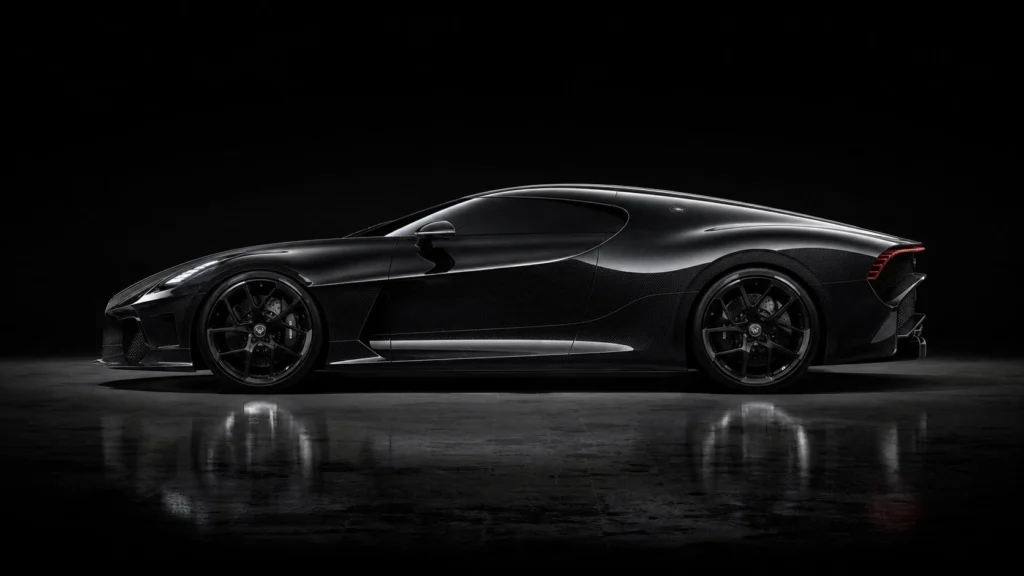
The Bugatti La Voiture Noire exterior is where the tribute to the Atlantic becomes most visible, even though the underlying proportions come from the Chiron.
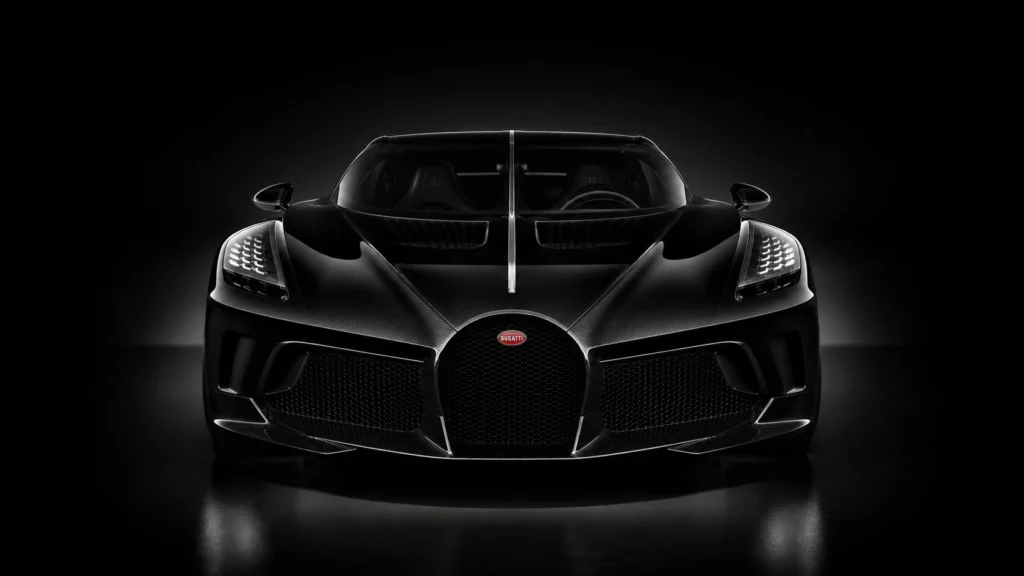
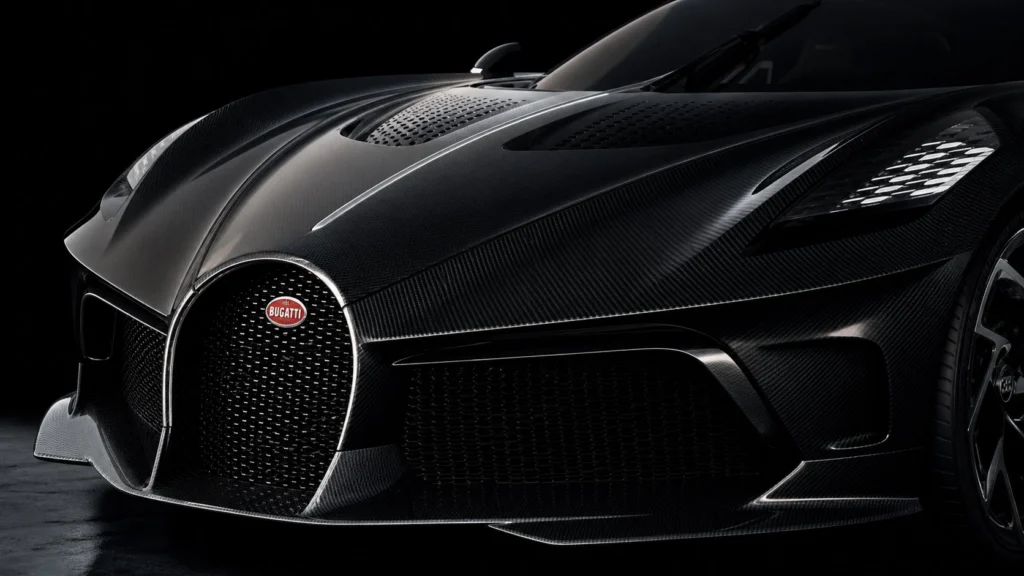
The nose is stretched and lower than a standard Chiron’s, giving the car a longer, more horizontal stance. Bugatti’s signature horseshoe grille sits at the front, flanked by slim, deeply integrated LED headlights that sit flush with the bodywork rather than protruding from it.
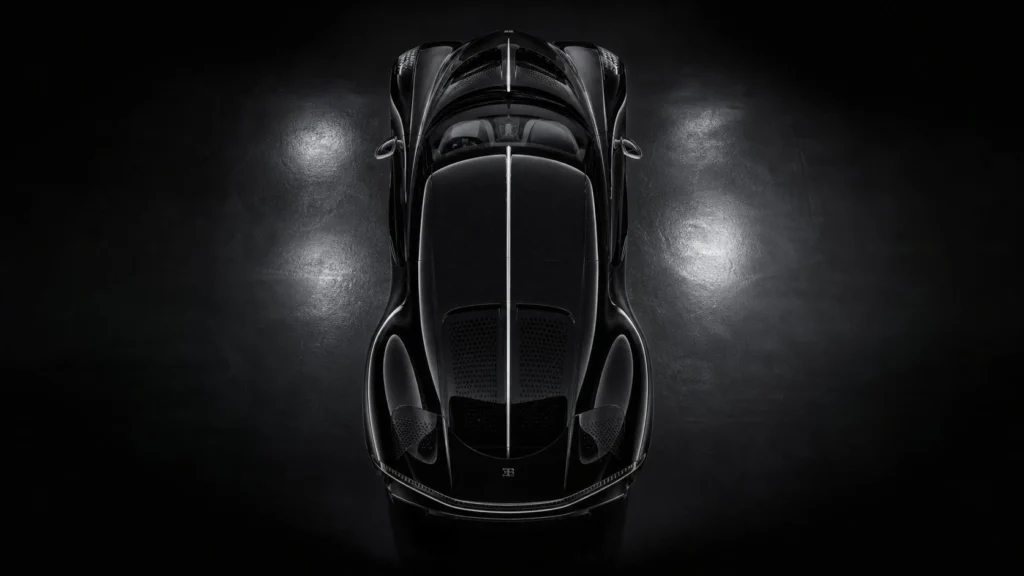
Move along the side profile and the car’s most distinctive feature appears: a central spine, or “dorsal fin,” that runs from the split engine cover at the front all the way to the tail. It’s a direct nod to the ridge that ran down the roof and rear deck of the original Atlantic, reinterpreted here as a sculpted seam rather than a riveted structural element.
The roofline is low and continuous, with the windshield appearing to blend into the side glass almost like the visor of a helmet — a deliberate design choice meant to keep the surface as uninterrupted as possible. Bugatti’s design team, led by Etienne Salomé, has spoken about wanting a single, flowing silhouette without disruptive lines breaking up the car’s form.
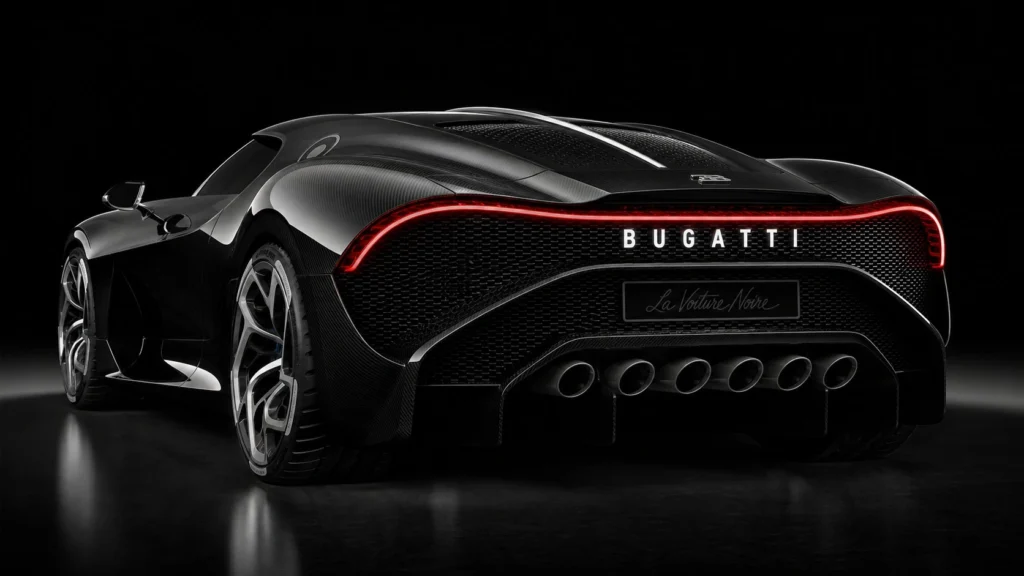
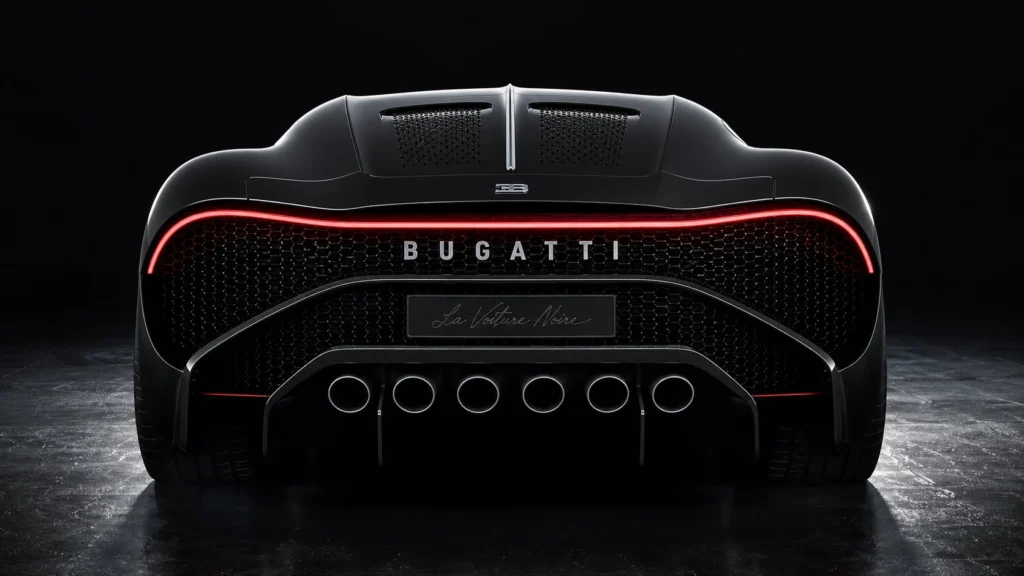
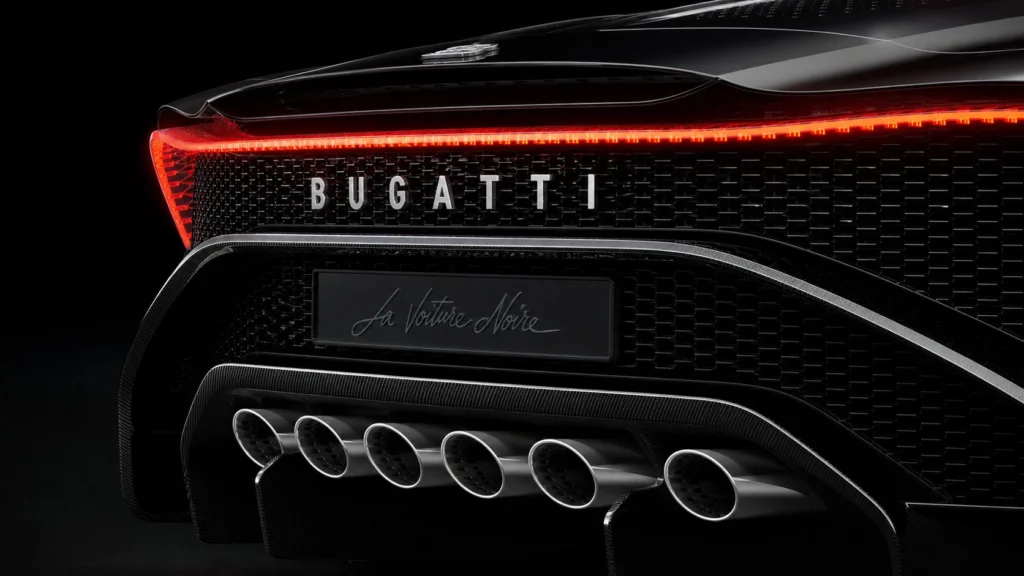
At the rear, six exhaust outlets are arranged in a way that echoes the engine’s sixteen cylinders — a detail that’s as much symbolic as it is functional. The taillights are thin, horizontal strips that reinforce the width of the rear end, while the diffuser and lower bodywork are shaped to manage airflow without resorting to the aggressive wings and vents seen on more track-focused hypercars.
The entire body is finished in exposed carbon fiber — the Bugatti La Voiture Noire carbon fiber body panels are polished to a deep, glossy black rather than left in a matte or satin finish, which is part of why photographs of the car often make it look like liquid rather than solid material.
The wheels were designed specifically for this car, and like nearly every visible component, they share no parts with any other Bugatti model. That level of bespoke detailing — a wheel design used on exactly one car — is a good summary of how Bugatti approached the entire project.
Aerodynamically, the car trades some of the Chiron’s more aggressive downforce elements for cleaner surfacing, consistent with its identity as a grand tourer rather than a track-focused machine. It’s built to cover long distances at high speed comfortably, not to set lap records.
Interior and Technology
Bugatti has kept most interior details of the La Voiture Noire private, which is itself notable — this isn’t a car built for a press photo spread of its cabin. What has been confirmed and reported points to an interior built around the same philosophy as the exterior: minimalism executed at an extremely high level of craftsmanship.
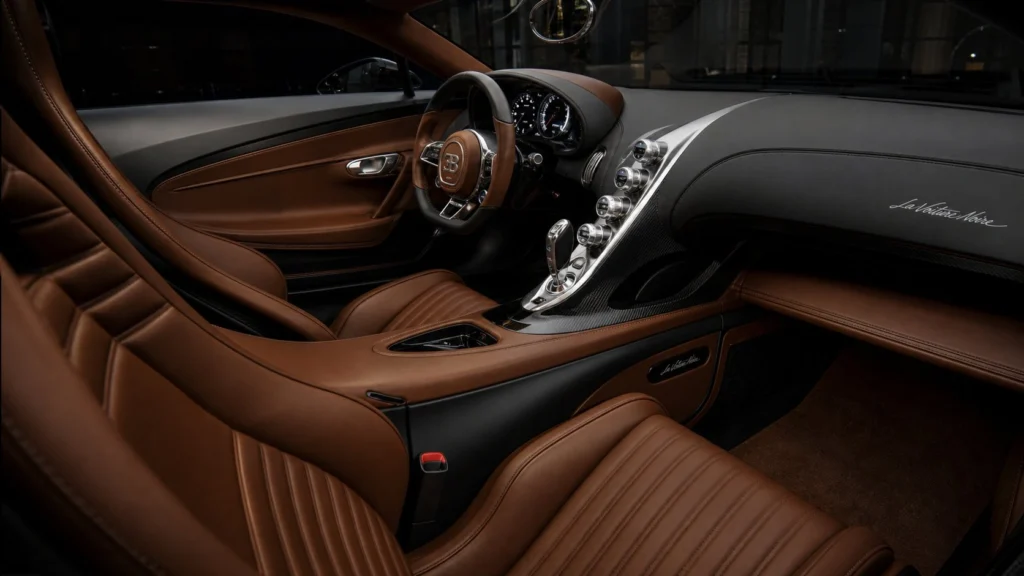
The Bugatti La Voiture Noire interior is understood to feature handcrafted leather upholstery, milled aluminum switchgear, and trim pieces made specifically for this one car rather than adapted from the Chiron’s parts bin. Bugatti has described the approach as drawing from haute couture — the idea that every stitch and surface should feel considered rather than mass-produced.
The layout follows Bugatti’s usual driver-focused approach: a clean dashboard, physical switchgear for key functions rather than a screen-heavy interface, and digital instrumentation that prioritizes clarity over flash. This is consistent with how Bugatti designs its production models, where the goal is to keep the driver’s attention on the road and the machine, not on menus.
Personalization would have been extensive, given the nature of a one-off commission. Bugatti’s customization program for its regular models already allows customers to select from a vast range of materials and finishes; for a car like this, that process would have gone even further, likely involving direct collaboration between the customer and Bugatti’s design and engineering teams.
The philosophy at play here is one Bugatti applies across its range, but especially on projects like this: extreme performance and old-world luxury aren’t treated as contradictions. The same car capable of covering ground at Chiron-rivaling speeds is also expected to be comfortable enough for a multi-hour drive, with a cabin that feels closer to a bespoke lounge than a stripped-out track car.
Engine and Performance
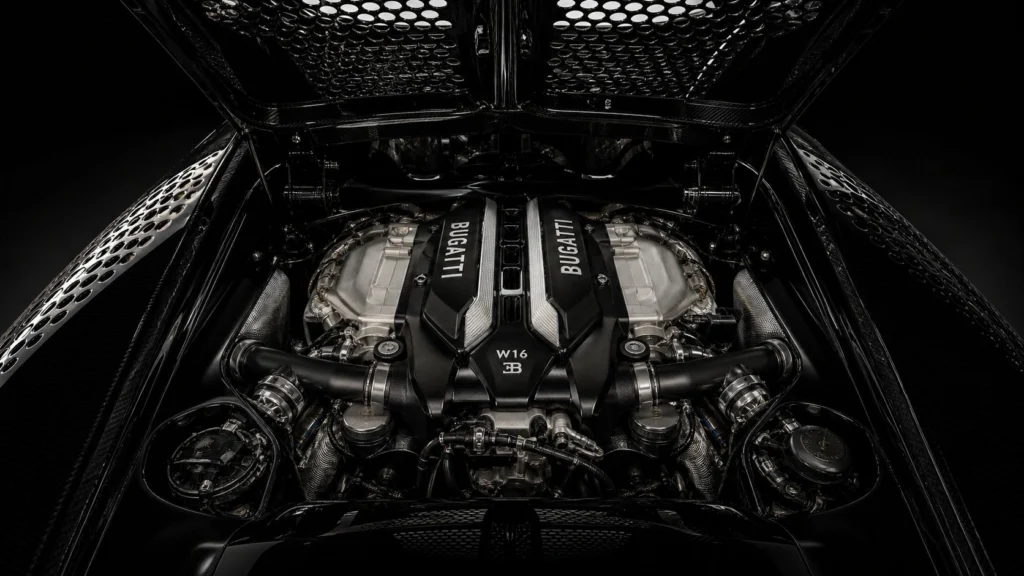
At the heart of the La Voiture Noire is Bugatti’s 8.0-liter quad-turbocharged W16 — the same basic architecture that powers the Chiron, and arguably the engine most associated with the modern Bugatti brand.
A quick explainer for anyone unfamiliar with the layout: a W16 engine is essentially two V8 engines joined together at a narrow angle, sharing a single crankshaft. It’s an unusually compact way to fit sixteen cylinders into an engine bay, and Bugatti pairs it with four turbochargers — one for every four cylinders — to build power progressively rather than all at once.
The Bugatti La Voiture Noire horsepower figure stands at 1,500 PS (1,479 hp), with 1,600 Nm of torque — both figures officially confirmed by Bugatti and identical to the standard Chiron’s output. Power is sent to all four wheels through a seven-speed dual-clutch automatic transmission, with the all-wheel-drive system helping put that torque down without overwhelming the tires.
In simple terms: horsepower tells you how quickly the engine can do work, while torque tells you how much twisting force it produces at the wheels. A car with this much of both doesn’t just accelerate hard — it does so with a shove that stays consistent well past the speeds where most cars have already run out of breath.
What makes the W16 significant for Bugatti isn’t just the numbers. It’s the engineering approach — an enormous, complex engine built with the same obsession over craftsmanship that goes into the bodywork. Bugatti has treated the W16 as close to the brand’s mechanical signature, and putting it, unmodified in output, into a bespoke coachbuilt body was as much a statement of identity as it was a performance decision.
Bugatti has not published independent dyno results or acceleration testing specific to this one-off car, since it was engineered to share the Chiron’s certified powertrain rather than to set new performance records of its own.
Specifications
| Category | Detail |
|---|---|
| Engine | 8.0-liter W16, quad-turbocharged |
| Cylinders | 16, in W configuration |
| Turbochargers | 4 |
| Power | 1,500 PS / 1,479 hp / 1,103 kW (officially confirmed) |
| Torque | 1,600 Nm / 1,180 lb-ft (officially confirmed) |
| Transmission | 7-speed dual-clutch automatic |
| Drivetrain | All-wheel drive |
| Body construction | Carbon fiber, hand-built |
| Seating | 2-seat coupe |
| Production quantity | One unit (one-off) |
| Price | €11 million before tax (officially confirmed) |
Top Speed and Acceleration
This is one area where it’s important to separate what Bugatti has confirmed from what’s commonly reported.
Because the Bugatti La Voiture Noire shares its powertrain and chassis with the Chiron, most outlets report a top speed around 420 km/h (261 mph), electronically limited — the same figure widely associated with the standard Chiron. Bugatti has not published a separate, independently verified top-speed test specifically for this one-off car, since it was built as a bespoke grand tourer rather than a speed-record vehicle.
The same caveat applies to acceleration. Reported figures commonly put the Bugatti La Voiture Noire 0-60 time at around 2.4 seconds, with 0-100 km/h in a similar range — again mirroring the Chiron rather than reflecting a published, car-specific test.
Why does this matter? A few reasons:
- Bugatti tunes some of its special editions differently from the base Chiron, so borrowing another model’s figures isn’t always accurate.
- The La Voiture Noire was explicitly designed with a more relaxed, grand-touring character in mind, with revised suspension and damper tuning geared toward comfort over outright speed.
- All-wheel drive plays a major role in how quickly that torque translates into forward motion; without it, a car with this much power would struggle for traction off the line.
So when people ask how fast is Bugatti La Voiture Noire, the honest answer is: almost certainly in Chiron territory, but not confirmed by Bugatti as an independently tested figure for this specific car. Straight-line numbers are also only part of the story here — this was never meant to be judged purely by lap times or drag-strip runs.
Price
The Bugatti La Voiture Noire price is one of the few figures Bugatti has stated plainly: €11 million before tax, confirmed at the time of the car’s reveal in 2019. Depending on the buyer’s country of residence and applicable taxes, the final out-the-door cost is often reported as considerably higher — some estimates place it closer to $18-19 million once local taxes are factored in, though Bugatti itself has only ever confirmed the net figure.
So, how much is Bugatti La Voiture Noire? Officially, €11 million before tax. Anything beyond that is a reasonable estimate, not a manufacturer-confirmed number.
What justifies that price tag? A few factors converge here:
- Bespoke engineering — components designed and built for this car alone, not shared across a production run.
- Hand-finished construction — panels, trim, and switchgear assembled individually rather than on a standard assembly line.
- Design development — years of work translating a 1930s design language into a modern carbon-fiber body.
- Exclusivity — there is no second unit, no waiting list, no possibility of ordering one after the fact.
- Heritage value — a direct, sanctioned connection to one of the most famous lost cars in automotive history.
It’s worth being cautious about resale value here, too. Because there’s only one Bugatti La Voiture Noire and it has never appeared on the open market, any claims about its current worth are speculation rather than fact.
Pros and Cons
| Pros | Cons |
|---|---|
| Extreme exclusivity | Extremely expensive |
| Unique, hand-finished design | One-off production — no availability |
| Powerful W16 engine shared with the Chiron | Limited everyday practicality |
| Exceptional craftsmanship throughout | Not accessible to typical buyers |
| Strong historical connection to the Type 57 SC Atlantic | Difficult to benchmark against conventional performance cars |
None of this is meant as a knock against the car. It simply reflects what it is: a bespoke, symbolic commission rather than a product built for a broad customer base. The trade-offs that come with total exclusivity are the same ones that make it desirable in the first place.
Comparison With Competitors
Calling anything a direct “competitor” to a one-off car is a stretch, since nothing else can be bought in the same way. Still, it’s useful to see where the Bugatti La Voiture Noire sits relative to other ultra-exclusive machines.
| Model | Power | Production | Price (approx.) | Philosophy |
|---|---|---|---|---|
| Bugatti La Voiture Noire | 1,500 PS | One-off | €11 million+ before tax | Bespoke heritage tribute, grand touring focus |
| Bugatti Chiron | 1,500 PS | Limited series | ~€2.4 million before tax | Series-produced hypercar performance |
| Pagani Huayra (various) | ~730-864 PS | Limited series | ~€2.6-3.5 million | Art-meets-engineering, driver-focused |
| Rolls-Royce Boat Tail | N/A (luxury focus) | 3 units | Reported ~$28 million | Ultra-bespoke luxury coachbuilding, not performance-led |
| Koenigsegg Jesko | Up to ~1,600 PS | Limited series | ~€2.8 million+ | Track-oriented hypercar performance |
A few honest distinctions matter here. The Chiron shares the Bugatti La Voiture Noire powertrain almost exactly, but it’s a series-production car available to any qualifying buyer — the Bugatti La Voiture Noire never was. The Rolls-Royce Boat Tail is arguably its closest philosophical match: another one-off (well, three-off) coachbuilt commission built around bespoke luxury rather than outright performance, though it isn’t a performance car in the same sense. Pagani and Koenigsegg, by contrast, are built by low-volume specialists chasing performance and driver engagement first, luxury second.
The Bugatti La Voiture Noire real position in this market isn’t about beating any of these cars on a spec sheet. It’s about occupying a category that barely has other entrants: a one-off, brand-defining hypercar built as a personal commission rather than a product line.
Who Should Buy It?
There’s only one owner, so this section is more about understanding the type of buyer this car was built for than offering shopping advice.
This is a car for ultra-high-net-worth collectors who already have serious automotive collections and are looking for something that can’t be duplicated by anyone else’s money. It appeals specifically to buyers with a genuine interest in Bugatti’s history — particularly the Jean Bugatti and Type 57 SC Atlantic story — rather than buyers simply chasing the fastest or newest hypercar on the market.
It also suits collectors who value design and craftsmanship as heavily as raw performance. Someone purely chasing lap times or drag-strip numbers has plenty of other options that cost a fraction of the price and are arguably quicker in a straight line.
Who wouldn’t choose this car? Almost everyone, by definition — it was never for sale to a general market. Beyond that obvious point, buyers who prioritize practicality, daily usability, or the ability to have a car serviced through a wide dealer network would find a one-off commission like this impractical regardless of budget. Parts, service, and even basic maintenance become bespoke undertakings when there’s only one car in existence.
Conclusion
The Bugatti La Voiture Noire isn’t the fastest car Bugatti has ever built, and it never claimed to be. What it represents instead is something harder to manufacture at any price: a direct, hand-built link between the company’s founding era and its modern hypercar ambitions.
Underneath the carbon-fiber skin sits familiar Chiron mechanicals — the 1,500 PS W16 engine, the all-wheel-drive system, the same fundamental performance envelope. But the body, the interior detailing, and the entire premise of the car are unrepeatable. Only one exists, built for one buyer, at a confirmed €11 million before tax.
For anyone tracking Bugatti’s modern output, the Bugatti La Voiture Noire remains a useful reference point precisely because it doesn’t fit the usual hypercar mold. It wasn’t built to top a leaderboard or headline a production run; it was built as a personal, one-off statement. That combination of familiar Bugatti engineering wrapped in a completely bespoke identity is what keeps the Bugatti La Voiture Noire in conversations about the brand’s most important modern cars, even years after the headlines around its reveal have faded.
Its real significance lies in what it says about Bugatti as a brand: a company still willing to treat its own history — specifically Jean Bugatti’s Type 57 SC Atlantic — as something worth honoring through genuine engineering and design effort, not just a marketing footnote. That’s a harder thing to pull off convincingly than simply building another fast car, and it’s why the Bugatti La Voiture Noire still gets discussed years after its reveal, long after the headlines about its price faded.
Bugatti has continued exploring the limits of its engineering identity since then, most notably with the track-focused Bugatti Bolide — a car that takes the same W16 heart in an entirely different, far more extreme direction. Seen side by side, the two cars make the point well: Bugatti isn’t chasing one definition of what a hypercar should be.
Frequently Asked Questions (FAQs)
It’s a one-off hypercar built by Bugatti, revealed in 2019, based on the Chiron’s platform but wrapped in a hand-built carbon-fiber body designed as a tribute to Jean Bugatti’s Type 57 SC Atlantic.
Bugatti confirmed a price of €11 million before tax. With taxes included, the final cost is often reported as higher, though Bugatti has not published an official taxed figure.
1,500 PS (1,479 hp), officially confirmed by Bugatti, matching the standard Chiron’s output.
An 8.0-liter, quad-turbocharged W16 engine — 16 cylinders arranged in a W configuration, fed by four turbochargers.
A top speed around 420 km/h (261 mph) is widely reported based on its shared Chiron platform, though Bugatti hasn’t published an independently verified top-speed test for this specific one-off car.
Exactly one. It was built as a single, unrepeatable commission rather than a limited production run.
Bugatti has not officially disclosed the owner’s identity. Various outlets have reported different names over the years, but none of these claims have been confirmed by Bugatti itself, so ownership should be treated as unconfirmed.
Its price reflects bespoke engineering, hand-finished construction, and unique design work created for a single car, combined with total exclusivity and a direct connection to one of Bugatti’s most famous historical models.