Ford Maverick: Complete 2026 Review, Specs, Price and Features
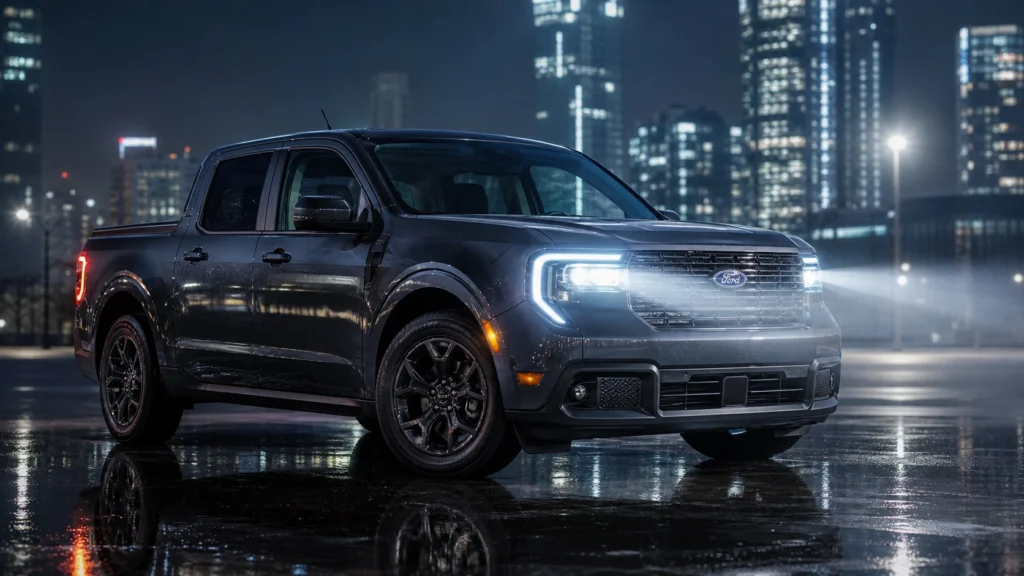
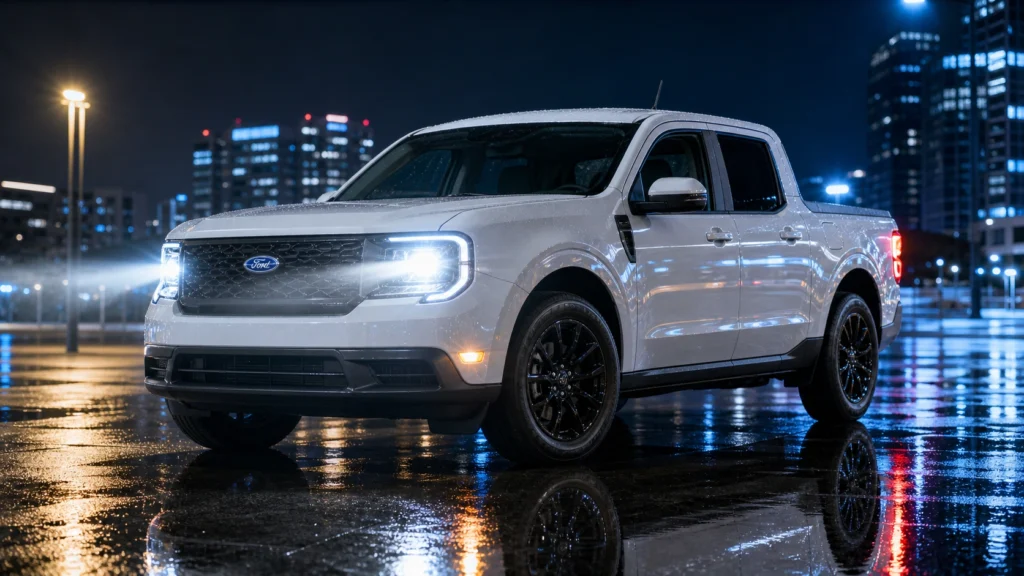
The Ford Maverick set out to answer a question the truck market had mostly stopped asking: what if a pickup didn’t have to be enormous to be useful? Since its 2021 debut, the Maverick has carved out its own lane as a compact pickup that drives more like a crossover than a traditional truck, and the 2026 model year keeps that formula largely intact while sharpening a few details.
What makes the Maverick interesting isn’t just its size. It’s the only compact pickup sold in the U.S. that offers a standard hybrid powertrain, alongside a more conventional turbocharged gas engine for buyers who want extra muscle. That split lets Ford sell essentially two different trucks under one nameplate — an efficiency-focused commuter and a quicker, more capable workhorse.
This guide walks through everything worth knowing about the 2026 Ford Maverick: pricing by trim, engine and performance details, fuel economy, towing and payload numbers, interior technology, safety, reliability, and how it measures up against the Hyundai Santa Cruz, Ford Ranger, and Honda Ridgeline.
Quick Specifications
| Specification | 2026 Ford Maverick |
|---|---|
| Vehicle Type | Compact pickup truck |
| Model Year | 2026 |
| Starting Price | Roughly $28,145–$28,840 (destination included), XL trim |
| Standard Engine | 2.5L hybrid inline-4 (191 hp / 155 lb-ft) |
| Available Engine | 2.0L EcoBoost turbo inline-4 (250 hp / 280 lb-ft) |
| Transmission | eCVT (hybrid) or 8-speed automatic (EcoBoost); 7-speed quick-shift on Lobo |
| Drivetrain | FWD standard; AWD available; Advanced 4WD on Lobo and Tremor |
| Fuel Economy | Up to 42 mpg city / 38 mpg combined (hybrid FWD) |
| Maximum Towing | Up to 4,000 lbs with the available 4K Tow Package |
| Maximum Payload | Up to 1,500 lbs, configuration-dependent |
| Seating | Up to 5 |
| Bed Length | 4.5 feet (54.4 in) |
| Bed Volume | Approximately 33.3 cu. ft. |
Figures vary by trim, engine, and drivetrain. Confirm exact numbers for your build against Ford’s official specifications before purchase.
What Is the Ford Maverick?
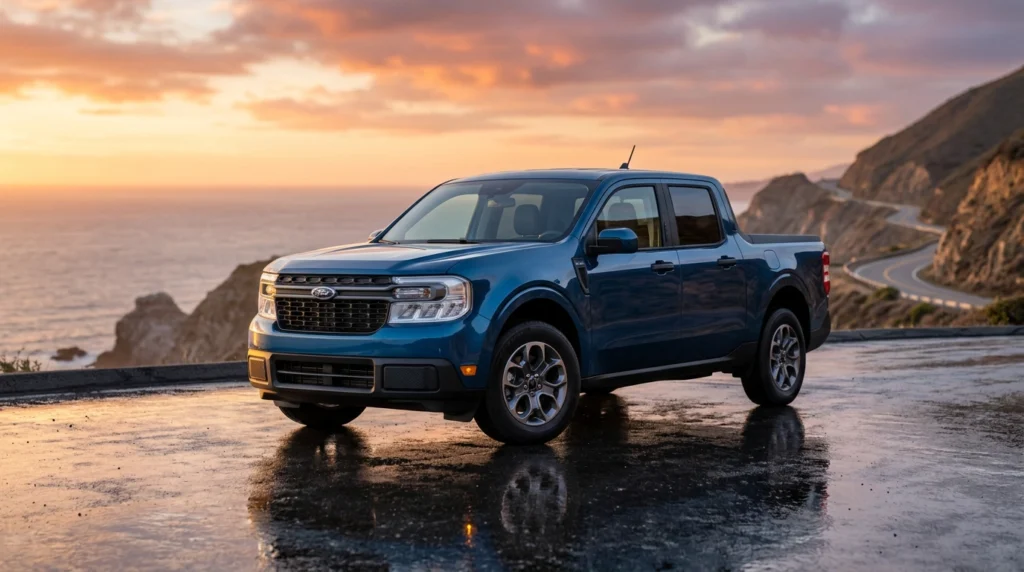
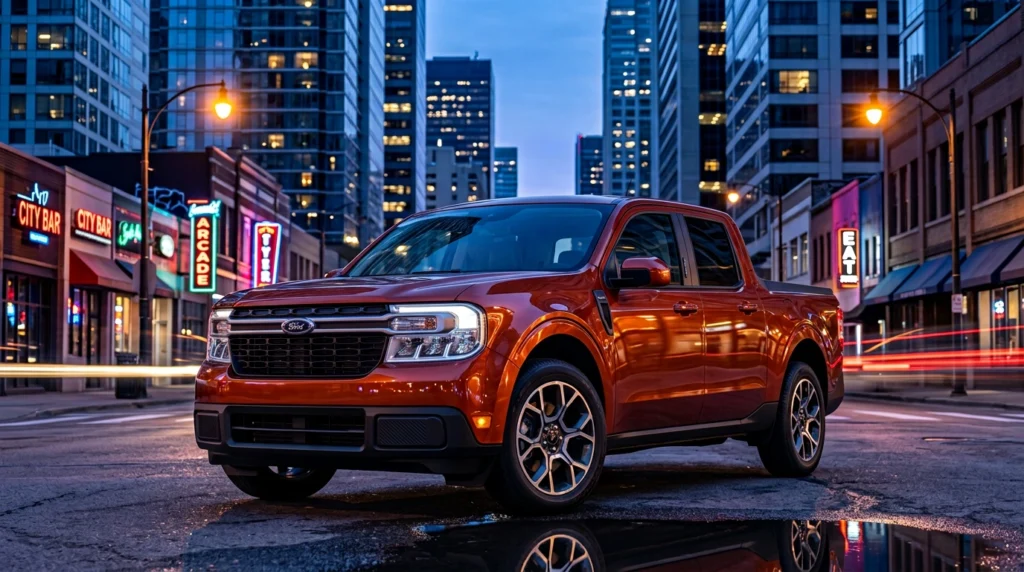
The Ford Maverick is a compact pickup truck, smaller and less expensive than the midsize Ford Ranger and dramatically smaller than the full-size F-150. It rides on a unibody platform shared with the Ford Bronco Sport and Escape, rather than the body-on-frame construction typical of most trucks.
That construction choice is central to what the Maverick is. Unibody design trades some maximum towing and payload capability for a smoother ride, tighter handling, and better everyday drivability — the kind of traits people associate with crossovers, not trucks.
Ford built the Maverick for buyers who want a functional bed without committing to a vehicle that dominates a parking space or the household budget. First-time truck buyers, small-space city dwellers, and commuters who occasionally need to haul something all fit the profile.
The standard hybrid powertrain is the other defining trait. Most compact and midsize trucks still run on gasoline alone, so a truck that can return close to 40 mpg in daily driving is a genuine departure from the norm. Between the size, the price, and the hybrid option, the Maverick occupies a niche that, until recently, didn’t really exist in the U.S. market.
History and Background
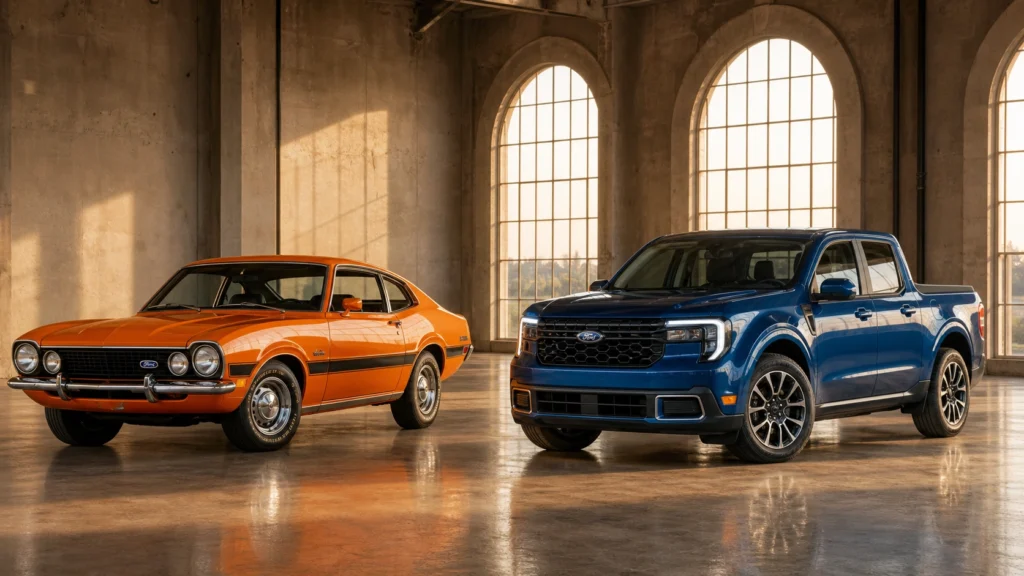
Ford revived the Maverick name — last used on a compact car sold from 1970 to 1977 — for its new compact pickup, unveiled in mid-2021 for the 2022 model year. The move came as Ford watched compact trucks disappear from American showrooms through the 1990s and 2000s, even as demand for practical, affordable vehicles never really went away.
The Ranger, meanwhile, had grown larger and pricier with each generation, leaving a gap between compact cars and midsize trucks. The Maverick was built specifically to fill it, using components shared with Ford’s crossover lineup to keep manufacturing costs, and therefore the sticker price, down.
Early demand outpaced Ford’s expectations, and waitlists stretched for months in the truck’s first couple of years on sale. A mid-cycle refresh brought styling updates and, notably, the addition of hybrid all-wheel drive — previously, hybrid buyers were limited to front-wheel drive only.
The Lobo trim arrived as a street-performance-oriented variant, joining the off-road-focused Tremor that had launched a year earlier. For 2026, the changes are evolutionary rather than revolutionary: new paint colors, a front-wheel-drive EcoBoost option that slightly undercuts hybrid pricing, and minor equipment shuffling across trims.
Design and Exterior
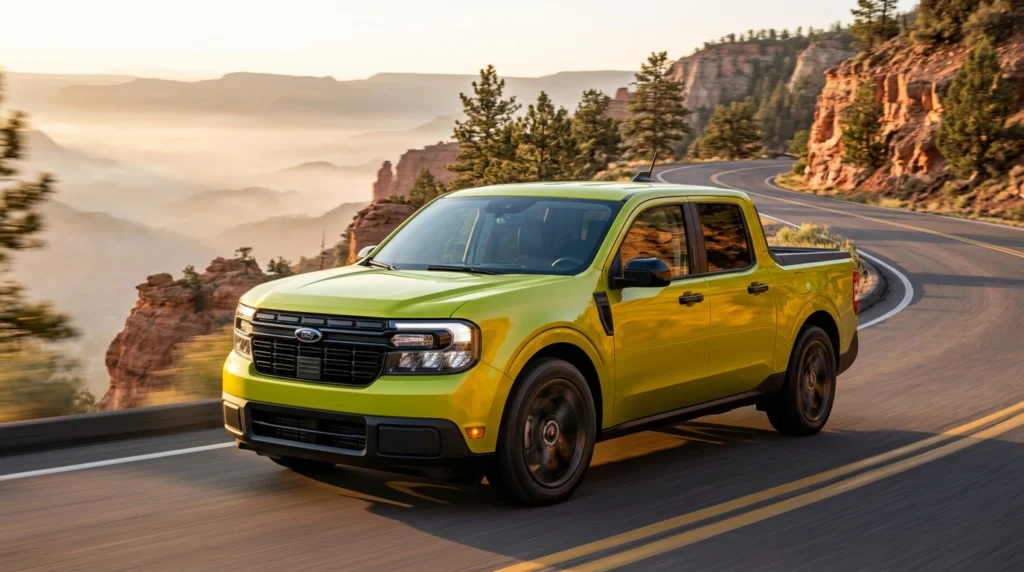
The Maverick’s styling leans utilitarian rather than flashy, with a squared-off hood, upright grille, and available LED lighting that give it a purposeful look without the aggressive front-end treatment some rivals favor. It reads as a small truck rather than a lifted crossover, which seems to be exactly the intent.
Where the exterior gets genuinely clever is the bed. Ford’s FLEXBED system includes pre-stamped slots sized for 2×4 and 2×6 lumber, letting owners build custom dividers, shelving, or tie-down points without drilling into the bed itself. A separately fused 12-volt circuit in the bed adds power for accessories or lighting.
The 4.5-foot bed is short compared to a full-size truck, but Ford designed around that limitation. With the tailgate down, a 4×8 sheet of plywood can rest flat, supported by the wheel wells, and an available bed extender stretches usable length to nearly six feet.
Trim-specific styling diverges more than you might expect from a compact truck. The Tremor gets a raised ride height, unique 17-inch wheels, orange accents, and underbody skid plates that visually signal its off-road intent. The Lobo goes the opposite direction, sitting lower with a wider stance, 19-inch wheels, and a model-specific grille that nods to tuned street trucks of decades past.
Day to day, the Maverick’s compact footprint is arguably its best design feature. At under 200 inches long and 72.6 inches wide, it fits into standard garage spaces and city parking spots that would swallow a Ranger or F-150 whole, without giving up a genuine pickup bed.
Interior and Technology
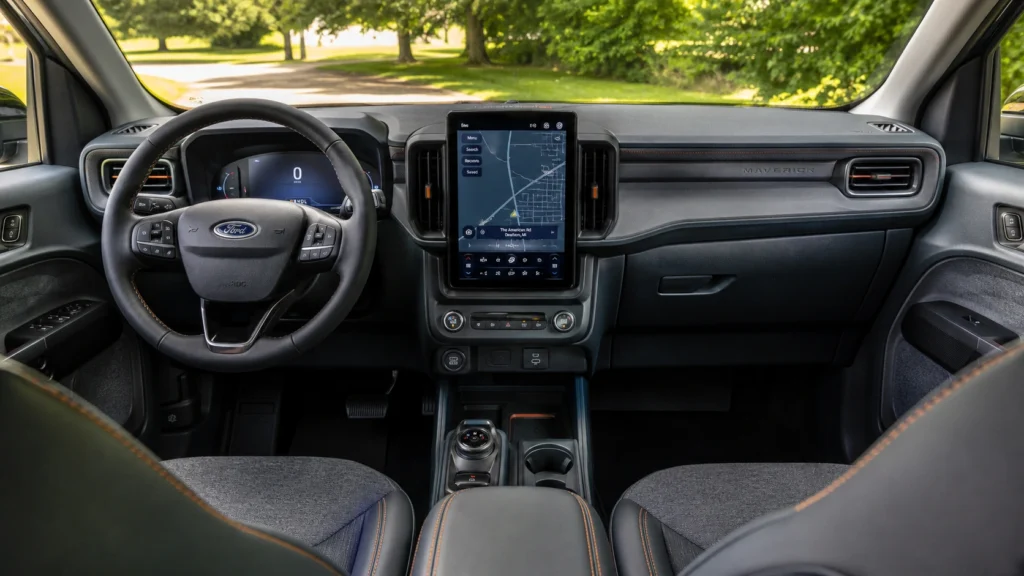
Step inside and the Maverick feels more like a modern crossover than a traditional work truck. Even the base XL trim comes standard with a 13.2-inch SYNC 4 touchscreen, wireless Apple CarPlay and Android Auto, a 5G modem, and cloud connectivity — features that used to be reserved for higher trims across the industry.
A one-year trial of Ford’s Connectivity Package adds integrated Google Maps, a built-in voice assistant, and a Wi-Fi hotspot supporting up to ten devices. For 2026, Ford removed the wireless charging pad from the lineup, so anyone who wants it will need to rely on a cabled connection instead.
Seating for five comes standard across every trim, with front legroom that’s genuinely comfortable for taller adults and rear-seat space that’s usable, if not class-leading. Under-seat storage bins in the rear make good use of space that would otherwise go to waste.
Materials scale up noticeably as you climb the trim ladder. XL and XLT trims use durable cloth upholstery suited to work-truck duty, while Lariat, Lobo, and Tremor switch to ActiveX synthetic leather — Ford doesn’t offer genuine leather on any Maverick trim, a deliberate choice given synthetic materials hold up better to temperature swings and heavy use.
On the technology side, Lariat adds a 360-degree camera system, adaptive cruise control, and a premium Bang & Olufsen audio system as standard equipment, along with Ford Co-Pilot360 Assist 2.0 and Pro Trailer Backup Assist. Whether the cabin feels like “a truck” is honestly debatable — it’s closer in character to the Escape or Bronco Sport, which is part of the Maverick’s appeal to buyers who don’t want a stripped-down work rig.
Engine and Performance
Ford offers two distinct powertrains across the Maverick lineup, and which one makes sense depends heavily on how the truck will actually be used.
2.5L Hybrid
The standard engine on XL, XLT, and Lariat trims pairs a 2.5-liter Atkinson-cycle four-cylinder with an electric motor for a combined 191 horsepower and 155 lb-ft of torque, routed through an eCVT (electronically controlled continuously variable transmission). It’s available with front-wheel drive or, on higher trims, all-wheel drive.
In everyday driving, the hybrid system shines in stop-and-go traffic, where the electric motor handles low-speed acceleration smoothly and regenerative braking recaptures energy that would otherwise be wasted. It’s not a quick truck by any measure, but it never feels underpowered for commuting, errands, or light hauling.
2.0L EcoBoost
The available 2.0-liter turbocharged four-cylinder makes 250 horsepower and 280 lb-ft of torque, paired with an 8-speed automatic transmission on most applications. It’s available on XL and XLT (now with a front-wheel-drive option for 2026) and standard on Lobo and Tremor.
Where the hybrid prioritizes efficiency, the EcoBoost prioritizes response. Independent testing has generally clocked the EcoBoost Maverick from 0-60 mph in the high-5-second to mid-7-second range depending on drivetrain and load, noticeably quicker than the hybrid. It’s the engine to choose for regular towing, frequent highway merging, or simply wanting more usable power in reserve.
Maverick Lobo
The Lobo swaps the standard 8-speed automatic for a 7-speed quick-shift transmission with paddle shifters, exclusive to this trim. A torque-vectoring rear drive unit, performance-tuned suspension, quick-ratio steering, and upgraded brakes work together to sharpen handling in a way no other Maverick trim attempts.
A dedicated Lobo drive mode adjusts throttle response, steering weight, and transmission behavior for a more engaging experience. It’s a genuinely different character from the rest of the lineup — less about capability, more about how the truck feels to drive.
Maverick Tremor
The Tremor takes the opposite approach, built specifically for off-road use. It pairs the EcoBoost engine with Ford’s Advanced 4WD system, a twin-clutch rear drive unit, off-road-tuned suspension, all-terrain tires, and underbody skid plates.
Trail Control functions like low-speed cruise control for rough terrain, letting the driver focus on steering while the truck manages throttle and braking. An electronic-locking rear differential and dedicated off-road drive modes round out a setup meant for trails and job sites rather than street performance — buyers shouldn’t expect Tremor and Lobo to overlap much in what they’re good at.
Fuel Economy and Ford Maverick MPG
The hybrid powertrain is where the Maverick separates itself from every other compact or midsize truck on sale. EPA estimates for the front-wheel-drive hybrid come in at 42 mpg city, 35 mpg highway, and 38 mpg combined — figures that rival many compact sedans, let alone trucks.
Adding all-wheel drive to the hybrid trims those numbers slightly, to an estimated 40 city / 34 highway / 37 combined on XL and XLT, and 39/32/36 on the AWD-only Lariat Hybrid. It’s a small efficiency penalty for meaningfully better traction in poor weather.
The EcoBoost engine, as expected, trades efficiency for power. Front-wheel-drive EcoBoost models are EPA-rated around 23 city / 30 highway / 26 combined, dropping to roughly 22/29/25 with all-wheel drive. The Lobo comes in around 21 city / 30 highway / 24 combined, and the Tremor, weighed down by its off-road hardware, lands near 21 city / 27 highway / 23 combined.
Real-world driving tends to track fairly close to EPA estimates for the hybrid, particularly in city and suburban conditions where the electric motor does the most work. Highway-heavy commutes will see a smaller efficiency advantage over the EcoBoost, since hybrid systems generally shine brightest at lower, more variable speeds.
For urban commuters and anyone logging a lot of stop-and-go miles, the hybrid’s efficiency advantage is substantial enough to offset a higher purchase price fairly quickly at the pump.
Ford Maverick Towing and Payload Capacity
Towing and payload numbers vary meaningfully by trim and equipment, so it’s worth being precise here rather than quoting a single headline figure.
Standard towing capacity across most Maverick configurations is 2,000 pounds — enough for a small utility trailer, a couple of jet skis, or a light cargo trailer. Stepping up to the available 4K Tow Package, which adds a trailer brake controller, a Class III hitch with wiring, and upgraded cooling, raises maximum towing to 4,000 pounds on XL, XLT, and Lariat trims.
Notably, the Lobo and Tremor cap out at 2,000 pounds of towing regardless of equipment, since their Advanced 4WD hardware is tuned for traction and off-road capability rather than trailer duty. Buyers who need both a specialty trim and serious towing capacity won’t find that combination in the current Maverick lineup.
Payload capacity — the weight the truck can carry in the cab and bed combined — tops out around 1,500 pounds depending on configuration. That’s enough for several sheets of plywood, a riding mower, camping gear for a family trip, or a decent haul of mulch and landscaping materials.
For context: a small trailer carrying a couple of motorcycles or a pop-up camper generally falls within the base 2,000-pound rating. Larger boats, enclosed trailers, or anything approaching 4,000 pounds will require the tow package and careful attention to the door-jamb rating for the specific truck being loaded.
Ford Maverick Specifications and Dimensions
| Specification | Ford Maverick |
|---|---|
| Length | Approximately 199.8 in (200.7 in on Tremor) |
| Width | 72.6 in |
| Height | Approximately 68.7 in; varies by trim (69.5 in Tremor; lower on Lobo) |
| Wheelbase | 121.1 in |
| Ground Clearance | 8.1 in (hybrid) / 8.3 in (EcoBoost); higher on Tremor |
| Bed Length | 4.5 ft (54.4 in) |
| Bed Width (at wheel wells) | 42.6 in |
| Cargo Volume | Approximately 33.3 cu. ft. |
| Seating Capacity | 5 |
| Curb Weight | Roughly 3,540–3,840 lbs, varies by configuration |
| Towing Capacity | 2,000 lbs standard; up to 4,000 lbs with 4K Tow Package (XL/XLT/Lariat) |
| Payload Capacity | Up to 1,500 lbs |
| Fuel Tank | Approximately 13.8 gallons |
Dimensions shift slightly by trim: Tremor’s off-road suspension adds height and length over standard models, while Lobo’s lowered stance actually reduces overall height. Always check the specific configuration against the window sticker for a given truck.
Ford Maverick Top Speed and Acceleration
Ford doesn’t publish an official top-speed figure for the Maverick, and given the truck’s role as a practical commuter rather than a performance vehicle, that’s not surprising. Independent outlets that have tested the truck haven’t reported a definitive top speed either, so treat any specific number you see elsewhere with skepticism.
Acceleration is a different story, since multiple publications have run instrumented 0-60 mph tests. Results cluster in the high-5-second to upper-7-second range depending on engine, drivetrain, and payload: EcoBoost models have run as quick as the high-5-second range unloaded, while hybrid models have generally landed in the high-6-second to high-7-second range. The Lobo, with its quicker-shifting transmission, has posted some of the fastest recorded times in the lineup.
In everyday terms, the hybrid feels adequate rather than eager — instant electric torque off the line masks some of the four-cylinder’s modest output, but merging onto a fast-moving highway requires planning ahead. The EcoBoost feels noticeably more confident in the same scenario, with enough mid-range torque to pass without much drama.
The Tremor, weighed down by off-road hardware and taller all-terrain tires, is the least quick of the EcoBoost-equipped trims, though its personality is built around trail capability rather than straight-line speed anyway.
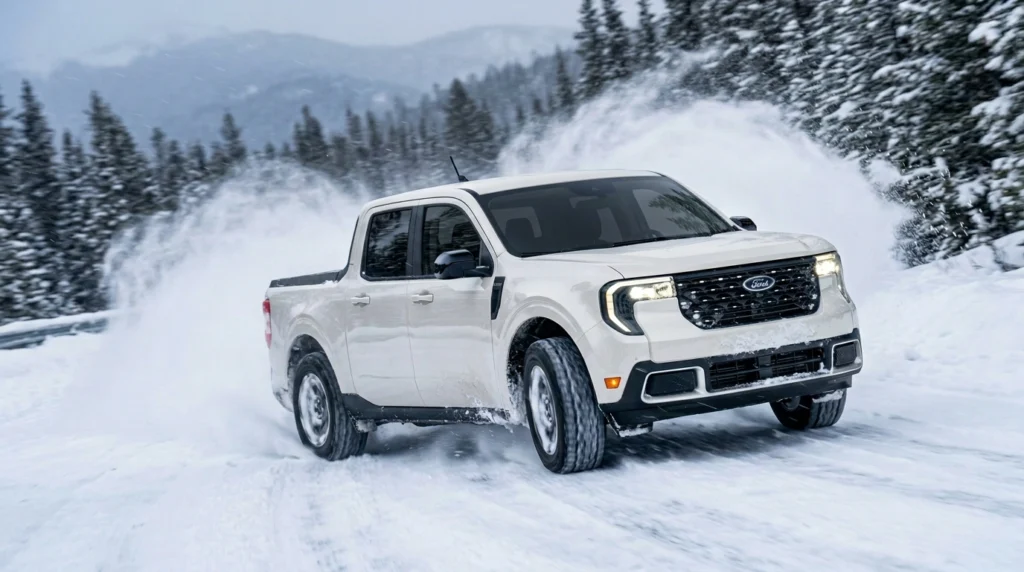
Ford Maverick Price and Trims
Pricing spans a wide range once you account for engine, drivetrain, and specialty trims — a loaded Lobo or Tremor can cost nearly as much as a base Ranger.
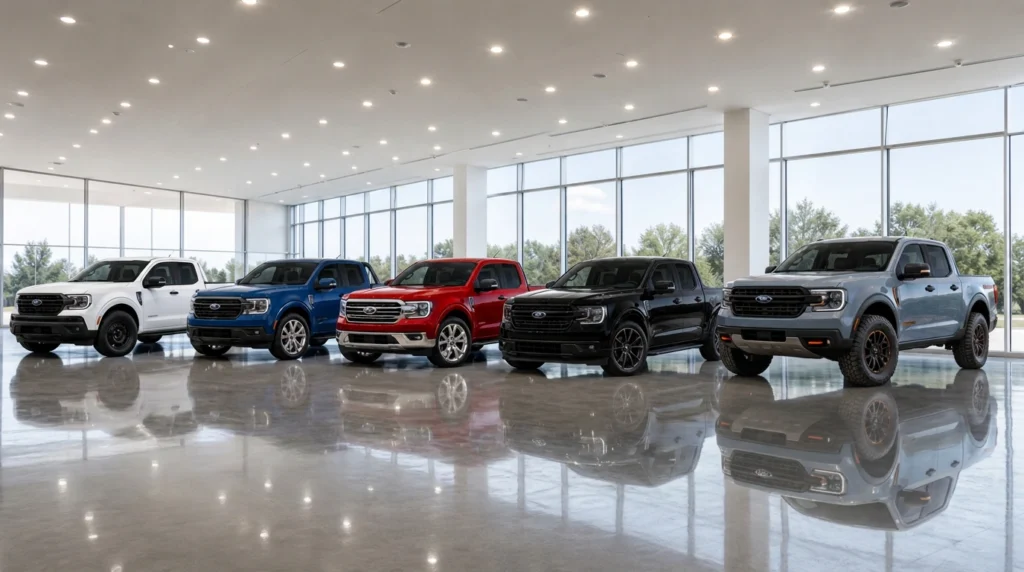
Ford Maverick XL
The entry point into Maverick ownership, XL still includes the 13.2-inch touchscreen, LED headlights, and the standard hybrid powertrain (with a new front-wheel-drive EcoBoost option for 2026 that slightly undercuts hybrid pricing). It’s aimed squarely at budget-conscious buyers who want genuine truck utility without extras they won’t use.
Ford Maverick XLT
Stepping up to XLT, starting around $30,645, adds upgraded cloth upholstery, painted aluminum wheels, and additional convenience features. It’s consistently the volume seller in the lineup, and for good reason — it strikes a sensible balance between price and equipment. The XLT is also where buyers can add the FX4 Off-Road Package or the Luxury Package.
Ford Maverick Lariat
Lariat brings the Maverick’s most complete feature set: standard all-wheel drive, 19-inch wheels, ActiveX synthetic leather, adaptive cruise control, a 360-degree camera, and premium audio. Pricing lands in the high-$30,000 range. Buyers who want the hybrid’s efficiency without giving up creature comforts should look here first.
Ford Maverick Lobo
Lobo occupies its own niche, prioritizing on-road handling and street-inspired styling over outright capability. With EcoBoost power, a quick-shift transmission, and torque-vectoring AWD, it’s aimed at drivers who want a Maverick that feels genuinely different to drive, not just to look at.
Ford Maverick Tremor
At the top of the lineup, Tremor is built for buyers who actually plan to go off-road — hunters, farmers, and weekend trail enthusiasts. Its off-road suspension, locking differential, and Trail Control system deliver real capability, though at a price that approaches midsize-truck territory.
Best trim for most buyers: For the majority of shoppers, the XLT with the standard hybrid strikes the best balance of price, efficiency, and features. It avoids the base trim’s sparse equipment list while staying well under Lariat pricing, and the hybrid powertrain’s fuel savings compound nicely over years of ownership. Buyers who tow regularly should strongly consider adding the 4K Tow Package regardless of trim.
Ford Maverick Pros and Cons
Pros
- Compact dimensions make it easy to park and maneuver
- Standard hybrid powertrain delivers class-leading fuel economy
- FLEXBED system adds genuine practicality to a short bed
- Multiple specialized trims (Lobo, Tremor) broaden the truck’s appeal
- Competitive towing capability for its size and price point
- Strong base technology, even on the entry-level XL
Cons
- Maximum towing capacity trails every midsize truck rival
- Lobo and Tremor sacrifice tow rating for their specialty hardware
- Some desirable safety and comfort features require higher trims
- Bed is notably shorter than a traditional midsize truck
- Configuration complexity makes apples-to-apples comparisons harder than it should be
Ford Maverick vs. Competitors
The Maverick essentially created its own category, but it doesn’t compete in a vacuum. The Hyundai Santa Cruz is its most direct rival, while the Ford Ranger and Honda Ridgeline represent a step up in size, price, and capability.
| Feature | Ford Maverick | Hyundai Santa Cruz | Ford Ranger | Honda Ridgeline |
|---|---|---|---|---|
| Starting Price | ~$28,145 | ~$31,350 | ~$33,550 | ~$41,000 |
| Engine Options | 2.5L hybrid / 2.0L turbo-4 | 2.5L / 2.5L turbo | 2.3L turbo-4 / 2.7L turbo-V6 | 3.5L V6 only |
| Hybrid Option | Yes (standard) | No | No | No |
| Horsepower | 191–250 hp | 191–281 hp | 270–315 hp | 280 hp |
| Fuel Economy (combined) | Up to 38 mpg | Up to 25 mpg | ~20–23 mpg | ~20–21 mpg |
| Towing Capacity | Up to 4,000 lbs | Up to 5,000 lbs | Up to 7,500 lbs | Up to 5,000 lbs |
| Payload | Up to 1,500 lbs | Up to 1,411 lbs | Up to 1,788 lbs | Up to ~1,583 lbs |
| Bed/Cargo Utility | 4.5-ft FLEXBED, 33.3 cu ft | 4.3-ft bed, ~27 cu ft | 5–6 ft steel bed | In-bed trunk, dual-action tailgate |
| Best For | Fuel economy and value | Style and turbo power | Towing and off-road capability | Comfort and ride quality |
For fuel economy, nothing here touches the Maverick hybrid. For towing, the Ranger’s body-on-frame construction and available V6 give it a clear edge, with a max rating nearly double the Maverick’s. Off-road, the Ranger and Maverick Tremor both offer genuine capability, though the Ranger’s larger size and available Raptor variant push further into serious terrain.
For comfort and refinement, the Ridgeline’s unibody platform and standard V6 make it the smoothest, quietest option of the four — it just costs considerably more to get there. For urban use and daily-driver practicality, the Maverick’s smaller footprint and lower price make it hard to beat. There’s no single winner across every category; the right choice depends on which of these priorities matters most.
The Ford Maverick has full build-and-price tools if you want to compare exact configurations and current local pricing.
Ford Maverick Reliability and Common Problems
Reliability data for the Maverick tells a mixed but improving story. Early model years, particularly 2022 through 2024, saw a notable number of recalls, including a Hybrid Powertrain Control Module software issue that could cause the truck to unexpectedly shift into neutral, a rearview camera software glitch that could leave the display blank or frozen, and a separate recall addressing a potential crack in the optional engine block heater.
NHTSA complaint data compiled by third-party trackers has shown powertrain- and brake-related complaints running somewhat above the compact-truck segment average for those early model years, though these trackers vary in methodology and shouldn’t be treated as a definitive verdict. Several independent sources note that 2024 and 2025 model years appear to show fewer reported issues than the truck’s first couple of years on sale, suggesting Ford has addressed at least some early quality concerns through running production changes.
It’s also worth noting that the Maverick is still a relatively young nameplate, having launched for the 2022 model year, so long-term reliability data — the kind that comes from vehicles racking up 100,000-plus miles — simply doesn’t exist yet in the way it does for established trucks like the Ridgeline or Tacoma.
On the safety side, the Maverick earns a “Good” IIHS rating in the updated side-impact test and “Superior” marks for its standard front crash-prevention system in vehicle-to-vehicle testing. It scored “Marginal” in the IIHS’s more demanding moderate-overlap frontal test, a result that applies across the 2022-2026 model range and has kept the truck out of IIHS’s Top Safety Pick category under the institute’s revised 2026 criteria. Standard Ford Co-Pilot360 technology includes automatic emergency braking, blind-spot monitoring with cross-traffic alert, and automatic high beams across every trim.
Given the mixed early recall history, a pre-purchase inspection and a review of open recalls by VIN are sensible steps for anyone considering a used Maverick, particularly from the 2022 or 2023 model years.
Who Should Buy the Ford Maverick?
The Maverick makes the most sense for a fairly specific but sizable group of buyers. Daily commuters who want genuine fuel savings without sacrificing utility are the clearest fit, especially anyone spending significant time in stop-and-go traffic where the hybrid system does its best work.
First-time truck buyers who find full-size pickups intimidating to park, drive, or afford will likely appreciate the Maverick’s smaller footprint and lower starting price. The same goes for small families who want occasional truck-bed utility without committing to a vehicle built primarily for towing or hauling.
Small-business owners, landscapers, and DIY enthusiasts who need to move materials but don’t require maximum payload or towing numbers will find the Maverick’s bed genuinely useful, particularly with the FLEXBED system’s customization options. Outdoor enthusiasts drawn to the Tremor’s trail capability, or drivers who simply want something that looks and drives differently than every other truck on the road via the Lobo, both have dedicated trims built around those interests.
Buyers who regularly tow heavy trailers, haul maximum payloads, or need serious off-road articulation beyond what the Tremor offers should look at the Ranger or a full-size truck instead — the Maverick’s unibody construction and capped towing ratings simply aren’t built for that kind of duty cycle.
Conclusion
The Ford Maverick remains one of the more interesting vehicles in Ford’s lineup precisely because it doesn’t try to be everything. It won’t out-tow a Ranger, and it won’t match a full-size truck’s payload, but for buyers who want genuine pickup utility wrapped in a smaller, more efficient, and more affordable package, few vehicles do it better.
The standard hybrid powertrain remains the Maverick’s signature strength, delivering fuel economy that no rival compact or midsize truck can match. The FLEXBED system, wide range of trims, and surprisingly strong base technology round out a genuinely thoughtful package. Its main limitations — a shorter bed, capped towing on specialty trims, and an early recall history worth researching before buying used — are worth weighing honestly rather than glossing over.
Commuters, first-time truck buyers, and anyone who wants pickup practicality without pickup-sized compromises should put the Maverick near the top of their list. Buyers whose priorities center on maximum towing or heavy-duty capability will be better served by stepping up to the Ranger or a full-size truck instead. Either way, test-driving both the hybrid and EcoBoost versions before deciding is worth the extra hour at the dealership — the two feel different enough that the choice genuinely matters.
Frequently Asked Questions (FAQs)
For its intended use — commuting, light hauling, and occasional truck-bed utility — yes, the Maverick is well regarded. It’s less suited to heavy towing or serious off-road work compared with larger, body-on-frame trucks.
The 2026 Maverick starts around $28,145–$28,840 including destination charge for the base XL trim, climbing to roughly $40,000–$41,000 for a well-equipped Tremor. Exact pricing varies by dealer, region, and available incentives.
The standard 2.5L hybrid produces 191 horsepower combined, while the available 2.0L EcoBoost turbo engine makes 250 horsepower.
The hybrid front-wheel-drive model is EPA-rated at up to 42 mpg city and 38 mpg combined. The EcoBoost engine returns roughly 23–26 mpg combined depending on drivetrain and trim.
Standard towing capacity is 2,000 pounds. With the available 4K Tow Package on XL, XLT, or Lariat trims, maximum towing rises to 4,000 pounds. Lobo and Tremor are capped at 2,000 pounds.
Early model years saw a higher-than-average number of recalls and complaints, though 2024 and 2025 models appear improved. As a relatively new nameplate, long-term reliability data is still limited.
For most buyers, the XLT hybrid offers the best balance of price, features, and fuel economy. Buyers prioritizing luxury should look at Lariat; those wanting off-road capability or sportier handling should consider Tremor or Lobo, respectively.
Neither is objectively better — it depends on priorities. The Hybrid delivers significantly better fuel economy and is ideal for commuting. The EcoBoost offers stronger acceleration and is the better choice for regular towing or buyers who want more power in reserve.