Ferrari LaFerrari: The Hybrid Hypercar That Redefined Maranello’s Flagship Formula
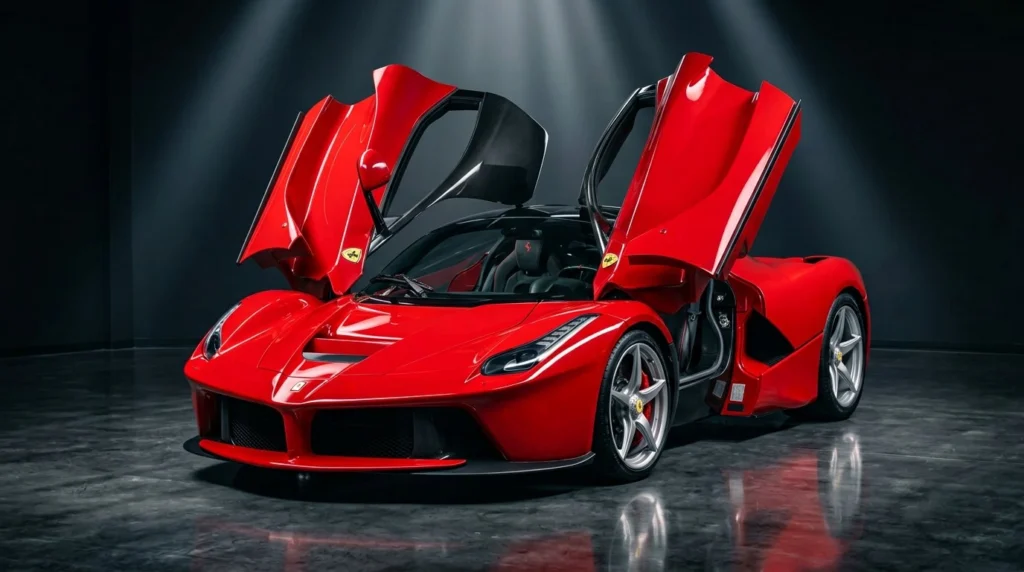
The Ferrari LaFerrari occupies a strange position in automotive history: it’s simultaneously a technological experiment and one of the most emotionally charged road cars Ferrari has ever built. Unveiled in 2013, it paired a screaming naturally aspirated V12 with a Formula 1-derived hybrid system, something that seemed almost contradictory at the time. Ferrari wasn’t chasing efficiency. It was chasing more power, more precision, and a sharper connection between driver and machine.
The Ferrari LaFerrari arrived as the successor to the Enzo, joining a lineage of Ferrari flagship cars built in strictly limited numbers for the brand’s most committed clients. It wasn’t just a faster Ferrari. It represented the company’s first serious attempt at hybrid performance technology on a road car, borrowing energy-recovery concepts straight from its F1 program.
More than a decade later, the Ferrari LaFerrari still generates conversation among collectors, engineers, and enthusiasts. Its combination of rarity, technical ambition, and old-school V12 character has kept it relevant even as Ferrari has moved toward newer hybrid architectures.
Quick Specifications
| Specification | Ferrari LaFerrari |
|---|---|
| Engine | 6.3-liter naturally aspirated V12 |
| Hybrid System | HY-KERS |
| Combined Power | Approximately 950 hp (963 CV) |
| Torque | Over 900 Nm combined |
| Transmission | 7-speed dual-clutch |
| Drivetrain | Rear-wheel drive |
| Body Construction | Carbon-fiber monocoque |
| Production | 499 coupes (plus ~210 open-top Aperta models) |
| Top Speed | Over 350 km/h / 217 mph |
What Is Ferrari LaFerrari?
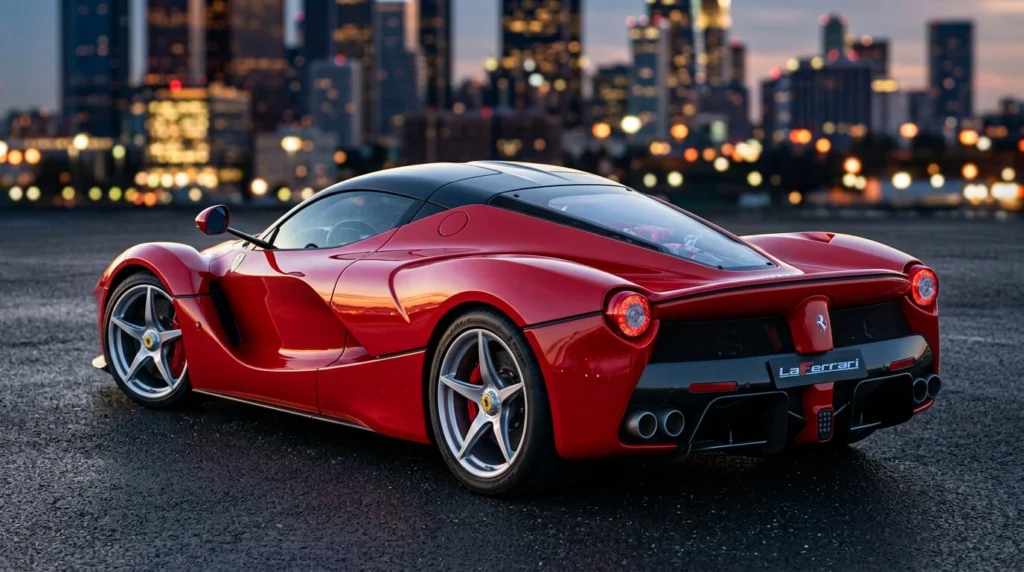
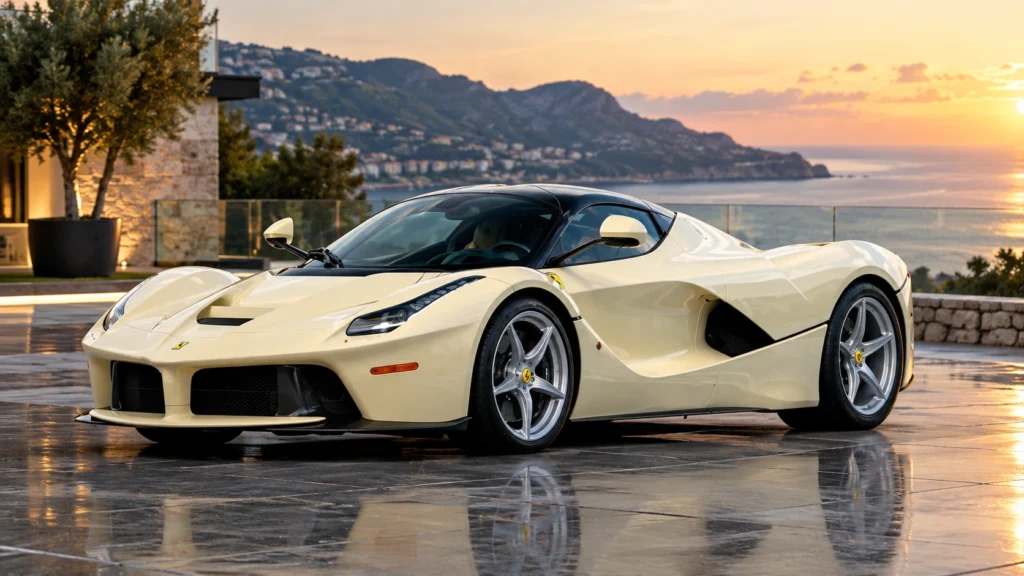
At its core, the Ferrari LaFerrari is a limited-production, mid-engine hybrid hypercar built to sit at the very top of Ferrari’s road-car range. Ferrari doesn’t release a car like this often. It’s reserved for moments when the company wants to showcase everything it currently knows about performance engineering, packaged into a single, uncompromising object.
The name itself, translating loosely to “The Ferrari,” tells you how the company viewed the project. This wasn’t meant to be one model among many. It was meant to represent the definitive expression of what Ferrari could build with no real budget or engineering constraints holding it back.
The LaFerrari followed a familiar pattern in Ferrari’s history: every couple of decades, the brand builds a flagship car that pushes far beyond its regular lineup. The Enzo held that role before it, and the LaFerrari picked up where the Enzo left off, adding a Ferrari LaFerrari hybrid powertrain that no previous flagship had attempted.
What separates a car like this from Ferrari’s regular production models isn’t just power. It’s the level of engineering investment per unit. With only a few hundred examples built, Ferrari could justify technology that would be far too costly to deploy across a mainstream model line.
The Ferrari LaFerrari V12 remained the emotional centerpiece, but the addition of electric assistance marked a turning point. It signaled that Ferrari saw hybrid technology not as a compromise, but as a tool for extracting more performance from an engine already near the limits of naturally aspirated design. That’s part of why the Ferrari LaFerrari hybrid hypercar concept still resonates with enthusiasts who assumed electrification and Ferrari’s traditional character were at odds.
History and Background
Ferrari’s habit of building extreme, limited-run flagship models goes back further than most people realize. The F40 arrived in 1987 as a raw, analog interpretation of speed. The F50 followed in the mid-1990s with a Formula 1-derived V12 mounted as a structural element of the chassis. Then came the Enzo in 2002, a car that introduced more advanced aerodynamics and electronic driver aids while still keeping the formula relatively conventional.
By the time Ferrari began developing the LaFerrari’s Ferrari LaFerrari history in the early 2010s, the engineering conversation inside Maranello had shifted. Formula 1 had already adopted energy-recovery systems, and Ferrari’s road-car engineers wanted to explore whether that same philosophy could translate to a street car without diluting the character people expected from a flagship Ferrari.
The result was Ferrari’s first application of HY-KERS, a hybrid system directly influenced by the Kinetic Energy Recovery Systems used in F1 at the time. Rather than using electrification purely to reduce emissions, Ferrari applied it to fill in torque gaps and sharpen throttle response, particularly in the mid-range where a high-revving V12 typically needs to build momentum.
The LaFerrari made its public debut at the 2013 Geneva Motor Show, arriving alongside two other hybrid hypercars that would later be nicknamed the “Holy Trinity” of the era: the McLaren P1 and the Porsche 918 Spyder. Each brand approached hybridization differently, which made 2013 something of a turning point for how the industry thought about extreme performance.
Ferrari’s decision to stick with a naturally aspirated V12, rather than moving to forced induction like some competitors, reflected the brand’s long-standing relationship with high-revving engines. The electric motor was there to complement that character, not replace it.
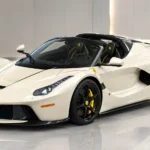
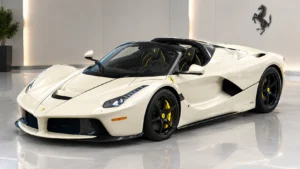
Production ran from 2013 through 2015 for the coupe, with Ferrari building 499 examples. In 2016, to mark the company’s 70th anniversary, Ferrari introduced the LaFerrari Aperta, an open-top variant with a removable roof. Around 210 Apertas were eventually built, slightly more than Ferrari’s original planning figures, due to strong demand among existing clients.
Design and Exterior
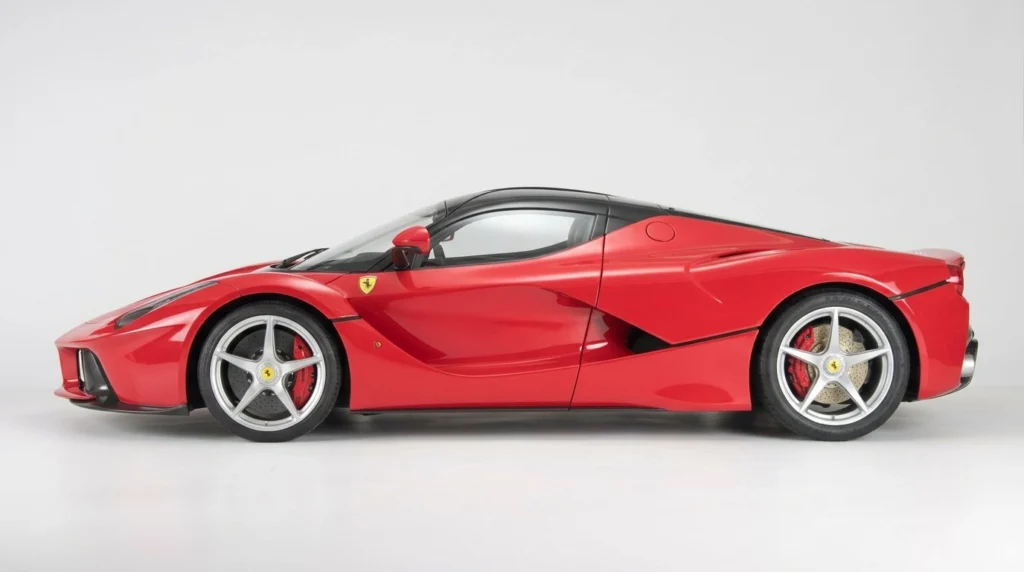
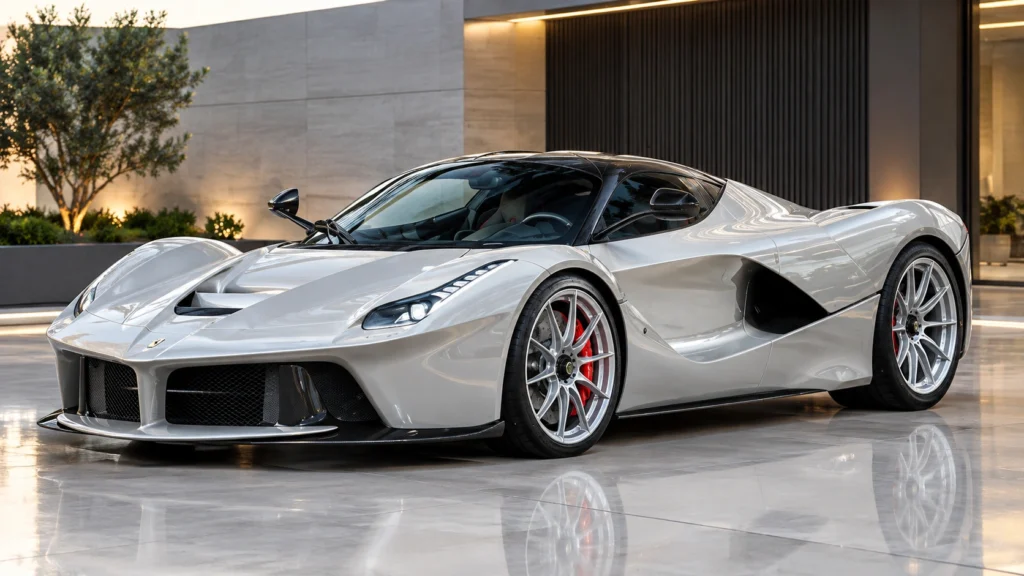
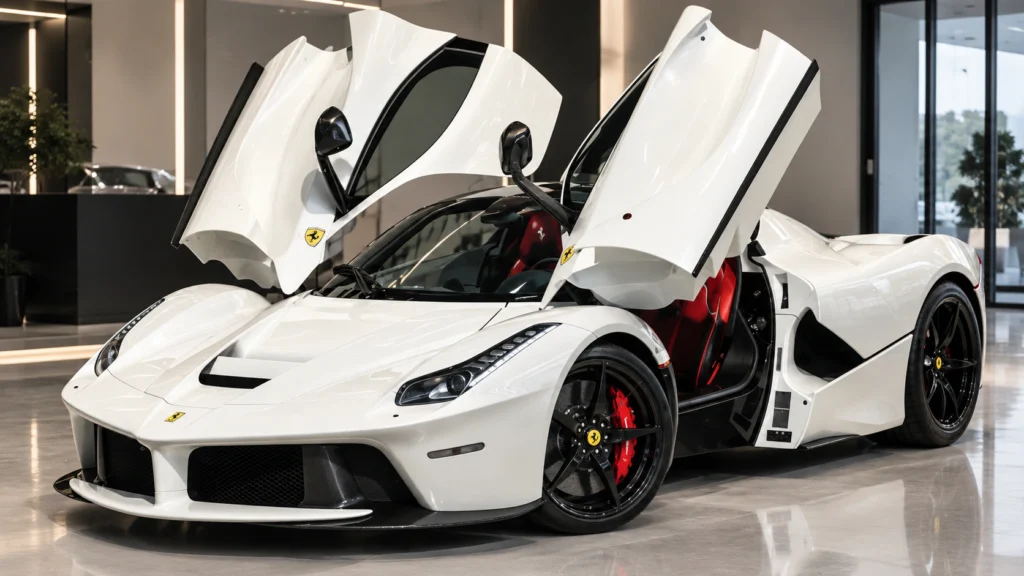
The Ferrari LaFerrari exterior was shaped almost entirely by aerodynamic requirements, and that shows the moment you look at the car in profile. The proportions are long and low, with a cabin pushed rearward to maximize front-end downforce and airflow toward the rear diffuser.
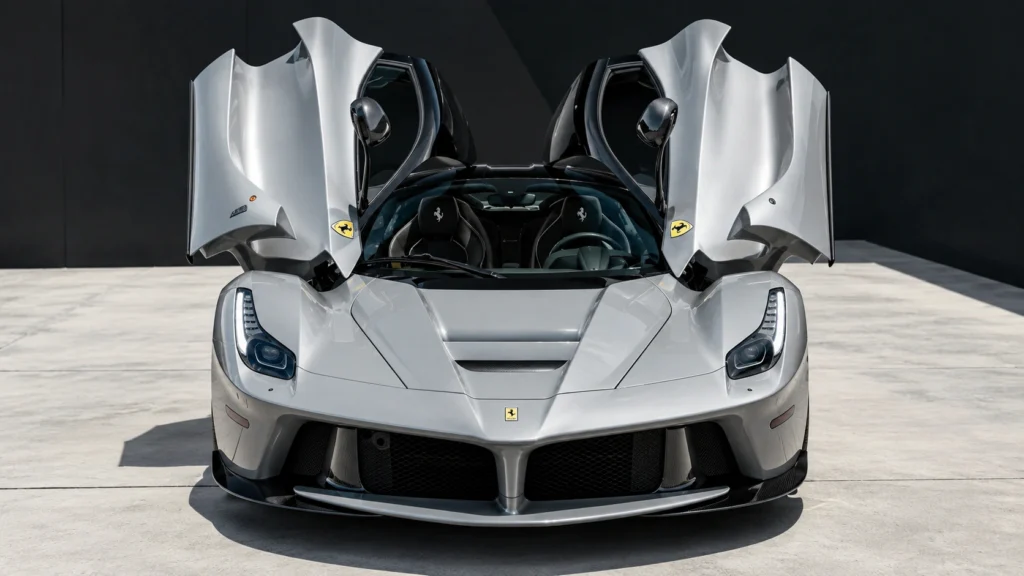
The front end uses a low, aggressive nose section with pronounced vertical fins that channel air around the front wheels rather than letting it create turbulence. The headlights are narrow and integrated tightly into the bodywork, avoiding anything that might disrupt airflow along the car’s leading edge.
Ferrari’s grille treatment here is minimal compared to the brand’s front-engine cars, since a mid-engine layout doesn’t need the same volume of cooling air directed straight through the nose. Instead, most of the intake work happens through side scoops and underbody channels.
The side profile is dominated by a dramatically sculpted lower section, with pronounced air channels running along the doors and into the rear haunches. These aren’t decorative. They feed the radiators and help manage the turbulent air generated by the front wheels before it reaches the rear of the car.
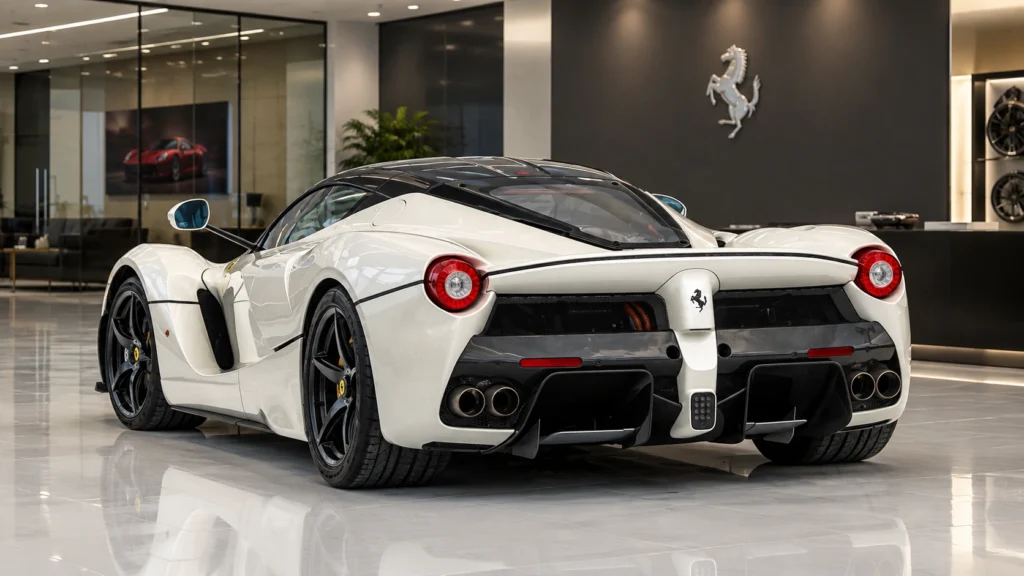
At the back, the Ferrari LaFerrari design leans heavily into function. A large rear diffuser works alongside a deployable rear spoiler, part of the car’s active aerodynamics system. This is one of the more technical aspects of the exterior, so it’s worth explaining simply: active aerodynamics means the car can physically change the shape or angle of certain aero elements depending on speed, braking, and cornering load, rather than relying on a fixed, static design.
At lower speeds, the rear spoiler stays retracted to reduce drag. Under hard braking or high-speed cornering, it extends to increase downforce and stability. This kind of adaptive system is far more common in Formula 1 than in road cars, and its presence here reflects how directly Ferrari’s F1 aerodynamics group was involved in the project.
The car’s Ferrari LaFerrari carbon fiber construction extends well beyond the chassis. Body panels, aerodynamic elements, and much of the interior structure use various grades of carbon fiber, chosen specifically for different strength and flex requirements across the car.
Even small details, like the exhaust layout positioned high and central at the rear, were dictated by airflow management rather than visual drama. The wheel design similarly prioritizes brake cooling and reduced turbulence over ornamentation.
Every exterior surface earns its shape through function first. That’s the philosophy that separates this car’s design language from something styled primarily to look aggressive.
Interior and Technology
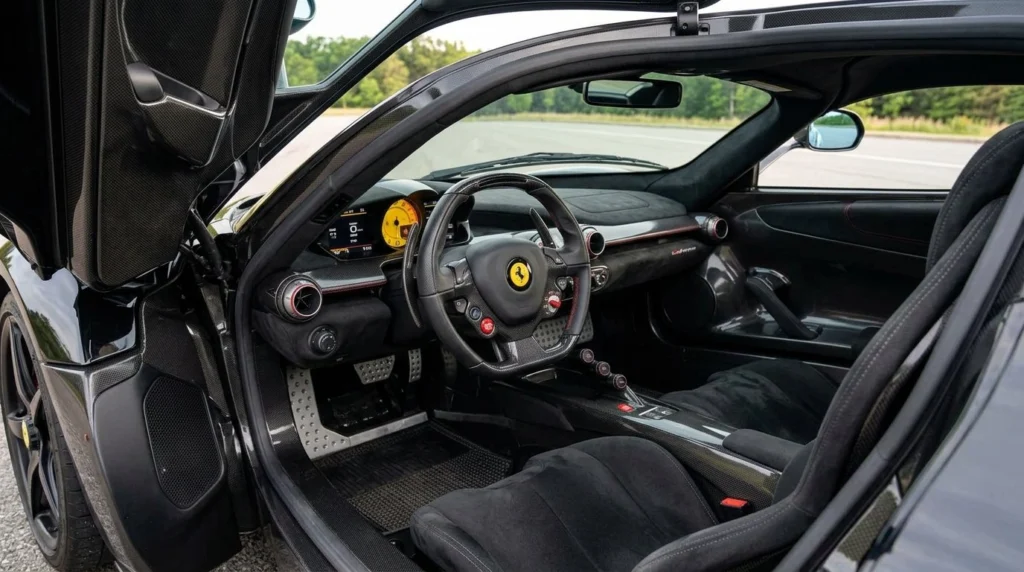
Step inside the Ferrari LaFerrari interior, and the first thing you notice is how little separates the driver from the mechanical experience of the car. The seats are fixed directly to the carbon-fiber tub instead of using a traditional sliding seat mechanism. To adjust the driving position, you move the steering wheel and pedals instead of the seat itself.
This decision saves weight and reduces mechanical complexity, both priorities for a car built around performance rather than everyday comfort. It also puts the driver in a lower, more reclined position, closer to what you’d experience in a race car than a conventional road car.
The steering wheel borrows heavily from Ferrari’s Formula 1 designs, integrating multiple controls directly onto its face, including drive-mode selection and indicators. The instrument cluster is fully digital, prioritizing information relevant to spirited driving, such as rev range and gear position, over traditional analog styling.
Carbon fiber appears throughout the cabin, from trim panels to structural elements, while Alcantara covers the seats and other touchpoints where grip and a tactile feel matter more than plush comfort. Ferrari kept the use of heavier materials deliberately minimal.
Visibility is reasonable for a car this low, though rear visibility is limited, as is common with mid-engine hypercars of this era. Passenger space is tight but functional. This was never meant to be a car built around cabin comfort, and Ferrari made no attempt to disguise that.
Cabin technology stays relatively restrained compared to modern Ferrari models. There’s no attempt to load the car with entertainment features. Every design decision inside reflects the same principle guiding the rest of the car: reduce weight, remove distraction, and keep the driver focused on the mechanical experience.
The balance Ferrari struck here is worth noting. This is still a Ferrari, so materials feel genuinely premium. But luxury takes a back seat to lightweight construction and functional clarity, and the cabin makes that priority obvious from the moment you sit down.
Engine and Performance
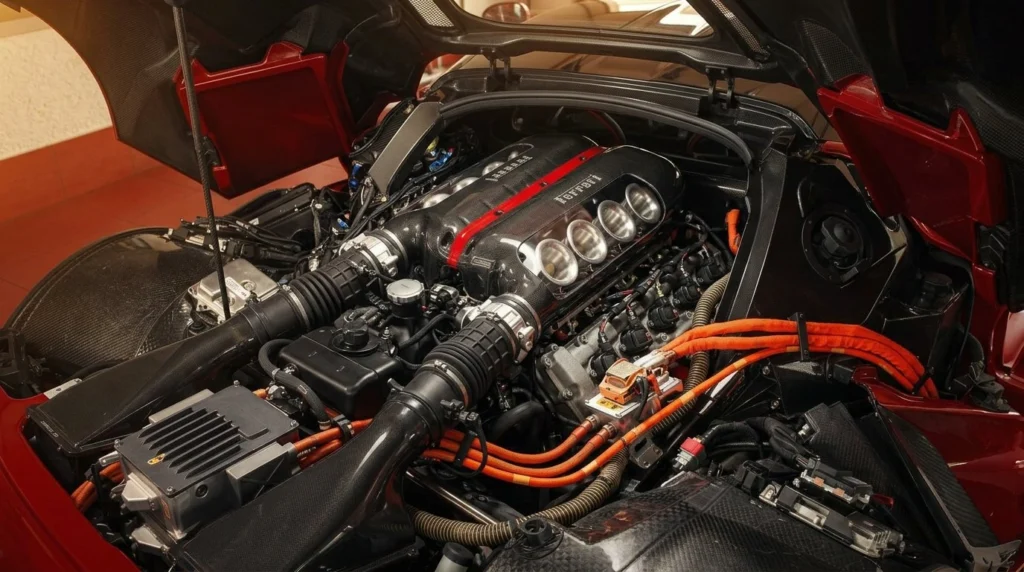
This is where the Ferrari LaFerrari engine earns its reputation. At the center of the car sits a 6.3-liter naturally aspirated V12, producing approximately 800 CV (roughly 789 horsepower) on its own, revving to a genuinely high 9,250 rpm. For an engine of this displacement, that’s an unusually high specific output, a reflection of Ferrari’s decades of experience refining large-displacement V12s for both road and track use.
Working alongside the combustion engine is Ferrari’s HY-KERS system, the brand’s first hybrid application in a road car. The name stands for Hybrid Kinetic Energy Recovery System, and the underlying concept borrows directly from Formula 1’s KERS technology, which captures energy typically lost during braking and reuses it to boost acceleration.
In simple terms, the Ferrari LaFerrari electric motor doesn’t replace the V12. It fills in the gaps. Naturally aspirated engines build power progressively as revs climb, which can create a slight lag in outright response at lower rpm. The electric motor, rated at roughly 120 kW (about 161 horsepower), delivers instant torque exactly in that window, smoothing out the power delivery and adding urgency to the car’s throttle response.
Combined, the Ferrari LaFerrari horsepower output reaches approximately 950 hp, with Ferrari’s own figures citing 963 CV. Combined torque exceeds 900 Nm. It’s worth noting that this is not simply the sum of each unit’s peak torque figure, since the two power sources peak at different points in the rev range and don’t necessarily combine at their absolute maximums simultaneously.
Power reaches the rear wheels through a 7-speed dual-clutch transmission, tuned for rapid shifts under hard acceleration. Ferrari chose to keep the car rear-wheel drive rather than adopting all-wheel drive, a decision that kept weight down and preserved the kind of direct, old-school handling balance associated with Ferrari’s V12 flagships.
Why did Ferrari commit to hybrid technology at all, given the brand’s strong identity around naturally aspirated engines? The answer lies in what the electric motor made possible without sacrificing that identity. Rather than downsizing the engine or adding turbochargers to hit a power target, Ferrari kept the V12 essentially uncompromised and used electrification purely as a performance supplement.
That’s a meaningfully different approach from how most manufacturers use hybrid systems, and it’s part of why the Ferrari LaFerrari is frequently cited as a bridge between Ferrari’s traditional engineering values and its more recent hybrid road cars.
Specifications
| Specification | Detail |
|---|---|
| Engine | 6.3-liter (6,262 cc) V12 |
| Configuration | 65-degree V12, naturally aspirated |
| Hybrid System | HY-KERS |
| V12 Power | Approximately 800 CV (789 hp) @ 9,000 rpm |
| Electric Motor Output | 120 kW (approximately 161 hp) |
| Combined Power | Approximately 950 hp (963 CV) |
| Combined Torque | Over 900 Nm |
| Transmission | 7-speed dual-clutch |
| Drivetrain | Rear-wheel drive |
| Body Construction | Carbon-fiber body panels |
| Chassis | Carbon-fiber monocoque |
| Approximate Dry Weight | Around 1,255 kg (figures vary slightly by measurement standard) |
| Seating Capacity | 2 |
| Production | 499 coupes; approximately 210 Aperta open-top models |
| Top Speed | Over 350 km/h (217+ mph) |
| 0–100 km/h | Under 3 seconds (Ferrari-quoted) |
| 0–200 km/h | Under 7 seconds |
| Fuel Type | Premium gasoline |
A note on measurement standards: Ferrari’s official figures use CV (a metric horsepower unit) alongside conventional horsepower conversions. When you see slightly different numbers across sources, it’s often because outlets convert CV to hp using different rounding conventions, not because the underlying performance has changed.
Top Speed and Acceleration
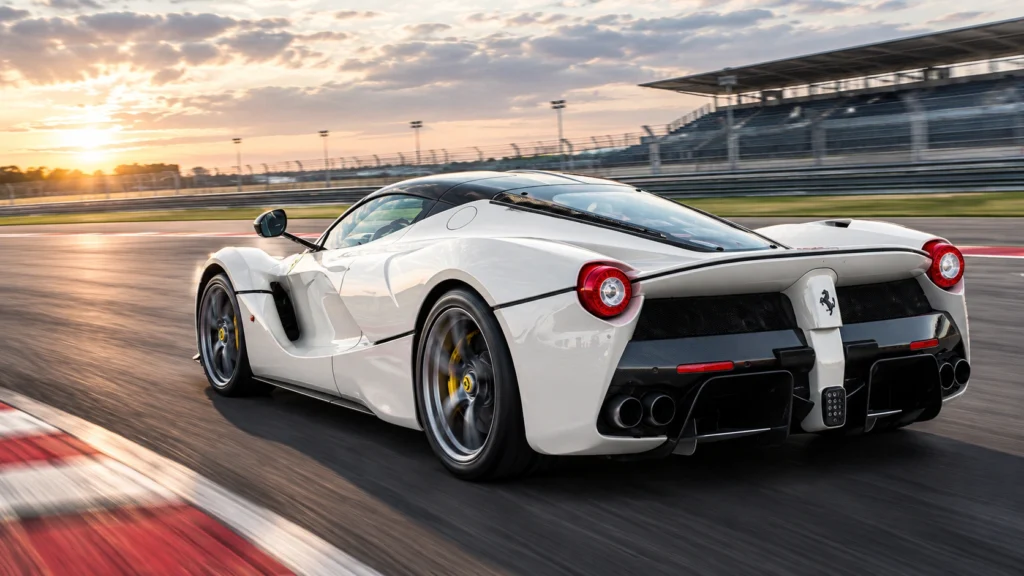
Ferrari’s official figures put 0–100 km/h at under 3 seconds, with 0–200 km/h arriving in under 7 seconds and 0–300 km/h in around 15 seconds. Ferrari LaFerrari top speed exceeds 350 km/h (217 mph), making it one of the fastest cars the company had built up to that point.
If you’ve seen different 0–60 mph figures elsewhere, that’s not unusual. Several independent outlets and dealer specification sheets have cited numbers in the 2.4 to 2.8-second range for 0–60 mph, faster than Ferrari’s own conservative factory claim. This kind of gap between manufacturer figures and independent testing is common across the industry. Factory numbers are often generated under standardized, repeatable conditions with built-in margin, while independent tests can benefit from optimal track surfaces, tire temperatures, and launch techniques that push closer to a car’s absolute limit.
Several factors help explain why the LaFerrari achieves the acceleration numbers it does. The instant torque delivery from the electric motor removes the brief hesitation that naturally aspirated engines can show off the line, particularly before the V12 reaches its stronger mid-range. Rear-wheel drive, paired with a wide contact patch and sophisticated traction control, allows the car to put that power down effectively despite lacking the additional grip an all-wheel-drive system provides.
The car’s power-to-weight ratio also plays a significant role. With extensive carbon-fiber construction keeping mass in check relative to nearly 950 horsepower, the LaFerrari carries less weight per unit of power than many rivals of the same era.
Aerodynamic efficiency matters just as much at higher speeds. The car’s active aerodynamic elements are tuned to minimize drag when accelerating in a straight line, only adding downforce when cornering or braking loads call for it. That balance is part of why the LaFerrari can post genuinely quick times without sacrificing high-speed stability.
Price
The question “How much is a Ferrari LaFerrari?” doesn’t have a single clean answer, and understanding why requires separating two very different numbers: the original list price and today’s collector-market value.
When new, the Ferrari LaFerrari carried a list price of approximately $1.4 million in the United States, translating to roughly €1.3 million in Europe at the time. That was the original MSRP before options, and Ferrari’s allocation process meant most buyers were personally selected clients rather than open retail customers.
Because production was capped at 499 coupes, and clients were required to already own multiple Ferraris to even be considered, the car was scarce from day one. That scarcity, combined with strong ongoing demand, pushed resale values well beyond the original sticker price almost immediately.
Today, Ferrari LaFerrari coupes typically trade in the multi-million-dollar range, with specific prices varying significantly depending on mileage, service history, specification, and provenance. The rarer Aperta variant generally commands a further premium over the coupe due to its lower production numbers. Some individual sales, particularly of exceptionally low-mileage or unique-specification cars, have reached considerably higher figures at auction.
It’s worth being cautious about treating any single reported sale price as representative of the model’s overall market value. Collector-car pricing can swing significantly based on factors like documented ownership history, originality, color combination, and even the reputation of the selling channel. A well-documented, low-mileage example with desirable specification will consistently outperform a higher-mileage car with a less complete history, even if both are technically the same model year.
Pros and Cons
| Pros | Cons |
|---|---|
| Naturally aspirated V12 | Extremely expensive |
| Advanced hybrid technology | Very limited availability |
| Exceptional performance | Limited practicality |
| Carbon-fiber construction | High maintenance complexity |
| Exclusive production | Collector-market prices can be extremely high |
| Advanced aerodynamics | Not designed as an everyday family car |
The Ferrari LaFerrari strengths and weaknesses are really two sides of the same coin. Everything that makes it extraordinary as a piece of engineering, its exclusivity, its complexity, its extreme performance ceiling, also makes it impractical, costly to maintain, and difficult to simply acquire. That trade-off is by design rather than accident.
Comparison With Competitors
The Ferrari LaFerrari arrived within months of two other hybrid hypercars, the McLaren P1 and the Porsche 918 Spyder, and enthusiasts have compared the three ever since. Each took a distinctly different engineering approach to solving a similar problem: how to use electrification to push performance further without abandoning driver engagement.
| Feature | Ferrari LaFerrari | McLaren P1 | Porsche 918 Spyder |
|---|---|---|---|
| Engine | 6.3L naturally aspirated V12 | 3.8L twin-turbo V8 | 4.6L naturally aspirated V8 |
| Hybrid System | HY-KERS (single electric motor) | Electric motor + battery | Two electric motors (plug-in) |
| Power | Approx. 950 hp combined | Approx. 903 hp combined | Approx. 875–887 hp combined |
| Drivetrain | Rear-wheel drive | Rear-wheel drive | All-wheel drive |
| Production | 499 coupes (+ ~210 Aperta) | 375 units | 918 units |
| Top Speed | Over 217 mph | 217 mph (limited) | Approx. 211–214 mph |
| Character | High-revving V12, analog feel | Turbocharged, F1-inspired | Plug-in hybrid, electric-capable |
Ferrari LaFerrari vs McLaren P1 is largely a debate between two different definitions of drama. The P1 uses forced induction to reach big numbers from a smaller engine, favoring immediacy and low-end torque. The LaFerrari instead keeps its V12 naturally aspirated, favoring a higher-revving, more theatrical power delivery that builds toward the top of the rev range.
Ferrari LaFerrari vs Porsche 918 Spyder highlights an even bigger philosophical gap. Porsche built a genuine plug-in hybrid, complete with real electric-only range and all-wheel drive for maximum traction. Ferrari’s HY-KERS system, by contrast, has no plug and no meaningful electric-only mode. It exists purely to support the combustion engine, not to offer an efficiency-focused driving mode.
None of these differences make one car objectively superior to the others. They reflect three manufacturers with different engineering priorities and different definitions of what a hypercar should feel like from behind the wheel. Weight, aerodynamic strategy, and drivetrain layout all shape how each car behaves at the limit, and that’s a bigger factor in how they’re remembered than horsepower figures alone.
Collectibility today generally favors all three cars strongly, though rarity plays a role. With only 499 coupes built, the Ferrari LaFerrari sits at the more exclusive end of the trio, ahead of the P1’s 375 units but behind the Porsche’s larger 918-unit run in a different way, since Porsche’s higher volume hasn’t dampened enthusiasm for the 918 Spyder either.
Who Should Buy It?
Realistically, the Ferrari LaFerrari was never intended for a broad audience, and that hasn’t changed with time. It appeals most directly to serious Ferrari collectors who already understand the brand’s history and want a car that represents a specific technological turning point.
Hypercar collectors more broadly, particularly those building out a set spanning the “Holy Trinity” era, often view the LaFerrari as a cornerstone piece. Enthusiasts who specifically value naturally aspirated V12 engines also gravitate toward it, since this represents one of the last flagship Ferraris built around that architecture before the brand shifted toward smaller, turbocharged, and electrified powertrains.
Buyers with a genuine interest in Ferrari’s technological history, rather than just outright performance figures, tend to appreciate the LaFerrari’s significance as the company’s first hybrid road car. And naturally, collectors focused specifically on limited-production models find the sheer scarcity appealing on its own.
On the other hand, this isn’t the right car for buyers looking for an everyday sports car. Families needing practicality won’t find much use for a two-seat hypercar with a fixed seating position and minimal storage. Drivers prioritizing comfort over outright engagement are likely to find the driving position and ride quality demanding rather than relaxing.
It’s also not a fit for buyers working with a conventional supercar budget, given both the scarcity-driven pricing and the specialized costs of ownership. And buyers who specifically prefer newer plug-in or fully electric performance cars may find the LaFerrari’s purely performance-oriented hybrid system less relevant to their priorities.
Ownership of a car like this extends well beyond the purchase price. Specialized servicing is required, given the complexity of the hybrid system and the V12’s high-revving nature. Insurance costs reflect both the car’s value and its performance capability. Storage needs are more particular than a typical sports car, and tire wear can be significant given the performance envelope. The hybrid battery system also requires monitoring specific to Ferrari’s own service protocols. Most owners rely on dedicated Ferrari specialists rather than general high-performance shops for this reason.
Full technical details, official specifications, and historical documentation on the model are available through Ferrari, which remains the most reliable source for confirming manufacturer-stated figures.
Conclusion
The Ferrari LaFerrari represents a specific moment when Ferrari chose to answer a difficult engineering question rather than simply chase bigger numbers. Instead of abandoning the naturally aspirated V12 that defines so much of the brand’s identity, Ferrari built a hybrid system designed to enhance it, borrowing directly from lessons learned in Formula 1.
That decision shaped everything else about the car: its design, driven almost entirely by aerodynamic necessity; its stripped-back interior, prioritizing driver connection over comfort; and its limited production, which turned scarcity into part of the car’s identity rather than a side effect of it.
More than a decade after its debut, the LaFerrari still holds a distinct place in Ferrari’s history. It wasn’t the fastest hypercar ever built, and it won’t be the last Ferrari flagship to push boundaries. But it captured a specific transition point between traditional V12 performance and the hybrid era that followed, and that combination is part of why it remains so closely studied by collectors and engineers alike.
Frequently Asked Questions (FAQs)
The Ferrari LaFerrari is a limited-production hybrid hypercar introduced in 2013 as the successor to the Ferrari Enzo. It combines a naturally aspirated V12 with Ferrari’s HY-KERS hybrid system, representing the brand’s first hybrid application in a road car.
The original list price was approximately $1.4 million when new. Today’s collector-market values are considerably higher and vary significantly based on condition, mileage, specification, and provenance, particularly between the coupe and the rarer Aperta variant.
The combined output from the V12 engine and electric motor is approximately 950 hp, with Ferrari’s own figures citing 963 CV.
It uses a 6.3-liter naturally aspirated V12 producing roughly 800 CV on its own, paired with an electric motor as part of the HY-KERS hybrid system.
Ferrari’s official figures cite a top speed above 350 km/h (217 mph), with 0–100 km/h achieved in under 3 seconds. Some independent sources report slightly quicker acceleration figures, which is typical when comparing factory claims to real-world testing.
Ferrari built 499 coupes between 2013 and 2015, followed by approximately 210 open-top Aperta models between 2016 and 2018.
Yes. It was Ferrari’s first hybrid road car, using the HY-KERS system to pair a naturally aspirated V12 with an electric motor purely for performance purposes, not fuel efficiency or electric-only driving.
Given its limited production, historical significance as Ferrari’s first hybrid flagship, and strong ongoing demand, it’s widely regarded as a significant collector car. As with any collectible vehicle, value depends heavily on condition, documentation, and market timing.