Mercedes-Benz C-Class: A Complete 2026 Review, Specs, and Buying Guide
The Mercedes-Benz C-Class has spent decades doing a difficult job well: making a compact sedan feel like a proper Mercedes. For 2026, that job hasn’t gotten any easier, with rivals from BMW and Audi sharpening their own game every year. Yet the C-Class holds its ground by leaning into what Mercedes does best — a calm, well-built cabin, a wide spread of powertrains, and a design language borrowed from cars costing twice as much. This article walks through what the 2026 C-Class actually offers, from the everyday C 300 to the 671-horsepower AMG C 63 S E Performance, so you can decide whether it deserves a spot on your shortlist.
Quick Specifications
| Specification | Mercedes-Benz C-Class (2026, US) |
|---|---|
| Vehicle Type | Compact luxury sedan |
| Model Year | 2026 |
| Engine Options | 2.0L turbo inline-4 mild hybrid (C 300); 2.0L turbo inline-4 mild hybrid (AMG C 43); 2.0L turbo inline-4 plug-in hybrid (AMG C 63 S E Performance) |
| Transmission | 9G-TRONIC 9-speed automatic (all variants) |
| Drivetrain | Rear-wheel drive standard on C 300; 4MATIC all-wheel drive standard on C 300 4MATIC, AMG C 43, and AMG C 63 S E Performance |
| Horsepower | 255 hp (C 300) to 416 hp (AMG C 43) to 671 combined hp (AMG C 63 S E Performance) |
| Torque | 295 lb-ft (C 300, plus up to 148 lb-ft electric boost) to 752 lb-ft combined (AMG C 63 S E Performance) |
| 0–60 mph | ~5.8–6.0 sec (C 300) to 3.1 sec (AMG C 63 S E Performance, independently tested) |
| Fuel Economy | 25/35 mpg city/highway (C 300 RWD) to 19/27 mpg (AMG C 43) |
| Seating Capacity | 5 |
| Starting Price (US) | $49,650 MSRP (C 300) up to roughly $88,000 (AMG C 63 S E Performance) |
| Cargo Capacity | 11.6 cu ft (sedan, all trims) |
Figures above reflect US-market Mercedes-Benz C-Class Sedan pricing and specifications. Output, fuel economy, and equipment vary by trim, drivetrain, and market, and are detailed further in the sections below.
What Is the Mercedes-Benz C-Class?
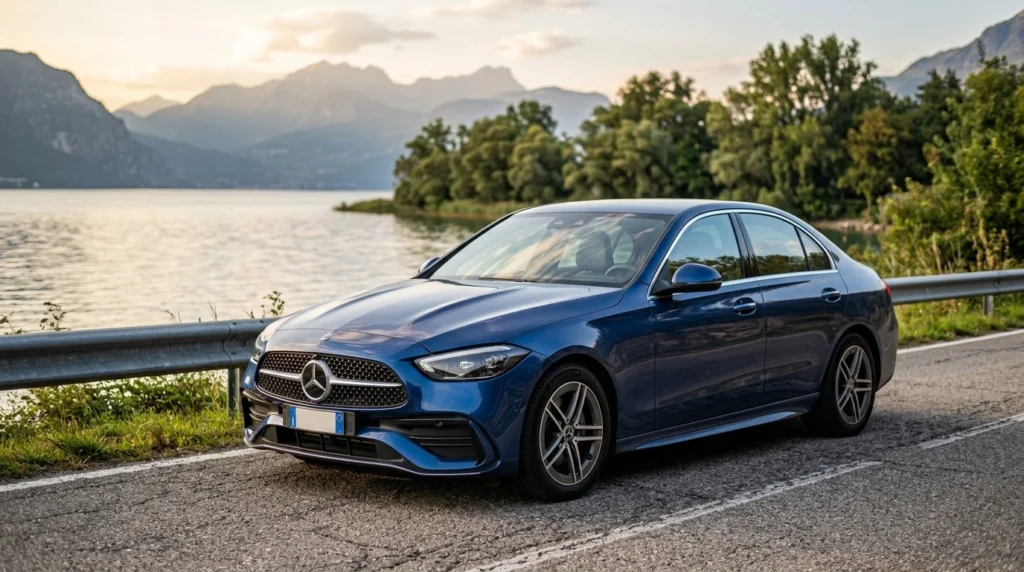
The Mercedes-Benz C-Class is the brand’s entry point into three-pointed-star ownership, sitting below the mid-size E-Class and above the smaller CLA. It’s sold in the US strictly as a four-door sedan, and it exists to answer one question: can a compact car feel genuinely upscale without the price tag of a flagship? For most trims, the answer is yes.
The C-Class sedan targets a broad but specific type of buyer — professionals who want a badge that signals success, empty-nesters downsizing from a larger luxury car, and enthusiasts who want a taste of AMG performance without committing to a six-figure sports sedan. Its most direct rivals are the BMW 3 Series and the Audi A5 (which now effectively replaces the old A4 in Audi’s US lineup), along with secondary competitors like the Genesis G70 and Lexus IS.
What makes the C-Class important to Mercedes-Benz isn’t just sales volume, though it is one of the brand’s higher-volume nameplates. It’s also a proving ground: features that debut in the Mercedes-Benz C-Class, from MBUX voice control to driver-assistance software, often trickle down from bigger Mercedes models first before becoming standard lower in the range. That trickle-down effect is a big part of why the Mercedes-Benz C-Class punches above its price bracket.
History and Background
The Mercedes-Benz C-Class name dates back to 1993, when Mercedes-Benz split its compact sedan off from the “190” naming scheme it had used since the 1980s and gave it real identity as an entry point to the brand. Early Mercedes-Benz C-Class generations were solid, if conservative, competing more on badge prestige than outright dynamism.
The car matured considerably over subsequent generations. Diesel and four-cylinder engines became more efficient, AMG performance variants grew from niche curiosities into halo models people specifically cross-shopped against BMW’s M3, and interior quality climbed steadily until Mercedes could credibly claim its compact sedan felt like a shrunken S-Class.
The current-generation Mercedes-Benz C-Class, which arrived for the 2022 model year and carries into 2026 with running updates rather than a ground-up redesign, represents the biggest single leap in the nameplate’s history. Every engine now uses some form of electrification, the interior adopted the vertical touchscreen and digital gauge cluster first seen on the S-Class, and Mercedes leaned hard into software-driven features like voice control and over-the-air updates. Compared with Mercedes-Benz C-Class models from even a decade ago, the 2026 car is quieter, more efficient, and dramatically more connected — even if some longtime owners miss the simpler switchgear of previous generations.
Design and Exterior
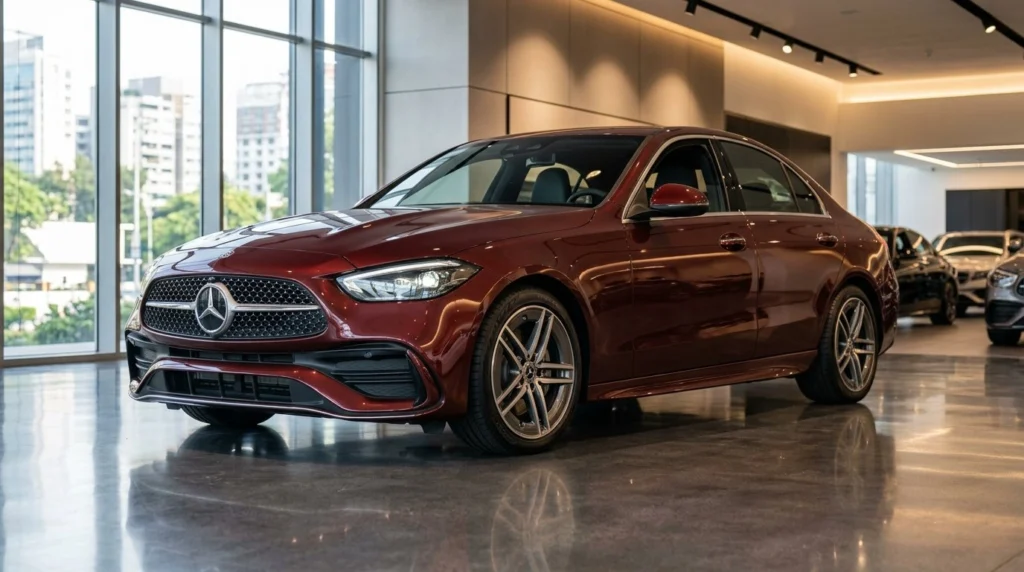
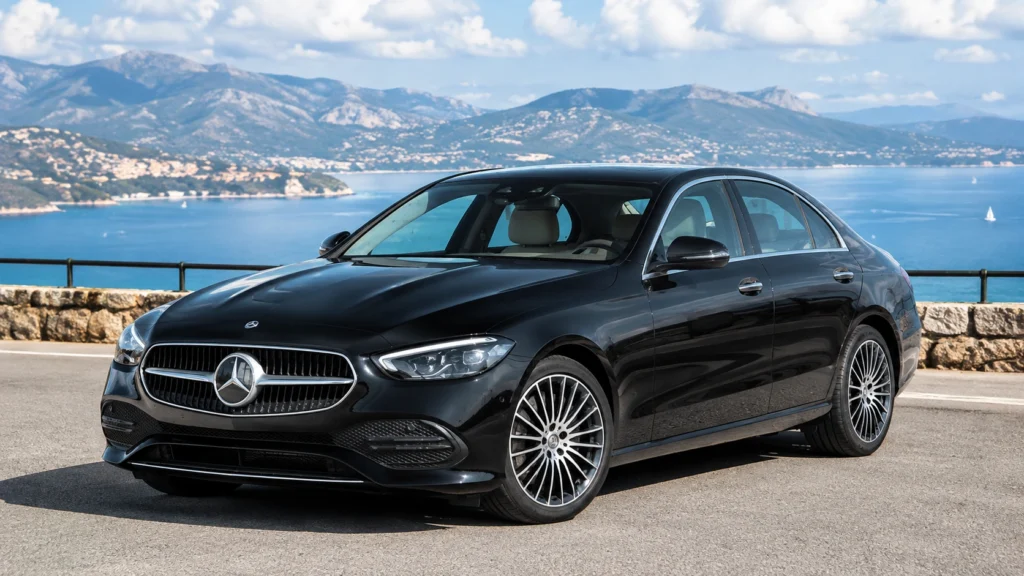
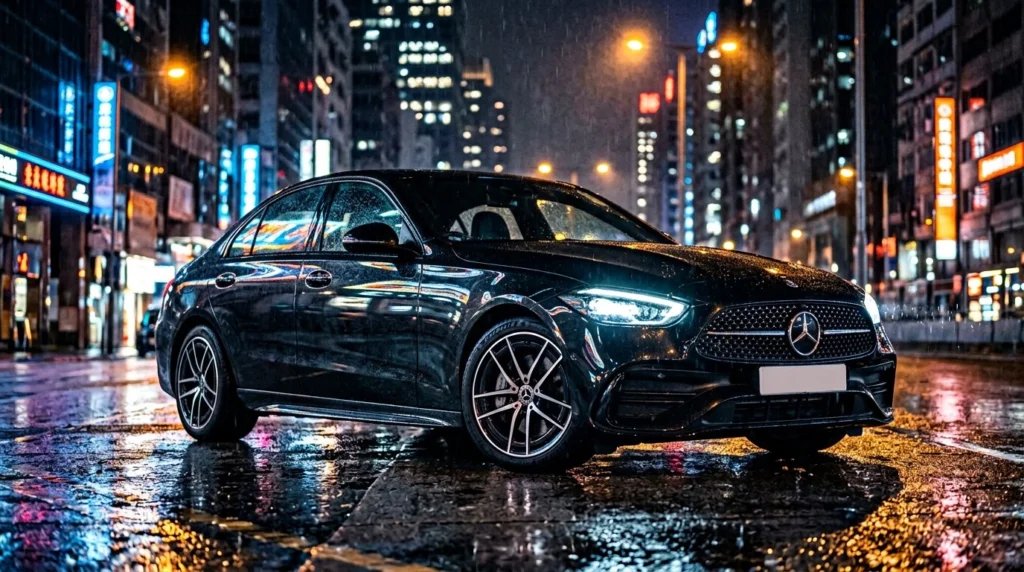
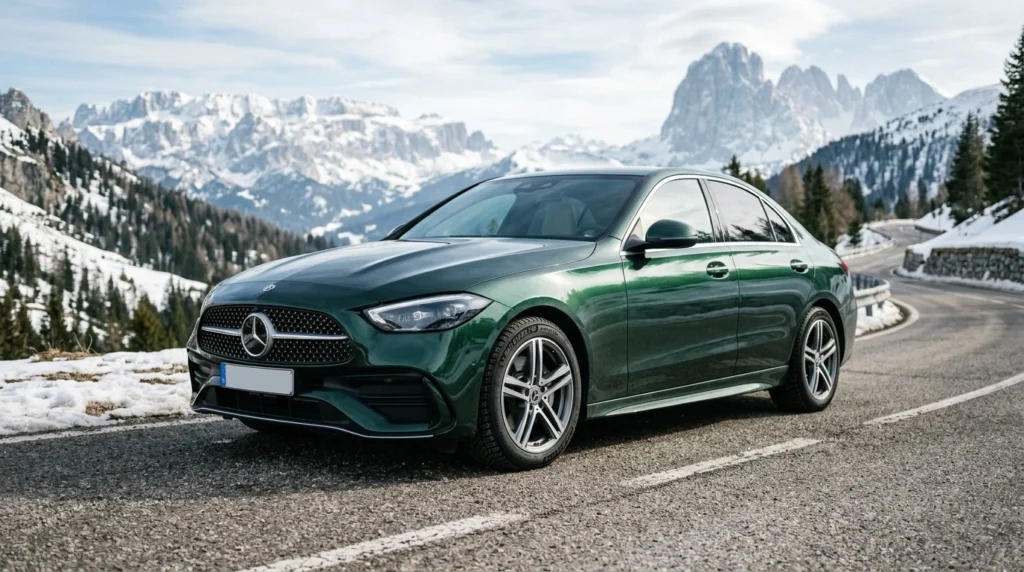
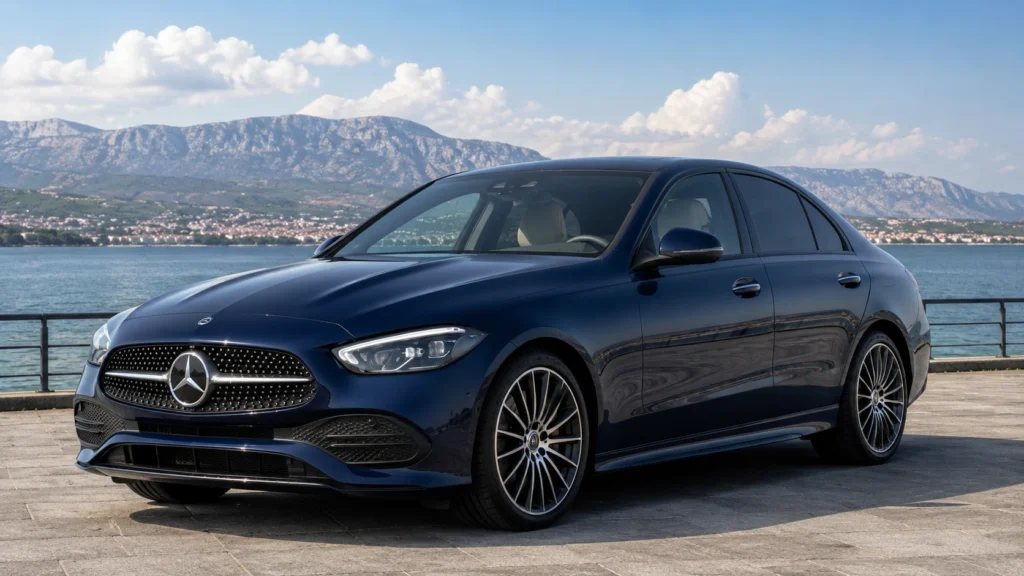
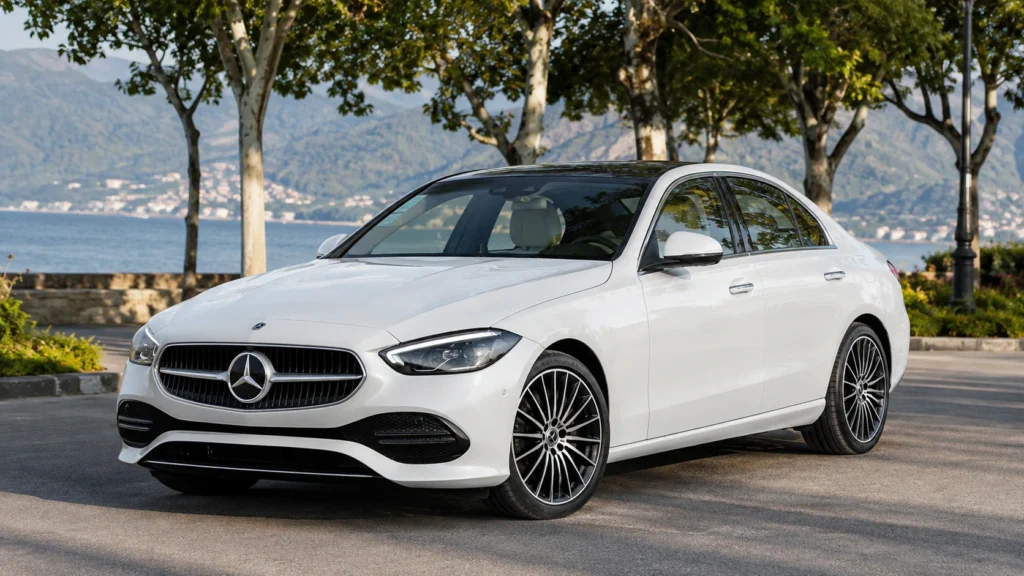
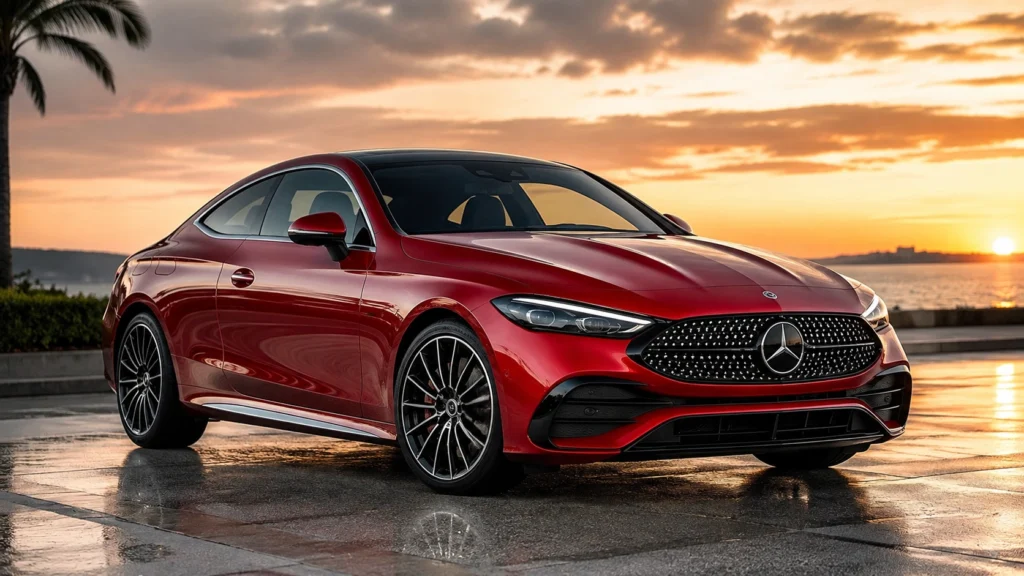
Mercedes-Benz didn’t reinvent the Mercedes-Benz C-Class visually for 2026, and that’s largely a compliment. The front end carries a wide, low grille flanked by headlights that taper into sharp LED signatures, giving the car a purposeful, slightly aggressive face without resorting to gimmicky lighting effects. Every trim gets LED headlights standard, with Mercedes’ more elaborate Digital Light projection system available further up the lineup.
In profile, the Mercedes-Benz C-Class reads as longer and lower than its footprint suggests, thanks to a long hood, a short front overhang, and a roofline that tapers gently toward a compact trunk lid. It’s a proportion trick Mercedes has used since the current generation launched, and it still works — the car looks more expensive than its starting price implies, particularly on the larger wheel options offered with the AMG Line package.
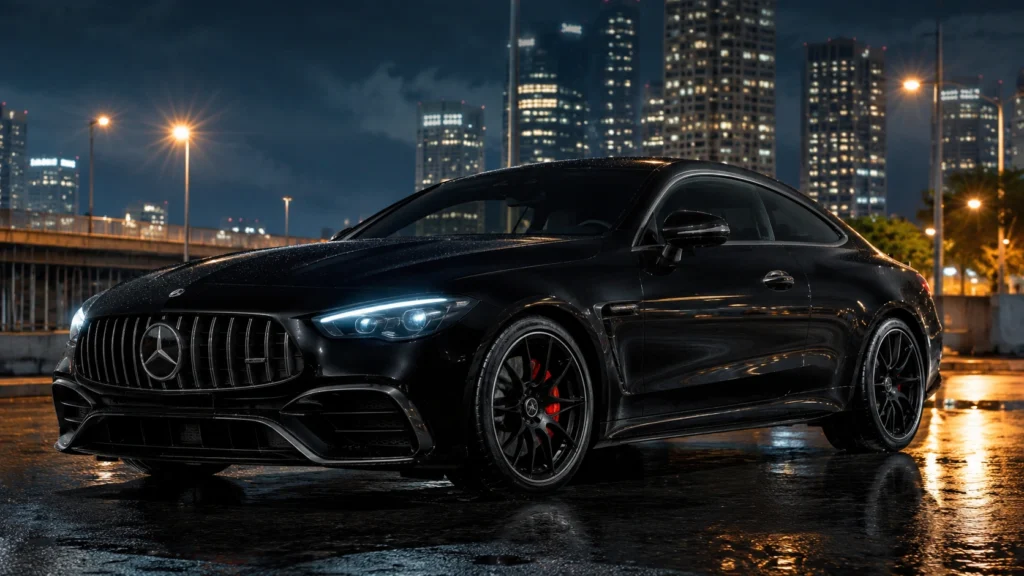
The AMG C 43 and AMG C 63 S E Performance push the styling further with a more aggressive front splitter, a rear diffuser, quad exhaust outlets, and wider AMG-specific bodywork, plus wheels sized appropriately for their performance ambitions. These aren’t just badge-and-wheel packages; the changes are functional, feeding cooling to bigger brakes and helping manage airflow at speed.
Around back, the Mercedes-Benz C-Class uses a two-piece taillight design and a subtle trunk lip spoiler on regular models, growing into a proper AMG-specific rear diffuser on performance variants. Against the BMW 3 Series, which leans into sharper creases, and the Audi A5, which has adopted a more flowing, almost coupe-like roofline since it absorbed the old A4’s role, the Mercedes-Benz C-Class comes across as the most restrained of the three — confident rather than showy, which suits buyers who want a luxury car that doesn’t shout about it.
Interior and Technology
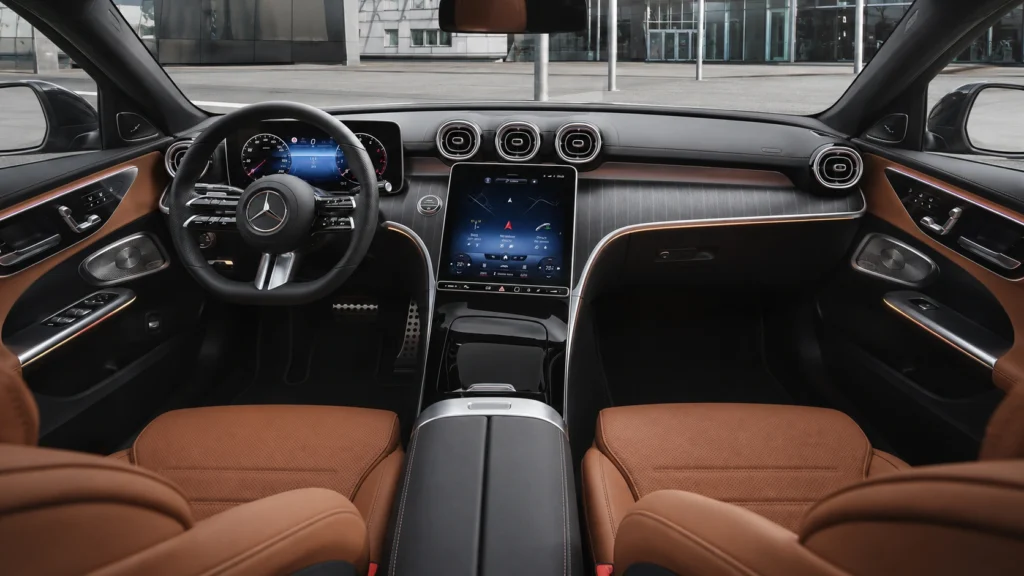
Step inside and the C-Class’s cabin is where the “junior S-Class” comparison earns its keep. The dashboard is dominated by an 11.9-inch vertical touchscreen running Mercedes’ third-generation MBUX infotainment system, paired with a 12.3-inch digital instrument cluster that can be reconfigured between several display styles, from a minimalist layout to one packed with driving data.
MBUX supports natural-language voice commands — you can simply say “Hey Mercedes, I’m cold” and the climate system responds, rather than requiring a memorized phrase. Wireless Apple CarPlay and Android Auto come standard across the range, which matters for buyers who’d rather use their phone’s native navigation than learn Mercedes’ onboard system. A wireless charging pad with NFC phone pairing and in-car Wi-Fi round out the connectivity picture.
Material quality is a genuine strength. Base cars use MB-Tex, Mercedes’ synthetic leather substitute, but even that feels dense and well-stitched rather than cheap, and higher trims add real leather, aluminum, or open-pore wood trim. Ambient lighting with 64 selectable colors runs along the dash and doors, a small but effective touch that makes the cabin feel more special after dark.
Rear-seat space is adequate rather than generous — Mercedes lists roughly 36 inches of rear legroom, which is comfortable for adults on shorter trips but noticeably tighter than what you’d get in the larger E-Class. Cargo space follows the same pattern: at 11.6 cubic feet, the trunk is on the smaller side for the segment, and rear seatbacks that split 40/20/40 help with occasional bulky items but won’t turn the C-Class into a practical hauler.
Safety and driver-assistance technology is comprehensive as standard. Every Mercedes-Benz C-Class comes with Mercedes’ PRE-SAFE system, which prepares the car for a detected collision, along with Active Brake Assist, Blind Spot Assist, and Attention Assist to monitor driver fatigue. Optional packages add adaptive cruise with steering assist, a 360-degree camera system, and a head-up display. Readers who want a broader look at how these technologies are shared across the brand’s lineup, along with wider pricing and model context, can also explore our Mercedes-Benz Guide 2026 before comparing individual models.
The one recurring criticism, echoed across independent reviews, is that Mercedes has pushed too many functions into the touchscreen, including some climate controls, which can be more distracting to adjust while driving than a physical dial would be.
Engine and Performance
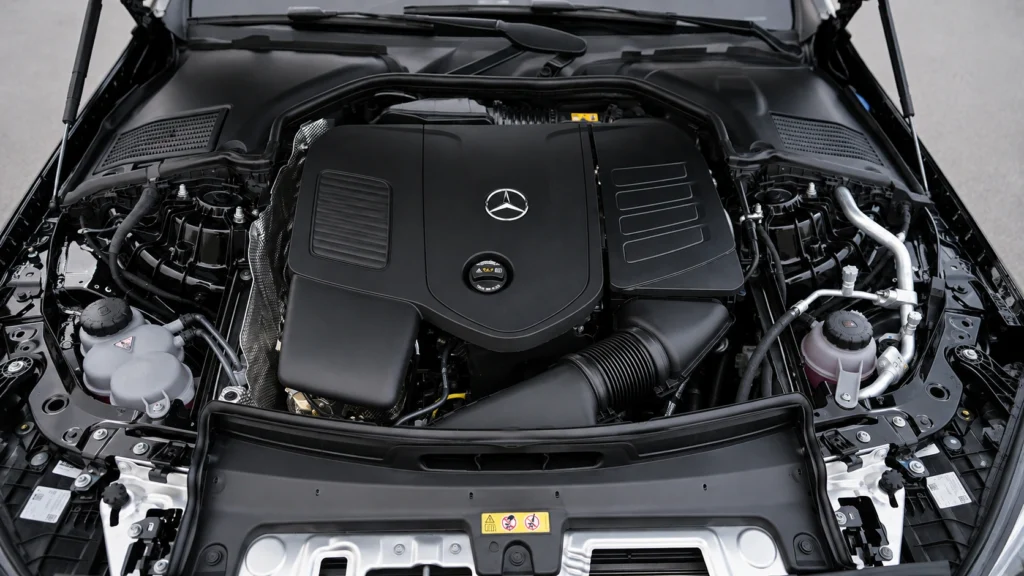
Every 2026 Mercedes-Benz C-Class starts from the same architectural idea: a turbocharged 2.0-liter inline-four paired with some form of electrification, then tuned to wildly different outputs depending on the model.
The C 300 is the volume model, producing 255 horsepower and 295 lb-ft of torque from its turbo four-cylinder, with a 48-volt mild-hybrid system contributing up to an additional 20 horsepower and 148 lb-ft on demand for a brief electric boost off the line. Power routes through a 9G-TRONIC nine-speed automatic transmission to the rear wheels standard, with 4MATIC all-wheel drive available as an option. In everyday driving, that mild-hybrid assist is most noticeable at low speeds, smoothing out the transition when the engine’s automatic stop-start system kicks back in.
Step up to the AMG C 43, and Mercedes-AMG reworks the same basic 2.0-liter engine with an electrically assisted turbocharger — a piece of Formula 1-derived technology that all but eliminates lag — to extract 416 horsepower. 4MATIC all-wheel drive is standard here, not optional, reflecting the car’s higher performance ceiling. It’s genuinely quick in a straight line and handles with real precision, thanks in part to standard rear-axle steering, though the electrically assisted steering itself doesn’t communicate road feel as clearly as some rivals.
At the top sits the AMG C 63 S E Performance, which pairs that same 2.0-liter turbo four with a rear-mounted electric motor and a 48-volt hybrid system to produce a combined 671 horsepower and 752 lb-ft of torque — Mercedes-AMG calls it the most powerful four-cylinder engine in production, and independent reviewers haven’t disputed that claim. It’s important to be clear here: this is not a lightly warmed-over C-Class. The added battery and motor hardware push curb weight up substantially, and while the acceleration numbers are supercar-adjacent, the extra mass is noticeable in fast direction changes, particularly on rougher pavement.
All C-Class models offer selectable driving modes — typically Comfort, Sport, and Eco, with AMG models adding Sport+ and an individually configurable setting — that adjust throttle response, transmission shift points, steering weight, and suspension firmness on cars equipped with adaptive dampers. Ride quality on the standard C 300 leans comfortable, soaking up broken pavement well for a sport-oriented sedan, while the AMG models trade some of that comfort for sharper body control, a trade-off that’s more noticeable around town than on a smooth highway.
Specifications
| Specification | C 300 | AMG C 43 | AMG C 63 S E Performance |
|---|---|---|---|
| Engine | 2.0L turbo inline-4, mild hybrid | 2.0L turbo inline-4, mild hybrid | 2.0L turbo inline-4, plug-in hybrid |
| Displacement | 2.0L | 2.0L | 2.0L |
| Horsepower | 255 hp @ 5,800 rpm | 416 hp | 671 hp combined |
| Torque | 295 lb-ft (+148 lb-ft electric boost) | Not disclosed separately by Mercedes | 752 lb-ft combined |
| Transmission | 9G-TRONIC 9-speed automatic | 9G-TRONIC 9-speed automatic | 9G-TRONIC 9-speed automatic |
| Drivetrain | RWD standard, 4MATIC AWD optional | 4MATIC AWD standard | 4MATIC AWD standard |
| Fuel Type | Premium unleaded | Premium unleaded | Premium unleaded + plug-in charging |
| Seating | 5 | 5 | 5 |
| Length | 187.0 in | 188.6 in | 190.6 in |
| Wheelbase | 112.8 in | 112.8 in | 113.1 in |
| Height | 56.6 in | 57.1 in | 57.4 in |
| Cargo Capacity | 11.6 cu ft | 11.6 cu ft | 11.6 cu ft |
| Curb Weight | ~3,792–3,957 lb (RWD/4MATIC) | ~4,165 lb | ~4,800 lb (as independently tested) |
| Fuel Economy | 25/35 mpg city/highway (RWD) | 19/27 mpg city/highway | Lower combined mpg, plus a short all-electric range |
Figures reflect official Mercedes-Benz and EPA data for the US-market C-Class Sedan where available; curb weight for the AMG C 63 S E Performance reflects an independently tested example rather than a factory-published figure, since Mercedes does not always publish that number by trim. You can review official specifications directly on the official Mercedes-Benz C-Class page.
Top Speed and Acceleration
The C 300’s 0–60 mph run lands around 6.0 seconds by Mercedes’ own estimate, though independent testing by Edmunds recorded a slightly quicker 5.8 seconds — a reminder that manufacturer figures tend to be conservative and real-world results can vary with conditions, tires, and testing methodology. Top speed on the standard C 300 is electronically limited to around 130 mph.
The AMG C 43 is noticeably quicker, with independent testing putting its 0–60 mph time at roughly 4.4 seconds — comparable to, though not dramatically faster than, its natural rival, the BMW M340i. That’s the reality of the compact performance-sedan segment right now: gaps between competitors are often measured in tenths, not full seconds.
The AMG C 63 S E Performance is in a different league entirely. Independent testing has clocked it at 3.1 seconds to 60 mph, and it’s worth restating that this is a plug-in-hybrid four-cylinder sedan running with the pace of cars carrying twice the cylinder count. Mercedes-AMG’s own factory estimate is similarly aggressive, though third-party testing has occasionally recorded times a touch quicker still, depending on conditions. This performance comes with real trade-offs in everyday usability, discussed further below — chiefly added weight and a firmer ride.
It’s worth being direct about one thing: the AMG C 63 S E Performance is not simply a C 300 with a bigger number on the trunk lid. Its hybrid hardware, weight distribution, and drivetrain complexity make it a fundamentally different car to live with day to day, and buyers should treat it as its own decision rather than an upgrade tier.
Mercedes-Benz C-Class Price
US pricing for the 2026 Mercedes-Benz C-Class starts at roughly $49,650 MSRP for the base rear-wheel-drive C 300, before destination charges; once those are added, real-world starting prices land closer to the $50,000–$51,000 mark depending on the source and timing of the quote. Stepping up to C 300 4MATIC all-wheel drive adds roughly $2,000 to that starting figure.
The AMG C 43 starts significantly higher, with published MSRPs (including destination) landing around $64,000, and commonly optioned examples at dealerships running into the mid-$70,000s to upper-$70,000s once packages like the Pinnacle trim, upgraded wheels, and the Burmester sound system are added.
At the top of the range, the AMG C 63 S E Performance carries a starting MSRP in the neighborhood of $88,000 including destination — a substantial jump that reflects its plug-in-hybrid hardware and near-supercar performance.
A few important caveats apply to all of this. Pricing varies by country, and figures above are specifically US pricing, labeled as such because Mercedes-Benz C-Class pricing in Europe, the UK, and other markets differs due to taxes, equipment bundling, and available powertrains — some markets, for instance, still offer diesel or wagon (Estate) variants not sold in the US. Even within the US, optional packages such as the AMG Line appearance package, driver-assistance bundles, and premium paint or interior trims can add several thousand dollars to a build quickly. Buyers should treat published starting MSRPs as a floor, not a realistic target price once they’ve configured the car they actually want.
Pros and Cons
| Pros | Cons |
|---|---|
| Interior materials and build quality feel a level above the segment average | Trunk space (11.6 cu ft) is small for a sedan this size |
| Wide spread of powertrains, from efficient C 300 to 671-hp AMG C 63 | Some climate and comfort controls are buried in the touchscreen |
| MBUX voice control genuinely understands natural language | Options and packages can push the price up quickly |
| Standard driver-assistance and safety tech across the range | AMG models ride firmly, especially on larger optional wheels |
| Strong resale association with the Mercedes-Benz badge | Rear-seat legroom trails larger rivals like the E-Class |
Comparison With Competitors
Mercedes-Benz C-Class vs BMW 3 Series
| Category | Mercedes-Benz C-Class | BMW 3 Series |
|---|---|---|
| Starting Price (US) | ~$49,650 (C 300) | ~$48,000–$49,350 (330i, with destination) |
| Base Horsepower | 255 hp | 255 hp |
| Base 0–60 mph | ~5.8–6.0 sec | ~5.1–5.2 sec |
| Performance Flagship | AMG C 63 S E Performance, 671 hp | M3 Competition |
| Interior Character | Softer, more luxury-focused | Slightly sportier, driver-focused |
| Infotainment | MBUX, voice-first | iDrive 8.5, menu-driven with QuickSelect shortcuts |
Both cars start from a similar 255-horsepower turbo four-cylinder base engine, which makes the decision less about raw numbers and more about character. The BMW 3 Series has historically been the enthusiast’s pick, with steering and chassis tuning that reward a more spirited driving style, and independent testing shows the base 330i is quicker to 60 mph than the equivalent C 300. The Mercedes-Benz C-Class counters with a calmer ride, a more visually striking interior, and MBUX’s more conversational voice assistant. Neither car is objectively “better” — buyers who prioritize outright driving engagement tend to lean BMW, while those who want a hushed, tech-forward cabin lean Mercedes.
Mercedes-Benz C-Class vs Audi A5 (Successor to the A4)
Audi has folded its long-running A4 nameplate into the redesigned A5 for the 2026 model year, which now serves as the brand’s direct C-Class and 3 Series competitor. The 2026 Audi A5 starts at roughly $50,200, powered by a 268-horsepower turbocharged 2.0-liter four-cylinder paired with a seven-speed dual-clutch automatic and standard quattro all-wheel drive — notably, AWD comes standard on every Audi A5, unlike the Mercedes-Benz C-Class, where it’s optional on the base trim.
The A5 also brings genuine practicality advantages: it uses a rear hatch rather than a conventional trunk lid, which meaningfully improves cargo flexibility compared with the C-Class’s fixed 11.6-cubic-foot trunk. Where the Mercedes-Benz C-Class pulls ahead is interior material depth and screen technology, which multiple reviewers have described as a tier above Audi’s otherwise well-regarded cabin. Buyers cross-shopping the two should weigh whether standard all-wheel drive and added cargo versatility (Audi) matter more than outright interior polish and a broader range of AMG performance options (Mercedes).
Who Should Buy the Mercedes-Benz C-Class?
The Mercedes-Benz C-Class makes the most sense for buyers who want the badge, the technology, and the interior ambiance of a larger Mercedes-Benz sedan without stepping up to E-Class pricing. It suits:
- Daily commuters and professionals who spend real time behind the wheel and value a quiet, well-finished cabin over outright driving thrills.
- Tech-focused buyers who’ll actually use MBUX’s voice control, wireless smartphone integration, and driver-assistance features regularly.
- Buyers who want a performance ladder, since the lineup scales cleanly from an efficient C 300 up through the genuinely quick AMG C 43 to the borderline-outrageous AMG C 63 S E Performance, without switching model lines.
- Enthusiasts considering AMG models who want serious pace but still need a car that’s comfortable and usable every day, not just on a track day.
Buyers who prioritize outright cargo space, rear-seat room, or the sharpest possible steering feel might be better served elsewhere — the Audi A5’s hatch-style trunk suits people who regularly haul bulky items, while the BMW 3 Series remains the choice for drivers who rank chassis feel above almost everything else. Families who need more rear-seat space should also look at the larger E-Class rather than stretching the C-Class beyond its intended footprint.
Conclusion
The 2026 Mercedes-Benz C-Class remains one of the more convincing arguments in the compact luxury sedan class, not because any single element of it is unmatched, but because the whole package is so consistently well-executed. The C 300 delivers genuine daily-driver comfort and respectable efficiency, the AMG C 43 adds real pace without sacrificing usability, and the AMG C 63 S E Performance pushes a four-cylinder engine to a place that felt unimaginable a decade ago. None of that comes without trade-offs — the trunk is smaller than the segment norm, some controls are needlessly buried in the touchscreen, and pricing climbs fast once options enter the picture.
Against the BMW 3 Series and the newly reshaped Audi A5, the Mercedes-Benz C-Class doesn’t win every category outright, but it doesn’t need to. It suits buyers who want their compact luxury sedan to feel unmistakably like a Mercedes-Benz inside, with technology that’s genuinely useful rather than merely flashy. For that specific buyer, the C-Class earns its place at the top of the shortlist.
Frequently Asked Questions (FAQs)
Yes, for buyers who value cabin quality and technology over outright practicality. Independent reviews consistently praise its interior finish and range of powertrains, while flagging a smaller-than-average trunk and touchscreen-heavy controls as its main weaknesses.
US pricing starts at roughly $49,650 MSRP for the base C 300, rising to about $64,000 for the AMG C 43 and around $88,000 for the AMG C 63 S E Performance, before options. Pricing varies by market and country.
The base C 300 reaches 60 mph in roughly 5.8–6.0 seconds. The AMG C 43 does it in about 4.4 seconds, and the AMG C 63 S E Performance has been independently tested at 3.1 seconds, with a top speed that’s electronically limited on most trims.
Every 2026 C-Class uses a version of the same turbocharged 2.0-liter inline-four, tuned from 255 horsepower with mild-hybrid assist in the C 300, to 416 horsepower in the AMG C 43, up to a combined 671 horsepower in the plug-in-hybrid AMG C 63 S E Performance.
The C 300 is the efficiency leader in the range, rated at 25 mpg city and 35 mpg highway with rear-wheel drive. The AMG C 43 trades efficiency for performance at 19 mpg city and 27 mpg highway, while the plug-in-hybrid AMG C 63 S E Performance adds a limited all-electric range on top of its gasoline economy.
Reliability perception has been mixed among owners of this generation, with some reporting infotainment glitches and interior rattles in early production examples. As with most luxury sedans, opting for the extended warranty and staying current on maintenance intervals is worth considering.
Neither is universally better. The BMW 3 Series generally edges the C-Class in outright driving engagement and independently tested acceleration from its base engine, while the Mercedes-Benz C-Class counters with a more luxurious cabin feel and a more conversational voice-assistant experience. The right choice depends on whether you prioritize dynamics or cabin ambiance.
For buyers who want a compact luxury sedan with strong interior quality, comprehensive standard safety tech, and a powertrain lineup that scales from efficient to genuinely fast, the C-Class is a strong pick. Buyers who need maximum cargo space or the sharpest possible handling may want to cross-shop the Audi A5 or BMW 3 Series before deciding.