Mercedes-Benz AMG: Inside the Performance Division Behind the Three-Pointed Star
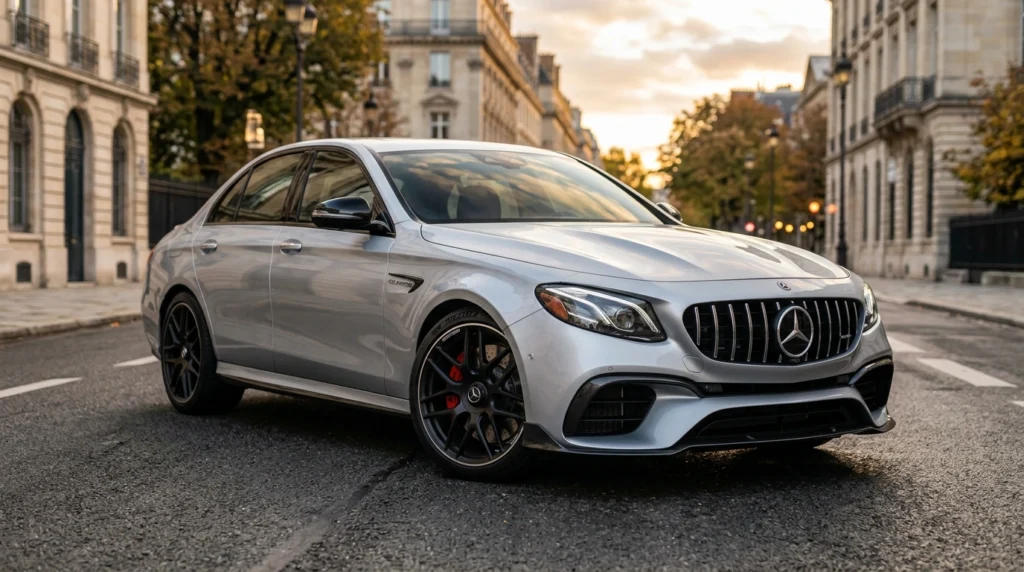
When someone says a Mercedes “sounds different” or “drives like a different car,” they’re usually talking about Mercedes-Benz AMG. AMG isn’t a single model — it’s Mercedes-Benz’s in-house performance division, responsible for reworking everything from engines and suspension tuning to brakes and aerodynamics on dozens of models across the brand’s sedan, coupe, SUV and roadster ranges.
What started as an independent racing and engine-tuning workshop in the late 1960s is now fully integrated into Mercedes-Benz, building everything from the 416-horsepower AMG GLC 43 to the 1,000-plus-horsepower AMG ONE hypercar. This guide breaks down what makes Mercedes-AMG different from a standard Mercedes-Benz, how the current lineup is organized, what these cars cost, and which model actually makes sense depending on how you plan to drive it.
Quick Specifications
| Category | Mercedes-AMG |
|---|---|
| Brand | Mercedes-AMG, performance division of Mercedes-Benz |
| Vehicle Type | Performance luxury sedans, coupes, SUVs and roadsters |
| Key Models | C-Class, CLA, CLE, GLC, GLE, GLS, G-Class, GT, SL, AMG ONE |
| Powertrains | Turbocharged four-, six- and eight-cylinder engines; several with plug-in hybrid E PERFORMANCE assistance |
| Drivetrain | Rear-wheel drive on select GT and SL variants; AMG Performance 4MATIC+ all-wheel drive on most sedans, SUVs and hybrid models |
| Performance Focus | Acceleration, braking, cornering grip and high-speed stability |
| Performance Technology | AMG-tuned chassis and suspension, AMG Ride Control, AMG Dynamic Select drive modes, AMG-specific brakes and aerodynamics |
Specifications vary by model, model year, trim and market. Always confirm current figures through the official Mercedes-AMG website before making a purchase decision.
What Is Mercedes-Benz AMG?
AMG stands for Aufrecht, Melcher and Großaspach — the surnames of founders Hans Werner Aufrecht and Erhard Melcher, combined with Großaspach, Aufrecht’s hometown in Germany. What began in 1967 as an independent engineering firm building race-tuned Mercedes engines is now the performance and motorsport arm of Mercedes-Benz itself, headquartered in Affalterbach.
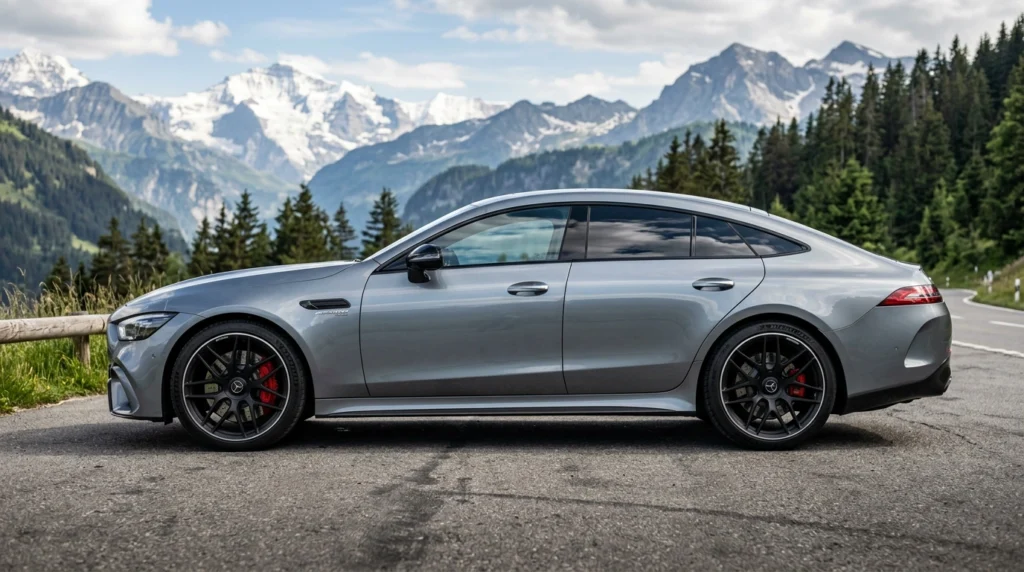
The easiest way to understand what makes Mercedes AMG different from a regular Mercedes-Benz is to separate two things people often confuse. “AMG Line” is a styling package — sportier bumpers, larger wheels, firmer-looking trim — applied to ordinary Mercedes-Benz models. A true Mercedes-AMG model, on the other hand, is engineered from the ground up: a different (often hand-assembled) engine, a reinforced body structure, AMG-specific suspension geometry, larger brakes, unique gear ratios and software calibration that changes how the car actually behaves, not just how it looks.
AMG’s performance philosophy centers on a few recurring technologies. AMG 4MATIC+ is the brand’s variable all-wheel-drive system, capable of shifting power almost entirely to the rear axle for a more playful, rear-biased feel, or spreading it across all four wheels for traction in poor conditions.
AMG E PERFORMANCE describes the brand’s plug-in hybrid performance architecture, pairing a combustion engine with a high-output electric motor and a dedicated battery designed for repeated hard acceleration rather than long electric-only range. Chassis-wise, AMG models typically get adaptive dampers, retuned anti-roll bars, and — on higher trims — larger, more heat-resistant brakes than their standard Mercedes-Benz counterparts.
History and Background
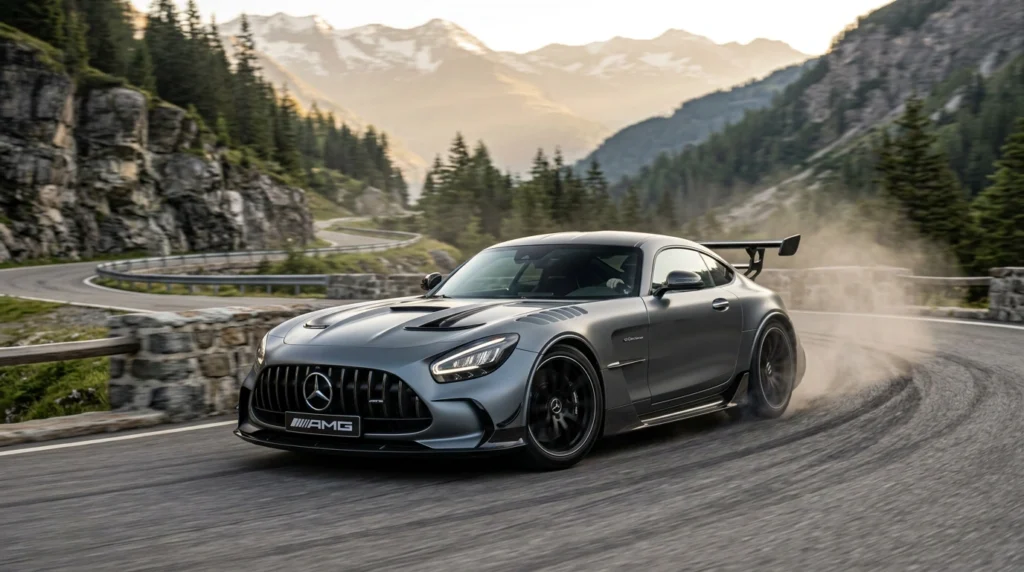
AMG’s roots trace back to motorsport. Aufrecht and Melcher left Mercedes-Benz’s engine development department to start their own tuning workshop, and the company’s breakthrough came at the 1971 24 Hours of Spa, where a Mercedes 300 SEL 6.8 AMG — nicknamed the “Red Pig” — finished second overall against dedicated race cars, despite being a full-size luxury sedan.
Through the 1970s and 1980s, AMG built its reputation modifying customer Mercedes-Benz cars with upgraded engines and aerodynamic parts, largely outside the factory’s direct involvement. That changed in 1990, when AMG signed a formal cooperation agreement with Mercedes-Benz, allowing AMG-built vehicles to be sold through Mercedes-Benz dealerships. Mercedes-Benz took a majority stake in AMG in 1999, and by 2005 it had become a wholly owned subsidiary, formally renamed Mercedes-AMG GmbH.
Since then, AMG has produced some of Mercedes-Benz’s most recognizable performance cars, from the supercharged V8s of the 2000s to today’s hand-built twin-turbo engines and hybrid powertrains. The division has also stayed close to motorsport, supplying engines and technology to the Mercedes-AMG Petronas Formula 1 team, a relationship that directly shaped the AMG ONE hypercar’s Formula 1-derived hybrid powertrain. More recently, AMG has expanded into electrified performance, with plug-in hybrid E PERFORMANCE models sitting alongside its traditional turbocharged combustion engines rather than replacing them outright.
Design and Exterior
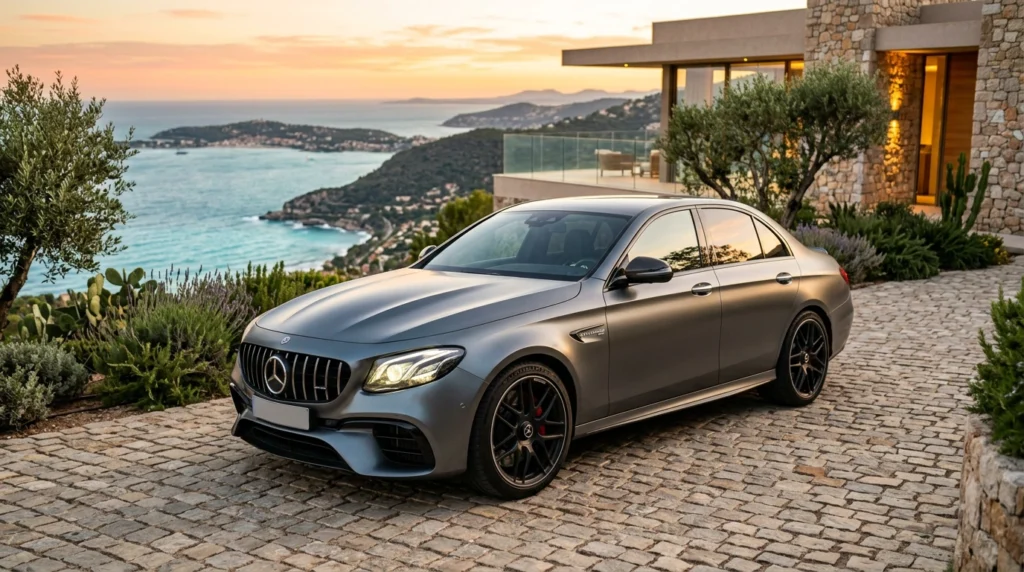
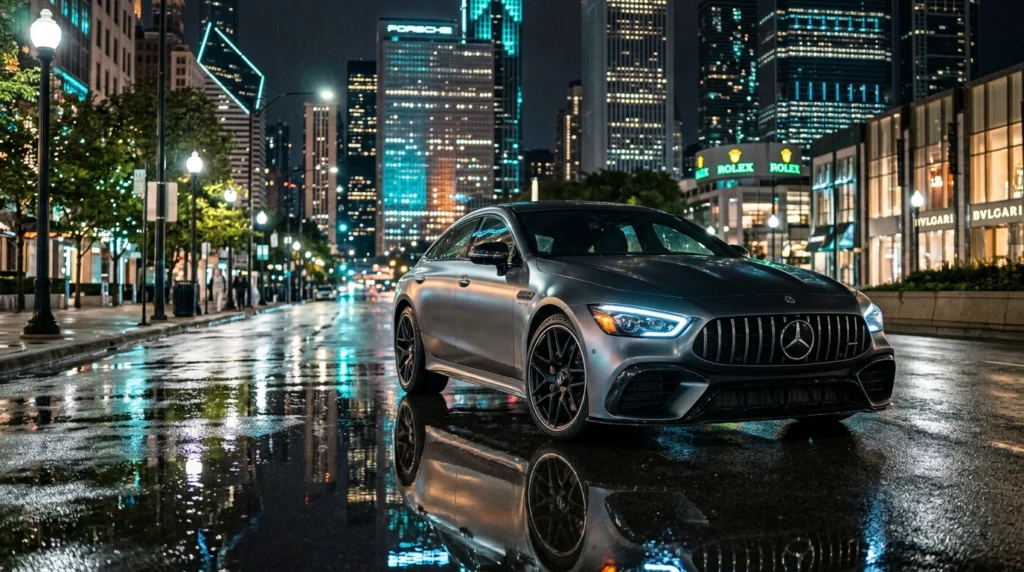
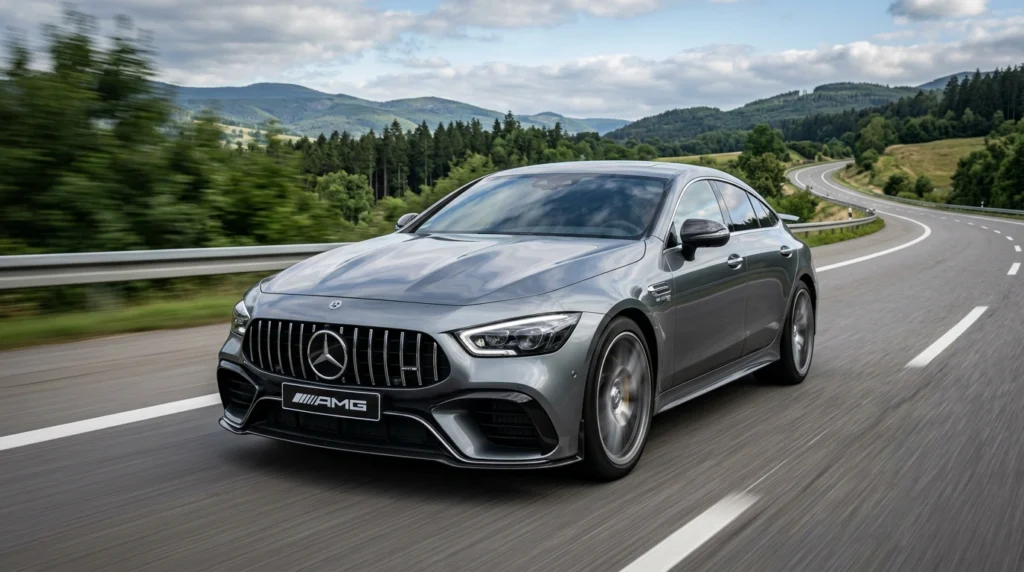
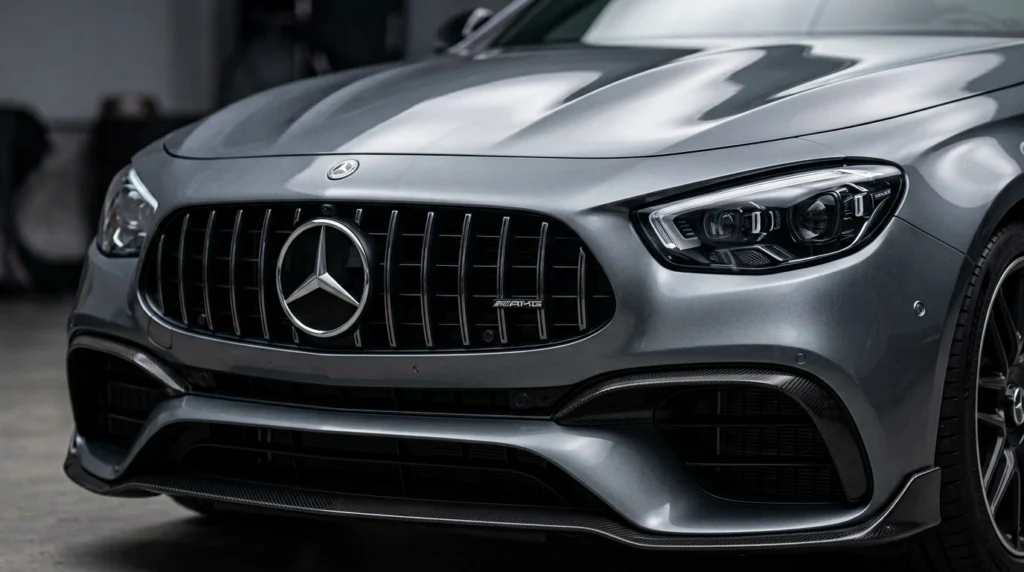
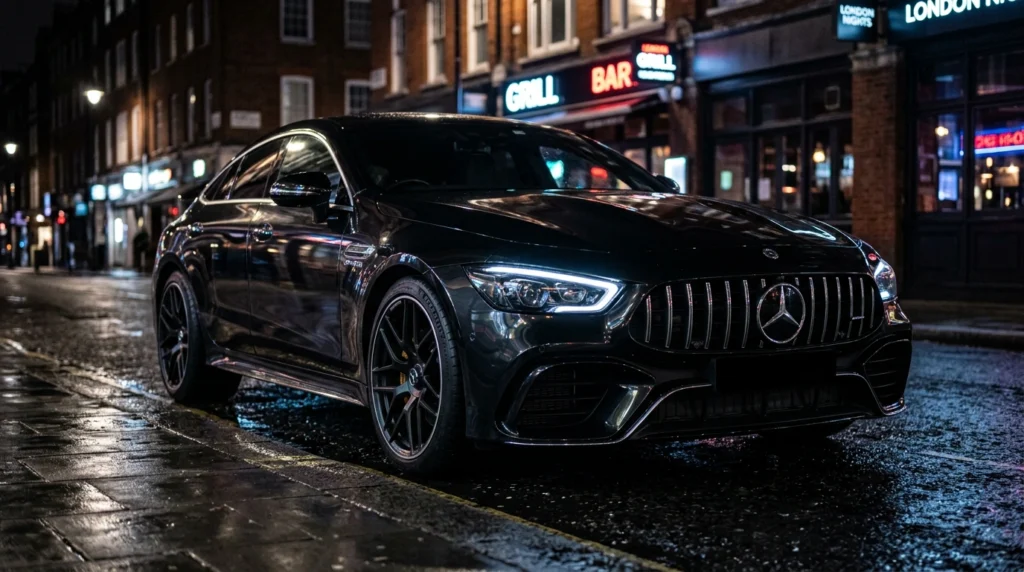
Every Mercedes-Benz AMG model shares a family look, but the details go beyond styling for its own sake. The AMG-specific front grille, typically a wider, more vertically slatted “Panamericana” design on higher-performance variants, isn’t just visual drama — it’s sized to feed more air into larger radiators and intercoolers that AMG engines need under sustained hard use.
The front bumpers on Mercedes-Benz AMG models are reshaped with larger air intakes that route air toward the brakes for cooling and, on some models, toward channels that improve underbody airflow. Side skirts and rear diffusers help manage airflow along the car’s flanks and underneath the rear axle, reducing lift at speed. On track-focused variants, you’ll also find functional elements like larger front splitters, gurney flaps on the trunk lid, and — on the most extreme cars — active aerodynamic components that adjust automatically based on speed and drive mode.
Wheel and brake packages are another giveaway. Mercedes-Benz AMG models generally run larger wheels than their standard Mercedes-Benz counterparts, wrapped around brake rotors that can be noticeably bigger in diameter, sometimes with red or yellow calipers as a visual (and functional) indicator of the upgraded braking hardware underneath. Exhaust systems are tuned for both sound and flow, often with switchable valves that open up under load and quiet down in Comfort mode. Badging is understated by design — most AMG models simply carry a small “AMG” script rather than anything ostentatious, letting the proportions and stance do the talking.
Interior and Technology
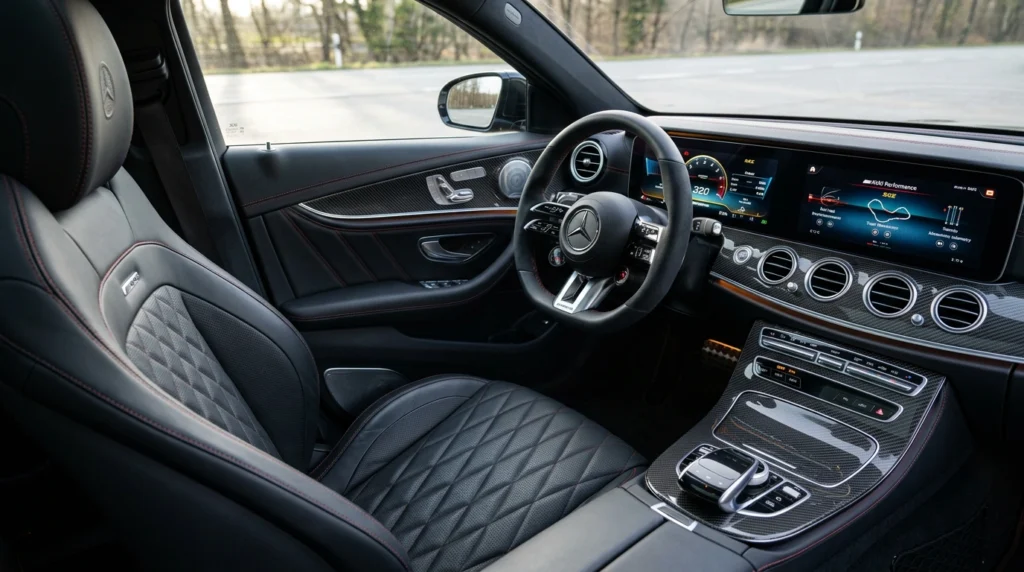
Step inside a Mercedes-Benz AMG model and the cabin generally mirrors its non-AMG sibling’s overall layout, but with a noticeably sportier edge. AMG-specific sport seats offer more aggressive bolstering to hold occupants in place during hard cornering, usually finished in Nappa leather or a leather/microfiber combination with contrast stitching. The steering wheel is typically flat-bottomed with a thicker rim, and on many models it includes dedicated rotary controllers on the spokes that let the driver adjust suspension stiffness, exhaust sound and drivetrain behavior without digging through a touchscreen menu.
Mercedes-Benz’s MBUX infotainment system carries over to AMG models, but with AMG-specific menu themes, including a full-screen “AMG” digital instrument cluster layout that displays g-force, oil temperature, turbo boost pressure and lap-timer functions on models where that’s relevant. Mercedes-Benz AMG Dynamic Select lets drivers toggle between drive modes — typically Comfort, Sport, Sport+, Individual and, on some models, a dedicated Race or Slippery setting — each of which retunes throttle response, transmission shift points, steering weight and suspension firmness together.
Comfort hasn’t been sacrificed in the process. Heated and ventilated seats, massage functions, ambient lighting, and Mercedes-Benz’s full suite of driver-assistance features — adaptive cruise control, blind-spot monitoring, active lane-keeping — remain standard or available across most Mercedes-Benz AMG models. The result is a cabin that can feel like any other well-equipped Mercedes-Benz on a routine errand, then shift into something considerably more focused the moment the drive mode dial gets turned.
Engine and Performance
This is where Mercedes-Benz AMG performance cars separate themselves most clearly from the rest of the Mercedes-Benz lineup, and it’s worth being specific, because not every Mercedes-Benz AMG model uses the same architecture.
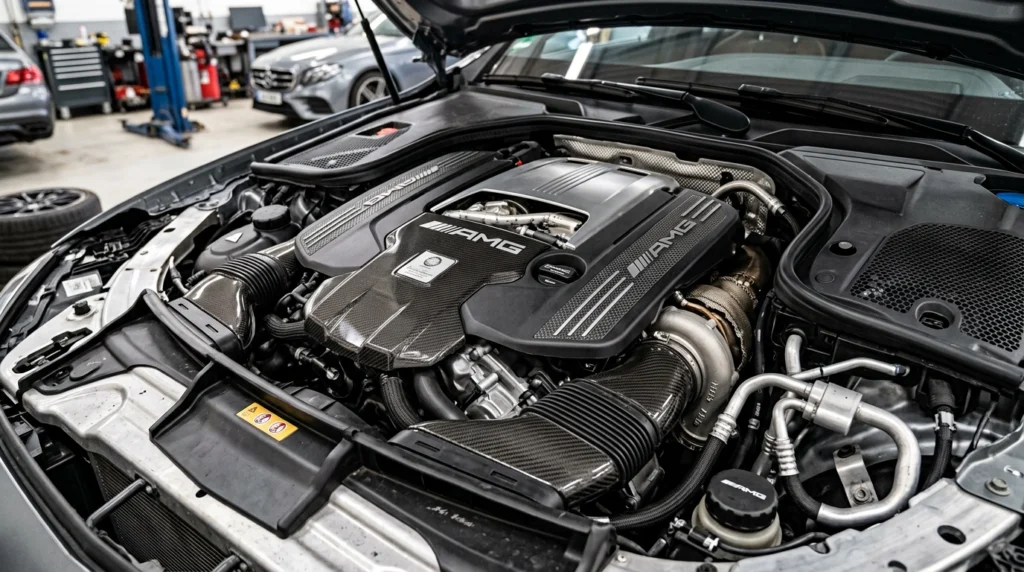
At the entry level, Mercedes-Benz AMG turbocharged four-cylinder engines do a lot of the lineup’s heavy lifting. The GLC 43, for example, uses a 2.0-liter turbo four with an electrically driven auxiliary turbocharger, producing 416 horsepower and 369 lb-ft of torque — enough for a 0-60 mph time of roughly 4.7 seconds in a compact SUV.
Mercedes-Benz AMG most technically ambitious four-cylinder is the M139l engine found in the C 63 S E PERFORMANCE: a hand-built 2.0-liter unit paired with an electric exhaust-gas turbocharger derived directly from Formula 1 technology, plus a 150-kW electric motor on the rear axle. Combined output reaches 671 horsepower, making it, according to Mercedes-AMG, the most powerful four-cylinder engine in production.
Six-cylinder Mercedes-Benz AMG models occupy the middle of the lineup. The GLE 53, for instance, pairs a turbocharged 3.0-liter inline-six with 48-volt mild-hybrid or plug-in hybrid assistance for a combined output in the mid-500-horsepower range, depending on configuration and market. Mercedes-Benz AMG has also begun introducing inline-six GLC 53 variants in some markets as a replacement for certain four-cylinder GLC 43 configurations, illustrating how the lineup continues to shift model by model.
At the top sits Mercedes-Benz AMG V8 lineup — the twin-turbo 4.0-liter “hot-vee” engine, so named because the turbochargers sit in the valley between the cylinder banks rather than outside them, shortening the intake path and sharpening throttle response. This engine, in various states of tune, powers the G 63 (577 horsepower, with 48-volt hybrid assistance capable of a further boost), the GLE 63 S and GLS 63 (both around 603 horsepower), and the AMG GT 63 range. The most powerful production application pairs this V8 with a plug-in hybrid rear motor in the S 63 E PERFORMANCE and GT 63 S E PERFORMANCE, pushing combined output past 790 horsepower.
Transmission duty across most Mercedes-Benz AMG models falls to a nine-speed AMG SPEEDSHIFT MCT or TCT automatic, engineered for faster, more aggressive gear changes than a standard Mercedes-Benz transmission, with a wet clutch pack replacing a conventional torque converter on several models for quicker response. Suspension setups range from adaptive steel-spring dampers on entry models to fully active Mercedes-Benz AMG Ride Control air suspension on SUVs and the S 63, capable of adjusting damping stiffness in milliseconds. Braking hardware scales with performance, with larger cast-iron rotors standard and carbon-ceramic brakes available as an option on the most powerful models to reduce weight and resist fade during repeated hard stops.
Specifications
Because Mercedes-Benz AMG covers everything from compact SUVs to two-seat hypercars, there’s no single spec sheet that applies across the board. The table below is a representative snapshot of current-generation models; always verify exact figures for your market and model year, since power outputs and drivetrain configurations are periodically updated.
| AMG Model | Engine/Powertrain | Approx. Power | Drivetrain | Performance Character |
|---|---|---|---|---|
| AMG GLC 43 | 2.0L turbo I4, mild hybrid | 416 hp | AMG 4MATIC+ | Compact performance SUV |
| AMG C 63 S E PERFORMANCE | 2.0L turbo I4 plug-in hybrid | 671 hp | AMG 4MATIC+ | High-performance sedan |
| AMG GLE 53 | 3.0L turbo I6 hybrid | ~536 hp (varies by market) | AMG 4MATIC+ | Performance SUV |
| AMG GLE 63 S | 4.0L twin-turbo V8, mild hybrid | 603 hp | AMG 4MATIC+ | High-performance SUV |
| AMG GLS 63 | 4.0L twin-turbo V8, mild hybrid | 603 hp | AMG 4MATIC+ | Full-size performance SUV |
| AMG G 63 | 4.0L twin-turbo V8, mild hybrid | 577 hp | AMG 4MATIC+ | Off-road-capable luxury SUV |
| AMG GT 63 | 4.0L twin-turbo V8 | Verify current specification | Rear-biased AMG 4MATIC+ | Grand touring sports car |
| AMG S 63 E PERFORMANCE | 4.0L twin-turbo V8 plug-in hybrid | 791 hp | AMG 4MATIC+ | Flagship performance sedan |
| AMG ONE | 1.6L turbo hybrid V6 + 4 electric motors | Approx. 1,049–1,063 hp | All-wheel drive (hybrid) | Limited-production hypercar |
Top Speed and Acceleration
Acceleration figures across the Mercedes-Benz AMG lineup vary dramatically depending on weight, drivetrain and power output, so it’s worth understanding why rather than just memorizing numbers. The GLC 43, at around 4.7 seconds to 60 mph, is quick for a compact SUV but nowhere near Mercedes-Benz AMG fastest offering. The C 63 S E PERFORMANCE, boosted by its rear electric motor and all-wheel-drive traction, has been independently tested in the low-3-second range to 60 mph — quicker than its four-cylinder engine alone would suggest, largely because the electric motor fills in torque before the turbocharger fully spools.
Heavier vehicles need more power to hit similar numbers. The GLS 63, despite its nearly three-ton curb weight, still manages 0-60 mph in roughly 4.1 seconds thanks to its 603-horsepower V8 and launch control system, which manages wheel slip and power delivery for a consistent, repeatable launch. Mercedes-Benz AMG plug-in hybrid flagships push further still — the S 63 E PERFORMANCE has been tested at around 3.0 seconds to 60 mph, on par with dedicated sports cars, despite being a full-size luxury sedan.
Top speeds on most Mercedes-Benz AMG models are electronically limited, typically to 155 mph unless the buyer specifies an available AMG Driver’s Package that raises the limiter, often to around 174-180 mph depending on model and tire rating. The AMG ONE is the outlier: Mercedes-Benz AMG has stated a top speed north of 217 mph, with acceleration figures Mercedes claims at roughly 2.9 seconds to 60 mph, figures that put it in the same conversation as dedicated hypercars from Ferrari and McLaren. Tires matter more than people expect here — high-performance summer tires unlock grip levels that all-season rubber can’t match, which is why acceleration and cornering figures published by manufacturers usually assume the optional performance tire package.
Mercedes AMG Price
There’s no single “Mercedes AMG price” — the lineup spans roughly six figures from bottom to top, and pricing varies by country, trim, options and model year, so treat the figures below as a general U.S. reference rather than a universal number.
At the accessible end, compact Mercedes-Benz AMG models like the GLC 43 and C-Class AMG variants generally start in the $55,000-$65,000 range before options, positioning them as a step up from a well-equipped standard Mercedes-Benz rather than an exotic purchase. The plug-in hybrid C 63 S E PERFORMANCE carries a noticeably higher starting price around $88,000, reflecting its far more complex hybrid drivetrain.
Move into SUVs and the range climbs steadily. The GLE 53 starts around $91,000-$92,000, the GLE 63 S around $131,000-$133,000, and the full-size GLS 63 starts around $151,000-$152,000. The G 63, Mercedes-Benz AMG most image-driven SUV, starts around $195,000-$196,000 before options — and because buyers frequently add Manufaktur personalization packages, forged wheels, and exterior design packages, six-figure options bills aren’t unusual.
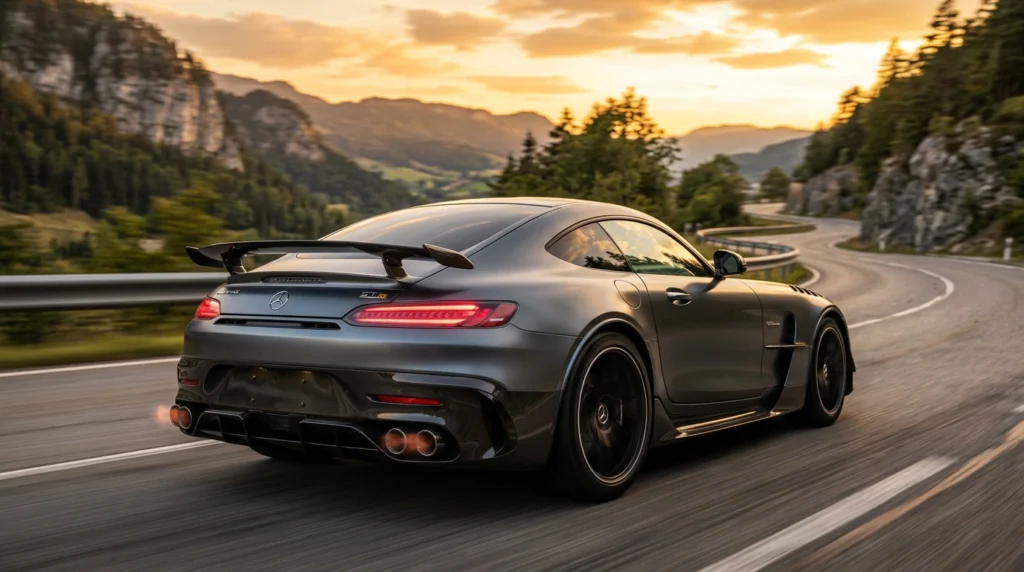
Sports cars carry the widest spread. The entry-level AMG GT 43 starts around $103,000, while the V8-powered GT 63 starts around $181,000, and the flagship GT 63 S E PERFORMANCE four-door starts north of $200,000. At the very top, the AMG ONE was a strictly limited run of 275 units, originally priced in the multi-million-dollar range and no longer available new; used examples now trade for considerably more than their original price due to scarcity.
Beyond the base MSRP, expect meaningful costs from optional carbon-ceramic brakes, forged wheel packages, Burmester premium audio, Manufaktur customization, and — in the U.S. — destination charges plus state and local taxes that aren’t included in advertised pricing. Buyers outside the U.S. should expect different baseline pricing entirely, since VAT, import duties and market-specific equipment requirements shift Mercedes-Benz AMG pricing substantially from one country to the next.
Pros and Cons
Pros
- Genuinely quick, engaging performance across nearly every model in the lineup
- Interiors that combine motorsport-inspired detailing with real Mercedes-Benz luxury
- Advanced chassis technology, including adaptive suspension and, on select models, active aerodynamics
- A wide model range covering sedans, coupes, SUVs and a roadster, so there’s an AMG for different lifestyles
- Distinctive, purposeful styling that doesn’t rely on gimmicks
- Strong engineering pedigree tied directly to Mercedes-AMG’s Formula 1 program
Cons
- Meaningfully more expensive than a standard Mercedes-Benz equivalent
- Options can add tens of thousands of dollars quickly
- Fuel economy on V8 and high-output hybrid models is poor, particularly under enthusiastic driving
- Maintenance, tires and brake replacement costs run higher than mainstream luxury vehicles
- Plug-in hybrid AMG models add weight and complexity that can blunt outright agility compared with lighter rivals
- Firmer AMG-tuned suspension can feel stiff on rough roads, especially on cars without adaptive air suspension
Comparison With Competitors
Mercedes-AMG vs BMW M
Both brands build genuinely quick, well-engineered performance cars, but their character differs. Mercedes-Benz AMG models tend to lean slightly more toward comfort and long-distance composure, with plush interiors and drive modes that can soften the experience dramatically for daily use. BMW M models are often regarded as slightly more communicative through the steering and chassis, with a driving feel that rewards a more involved driving style.
Mercedes-Benz AMG engine lineup skews toward turbocharged four-, six- and eight-cylinder units with growing hybrid integration, while BMW M continues to offer both turbocharged inline-sixes and, on select models, naturally influenced high-revving character that some enthusiasts prefer. Technology and daily usability are close to a wash between the two brands — both offer extensive driver-assistance suites and strong infotainment systems.
Mercedes-AMG vs Audi RS
Audi RS models are known for exceptionally capable all-wheel-drive systems (Quattro) that deliver strong all-weather traction, an area where AMG’s 4MATIC+ system is competitive but not always considered quite as planted at the limit. Interior quality is a strength for both brands, though AMG’s cabins generally feel slightly more luxury-oriented, while Audi RS interiors lean more driver-focused and minimalist. In terms of styling, Audi RS models are typically more restrained, while AMG design language tends to be bolder. Model variety favors Mercedes-Benz AMG slightly, given its broader spread across SUVs, sedans, coupes and a dedicated sports car range, though Audi RS has expanded its SUV lineup considerably in recent years.
| Category | Mercedes-AMG | BMW M | Audi RS |
|---|---|---|---|
| Performance | Strong, hybrid-assisted on top models | Strong, driver-focused | Strong, traction-focused |
| Luxury | High, comfort-oriented | High, slightly firmer edge | High, minimalist focus |
| Technology | Extensive MBUX suite | Extensive iDrive suite | Extensive MMI suite |
| AWD Systems | AMG 4MATIC+ | xDrive M (select models) | Quattro |
| Model Variety | Wide, sedans to SUVs to GT | Wide, sedans to SUVs | Wide, sedans to SUVs |
| Daily Usability | Strong in Comfort mode | Strong, firmer default ride | Strong, consistent traction |
Who Should Buy It?
Performance enthusiasts who still want a usable daily car are a natural fit for Mercedes-Benz AMG, particularly models like the C 63 S E PERFORMANCE or GT 63, which deliver serious straight-line and cornering ability without abandoning comfort features entirely. Buyers who prioritize luxury first and performance second will likely be happiest with six-cylinder models like the GLE 53, which add noticeable pace over a standard Mercedes-Benz without the harsher edges of the V8 cars.
Families needing SUV practicality with genuine performance credentials should look toward the GLE 63 S or GLS 63, both of which retain proper cargo space and, in the GLS’s case, a usable third row. Buyers who want off-road-capable styling and status above all else tend to gravitate toward the G 63, though it’s worth noting its fuel economy and size make it a poor fit for anyone prioritizing efficiency. If you’re weighing an AMG SUV against Mercedes-Benz’s broader SUV range, it’s worth comparing it directly against a model like the Mercedes-Benz GLE in non-AMG form to understand exactly how much extra performance, and cost, the AMG badge adds.
Buyers who should think twice about Mercedes-Benz AMG include anyone primarily focused on minimizing running costs, since insurance, tires, brakes and fuel expenses all run higher than a standard Mercedes-Benz AMG. Drivers who spend most of their time on poorly maintained roads may also find AMG’s firmer suspension tuning less forgiving day to day, particularly on models without adaptive air suspension as standard equipment.
Conclusion
Mercedes-Benz AMG isn’t one car — it’s an entire performance-focused approach applied across nearly every corner of the Mercedes-Benz lineup, from compact SUVs to a Formula 1-derived hypercar. What ties the range together is engineering intent: reworked engines, AMG-specific chassis tuning, and braking and aerodynamic hardware built for genuine performance rather than badge appeal alone. Whether that means a six-cylinder GLE 53 for buyers who want extra pace without sacrificing comfort, or a hybrid-assisted C 63 S E PERFORMANCE for those chasing outright speed, there’s meaningful variation in how “AMG” actually feels behind the wheel.
Anyone shopping this segment should weigh the higher purchase price and running costs against how much of that performance they’ll actually use day to day — and cross-shop specific models rather than assuming one Mercedes-Benz AMG drives like another, since the difference between a four-cylinder GLC 43 and a V8 GLS 63 is significant. Done right, that research pays off in a car that genuinely earns its badge.
Frequently Asked Questions (FAQs)
Mercedes-Benz AMG is the performance division of Mercedes-Benz, responsible for engineering high-performance versions of the brand’s sedans, coupes, SUVs and roadsters, along with dedicated performance models like the AMG GT and AMG ONE.
AMG stands for Aufrecht, Melcher and Großaspach — the surnames of the company’s two founders and the German town where it was originally based.
In terms of outright top speed and acceleration, the limited-production AMG ONE hypercar is the fastest model Mercedes-AMG has built, with a Formula 1-derived hybrid powertrain producing over 1,000 horsepower.
Among current production models, the AMG ONE leads on total output, followed by plug-in hybrid models like the S 63 E PERFORMANCE and GT 63 S E PERFORMANCE, which combine V8 power with electric motor assistance for output well above 700 horsepower.
Pricing spans a wide range, from roughly $55,000-$65,000 for entry compact AMG models to well over $200,000 for flagship hybrid sports models, with the AMG ONE priced in the millions when new. Exact pricing depends on model, trim, options and market.
Neither brand is objectively “better” — Mercedes-AMG generally leans toward comfort and luxury alongside performance, while BMW M is often considered slightly more driver-focused. The right choice depends on personal priorities and which driving character suits you.
A standard Mercedes-Benz is engineered primarily for comfort, efficiency and everyday usability, while a Mercedes-AMG model receives a reworked engine, suspension, brakes and software calibration specifically aimed at performance, handling and driving engagement.
Six-cylinder models like the GLE 53 or entry-level AMG GT variants tend to strike the best balance between performance and everyday comfort, offering a noticeable step up from a standard Mercedes-Benz without the firmer ride and higher running costs of the V8 models.