Mercedes-Benz Explained: A Complete Guide to the Brand, Lineup, and Buying Advice
Few names carry as much weight in the automotive world as Mercedes-Benz. For well over a century, the brand has stood at the intersection of engineering precision, comfort, and status, and that reputation still shapes how buyers cross-shop the luxury segment today.
This guide is built for anyone trying to make sense of the modern Mercedes-Benz portfolio, whether you’re comparing your first luxury sedan, weighing an AMG performance model, or deciding if an EQ electric vehicle fits your driving habits.
You’ll find an honest look at the current lineup, how the brand’s technology and safety systems work, what ownership really costs, and how Mercedes-Benz stacks up against BMW, Audi, and Lexus. The goal isn’t to sell you on the badge — it’s to help you decide whether it fits your driveway.
Quick Specifications
| Category | Details |
|---|---|
| Brand | Mercedes-Benz |
| Founded | 1926 (Daimler-Benz AG merger); roots trace to 1886 |
| Headquarters | Stuttgart, Germany |
| Main vehicle categories | Sedans, SUVs, coupes, convertibles, wagons, EVs |
| Performance division | Mercedes-AMG (Affalterbach, Germany) |
| Ultra-luxury division | Mercedes-Maybach |
| Electric vehicle lineup | CLA, EQB, EQE, and EQS families |
| Luxury positioning | Premium segment; competes with BMW, Audi, Lexus |
| Key model families | CLA, C-Class, E-Class, S-Class, GLA/GLB, GLC, GLE, GLS, G-Class, CLE, SL |
What Is Mercedes-Benz?
Mercedes-Benz is a German luxury automaker owned by Mercedes-Benz Group, headquartered in Stuttgart. It builds premium sedans, SUVs, coupes, convertibles, and EVs sold worldwide, and it’s historically credited with pioneering technologies like the crumple zone and the modern airbag.
Mercedes-Benz generally competes at the top of the luxury segment alongside BMW and Audi, with overlap against Lexus and Genesis in some models, and the lineup spans relatively accessible compact cars through some of the most expensive production vehicles on sale.
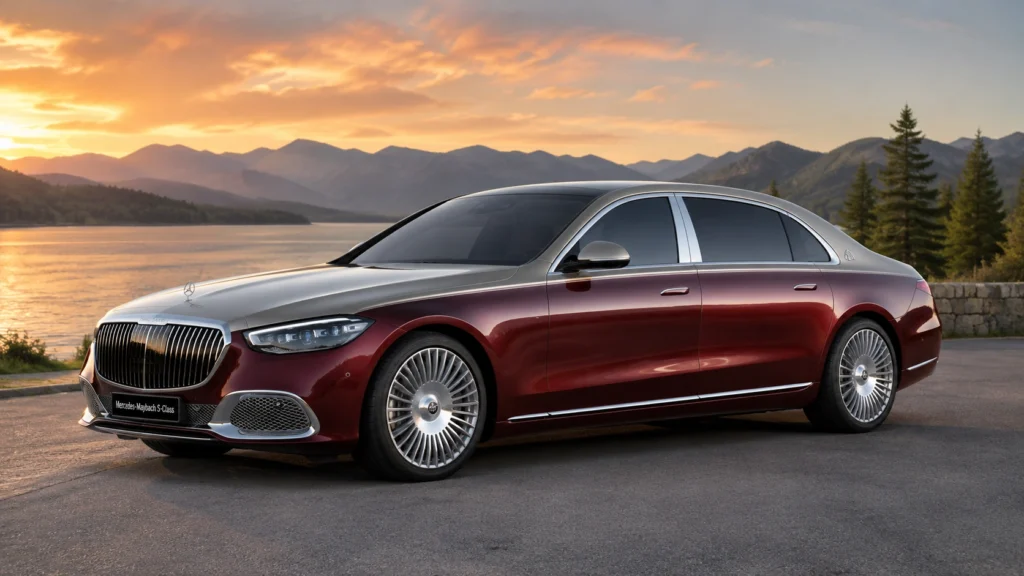
It helps to understand the brand’s structure before shopping. Standard models emphasize comfort. Mercedes-AMG is the in-house performance division, handling reworked engines and suspensions. Mercedes-Maybach sits above the standard lineup, applying extreme luxury treatment to the S-Class, GLS, and SL — these reflect genuinely different engineering, not just trim badges.
Mercedes-Benz History and Background
The story begins with two engineers who never met. Karl Benz built his three-wheeled Motorwagen in Mannheim in 1885, widely regarded as the first practical automobile with an internal combustion engine, while Gottlieb Daimler and Wilhelm Maybach developed their own engine technology in Stuttgart around the same time.
The Mercedes name arrived in 1901, when Daimler investor Emil Jellinek pushed for a model line named after his daughter, Mercédès, partly to help sales in France. The defining moment came in 1926, when Benz’s company merged with Daimler’s firm to form Daimler-Benz AG, officially creating Mercedes-Benz.
From there, the brand built its reputation on firsts: the crumple zone in the 1950s, the production airbag in 1980, and later predictive safety systems like PRE-SAFE. The 1930s Silver Arrows racing program reinforced its performance credibility early — a legacy that still shapes how the company positions itself today.
Mercedes-Benz Model Lineup
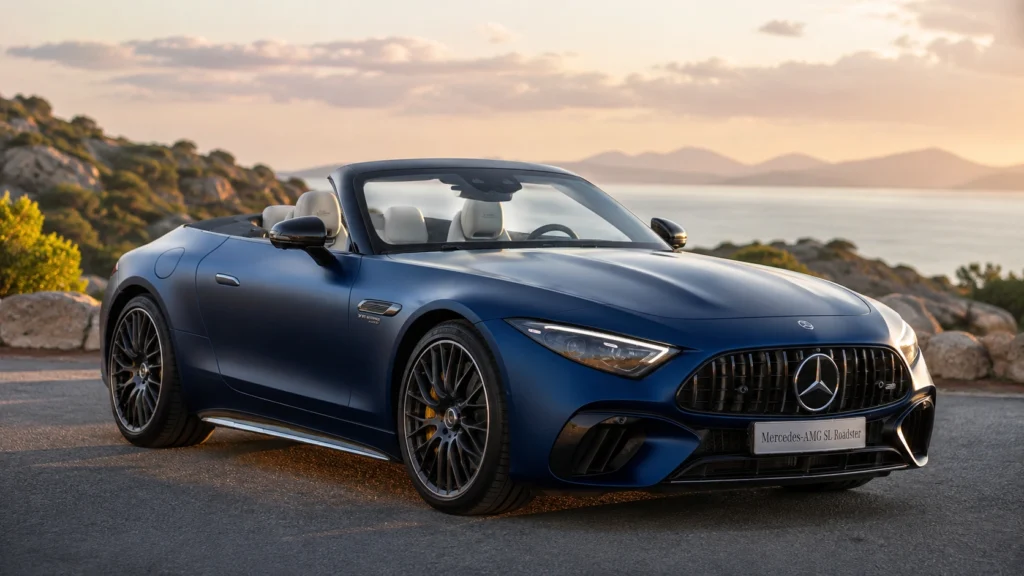
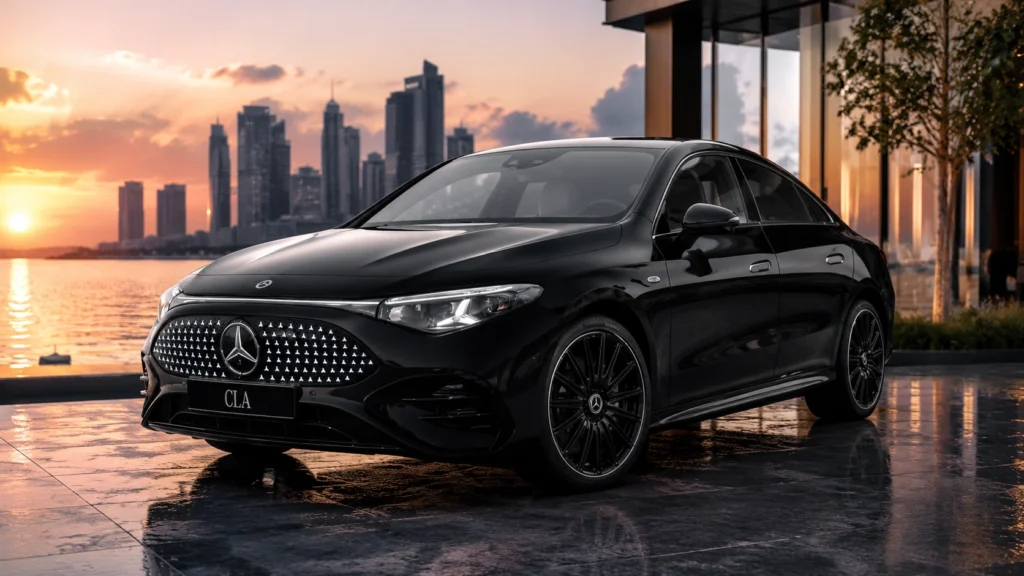
Compact models: The CLA is the brand’s entry point, a stylish four-door coupe with combustion and electrified powertrains, alongside the GLA and GLB compact SUVs, the latter offering an optional third row.
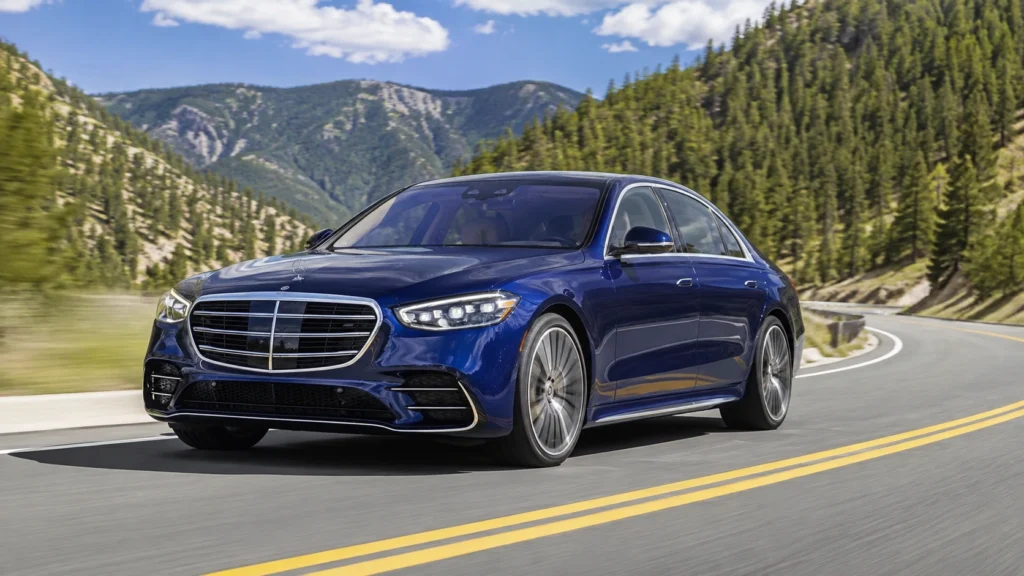
Core sedans: The compact C-Class, midsize E-Class (sedan and wagon), and flagship S-Class, plus the two-door CLE coupe and cabriolet.
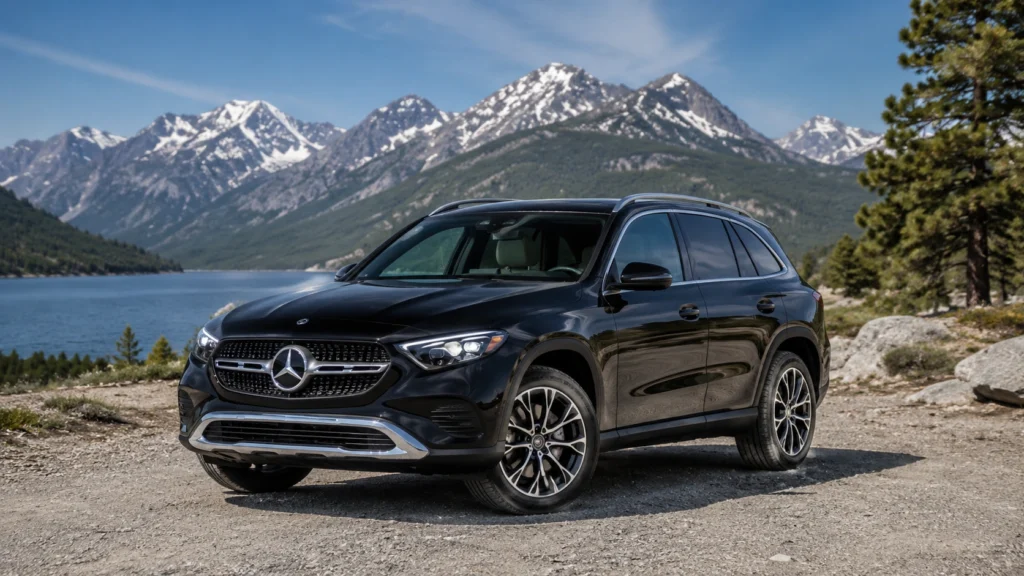
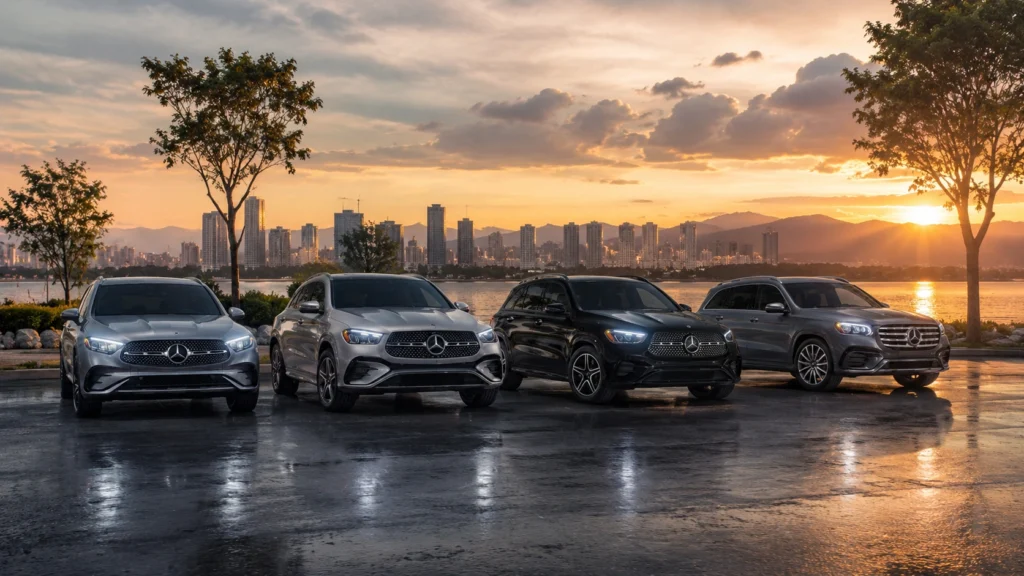
SUVs: The popular compact GLC, midsize GLE, three-row GLS flagship, and the boxy, body-on-frame G-Class.
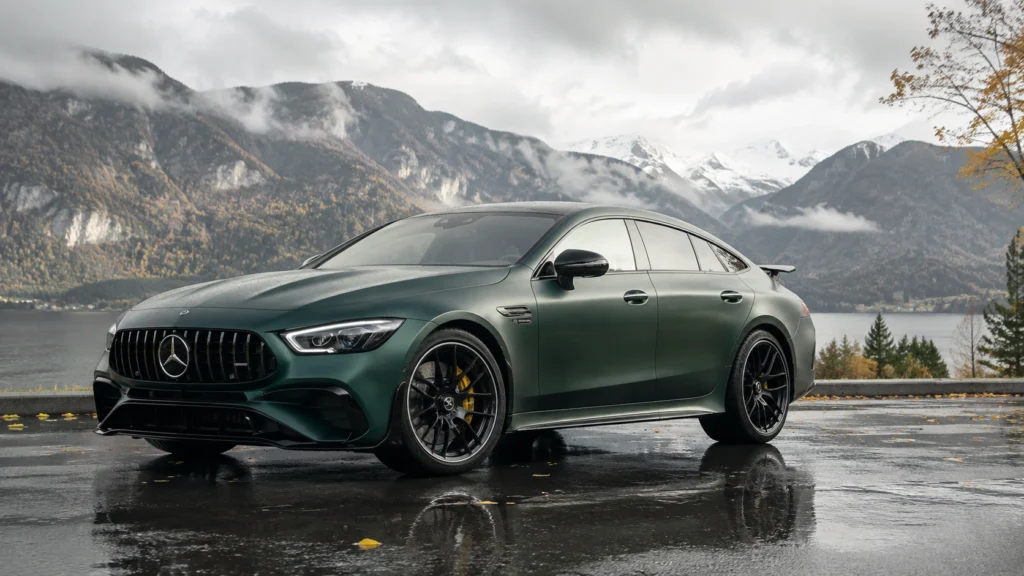
Sports and convertibles: The SL roadster and the dedicated AMG GT sports car.
Electric vehicles: The CLA with EQ Technology, EQB compact SUV, EQE sedan/SUV, and flagship EQS sedan/SUV.
AMG models: Available across nearly every family, from mildly upgraded 43-series cars to full 63-series flagships.
Maybach models: Ultra-luxury versions of the S-Class sedan and GLS SUV, plus limited SL editions.
Naming and trims shift year to year, so confirm current availability through the official Mercedes-Benz website before shopping.
Mercedes-Benz Body Styles Explained
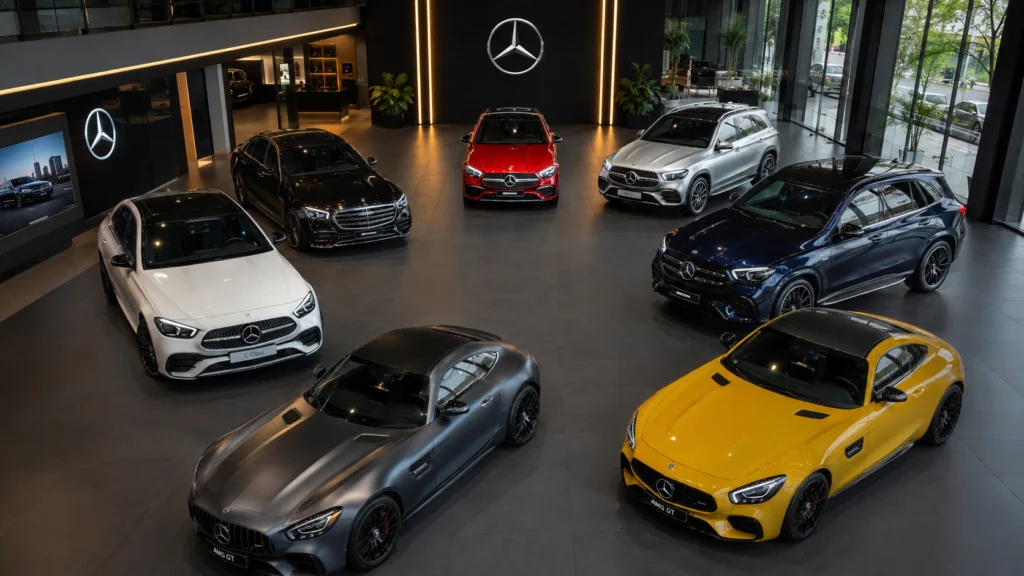
Sedans offer the best ride comfort and lowest running costs for their size, suiting commuters who want a quiet, composed drive. SUVs dominate sales because they combine ground clearance, easy entry, and flexible cargo room, making them popular with families. Coupes, like the CLE, trade rear-seat space for a sportier roofline.
Convertibles, such as the SL, are built around open-air driving and suit enthusiasts more than daily practicality. Compact models like the CLA and GLA offer a lower entry price without sacrificing much of the brand’s design language, and electric models span sedans and SUVs, prioritizing a quiet, torque-rich feel, though range and charging require more planning than a gas fill-up.
Mercedes-Benz Design and Exterior
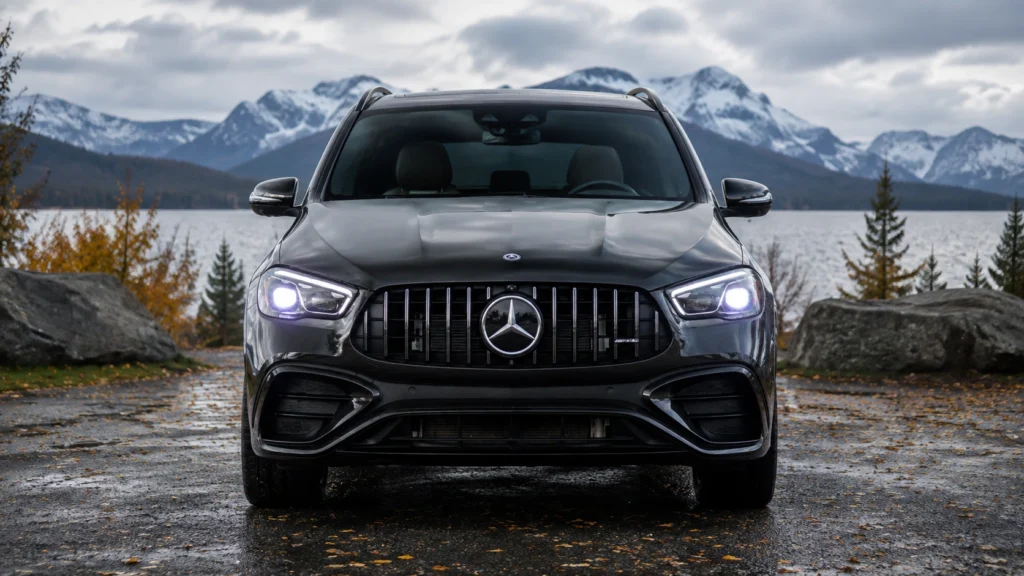
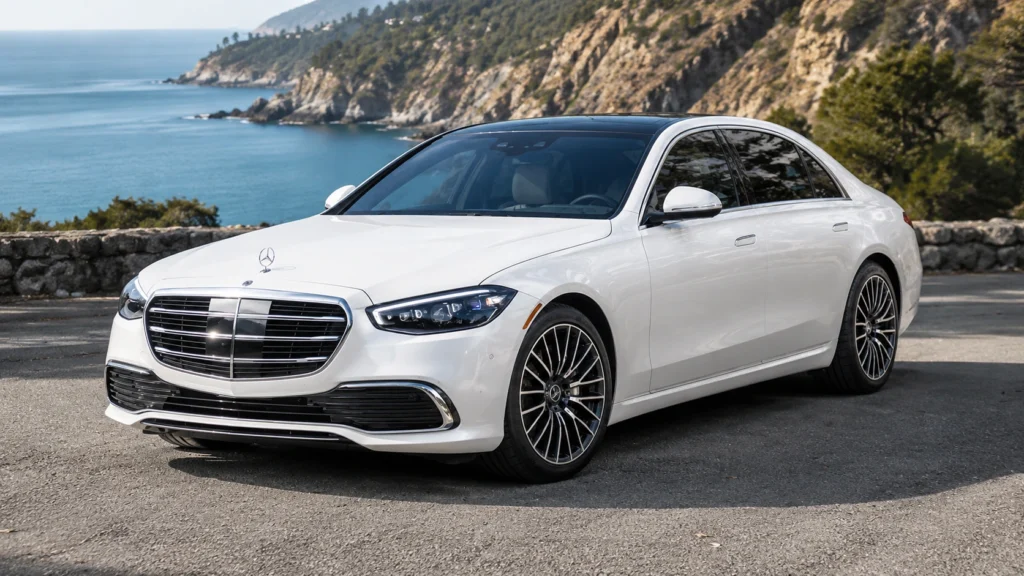
Exterior design has trended toward smoother, more sculptural surfacing, especially on EQ models, where aerodynamics plays a bigger role in the shape. The signature grille remains a key identifier — standard models center the three-pointed star on the hood or grille, while AMG models get wider, more aggressive intakes. Multibeam LED and Digital Light headlamp technology allow precise, adaptive illumination, and distinctive daytime running lights help buyers identify a Mercedes-Benz at a glance.
Wheel designs and trim finishes vary widely, from understated chrome on standard trims to blacked-out AMG Night packages. The clearest gap sits between tiers: standard models favor restrained surfacing, AMG adds aggressive splitters and unique wheels, and Maybach layers on extra chrome and badge details that signal a step above even a loaded standard model.
Mercedes-Benz Interior and Technology
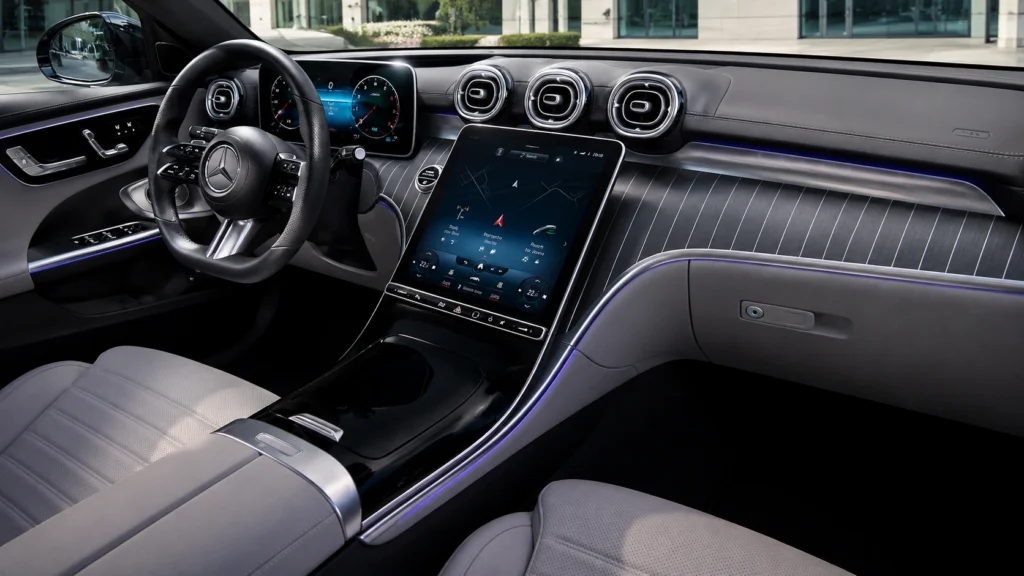
Cabin quality is one area where Mercedes-Benz has historically led. Even the C-Class uses soft-touch materials and tightly finished panel gaps, with real metal or wood accents on higher trims, and multi-contour, ventilated, or massaging seats available further up the range.
The centerpiece is MBUX, the brand’s infotainment software running the displays, navigation, climate, and voice assistant. Saying “Hey Mercedes” adjusts temperature or finds directions hands-free, similar to a smart speaker. Some models offer the optional MBUX Hyperscreen, a single glass panel spanning nearly the dashboard with separate displays for driver, center, and passenger.
Apple CarPlay, Android Auto, wireless charging, and real-time navigation are broadly available, with premium audio from brands like Burmester offered on higher trims. The cabin experience scales meaningfully as you move up the lineup, but even entry models feel distinctly upscale next to mainstream competitors.
Mercedes-Benz Safety and Driver-Assistance Technology
Mercedes-Benz offers a broad suite of driver-assistance features, though exact availability depends on model, trim, and market. Common systems include automatic emergency braking, active lane-keeping assistance, blind-spot monitoring, adaptive cruise control, and parking assistance ranging from basic sensors to semi-automated steering into a spot.
It’s worth being precise about autonomy here, since this technology has genuinely evolved. Mercedes-Benz was the first automaker to certify a SAE Level 3 conditional automated driving system, DRIVE PILOT, for parts of the U.S. and Germany on the S-Class and EQS — allowing eyes-off driving under limited highway conditions, though the driver must still retake control when prompted.
For the facelifted 2026 S-Class in the U.S., however, the brand shifted to a newer Level 2++ system called MB Drive Assist Pro instead, while developing more advanced Level 3 and Level 4 systems for the future. Availability changes quickly and varies by model year and region, so confirm the current system before assuming a capability — and treat none of these systems as fully self-driving.
Mercedes-Benz Engine and Performance
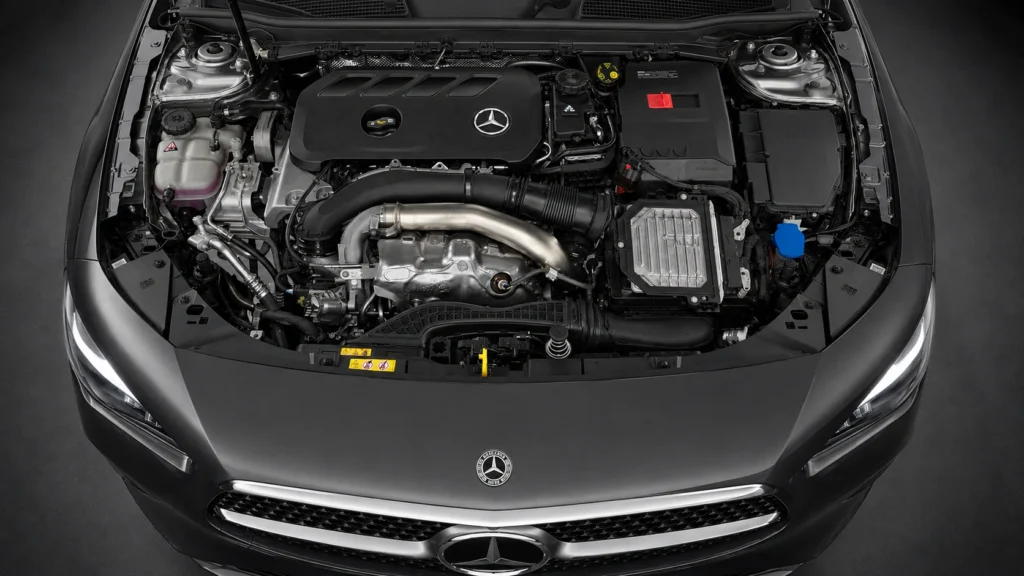
No single engine or output figure represents the whole lineup. Gasoline engines are typically turbocharged four-cylinders in compact and midsize cars, stepping up to six- and eight-cylinders in larger models. Horsepower measures power output; torque reflects twisting force, felt as low-end acceleration.
Mild-hybrid systems are now widespread, pairing a small electric motor with the engine to smooth stop-start behavior and add brief extra power, without pure-electric driving. Plug-in hybrids go further, offering limited electric-only range before the gas engine takes over. Fully electric powertrains power the EQ lineup, using one or two motors depending on whether the model is RWD or AWD (badged 4MATIC). AMG powertrains are covered next.
Rear-wheel drive is common on sportier and Maybach models, while 4MATIC all-wheel drive is widely available or standard on SUVs and many sedans.
Mercedes-AMG: Performance Explained
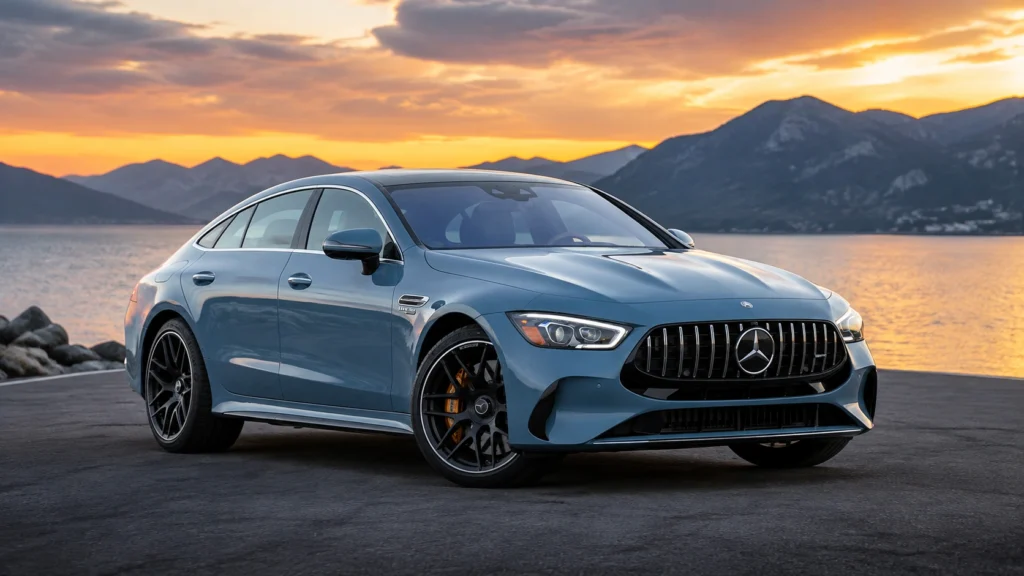
Mercedes-AMG is the brand’s official performance division, based in Affalterbach, Germany. It began in 1967 as an independent tuning company founded by former Mercedes engineers Hans Werner Aufrecht and Erhard Melcher, becoming a wholly owned subsidiary in 2005.
The biggest difference from standard models is under the hood. Many AMG engines are still hand-assembled by a single technician under the “One Man, One Engine” philosophy, and AMG models typically get reworked turbocharging, sport-calibrated transmissions, larger brakes, and tuned adaptive suspension, along with more aggressive styling and interior trim.
It’s worth separating true AMG models (badged 43, 53, 63, or higher) from the AMG Line appearance package, which adds sportier looks but doesn’t touch the engine or suspension. AMG suits buyers who genuinely want faster acceleration and sharper handling and accept the added cost; buyers who just want the look are better served by AMG Line.
Mercedes-Benz Electric Vehicles
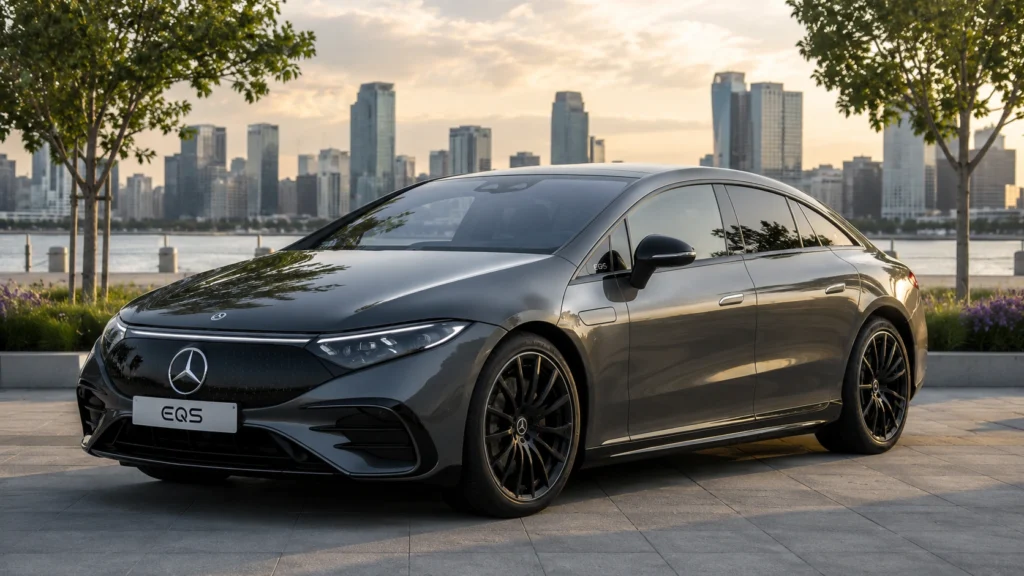
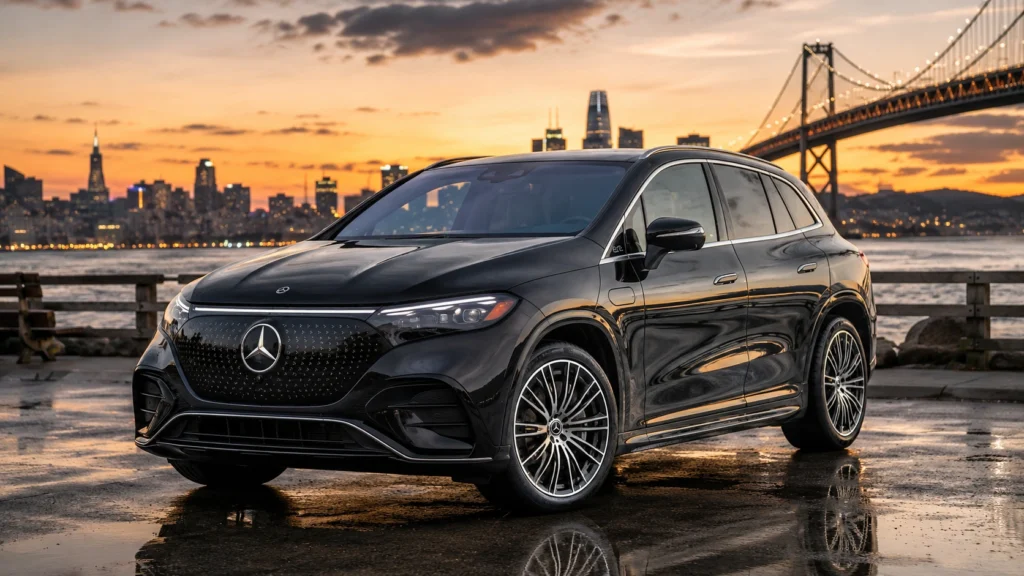
Mercedes-Benz’s EV strategy centers on the EQ sub-brand alongside EQ Technology versions of nameplates like the CLA. The lineup spans compact, midsize, and full-size vehicles at meaningfully different price points: the EQB is the entry point with compact SUV proportions, the EQE sedan and SUV sit in the midsize segment for buyers cross-shopping the E-Class or GLE, and the EQS sedan and SUV are the flagship electric experience, with Mercedes-Maybach also offering an ultra-luxury EQS SUV.
Charging works through AC and DC fast-charging, and Mercedes-Benz has added the NACS adapter as standard equipment on U.S.-market EQ models, opening up a larger public fast-charging network. Regenerative braking recaptures energy under deceleration, adjustable through drive modes or paddles, and performance varies by trim — entry-level EQ models favor efficiency, while AMG electric variants deliver acceleration comparable to combustion AMG models.
The main advantages are quiet, refined driving and useful real-world range on higher trims. The trade-offs are a price premium over combustion equivalents and the usual charging-infrastructure planning, especially without home charging.
Mercedes-Benz Specifications
Figures below are representative U.S. examples and vary by trim, model year, and drivetrain. Confirm exact specs for your configuration before purchase.
| Model | Body Style | Powertrain | Horsepower | 0–60 mph | Drivetrain | Starting MSRP (2026 US) |
|---|---|---|---|---|---|---|
| C 300 Sedan | Compact sedan | Turbo 4-cyl, mild hybrid | 255 hp | ~6.0 sec | RWD/AWD | ~$49,650 |
| E-Class Sedan | Midsize sedan | Turbo 4/6-cyl, mild hybrid | Varies | Varies | AWD | ~$63,900 |
| S-Class Sedan | Full-size sedan | Turbo 6-cyl/V8, mild hybrid | Varies | Varies | AWD | ~$119,500 |
| GLC 300 4MATIC Coupe | Compact SUV | Turbo 4-cyl, mild hybrid | Varies | Varies | AWD | ~$59,650 |
| GLS 450 | Full-size SUV | Turbo 6-cyl, mild hybrid | Varies | Varies | AWD | ~$90,250 |
| AMG G 63 | Off-road SUV | Twin-turbo V8, mild hybrid | Varies | Under 5 sec | AWD | ~$185,000 |
| EQS Sedan | Full-size electric sedan | Dual electric motors | Varies | Varies | RWD/AWD | ~$99,900 |
| EQS SUV | Full-size electric SUV | Single/dual motors | 355–536 hp | Varies | RWD/AWD | ~$89,950 |
| Maybach S 680 | Ultra-luxury sedan | Twin-turbo V12 | 621 hp | ~4.5 sec | AWD | ~$245,650 |
Mercedes-Benz Top Speed and Acceleration
There’s no single figure for the brand as a whole. Standard models like the C-Class and GLC are tuned for smooth daily performance, generally reaching 60 mph in 6-to-8 seconds. AMG models close that gap dramatically — cars like the AMG C 63 S E Performance and various 63-series SUVs hit 60 mph in roughly 3 to 4 seconds, rivaling dedicated sports cars.
Electric AMG variants push further, with some EQ AMG models capable of sub-3.5-second 0-60 times thanks to instant motor torque. Top speeds are typically limited on standard models for safety reasons, while select AMG models offer optional higher-speed packages. Exact figures depend on trim, options, and market regulations.
Mercedes-Benz Fuel Economy, Range, and Efficiency
Fuel economy varies significantly by powertrain. Compact four-cylinder models with mild-hybrid assist deliver the best combined figures, while V8 and V12 models trade efficiency for power. Plug-in hybrids offer strong efficiency for drivers who consistently charge and drive short trips electrically, though real-world economy drops once the battery depletes.
For EQ models, official range comes from standardized testing (EPA or WLTP depending on market), and real-world range is usually somewhat lower — driving style, temperature, tires, and climate control use all affect it. Cold weather is particularly relevant for EVs, since battery efficiency drops and cabin heating draws extra energy; unlike a gas car, sustained highway speed reduces EV range more than city driving. Treat manufacturer figures as a comparison tool, not a guaranteed number for your commute.
Mercedes-Benz Price
Figures reflect approximate 2026 model year starting MSRP for the U.S. market, before destination charges, taxes, and options.
Entry-level models like the GLA and CLA start in the low-to-mid $40,000s. Core models like the C-Class and GLC start around $50,000–$60,000, while the E-Class and GLE move into the mid-$60,000s to low-$90,000s. AMG models add a $15,000-to-$40,000-plus premium over standard counterparts, electric models price close to combustion equivalents (the EQS sedan starts near $99,900), and Maybach versions of the S-Class and GLS reach into the $200,000-plus range.
The sticker price is rarely the final price — options, taxes, dealer adjustments, and destination fees can add thousands, so request an out-the-door price before committing.
Mercedes-Benz Ownership Costs
Owning a Mercedes-Benz typically costs more than a mainstream brand. Routine maintenance relies on specialized diagnostics and manufacturer-approved parts, pushing service costs higher than a Toyota or Honda, and tires can be pricier too, especially on AMG’s staggered setups. Insurance premiums generally run higher given replacement cost and repair complexity, so it’s worth quoting before you buy.
New vehicles carry a 4-year/50,000-mile New Vehicle Limited Warranty in the U.S., with separate terms for plug-in hybrid batteries; extended coverage is available. Depreciation is worth researching model by model — AMG models often hold value better than heavily optioned standard trims due to lower production and resale demand. The bottom line: complexity, not lack of quality, is usually what drives up luxury maintenance costs.
Mercedes-Benz Reliability and Long-Term Ownership
Reliability here is genuinely nuanced — it’s not accurate to call the brand simply reliable or unreliable. J.D. Power’s newer-vehicle quality studies have generally placed Mercedes-Benz close to, or ahead of, some German rivals, with models like the CLE and E-Class ranking well within their segments, while Consumer Reports’ predicted-reliability rankings have placed the brand in the lower half of the industry, with technology-dense vehicles like the GLE pulling the average down.
Reliability depends on real factors: model, engine and drivetrain, model year, maintenance history, mileage, and prior ownership, and electronic systems are a common trouble spot across the luxury segment generally, since more screens and driver-assistance features mean more components that can glitch.
If shopping used, get an independent pre-purchase inspection, request full service history, and check for open recalls and any issues with air suspension or electronic modules. Despite mixed reliability data, Mercedes-Benz vehicles consistently earn strong crash-safety ratings from agencies like the IIHS, so the trade-off tends to be about maintenance rather than occupant safety.
Mercedes-Benz Pros and Cons
| Advantages | Disadvantages |
|---|---|
| Strong interior material quality and fit-and-finish | Maintenance and repair costs run higher than mainstream brands |
| Wide model variety across sedans, SUVs, coupes, and EVs | Reliability ratings are mixed and vary significantly by model |
| Advanced infotainment and driver-assistance technology | Complex electronics can be costly to fix out of warranty |
| Genuine AMG performance variants for enthusiasts | AMG and Maybach trims carry a substantial price premium |
| Comfortable, well-controlled ride quality on most models | Options can push prices well above base MSRP |
| Strong crash-safety reputation across the lineup | Some models score below average on dependability surveys |
Mercedes-Benz vs BMW vs Audi
| Category | Mercedes-Benz | BMW | Audi |
|---|---|---|---|
| Luxury feel | Plush, comfort-focused | Balanced, driver-oriented | Minimalist, tech-forward |
| Performance | Comfort-first; AMG adds sharp edge | Sportier as standard | Precise, AWD-confident |
| Technology | MBUX, strong voice control | iDrive, intuitive controls | MMI, clean screen layout |
| EV lineup | EQB, EQE, EQS | i4, i5, i7, iX | Q4, Q6, A6 e-tron |
| Ownership | Higher service costs, mixed dependability | Similar cost, strong performance reputation | Similar cost, strong tech reputation |
| Best for | Comfort and cabin luxury | Driving engagement | Understated design, AWD |
No brand wins every category: Mercedes-Benz suits comfort-first buyers, BMW suits those wanting a sportier daily feel, and Audi suits buyers who prefer quieter, minimalist design. Test-driving comparable models back-to-back is the best way to decide.
Mercedes-Benz vs Lexus
The choice usually comes down to prestige and technology versus long-term dependability. Mercedes-Benz offers a broader range, bolder styling, and deeper performance options through AMG, while Lexus consistently ranks near the top of independent reliability studies, drawing on Toyota’s manufacturing discipline.
Comfort is strong on both sides, though Mercedes-Benz leans into richer, bolder materials while Lexus prioritizes quiet refinement, and performance buyers typically favor AMG since Lexus’s F-branded lineup is smaller. Lexus generally has the edge on ownership costs and resale value — neither is objectively better, it’s technology and design versus worry-free ownership.
Who Should Buy a Mercedes-Benz?
Luxury-focused buyers and daily commuters benefit from cabin technology and comfort-oriented ride tuning. Families are well served by the GLC, GLE, and GLS. Performance enthusiasts have a clear path through AMG, EV buyers get competitive range through the EQE and EQS, and long-distance drivers benefit from highway comfort and adaptive cruise systems.
Buyers who prioritize the lowest running costs or class-leading dependability may be better served by Lexus or Toyota, while those who want a sportier character as standard, rather than added through AMG, might prefer BMW.
Which Mercedes-Benz Is Right for You?
- First-time luxury buyers: C-Class or GLC — genuine entry point without a flagship price tag.
- Families: GLE or GLS — space, third-row seating, and safety technology.
- Performance enthusiasts: AMG 63-series or AMG GT — the most direct, engaging driving experience.
- Long-distance comfort: E-Class or S-Class — adaptive suspension and quiet cabins.
- Electric-car buyers: EQE for balance, EQS for the full flagship experience.
- Maximum luxury: Mercedes-Maybach S-Class — rear-seat comfort and bespoke detailing.
These are starting points; your ideal choice still depends on budget, driving habits, and which features matter most.
Buying a New vs Used Mercedes-Benz
Buying new gets you the latest technology, a full factory warranty, and exact configuration control, though you’ll absorb the steepest early depreciation. Buying used can meaningfully lower entry cost, particularly on models two to four years old once depreciation has flattened, and Certified Pre-Owned (CPO) vehicles add a multi-point inspection and extra warranty coverage on top of any remaining factory warranty — confirm exactly what’s covered and for how long.
Before buying used, request a complete service history, check for open recalls, and get an independent inspection focused on air suspension, transmission health, and stored diagnostic codes. For AMG models, ask about track use and verify that items like brake fluid and spark plugs were serviced on schedule.
Conclusion
Mercedes-Benz remains one of the most complete luxury automakers on the market, offering genuine variety across sedans, SUVs, coupes, and electric vehicles rather than leaning on a single hero model. Whether you want understated comfort, AMG-level performance, or Maybach-grade luxury, there’s a version of Mercedes-Benz built for that priority.
The brand’s technology, from MBUX to its evolving driver-assistance systems, continues to push the segment forward, even as features like Level 3 automation availability shift year to year. Ownership costs and reliability data deserve honest scrutiny, since luxury and dependability don’t always move together in this segment.
For buyers who value comfort, design, and brand prestige, and who are prepared for higher running costs, Mercedes-Benz remains a strong, well-rounded choice. For buyers chasing the lowest possible cost of ownership, it’s worth cross-shopping carefully before signing.
Frequently Asked Questions (FAQs)
Luxury sedans and SUVs, pioneering safety technology, and its AMG performance division.
Yes — a premium automaker competing with BMW, Audi, and Lexus.
It varies, but simpler models like the C-Class and E-Class generally score better than heavily optioned or AMG variants.
Generally yes — specialized parts and labor make service pricier than mainstream brands.
Neither is universally better; Mercedes-Benz emphasizes comfort, while BMW leans sportier as standard.
AMG is the performance division with reworked engines and suspensions; standard models are tuned for comfort.
Yes, particularly the C-Class, E-Class, and GLC, tuned for comfort with useful driver-assistance features.
With reliable charging access, the EQE and EQS are genuinely competitive; without it, a hybrid may suit better.