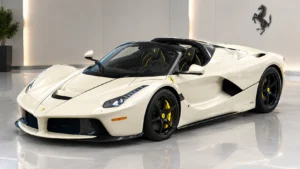
Lamborghini in 2026: Inside the Supercars, the Hybrids, and the Urus SE

There is no badge in the car world that triggers quite the same reaction as the raging bull. Say the word Lamborghini to a five-year-old or a fifty-year-old and you get the same wide-eyed response.
That is not an accident. It is the result of six decades of building cars that refuse to blend in.
What makes Lamborghini genuinely interesting right now, though, isn’t nostalgia. It’s the fact that the brand has just rebuilt its entire lineup around hybrid power without losing the drama that made it famous.
The Revuelto brought a hybrid V12 to the flagship supercar. The Temerario replaced the beloved Huracán with a twin-turbo V8 hybrid. The Urus SE turned the brand’s best-selling model into a plug-in hybrid Super SUV.
This piece walks through where Lamborghini came from, how its current cars are engineered, what they actually cost to buy and run, and who they genuinely make sense for.
Quick Specifications
| Model | Engine | Power | 0–100 km/h | Top Speed |
|---|---|---|---|---|
| Lamborghini Revuelto | 6.5L naturally aspirated V12 + 3 electric motors (PHEV) | 1,015 CV / 747 kW combined | 2.5 s | >350 km/h |
| Lamborghini Temerario | 4.0L twin-turbo V8 + 3 electric motors (PHEV) | 920 CV / 677 kW combined | 2.7 s | 343 km/h |
| Lamborghini Urus SE | 4.0L twin-turbo V8 + 1 electric motor (PHEV) | 800 CV / 588 kW combined | 3.4 s | 312 km/h |
Figures above are manufacturer-published performance data for the current model range.
What Is Lamborghini?
Lamborghini is an Italian manufacturer of luxury sports cars and supercars, headquartered in Sant’Agata Bolognese, a small town near Bologna. The company was founded in 1963.
It sits at the very top of the performance-car market, alongside Ferrari and a handful of other exotic marques. Lamborghini cars are built in relatively small numbers, and that scarcity is part of the appeal.
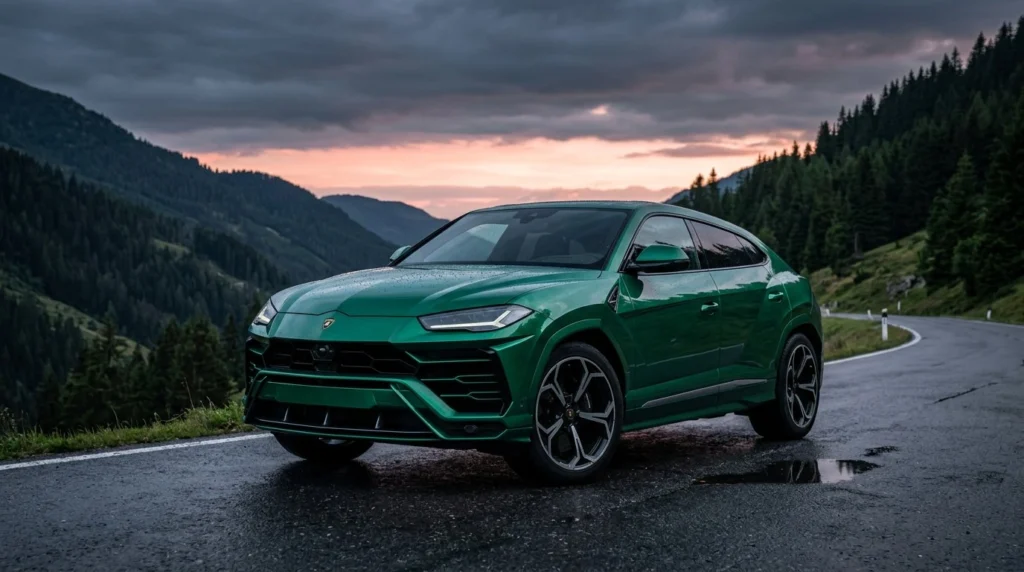
The brand’s current lineup covers two very different kinds of vehicle. There are the two-seat supercars — the Revuelto and the Temerario — and there is the Urus, a four-door Super SUV that outsells both of them combined.
That split matters. Lamborghini sports cars exist to deliver a visceral, track-capable experience with almost no compromise for daily comfort. The Urus, meanwhile, was built specifically to bring Lamborghini performance to buyers who also need rear seats and cargo space.
What has changed most in recent years is the powertrain philosophy. Every current Lamborghini model, from the V12 flagship to the Super SUV, is now a plug-in hybrid. The company has framed this not as a retreat from performance but as a way to add instant torque, a limited electric-only range, and lower emissions without diluting the driving experience.
You can see the full current model range, configurator, and factory-published specifications on the official Lamborghini website.

History and Background
Lamborghini’s origin story is one of the more famous ones in the car industry. Ferruccio Lamborghini had already built a successful tractor manufacturing business when he decided, in the early 1960s, that he could build a better grand tourer than Ferrari.
The story goes that Ferruccio owned a Ferrari, wasn’t happy with its clutch, and took his complaint directly to Enzo Ferrari, who reportedly told him to stick to tractors. Whether every detail of that exchange is accurate or embellished by decades of retelling, the rivalry it sparked was real, and it gave Automobili Lamborghini its founding motivation.
The 350 GT, launched in 1964, was the company’s first production model — a front-engined grand tourer that proved Lamborghini could build a refined, usable car.
Everything changed with the Miura in 1966. It moved the engine behind the driver, a layout borrowed from racing, and is widely credited as the car that created the modern supercar template.
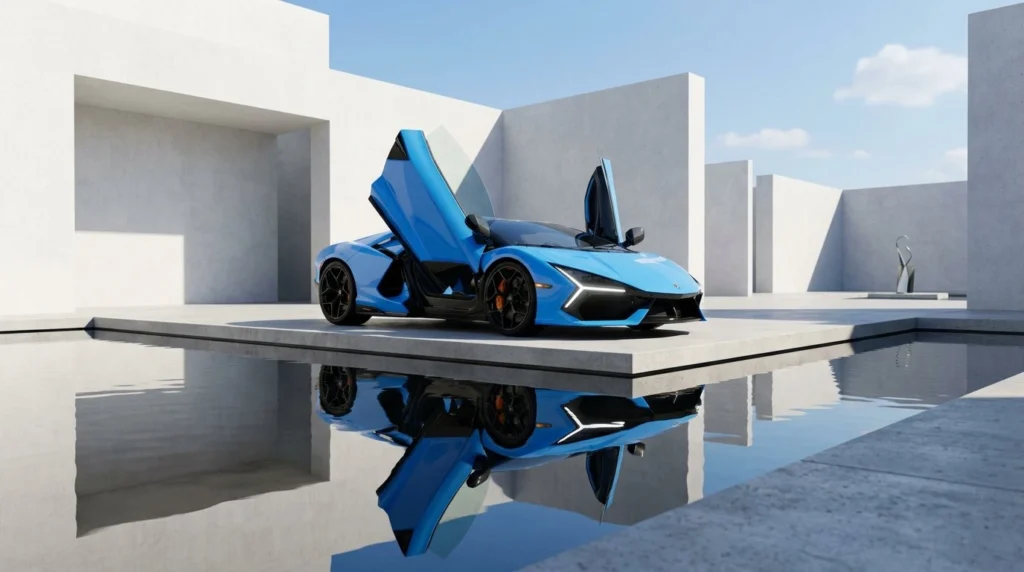
The Countach, introduced in the 1970s, pushed the wedge-shaped design language to its extreme and introduced the scissor doors that remain a Lamborghini signature today.
The Diablo carried that formula into the 1990s with more power and, eventually, all-wheel drive. The Murciélago, launched in 2001 under Audi’s ownership, brought a new level of build quality and reliability without losing the theatrical styling.
The Gallardo deserves special mention. Produced from 2003 to 2013, it became Lamborghini’s best-selling model up to that point and introduced a huge number of new buyers to the brand thanks to its relative usability.
The Aventador (2011–2022) replaced the Murciélago as the flagship V12, and the Huracán (2014–2024) replaced the Gallardo, both becoming the backbone of Lamborghini’s lineup for over a decade.
The Urus, launched in 2018, marked Lamborghini’s serious return to the SUV segment — a market it had briefly touched decades earlier with the military-inspired LM002.
Now the transition is toward electrification. The Revuelto replaced the Aventador as a hybrid V12 flagship, the Temerario replaced the Huracán with a hybrid V8, and the Urus SE brought plug-in hybrid technology to the Super SUV. Lamborghini history, in other words, is really a history of reinvention every decade or so, always keeping the drama while quietly updating the engineering underneath it.

Design and Exterior
Lamborghini’s design language has always been built around a few consistent ideas: low stance, wide track, sharp angular surfaces, and a silhouette that looks aggressive even standing still.
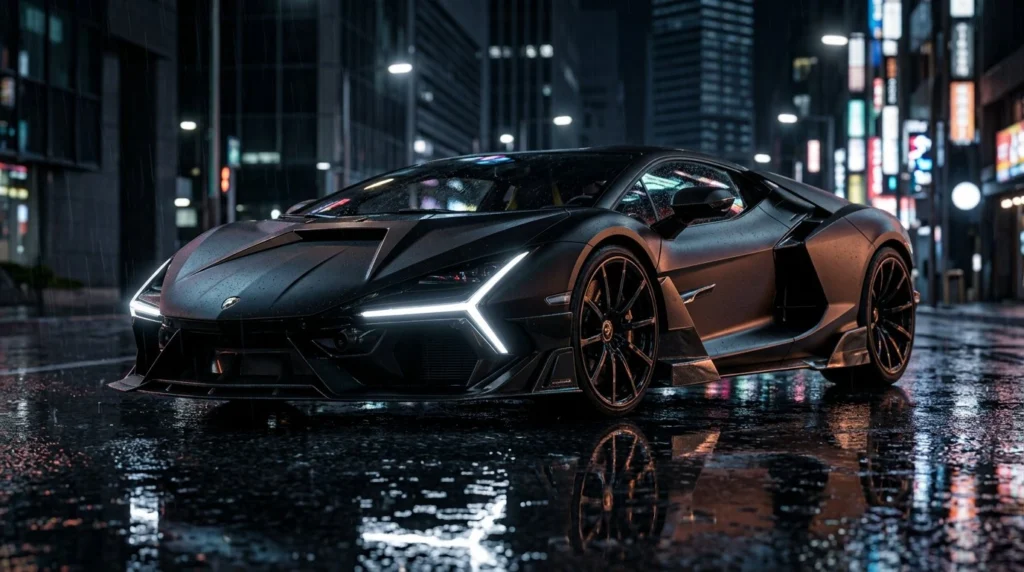
The current cars lean heavily on hexagonal shapes for lights, vents and details — a theme that ties the Revuelto, Temerario and Urus SE together visually despite their very different roles.
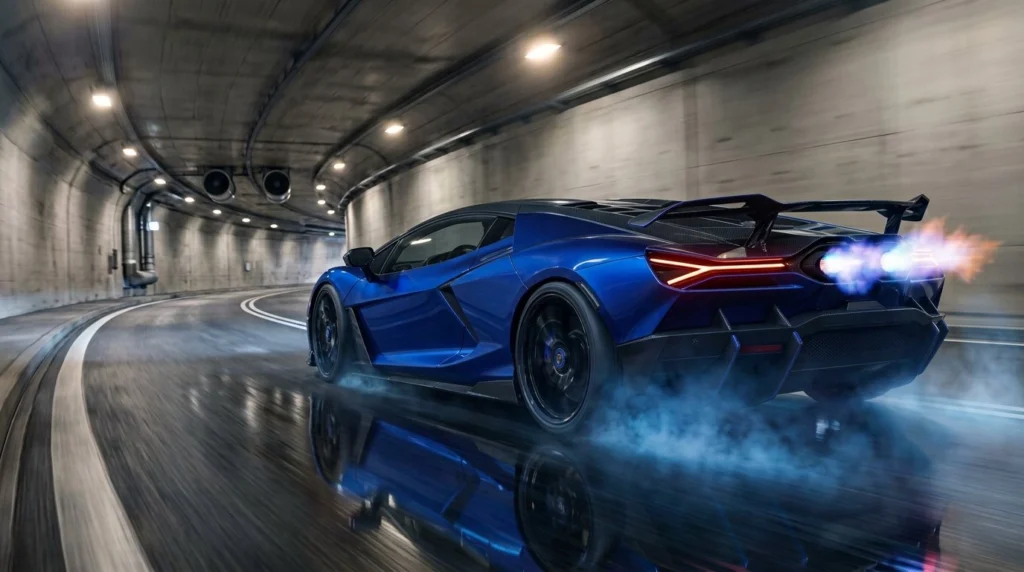
Aerodynamics plays a much bigger role than it used to. Both the Revuelto and Temerario use active aerodynamic elements, including rear wings and underbody devices that adjust to balance downforce against drag depending on the driving mode.
Large air intakes aren’t just styling flourishes. They feed the engine, the intercoolers, and the brakes, all of which generate serious heat under hard driving.
Carbon fiber is now central to how these cars are built, not just how they look. The Revuelto’s structure is based around a carbon-fiber monocoque, which keeps weight down despite the added mass of batteries and electric motors.
Lighting design has become a genuine signature element too, with sharp, Y-shaped or hexagonal daytime running lights that are instantly recognizable at night.
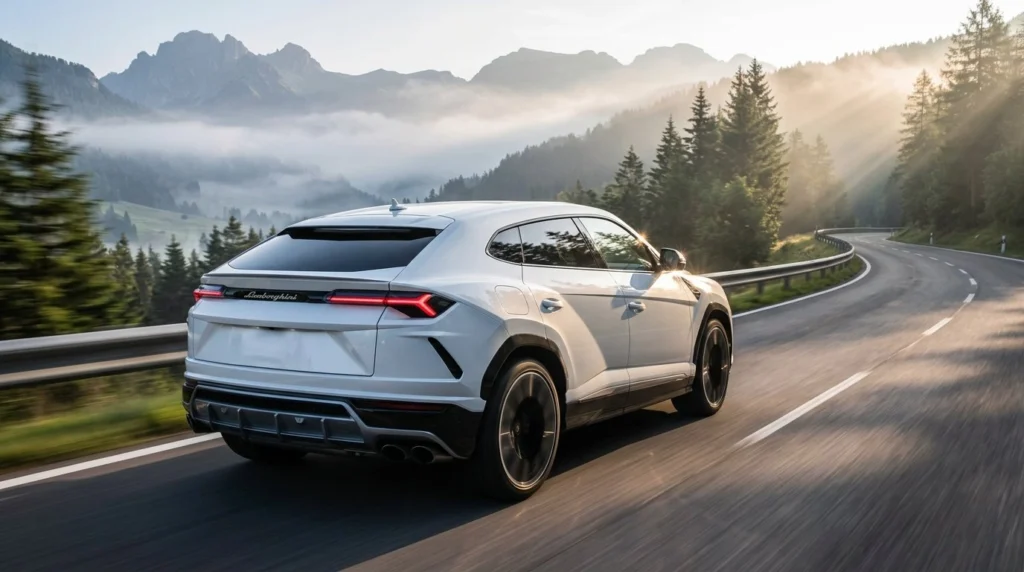
The scissor doors remain reserved for the two-seat supercars. The Urus, being a practical four-door SUV, uses conventional doors, though its designers worked hard to give it the same forward-leaning, muscular stance as its smaller siblings — proof that Lamborghini’s exterior design language can stretch across very different body styles without losing its identity.
Interior and Technology
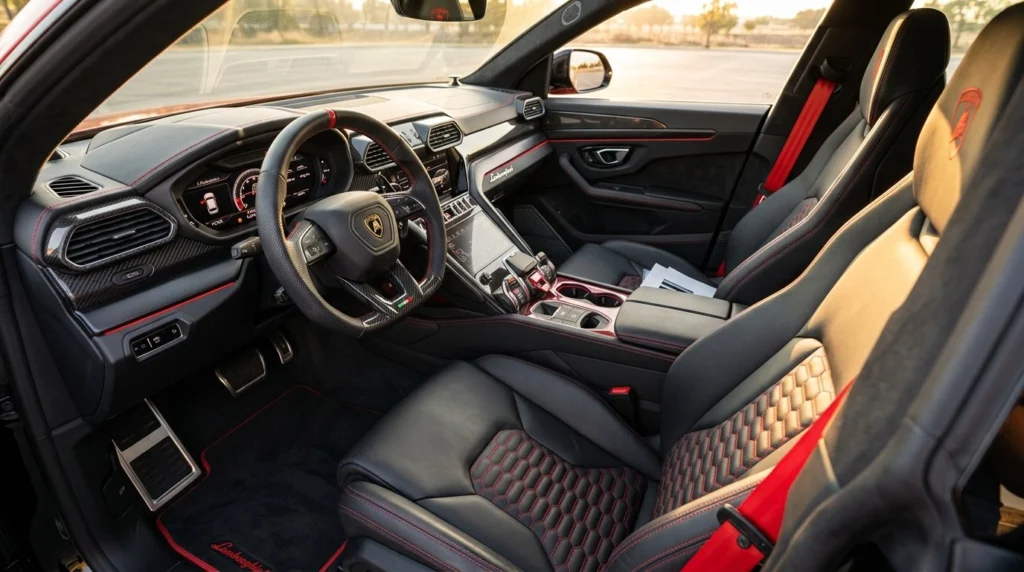
Step inside a modern Lamborghini and the cockpit still feels distinctly driver-focused, even with more everyday usability built in than earlier generations offered.
Leather and Alcantara remain the dominant materials, often mixed with exposed carbon fiber trim on the dashboard, center console and door panels.
Digital instrument clusters have replaced analog dials across the range, paired with a central touchscreen for infotainment, climate and vehicle settings. Smartphone connectivity, navigation and voice control are all standard expectations at this price point now, not premium extras.
Driving modes remain a huge part of the experience. Buyers can typically choose between comfort-oriented settings for daily use, sportier calibrations that sharpen throttle and steering response, and dedicated track modes that unlock the full character of the hybrid powertrain.
The hybrid systems themselves add a layer of technology that didn’t exist in older Lamborghinis: a small battery pack, electric motors, and a control system that decides when to add torque, when to recover energy under braking, and when to allow brief electric-only driving at low speed.
Driver-assistance technology has also expanded, with features like parking sensors, cameras and lane-related warnings now available, largely to make these cars easier to live with in daily traffic.
Personalization is where Lamborghini genuinely stands apart. Through its Ad Personam program, buyers can specify bespoke paint, stitching patterns, materials and trim combinations that go far beyond a standard options list — one of the reasons two Lamborghinis of the same model rarely look identical inside.
Engine and Performance
This is where Lamborghini’s engineering philosophy is easiest to see in action, and where the hybrid transition has actually added more than it has taken away.
The Revuelto uses a 6.5-liter naturally aspirated V12 paired with three electric motors, drawing from a 3.8kWh battery. Combined output is 1,015 CV (747 kW), sent through an eight-speed dual-clutch transmission to all four wheels.
The Temerario takes a different route. Its 4.0-liter twin-turbocharged V8 was designed from scratch in-house and works with three electric motors for a combined 920 CV (677 kW). Notably, it’s engineered to safely spin past 10,000 rpm, an unusual trait for a turbocharged engine, and one that helps it retain some of the high-revving character enthusiasts associated with the outgoing naturally aspirated V10.
The Urus SE pairs a re-engineered version of the same twin-turbo V8 architecture with a single electric motor built into the transmission, plus a larger 25.9kWh battery that allows for over 60 kilometers of electric-only driving. Combined output is 800 CV (588 kW).
Torque delivery is where the electric motors matter most in daily driving. Because electric motors produce maximum torque almost instantly, throttle response at low RPM feels sharper than the combustion engine’s output alone would suggest, filling in the moment before turbo boost or high engine speed builds full power.
All three current models use all-wheel drive, which helps put that power down without simply spinning the rear tires, particularly important given how much torque arrives at low speed.
Weight distribution and chassis tuning matter just as much as raw output. Lamborghini engineers battery placement, motor location and structural elements specifically to keep the center of gravity low and balance close to ideal, rather than just bolting hybrid components onto an existing platform.
Braking systems have had to evolve too. Carbon-ceramic brakes are standard across the current lineup, chosen for their resistance to fade under repeated hard stops — something a heavier, hybrid-assisted car demands more than ever.
This is also why horsepower figures alone don’t tell the full story. A car’s real-world speed depends on how efficiently it turns that power into forward motion — through gearing, traction, aerodynamics and weight — not just the number printed in a spec sheet.
Specifications
| Specification | Revuelto | Temerario | Urus SE |
|---|---|---|---|
| Engine | 6.5L NA V12 + 3 e-motors | 4.0L twin-turbo V8 + 3 e-motors | 4.0L twin-turbo V8 + 1 e-motor |
| Displacement | 6,498.5 cm³ | 3,995.2 cm³ | 3,996 cm³ |
| Power (combined) | 1,015 CV / 747 kW | 920 CV / 677 kW | 800 CV / 588 kW |
| Transmission | 8-speed dual-clutch | 8-speed dual-clutch | 8-speed automatic |
| Drive System | All-wheel drive | All-wheel drive | All-wheel drive |
| 0–100 km/h | 2.5 s | 2.7 s | 3.4 s |
| Top Speed | >350 km/h | 343 km/h | 312 km/h |
| Body Style | 2-door coupe | 2-door coupe | 5-door Super SUV |
In real-world terms, these numbers translate into very different personalities. The Revuelto’s V12 rewards high-rpm driving and delivers the most theatrical soundtrack of the three. The Temerario feels sharper and more immediate at everyday speeds thanks to turbo torque arriving earlier in the rev range. The Urus SE, despite weighing considerably more than either supercar, still closes a gap to 100 km/h faster than most sedans will ever manage.
Top Speed and Acceleration
Lamborghini’s published 0–100 km/h times are achieved under specific, controlled conditions: launch control engaged, a warmed-up powertrain, and ideal grip. Your driveway on a cold morning will not replicate a factory test track.
Traction is the single biggest variable in translating power into acceleration. All three current models use all-wheel drive precisely because putting close to or over 900 horsepower through only two tires would waste much of it to wheelspin.
Tire choice matters more than most buyers realize. The factory-fitted performance tires are optimized for grip in dry, warm conditions, and acceleration figures can shift noticeably on cold or wet asphalt.
Electric torque fills in a gap that combustion engines have always struggled with: the instant the driver presses the throttle. That immediate response is a big part of why these hybrid Lamborghinis feel so aggressive off the line, even before the combustion engine reaches its power band.
Top speed, by contrast, is far more about aerodynamics and drag than outright power. The Revuelto’s higher top speed compared to the Temerario reflects both its extra power and a body shape tuned with less drag at the very top end.
Braking performance deserves equal attention, since a car that can’t slow down as impressively as it accelerates isn’t actually faster in the real world — it’s just riskier. Carbon-ceramic brakes and modern electronic brake distribution are what let these cars repeatedly attack corners without fading.
None of this means published figures are meaningless. It simply means a 2.5-second 0–100 km/h claim describes a best-case scenario, not a public-road guarantee.
Lamborghini Price
There is no single honest answer to “how much does a Lamborghini cost,” and any article claiming otherwise is oversimplifying things.
Pricing varies significantly by country, due to import duties, local taxes, and market-specific equipment requirements. A Urus SE priced one way in the United States will carry a very different final number in the UAE, the UK, or Australia once local taxes are applied.
Based on figures reported by Lamborghini dealers and automotive outlets for the US market, starting prices for the 2025–2026 lineup have been reported in roughly the following order: the Urus SE resides around the low-to-mid $200,000s before options, the Temerario starts in the mid-$300,000s, and the Revuelto starts above $600,000. These are dealer- and market-reported starting figures rather than a single fixed global price, and actual transaction prices depend heavily on specification and market.
Personalization can move the final price substantially. Lamborghini’s Ad Personam program allows buyers to specify unique paint, interior materials, and trim combinations, and these choices routinely add tens of thousands of dollars to a build.
Ownership costs go well beyond the purchase price. Insurance for a car in this performance and value bracket is significantly higher than for a mainstream luxury vehicle, reflecting both repair costs and the risk profile of high-performance driving.
Maintenance and servicing must generally be handled through the dealer network, and scheduled service intervals, combined with specialized parts, keep annual running costs high compared to ordinary cars.
Tires and brakes are consumables that wear faster under spirited driving, and replacing a set of performance tires or carbon-ceramic brake components on a Lamborghini is considerably more expensive than doing the same on a typical sports car.
Because these are now plug-in hybrids, owners also need to think about home charging if they want to use the electric-only range, alongside premium fuel, registration and applicable luxury taxes.
Pros and Cons
Pros
- Genuinely distinctive design that stands out from every competitor
- Explosive acceleration and strong all-weather traction thanks to AWD
- Hybrid powertrains add usable torque and short electric-only range
- Extensive personalization through Ad Personam
- Strong brand exclusivity and resale interest on limited variants
Cons
- High purchase price before any customization
- Expensive ongoing maintenance, tires, and insurance
- Limited practicality on the two-seat supercars
- Long waiting lists for certain configurations and special editions
- Fuel economy and running costs remain far higher than mainstream luxury cars
Comparison With Competitors
Lamborghini doesn’t operate in isolation. Buyers cross-shopping a Revuelto or Temerario are almost always also looking at Ferrari, McLaren, and sometimes Porsche, Aston Martin or Bentley, depending on how they define “supercar.”
| Category | Lamborghini | Ferrari | McLaren | Porsche |
|---|---|---|---|---|
| Design | Aggressive, angular, unmistakable | Sculptural, GT-inspired elegance | Aerodynamics-first, understated drama | Clean, evolutionary styling |
| Performance | Explosive off the line, hybrid-assisted | Balanced, race-bred engineering | Track-focused, lightweight-first | Precise and consistent |
| Driving Character | Theatrical, emotionally intense | Engaging, driver-centric feedback | Analog, high steering feedback | Predictable, confidence-inspiring |
| Practicality | Urus adds genuine SUV usability | Limited, though GT models help | Limited across the range | Strong (Cayenne, Panamera, 911) |
| Exclusivity | Very high | Very high | High | Moderate to high |
Ferrari tends to lean on decades of racing pedigree and a slightly more restrained, GT-influenced design language, while still delivering comparable performance figures.
McLaren prioritizes lightweight construction and aerodynamic efficiency over outright visual drama, which gives its cars a more analog, purist feel behind the wheel.
Porsche occupies a different niche entirely. Its 911 Turbo and Cayenne/Panamera-based performance models can’t match Lamborghini’s outright exclusivity or visual aggression, but they offer far greater everyday usability and a lower total cost of ownership.
Aston Martin and Bentley compete more with Lamborghini’s luxury positioning than its performance numbers, favoring craftsmanship and grand-touring comfort over track capability.
None of these brands is universally “better.” The right choice depends on whether a buyer values daily usability, motorsport heritage, outright drama, or a specific driving character above the others.
Who Should Buy It?
A Lamborghini makes the most sense for buyers who genuinely want a car that turns heads and delivers an emotional, high-drama driving experience, not just fast point-to-point transportation.
Supercar enthusiasts who already understand the trade-offs of low ground clearance, firm suspension tuning and limited storage space will find the Revuelto and Temerario deliver exactly what they promise.
Collectors interested in limited-production variants, like the Revuelto SV, are buying into Lamborghini’s long history of special editions holding or appreciating in value over time.
Performance-focused drivers who plan to actually use their car on track days, not just at car meets, will appreciate the genuine engineering behind the hybrid systems, chassis tuning and braking performance.
Luxury buyers who want exclusivity and are comfortable with the associated running costs will find the personalization options through Ad Personam particularly appealing.
Buyers who want Lamborghini performance with real practicality should look specifically at the Urus SE, which brings rear seats, cargo space and genuine daily usability to the badge.
On the other hand, buyers prioritizing low running costs, maximum practicality, or a low profile in traffic should look elsewhere. A Lamborghini, by design, is not built to be discreet, and it will never be the cheapest way to get from A to B.
Conclusion
Lamborghini in 2026 is a genuinely different company than it was even a decade ago, even if the design language still looks unmistakably like a Lamborghini. The move to hybrid power across the Revuelto, Temerario and Urus SE hasn’t softened the brand’s character so much as reshaped how that character gets delivered.
The V12 still screams the way enthusiasts expect, just with an electric assist filling in the gaps. The V8 supercar still feels sharp and immediate, and the Super SUV still manages to look like it belongs on a race track rather than a school run.
What buyers get in return for the price of admission is exclusivity, drama, and engineering that genuinely justifies the badge, alongside running costs and practicality trade-offs that demand honest consideration before signing anything.
For the right buyer, that trade-off has never been in question. Lamborghini isn’t trying to be everything to everyone, and that focus is precisely why it remains one of the most compelling names in the performance-car world.
Frequently Asked Questions (FAQs)
Lamborghini is best known for building dramatic, mid-engine supercars with distinctive angular styling, scissor doors on flagship models, and a reputation for uncompromising performance.
Among current production models, the Revuelto has the highest manufacturer-quoted top speed, exceeding 350 km/h, ahead of the Temerario and Urus SE.
Yes. The Revuelto uses a 6.5-liter naturally aspirated V12, now paired with a hybrid system, making it Lamborghini’s current V12 flagship.
Yes. The Revuelto combines its V12 engine with three electric motors and a small plug-in battery, making it Lamborghini’s first series-production hybrid supercar.
The Temerario uses a newly developed 4.0-liter twin-turbocharged V8, paired with three electric motors as part of its hybrid powertrain.
Lamborghini quotes a 0–100 km/h time of 3.4 seconds and a top speed of 312 km/h for the Urus SE, making it one of the quickest Super SUVs currently on sale.
Prices vary by model, market and specification. Reported US starting prices for the current lineup range from roughly the low $200,000s for the Urus SE to over $600,000 for the Revuelto, before personalization.
The Urus SE is the most practical choice for daily use, offering four doors, usable cargo space and a plug-in hybrid system with a short electric-only range.