
Lamborghini Temerario: Price, Specs, Performance and Everything Else That Matters
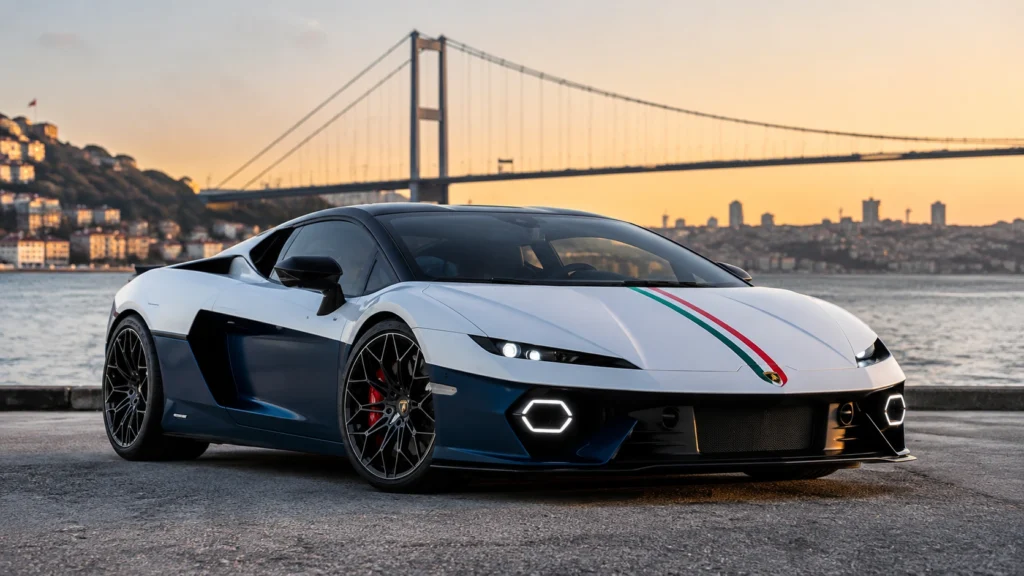
Ten thousand rpm used to be a number reserved for motorcycles and Formula 1 engines, not a road-legal Lamborghini you can order through a dealer. That’s exactly the number Sant’Agata Bolognese built into its newest V8, and it tells you almost everything about the philosophy behind this car before you even look at a spec sheet.
The Lamborghini Temerario is the car that replaces the Huracán, and replacing a model that sold more than 40,000 units over a decade is not a small assignment. Lamborghini didn’t play it safe. Instead of another naturally aspirated engine, the Lamborghini Temerario arrives as a plug-in hybrid supercar built around a twin-turbo V8 and three electric motors, a combination that would have seemed unthinkable from this brand a few years ago.
What makes it worth your time isn’t just the horsepower figure. It’s how Lamborghini engineered a turbocharged, electrified powertrain to still rev like a race engine, why the company chose all-wheel drive over the Huracán’s rear-drive variants, and whether any of this actually translates into a better driving experience. Let’s get into it.
What Is the Lamborghini Temerario?
The Lamborghini Temerario is a mid-engine, two-seat supercar that sits below the flagship Revuelto in Lamborghini’s current lineup. Lamborghini Temerario is the second model in what Lamborghini calls its High Performance Electrified Vehicle, or HPEV, range, following the V12-powered Revuelto that launched first.
Where the Revuelto is the brand’s halo car, the Lamborghini Temerario is positioned as the more accessible, higher-volume model, the role the Huracán played for the previous decade. That doesn’t make it a lesser car; it makes it the one more people will actually own and drive.
The most significant change from the Huracán isn’t styling, it’s architecture. The Huracán’s naturally aspirated 5.2-liter V10 is gone, replaced by a smaller-displacement, twin-turbocharged 4.0-liter V8 working alongside three electric motors. That’s a fundamental shift in how the car makes power, and it’s the reason so much of this article focuses on the powertrain.
What sets the Lamborghini Temerario apart from conventional V8 supercars isn’t the turbocharging itself, plenty of rivals do that. It’s the combination of turbo lag mitigation through electric torque fill, a genuinely high redline for a boosted engine, and all-wheel drive delivered through electric motors rather than a mechanical driveshaft.
This car is aimed at buyers who want Lamborghini theater and everyday usability from a hybrid supercar, without stepping up to Revuelto money. Huracán owners looking to upgrade, first-time Lamborghini buyers coming from Ferrari or McLaren, and collectors adding a modern V8 to a garage of older Lamborghinis are all part of the intended audience.
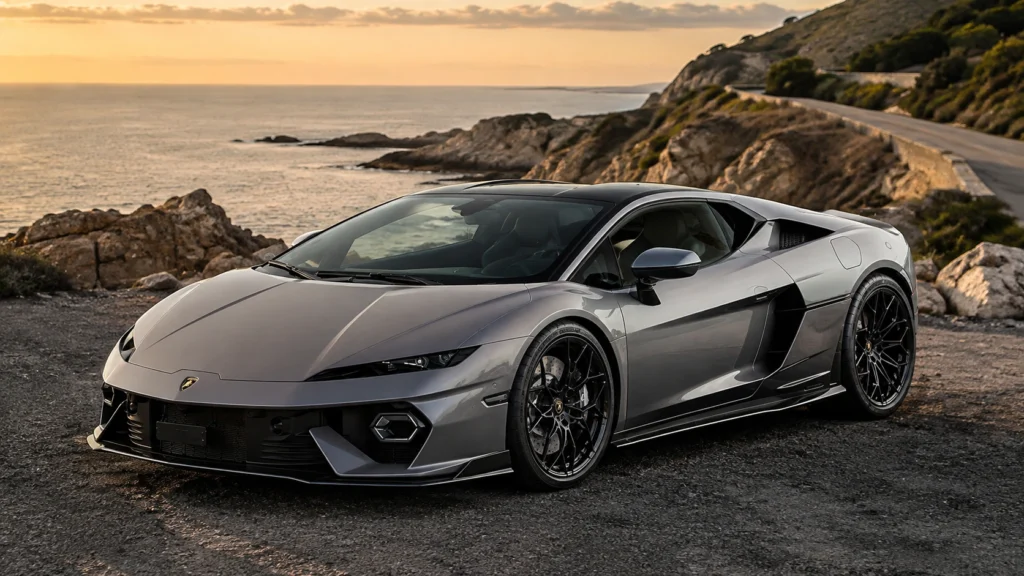
History and Background
Lamborghini’s modern V10 era started with the Gallardo in 2003 and continued through three generations of Huracán, spanning roughly two decades of naturally aspirated engines that became a signature of the brand’s entry-level supercars. That run ended with the Huracán STO and Sterrato, both sent off without any hybrid assistance.
The push toward electrification wasn’t sudden. Lamborghini had already previewed hybrid ambitions with the limited-run Sián, and the company committed publicly to hybridizing its entire lineup as part of its broader sustainability roadmap, a strategy it labeled “Direzione Cor Tauri.”
The Revuelto arrived first, in 2023, as proof that Lamborghini could electrify its flagship V12 without diluting the theater that defines the brand. It combines a naturally aspirated 6.5-liter V12 with three electric motors for a combined output of around 1,015 CV, and it set the template, if not the exact formula, for what came next.
The Lamborghini Temerario completes that transition at the volume end of the range. With the Huracán’s production run finished, Lamborghini no longer builds a series-production model without some form of electrification, a milestone that would have been hard to imagine a decade ago from a brand built on big, unassisted engines.
Positioned alongside the Revuelto, the Lamborghini Temerario fills a similar role to what the Huracán did next to the Aventador: a smaller, sharper, more attainable Lamborghini supercar wearing the same HPEV badge as the flagship. The V8 replacing a V10 is a bigger technical departure than it might first appear, since turbocharged, electrified architecture behaves very differently from a naturally aspirated engine at every point in the rev range.
Design and Exterior
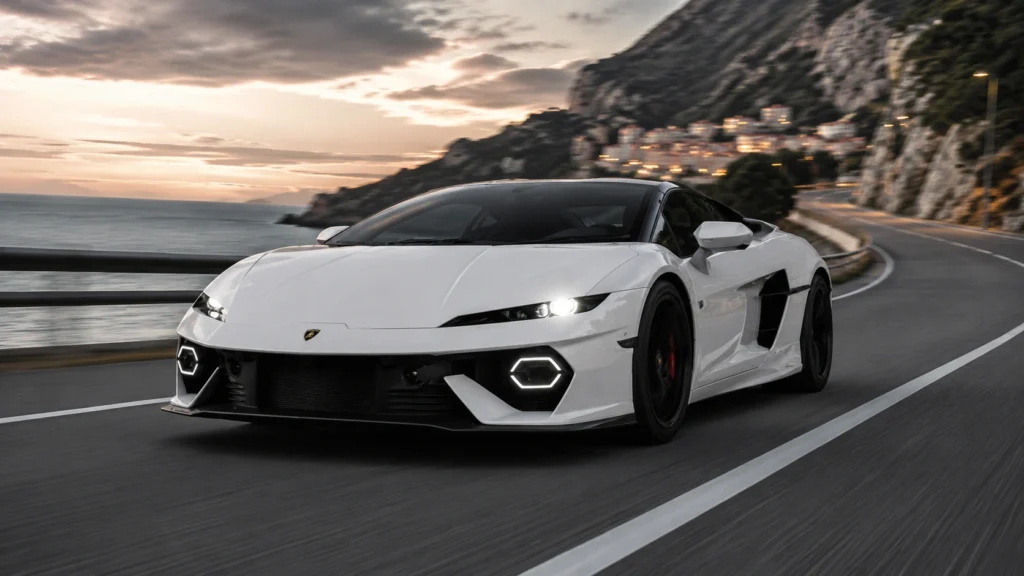
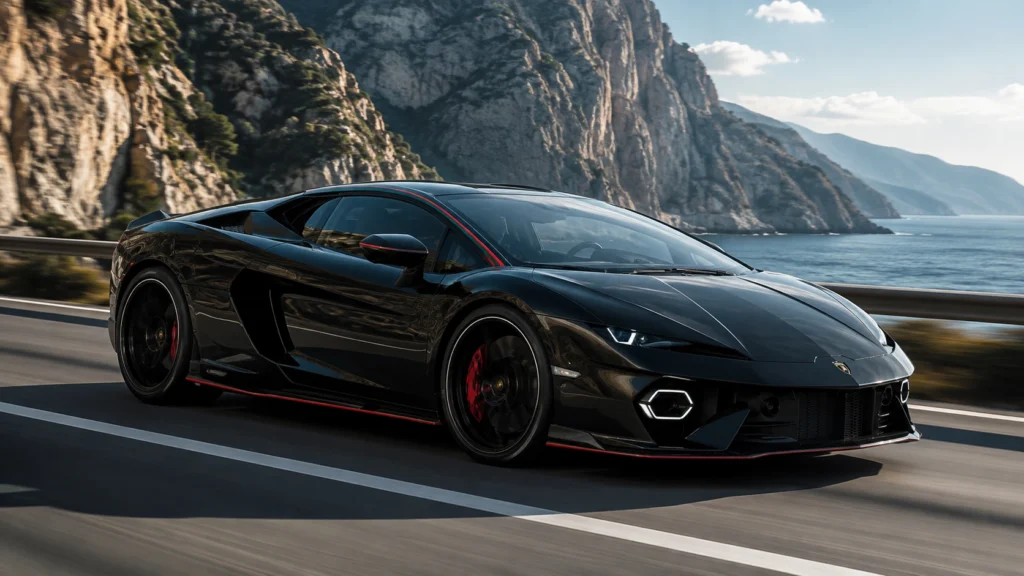
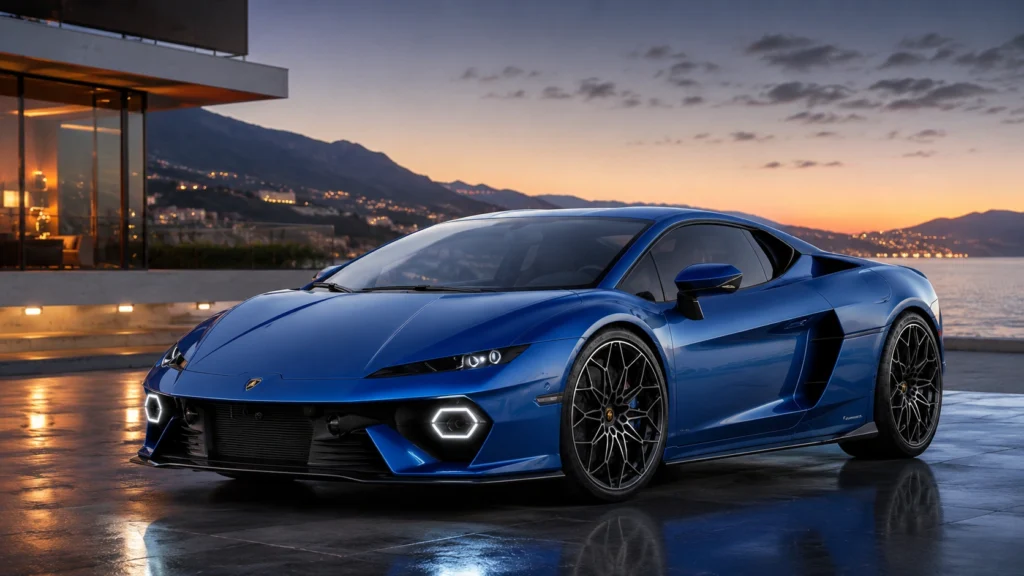
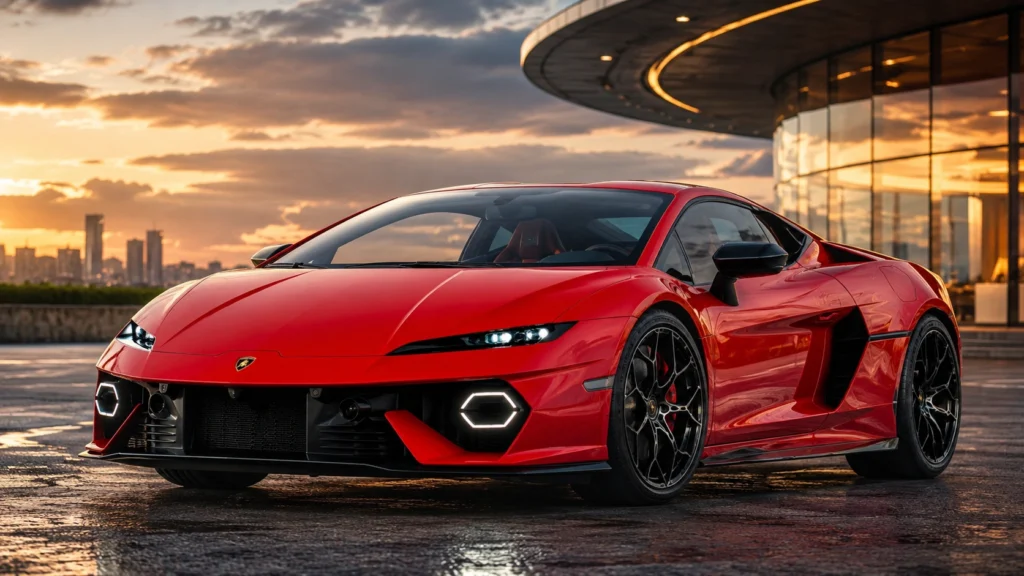
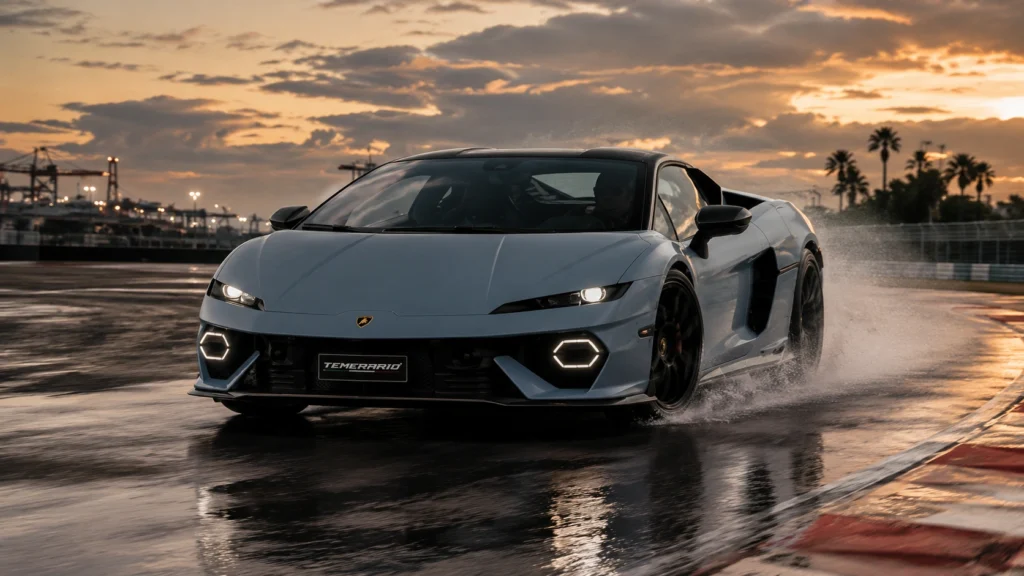
The Lamborghini Temerario proportions read as more angular and technical than the Huracán’s, with a lower nose, a wider stance, and details clearly borrowed from Lamborghini’s Sián and Revuelto design language. Mitja Borkert’s design team leaned into hexagonal shapes throughout, most visibly in the daytime running lights and headlight clusters.
At the front, the shark-nose fascia and a functional splitter aren’t there purely for visual drama. Lamborghini says the front-end elements manage airflow to the radiators and front brakes while also generating downforce, which matters more on this car than the Huracán given the added weight of the hybrid system.
The side profile shows larger, more prominent air intakes feeding the engine bay and rear-mounted radiators, a direct consequence of the added cooling demands of a turbocharged engine and three electric motors working together. Where the Huracán’s intakes were mostly about brake cooling, the Temerario’s have to manage heat from a much more complex powertrain.
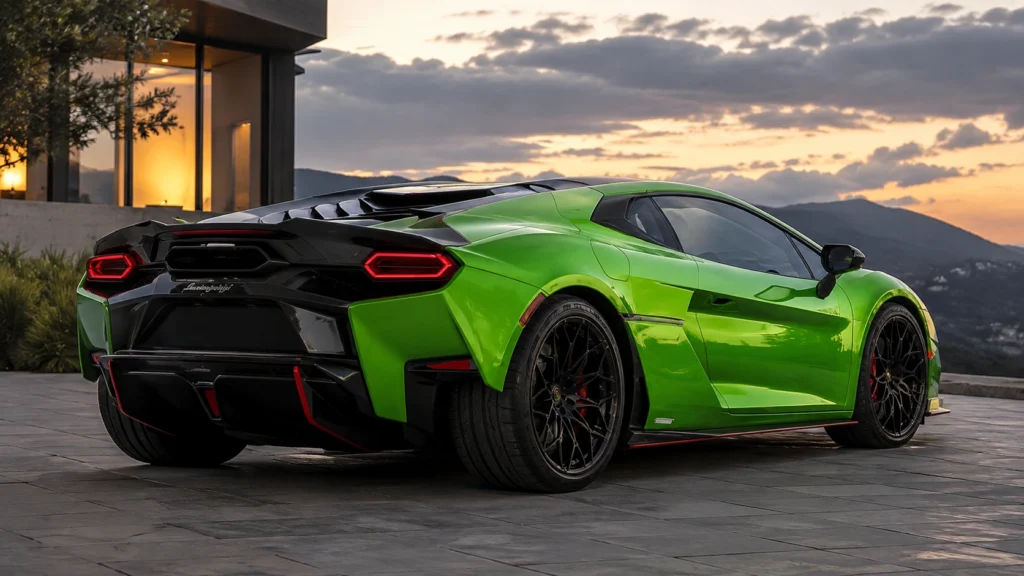
Around back, Lamborghini keeps the engine visible under a glass or louvered cover, continuing the brand’s tradition of showing off the mechanical hardware rather than hiding it. The exhaust exits high in a Y-shaped cluster reminiscent of the Revuelto, rather than the low, centered setup familiar from the Huracán, and a functional rear spoiler and diffuser work with underbody aero channels to keep the car planted at speed as cornering loads rise.
Wheel designs echo the hexagonal motif from the lighting signatures, and carbon-fiber is used extensively for the front splitter, side skirts, and available upgrades to the rear diffuser and engine cover, helping keep dry weight competitive despite the extra hybrid hardware. Overall, the design language has matured toward the sharper, more geometric style Lamborghini introduced with the Sián and carried through to the Revuelto, a deliberate family resemblance meant to signal that the Lamborghini Temerario belongs in the same generation as the flagship rather than feeling like a hand-me-down platform.
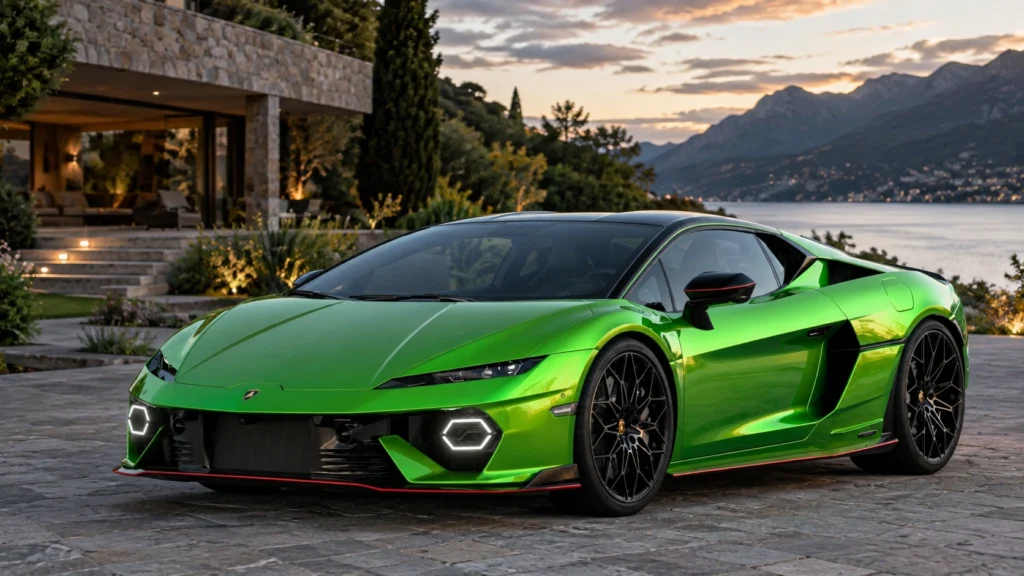
Interior and Technology
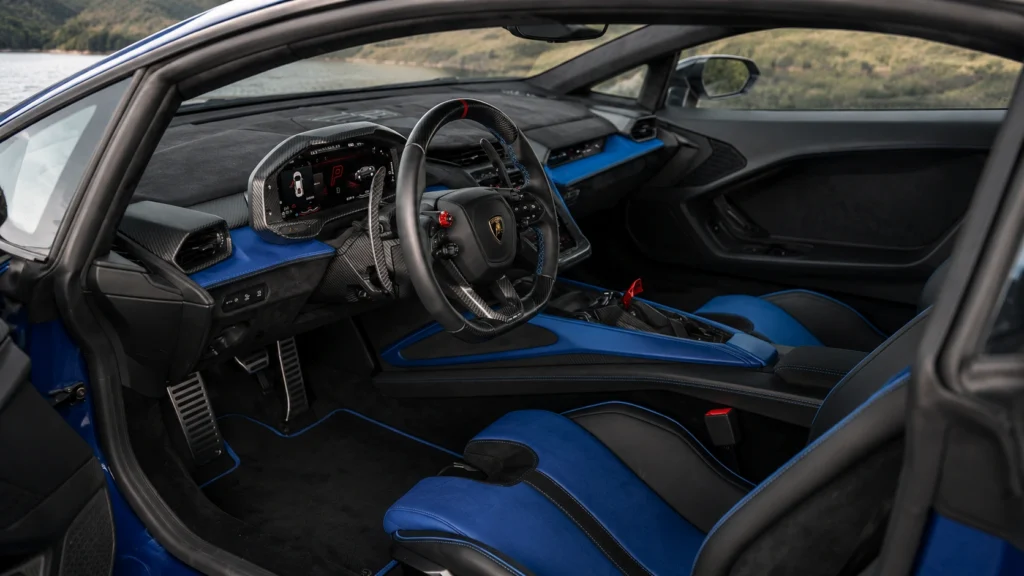
Lamborghini describes the Temerario’s cabin philosophy as “feel like a pilot,” and the layout backs that up. The dashboard wraps around the driver, with switchgear angled toward the seat rather than laid out flat across the center console, a configuration borrowed conceptually from the Revuelto.
Three digital displays anchor the interior: an 8.4-inch vertical touchscreen for infotainment, a 12.3-inch digital instrument cluster ahead of the driver, and a 9.1-inch passenger display for the person riding shotgun. That passenger screen lets a co-pilot check performance data or media without leaning across the car, a genuinely useful touch rather than a gimmick.
Materials follow the expected Lamborghini playbook: leather, Alcantara, and optional carbon-fiber trim, with seating that prioritizes support during hard cornering over long-distance plushness, though Lamborghini says cabin space improved over the outgoing Huracán. Infotainment runs on what Lamborghini calls the Lamborghini Vision Unit, paired with new HMI (human-machine interface) architecture, supporting smartphone connectivity, in-car recording for capturing driving footage, and telemetry-style data logging aimed at track-day owners. Driver assistance features are present but secondary to the performance mission, covering the usual forward-collision warning, automated emergency braking, and lane-departure alerts standard across this segment.
Practicality is modest by definition in this class. There’s a small frunk for soft bags, and visibility is better than you’d expect from a car this low, thanks to a steeply raked but relatively thin-pillared greenhouse. The genuinely performance-focused technology here is the driving mode selector and telemetry system, which log real data from real laps; the passenger display and Vision Unit connectivity, by contrast, are convenience features meant to make ownership more enjoyable rather than making the car faster.
Engine and Performance
This is where the Lamborghini Temerario earns its headlines, and it’s worth slowing down to actually understand what’s happening under that exposed engine cover, because the numbers only make sense once you know how they were achieved.
At the center of the car is a new 4.0-liter (3,995.2 cc) twin-turbocharged V8, internally designated the L411, developed entirely in-house at Lamborghini rather than sourced or adapted from another Volkswagen Group engine. On its own, this combustion engine produces 800 CV (789 hp) between 9,000 and 9,750 rpm, with 730 Nm (538 lb-ft) of torque available from 4,000 to 7,000 rpm.
What makes that horsepower figure remarkable is where it happens. Turbocharged engines typically make peak power well below 7,000 rpm because boost pressure and mechanical stress make higher revs impractical. Lamborghini engineered around that limitation using a flat-plane crankshaft, titanium connecting rods, a short stroke, and Diamond-Like Carbon-coated finger followers in the valvetrain, allowing the engine to safely spin to a 10,250 rpm redline, motorsport-derived solutions that make this the first Lamborghini engine to rev past 10,000 rpm.
The two turbochargers sit in the V of the engine in a “hot-vee” configuration, a packaging choice that shortens the path exhaust gases travel to the turbines, sharpening throttle response and improving thermal management, at the cost of a more complex engine bay layout.
Electrification comes from three motors. One, referred to as the P1 motor, sits between the engine and the 8-speed dual-clutch transmission, producing 150 CV (148 hp) and 300 Nm of torque at 3,500 rpm. Its job is filling the gap before boost builds, smoothing out what would otherwise be a noticeable pause in throttle response.
The other two motors sit on the front axle, one per wheel, using axial-flux motor technology that Lamborghini says offers a larger magnetic surface area than conventional radial-flux designs for a given size and weight. These front motors are what give the Temerario its all-wheel-drive capability, since there’s no mechanical connection to the front wheels at all.
Combined, the V8 and three electric motors produce a total system output of 920 CV (907 hp; 677 kW), fed through an 8-speed dual-clutch transmission built by Graziano. A 3.8 kWh lithium-ion battery pack supplies the electric motors and allows brief electric-only running at low speeds.
In practice, this means the electric motors do most of the work at low rpm and low speed, when the turbos haven’t spooled up and a naturally aspirated engine like the old V10 would have felt comparatively soft. As revs climb and boost arrives, the V8 takes over, and by the time you’re near the 10,250 rpm redline, you’re experiencing something closer to a motorsport engine than a typical road-going hybrid.
That’s a genuinely different character from the Huracán’s naturally aspirated V10, which built power in a smoother, more linear curve without any electric assistance filling gaps, and without the low-end torque that turbocharging (even hybridized turbocharging) makes available.
| Performance Element | Lamborghini Temerario |
|---|---|
| Engine | 4.0L twin-turbocharged V8 (L411) |
| Displacement | 3,995.2 cc |
| Induction | Twin-turbo, hot-vee layout |
| Electric Motors | 3 (1 rear P1 motor + 2 front axial-flux motors) |
| Combustion Engine Output | 800 CV / 789 hp @ 9,000–9,750 rpm |
| Total System Output | 920 CV / 907 hp / 677 kW |
| Transmission | 8-speed dual-clutch (Graziano) |
| Drivetrain | All-wheel drive |
Specifications
| Specification | Lamborghini Temerario |
|---|---|
| Engine | 4.0L twin-turbo V8 (L411) |
| Displacement | 3,995.2 cc |
| Turbochargers | Twin, hot-vee configuration |
| Electric Motors | 3 (axial-flux) |
| Total Power | 920 CV / 907 hp / 677 kW |
| Torque (combustion engine) | 730 Nm (538 lb-ft) |
| Transmission | 8-speed dual-clutch |
| Drivetrain | All-wheel drive |
| 0–100 km/h | 2.7 seconds |
| Top Speed | 343 km/h (213 mph) |
| Length | 4,706 mm (185.3 in) |
| Width | 1,996 mm (78.6 in), excluding mirrors |
| Height | 1,201 mm (47.3 in) |
| Wheelbase | 2,658 mm (104.6 in) |
| Fuel Type | Premium gasoline + electric |
| Hybrid System | Plug-in hybrid, 3.8 kWh lithium-ion battery |
These figures come from Lamborghini’s official technical data and the specifications published alongside the car’s launch. A few numbers deserve context. The 2.7-second 0-100 km/h time is genuinely competitive with rivals costing considerably more, and it’s made possible largely by the instant torque from the electric motors rather than the V8 alone.
The 343 km/h top speed places the Lamborghini Temerario firmly in modern supercar territory, though not at outright hypercar levels, which tracks with its positioning below the Revuelto. The 3.8 kWh battery is deliberately modest in size; this isn’t a car designed around long electric-only range, it’s designed around using electricity to sharpen the combustion engine’s responsiveness.
Top Speed and Acceleration
The 2.7-second 0-100 km/h claim isn’t just about horsepower, it’s about how that horsepower gets to the road. All-wheel drive means the Lamborghini Temerario can put power down from a standstill without the wheelspin that a rear-drive-only supercar with similar output would fight against, which is a big part of why hybrid all-wheel-drive supercars have gotten so quick off the line in the past few years.
The electric motors matter more at low speed than at the top end. Because they deliver full torque instantly, without waiting for turbo boost to build, the car can launch hard from a stop in a way that pure turbocharged engines historically couldn’t. As speed climbs and the V8’s boost comes fully online, the combustion engine takes over as the dominant power source.
At sustained high speed, the equation shifts again. Aerodynamic drag becomes the limiting factor rather than outright power, which is why the 343 km/h top speed sits below the Revuelto’s claimed figure of over 350 km/h despite the Lamborghini Temerario weighing less; the flagship’s larger V12 simply keeps making usable power at speeds where drag is punishing.
Weight matters throughout the range. Lamborghini quotes a dry weight of around 1,690 kg for the Lamborghini Temerario, lighter than the Revuelto but still heavier than a comparable naturally aspirated Huracán would have been, a direct consequence of carrying a battery pack, three electric motors, and their associated cooling and control hardware.
Compared with the Ferrari 296 GTB and McLaren Artura, both of which use smaller V6 hybrid powertrains, the Lamborghini Temerario all-wheel-drive traction gives it a straight-line advantage off the line, even though the Ferrari’s claimed 0-100 km/h time of 2.9 seconds isn’t far behind despite sending power only to the rear wheels. In practical terms, the Lamborghini Temerario numbers put it ahead in outright acceleration but not dramatically so; this segment has gotten close at the top.
Price
Lamborghini has not published a single universal retail price for the Temerario, and pricing varies meaningfully by market due to taxes, import duties, and regional specification differences, so treat any single figure as a starting point rather than a fixed number.
In the United States, dealer and configurator information points to a base MSRP of roughly $357,600 before options, based on figures reported by Lamborghini dealerships and corroborated by Lamborghini’s own Ad Personam order guide as shared by owners. That’s a meaningful jump from the outgoing Huracán’s roughly $240,000 starting price a decade ago, reflecting both the added hybrid hardware and general segment-wide price inflation.
Optional equipment adds up quickly. Paint alone ranges from no-cost gloss finishes to premium Ad Personam colors that can add well over $10,000, and a lightweight Alleggerita package can add tens of thousands more; a fully loaded configuration can reportedly exceed $550,000. Ad Personam, Lamborghini’s bespoke personalization program, lets buyers go further still with unique color combinations, stitching, and trim beyond the standard configurator, and it’s rarely a small line item.
Outside the U.S., prices differ based on local taxes and import regulations, and buyers in high-tax markets across parts of Asia and Europe should expect meaningfully higher on-road prices than the U.S. base figure suggests. Confirming current pricing directly with a local dealer remains the only reliable way to get a market-accurate number.
Pros and Cons
| Pros | Cons |
|---|---|
| Genuinely high-revving character despite turbocharging | Significantly more expensive than the Huracán it replaces |
| All-wheel drive improves traction and everyday confidence | Heavier than a comparable non-hybrid V8 supercar |
| Electric motors eliminate most turbo lag | Complex hybrid hardware may mean higher long-term maintenance costs |
| Strong straight-line performance versus key rivals | Modest electric-only range due to a small 3.8 kWh battery |
| Extensive Ad Personam personalization options | Options and personalization can add well over $150,000 to the price |
Comparison With Competitors
| Feature | Lamborghini Temerario | Ferrari 296 GTB | McLaren Artura | Lamborghini Revuelto |
|---|---|---|---|---|
| Powertrain | Plug-in hybrid | Plug-in hybrid | Plug-in hybrid | Plug-in hybrid |
| Engine | 4.0L twin-turbo V8 | 3.0L twin-turbo V6 | 3.0L twin-turbo V6 | 6.5L naturally aspirated V12 |
| Hybrid System | 3 motors, 3.8 kWh battery | 1 motor, 7.45 kWh battery | 1 motor, 7.4 kWh battery | 3 motors, 3.8 kWh battery |
| Total Power | 920 CV / 907 hp | 819 hp | 691 hp | 1,015 CV / 1,001 hp |
| 0–100 km/h | 2.7 s | 2.9 s | 3.0 s | 2.5 s |
| Top Speed | 343 km/h | 330+ km/h | 330 km/h | 350+ km/h |
| Drivetrain | All-wheel drive | Rear-wheel drive | Rear-wheel drive | All-wheel drive |
| Positioning | Entry-level Lamborghini supercar | Entry-level Ferrari hybrid | Entry-level McLaren hybrid | Lamborghini flagship |
Each of these cars solves the hybrid supercar equation differently, and the differences say a lot about each brand’s priorities. Ferrari built the 296 GTB around a smaller-displacement V6 and a single, powerful electric motor, prioritizing weight distribution and rear-drive purity over outright traction, which shows up in a car often praised for its handling balance even though it gives up a bit of straight-line advantage to the all-wheel-drive Temerario. McLaren’s Artura takes a similar single-motor, rear-drive approach with a slightly lower total output than either Italian rival, but counters with a genuinely lightweight carbon-fiber structure that keeps it competitive despite the power deficit, making it the most track-focused-feeling of the three at a more accessible price point.
The Lamborghini Temerario case for itself is traction and consistency. All-wheel drive, delivered through electric front motors rather than a mechanical link, means it can put power down in more conditions and with less drama than its rear-drive rivals, at the cost of some of the purity that rear-drive purists prize in the 296 GTB and Artura. Someone cross-shopping a Ferrari or McLaren against the Lamborghini Temerario is likely choosing based on character as much as numbers: the Lamborghini’s V8 has a harder-edged, more motorsport-like voice thanks to its flat-plane crank and 10,000-plus rpm redline, while the Ferrari and McLaren V6s each have their own distinct, if less theatrical, soundtracks.
Against its own stablemate, the Revuelto is a different proposition entirely, built around a naturally aspirated V12 rather than a turbocharged V8, with a higher price, more power, and flagship-level positioning. Someone who wants the emotional pull of an unassisted V12 and doesn’t mind the higher entry cost will lean Revuelto; someone who wants nearly the same drama with a lower price of entry and a sharper, turbocharged character will lean Lamborghini Temerario.
Who Should Buy It?
The Lamborghini Temerario makes the most sense for buyers who want genuine Lamborghini theater, exposed engine, dramatic styling, a soundtrack that revs past 10,000 rpm, without committing to Revuelto money. That’s a meaningfully large group of supercar buyers who were previously served by the Huracán.
Huracán owners looking to upgrade will find a car that’s faster, more traction-secure thanks to all-wheel drive, and more technologically advanced inside, though they should be prepared for a higher price and a different, more turbocharged engine character than the outgoing V10.
Buyers specifically drawn to hybrid performance, rather than tolerating it, will appreciate what Lamborghini has done here. The electric motors aren’t a compliance afterthought; they’re doing real work filling torque gaps and enabling all-wheel drive, a more integrated approach to hybridization than some rivals manage. Collectors adding to an existing Lamborghini garage will value the Lamborghini Temerario as a distinct, contemporary entry point that complements older naturally aspirated models rather than replacing their appeal.
Buyers who prioritize daily usability over outright drama might be better served elsewhere. While the Lamborghini Temerario is more livable than older Lamborghinis thanks to added cabin space and driver assistance tech, it’s still a low, firm, attention-grabbing supercar, not a grand tourer. Fuel consumption is what you’d expect from a nearly 1,000-hp car, charging requirements are minimal given the small 3.8 kWh battery, and maintenance on a complex hybrid system with three electric motors will likely carry a premium over a simpler, non-hybrid supercar once it ages out of factory warranty.
Those who’d genuinely prefer a Ferrari 296 GTB, a McLaren Artura, or the Lamborghini Revuelto are typically making a character choice rather than a value judgment: rear-drive purity favors the Ferrari and McLaren, while an unassisted V12 and flagship status favor the Revuelto.
Conclusion
The Lamborghini Temerario represents one of the bigger technical shifts in the brand’s recent history, trading a naturally aspirated V10 for a turbocharged, electrified V8 without losing the drama that defines a Lamborghini. A 920 CV combined output, a 2.7-second 0-100 km/h time, and a genuinely high-revving character built through motorsport-derived engineering make it a legitimate step forward rather than a compromise forced by emissions regulations.
Its all-wheel-drive layout, delivered through electric front motors rather than a mechanical link, gives it real advantages in traction over rear-drive rivals like the Ferrari 296 GTB and McLaren Artura, even if some enthusiasts will miss the simplicity of the Huracán it replaces. Pricing that starts around $357,600 in the U.S. and climbs quickly with options reflects both its added technology and its position in an increasingly expensive segment.
Whether the Lamborghini Temerario is the right choice comes down to what you want from a modern supercar. If a hybrid V8 with genuine performance credentials and Lamborghini’s usual visual theater appeals to you more than either rear-drive purity or flagship V12 status, Lamborghini Temerario is a car that delivers on its engineering promises without needing to exaggerate them.
For full official technical specifications, configurator options, and the latest news on the model, visit Lamborghini Temerario.
Frequently Asked Questions (FAQs)
The Lamborghini Temerario is a mid-engine, plug-in hybrid supercar that replaces the Huracán in Lamborghini’s lineup. It combines a twin-turbocharged 4.0-liter V8 with three electric motors for a combined output of 920 CV (907 hp), and it’s positioned below the V12-powered Revuelto as the more attainable entry point into Lamborghini’s current range.
The Temerario produces a total system output of 920 CV, equivalent to roughly 907 horsepower, combining the V8’s standalone 800 CV (789 hp) with contributions from its three electric motors. The V8 alone makes its peak power between 9,000 and 9,750 rpm.
Yes. It’s a plug-in hybrid supercar, pairing a twin-turbo V8 with three electric motors and a 3.8 kWh lithium-ion battery. Two motors drive the front wheels, giving the car all-wheel drive, while a third sits between the engine and gearbox to fill torque gaps at low rpm.
Lamborghini claims a 0-100 km/h time of 2.7 seconds and a top speed of 343 km/h (213 mph). Those figures are official manufacturer claims rather than independently verified test results, though they’re broadly in line with what this power-to-weight ratio and all-wheel-drive setup would be expected to produce.
It uses a newly developed 4.0-liter twin-turbocharged V8, internally known as the L411, built entirely in-house by Lamborghini. It features a flat-plane crankshaft, titanium connecting rods, and a hot-vee turbo layout, allowing it to safely rev to a 10,250 rpm redline, unusually high for a turbocharged production engine.
Pricing varies by market. In the United States, dealer and configurator information points to a base price of roughly $357,600 before options, though heavily optioned cars can exceed $550,000. Lamborghini has not published one universal global price, so figures outside the U.S. will differ based on local taxes and import duties.
Yes, the Temerario is the direct successor to the Huracán, which ended production after roughly a decade on sale. Rather than continuing with a naturally aspirated V10, Lamborghini moved to a hybridized, turbocharged V8 platform, making it a bigger technical departure from its predecessor than most model changeovers.
That depends on what you value. Buyers who want strong all-wheel-drive traction, a high-revving V8 character, and genuine Lamborghini design theater at a lower price than the Revuelto will likely find it a compelling choice. Buyers who prioritize rear-drive purity or a naturally aspirated engine might prefer a Ferrari 296 GTB, McLaren Artura, or the Revuelto instead.