BMW M2 Review 2026: Ferocious Power Meets Daily Comfort
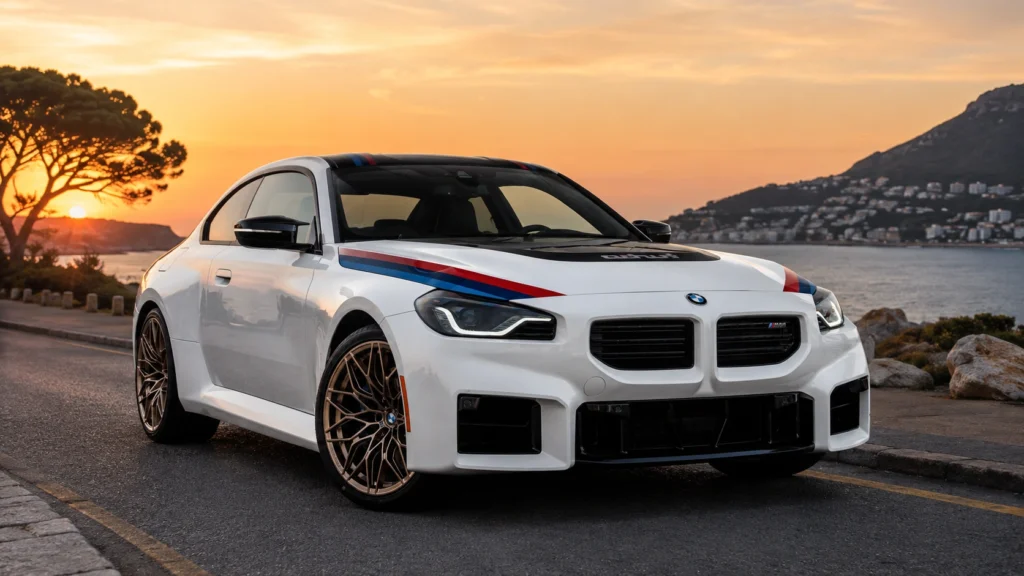
There’s a reason the BMW M2 keeps coming up in conversations among people who actually care about how a car drives, not just how fast it is on paper. It’s the smallest, least expensive way into BMW’s M lineup, and unlike a lot of “entry-level” performance cars, it doesn’t feel like a watered-down version of something better. It feels like its own thing.
The BMW M2 pairs a 473-horsepower twin-turbocharged inline-six with rear-wheel drive, a chassis borrowed largely from the bigger M3 and M4, and — for now, at least — a six-speed manual gearbox that most of its rivals gave up on years ago. For 2026, BMW also added a 523-hp M2 CS, and a first-ever all-wheel-drive M2 xDrive is arriving for the 2027 model year.
This guide walks through what the BMW M2 actually is, how it drives, what it costs, how it stacks up against the Audi RS3 and Toyota GR Supra, and who should — and shouldn’t — put one in their garage.
Quick Specifications
| Specification | BMW M2 (2026, RWD) |
|---|---|
| Engine | 3.0L twin-turbocharged inline-6 (S58) |
| Power | 473 hp @ 6,250 rpm |
| Torque | 406 lb-ft (manual) / 443 lb-ft (automatic) |
| Transmission | 6-speed manual or 8-speed automatic |
| Drivetrain | Rear-wheel drive (M xDrive AWD arrives for 2027) |
| 0–60 mph | 3.9–4.1 sec., depending on transmission (BMW estimate) |
| Top Speed | 155 mph (177 mph with M Driver’s Package) |
| Fuel Economy | 16 city / 23 hwy / 19 combined mpg |
| Seating Capacity | 4 |
| Starting Price (U.S.) | $69,375 MSRP |
What Is the BMW M2?
The BMW M2 sits at the bottom of BMW’s M car price list and the top of its 2 Series lineup. Underneath the aggressive bodywork, it shares its basic structure with the 2 Series coupe, but almost everything that matters — engine, suspension, brakes, differential — comes from BMW’s M division rather than the regular parts bin.
Think of it as a shrunken M4. It uses a related twin-turbo inline-six, a similar rear-drive chassis, and comparable brakes, just wrapped in a body that’s shorter, narrower, and lighter than its bigger sibling. That combination is exactly why enthusiasts pay attention to it: less weight and a shorter wheelbase generally mean sharper reactions on a twisty road, even if outright power trails the M3 and M4.
The target buyer is someone who wants genuine M-car performance without stepping up to M3 or M4 money, and who still values things like a usable back seat and a real trunk. It’s a car built for people who want to drive to a track day rather than trailer to one, and then drive home afterward.
BMW M2 History and Background
The BMW M2 nameplate traces back to the BMW 1M Coupe, a limited-run 2011 model that previewed the idea of a compact, rear-drive M car built around a twin-turbo six. The first car to officially wear the M2 badge arrived for 2016, using a tuned version of BMW’s N55 inline-six good for 365 horsepower.
BMW gave that original M2 a significant update in 2018 with the M2 Competition, which swapped in the S55 engine shared with the M3 and M4 of the era, raising output to 405 hp. That car ran through the 2021 model year and is still fondly remembered by enthusiasts for its relatively light weight and unfiltered feel.
The current, second-generation M2 — internally coded G87 — arrived for the 2023 model year with a fresh design, a longer wheelbase, and the S58 twin-turbo six shared with the M3 and M4, initially tuned to 453 hp. BMW gave the car a notable mid-cycle refresh for 2025, adding the latest iDrive 8.5 software, a new steering wheel, additional color choices, and a 20-horsepower bump to the current 473 hp.
For 2026, BMW expanded the range with the BMW M2 CS, a lighter, more powerful variant limited to the automatic transmission. And BMW confirmed that for the 2027 model year, the M2 will offer M xDrive all-wheel drive for the first time in the model’s history, alongside the continuing rear-drive, manual-available version. It’s a notable shift for a car whose whole identity has been built around rear-wheel-drive purity.
BMW M2 Design and Exterior
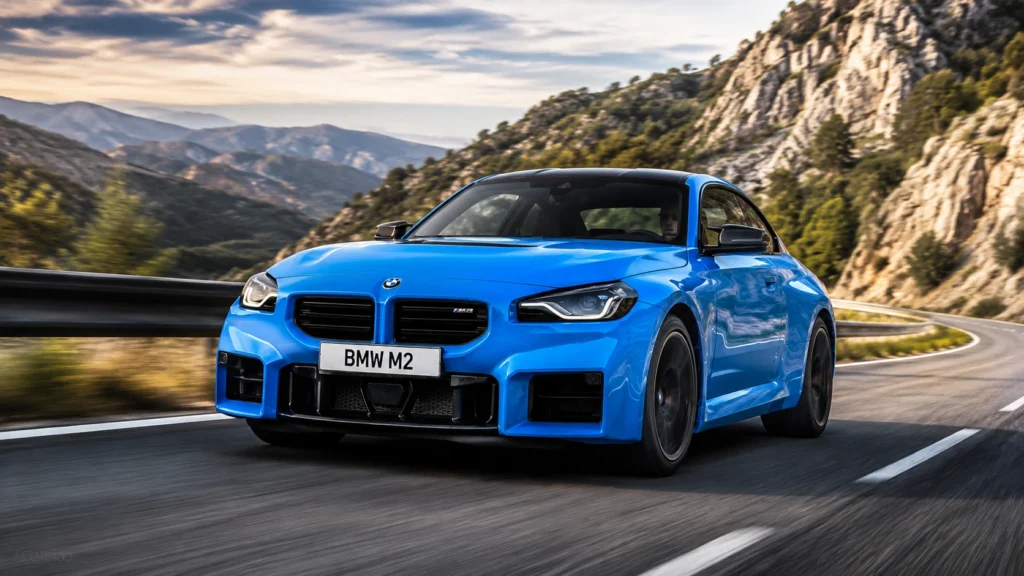
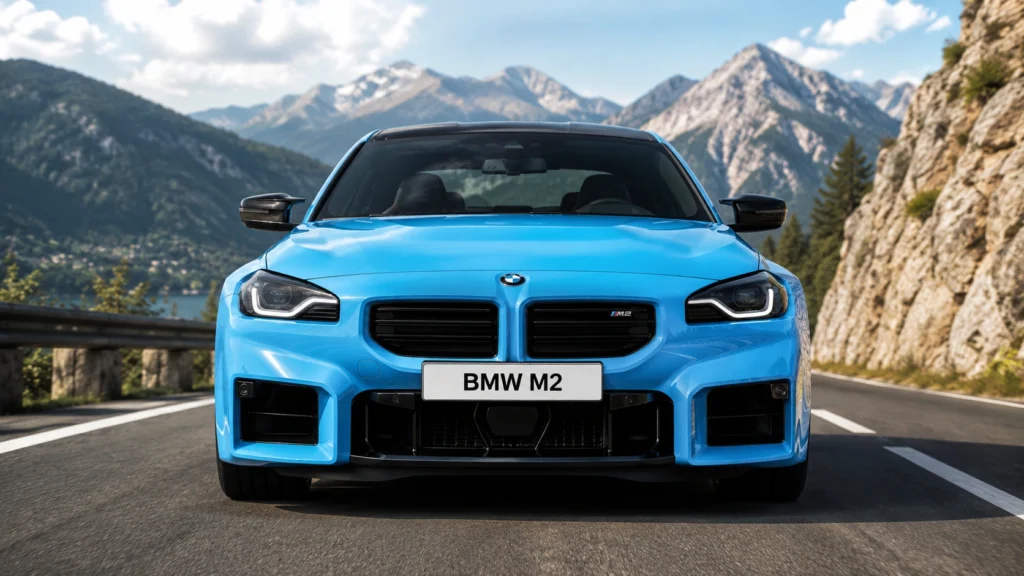
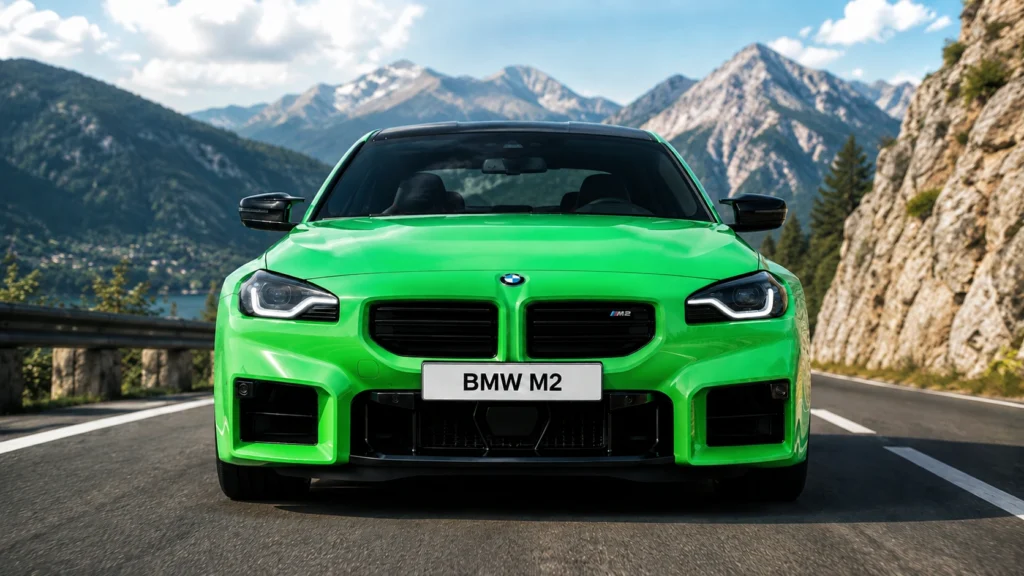
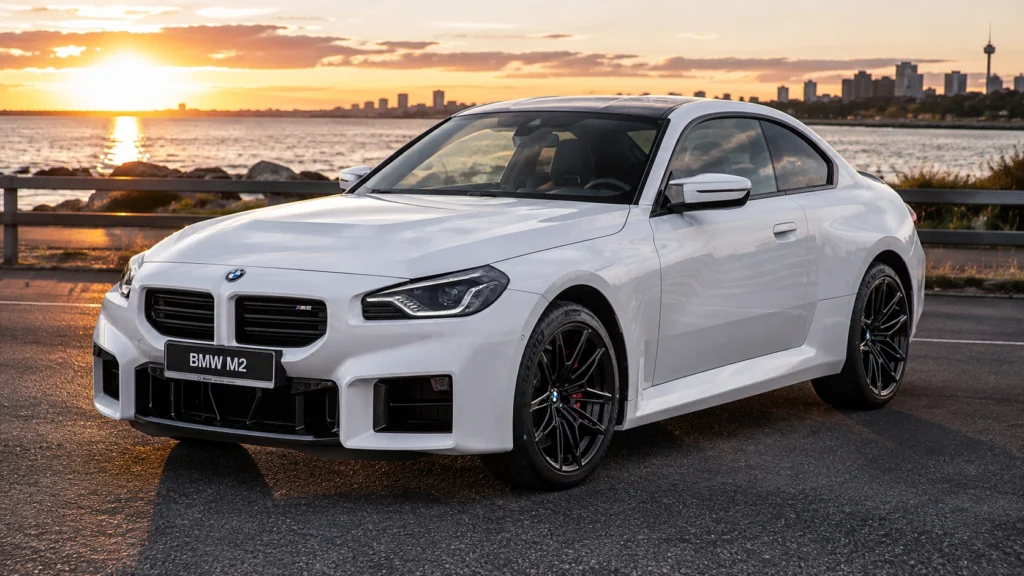
The M2 doesn’t try to hide what it is. Compared with a standard 2 Series coupe, the M2’s fenders are noticeably flared to cover a wider track, and the front bumper carries larger intakes to feed the engine’s twin turbos and additional coolers.
The kidney grille is upright and relatively restrained by current BMW standards — it hasn’t grown to the exaggerated proportions seen on some other recent BMW models. Adaptive LED headlights are standard, with laser light elements available depending on market and options.
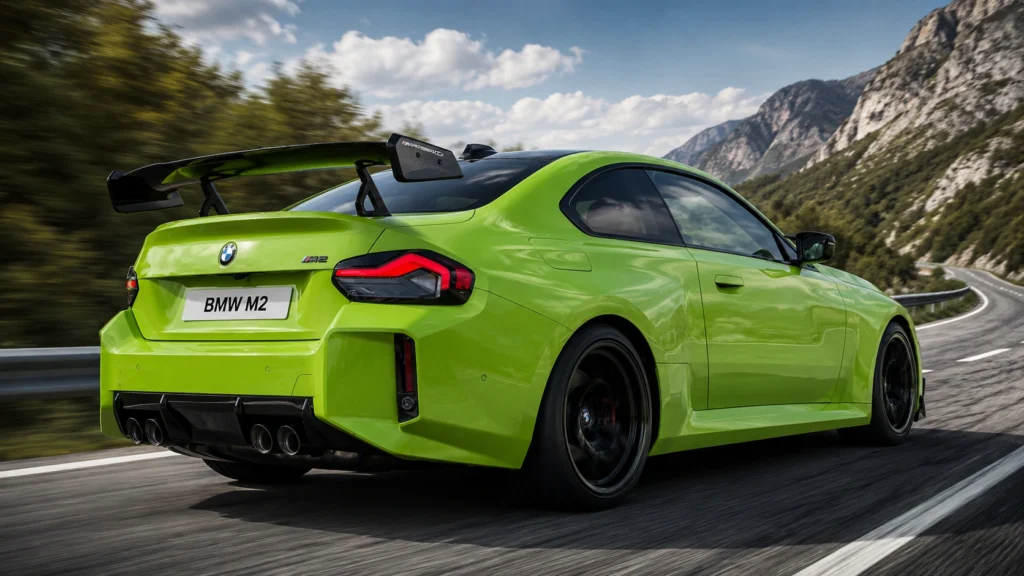
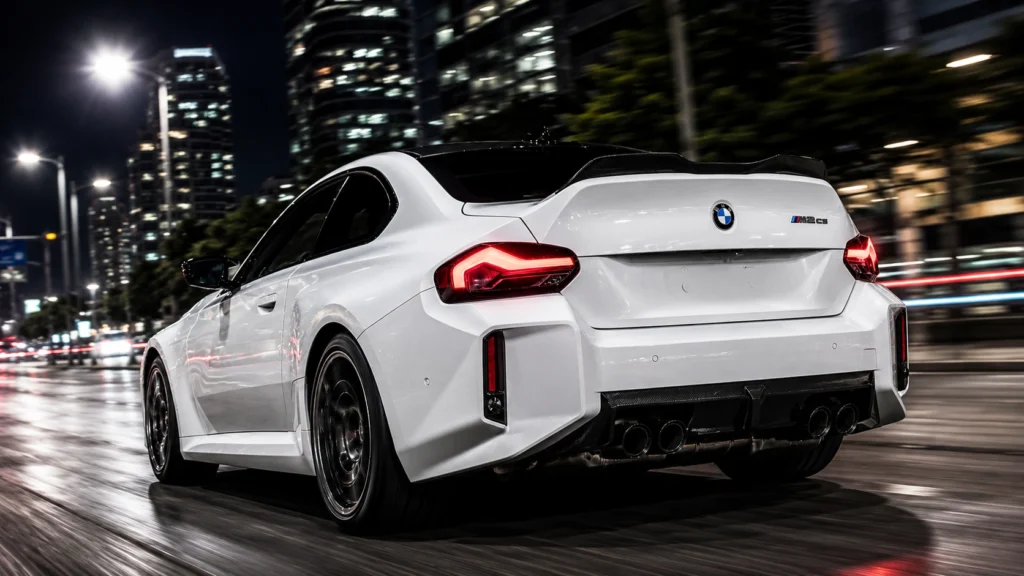
Around back, quad exhaust tips (functional, not decorative) sit under a subtle ducktail-style trunk lip, and the rear bumper houses a diffuser element that’s more about visual signature than serious aerodynamic downforce at road-legal speeds. Standard wheels measure 19 inches up front and 20 inches at the rear, staggered to match the wider rear tires.
Whether the design reads as handsome or a bit heavy-handed depends on who you ask. It’s a bigger, chunkier car than the outgoing 1M or the first-generation M2, and that added visual mass is a real trade-off for buyers who preferred the smaller, tauter look of earlier cars. BMW offers a wide color palette, including several eye-catching BMW Individual shades, plus a Carbon Package that adds a carbon-fiber roof to shave a bit of weight and lower the center of gravity.
BMW M2 Interior and Technology
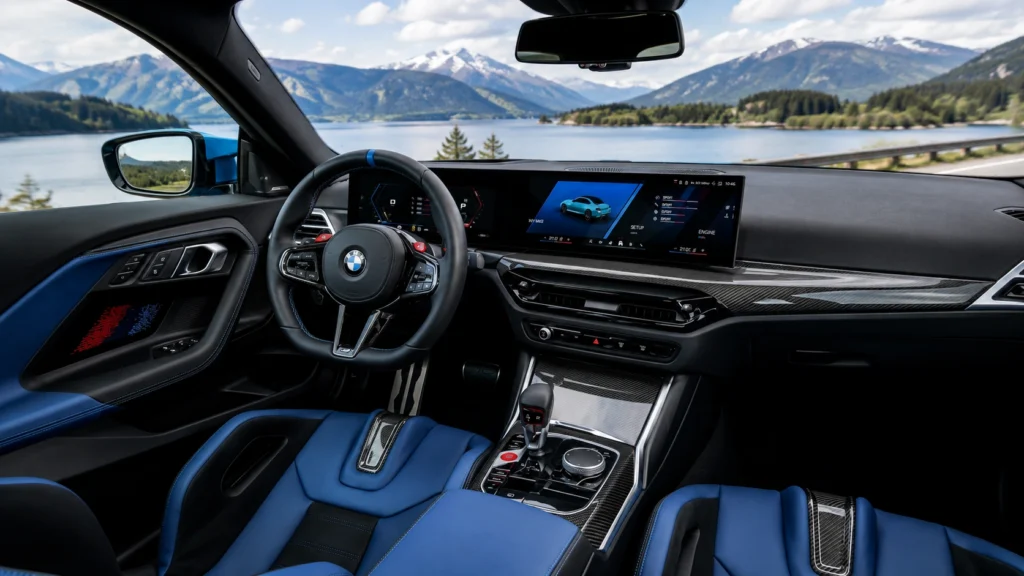
Inside, the M2 borrows heavily from the M3 and M4, which is generally a good thing. Standard M Sport seats hold occupants securely, and the optional M Carbon bucket seats — lighter and more aggressively bolstered — are a worthwhile upgrade for anyone planning track days, though they compromise comfort for taller or larger drivers.
The driving position is low and properly sporty, with a thick, flat-bottomed steering wheel and clear sightlines to the digital instrument cluster. BMW’s curved display setup, combining a 12.3-inch digital gauge cluster with a 14.9-inch central touchscreen running iDrive 8.5, comes standard and handles both infotainment and drive-mode configuration.
Rear seats exist, and adults can technically sit back there, but headroom and legroom are tight for anyone over about 5-foot-8. It’s best treated as occasional-use space for kids or short trips, not a genuine second row for regular carpooling.
Material quality is a step up from the standard 2 Series, with more soft-touch surfaces, contrast stitching, and available Alcantara trim on the wheel and shifter. Wireless Apple CarPlay and Android Auto come standard, along with a Harman Kardon surround-sound system and a suite of driver-assistance features, including forward collision warning, lane departure warning, and adaptive cruise control on higher trims.
Trunk space measures 13.8 cubic feet — genuinely useful for a performance coupe, big enough for a grocery run or a couple of soft-sided travel bags, if not a full set of golf clubs and luggage together. Combined with the compact exterior footprint, the M2 is one of the easier M cars to actually live with day-to-day, even if the ride quality and road noise remind you constantly that it’s not a luxury car first.
BMW M2 Engine and Performance
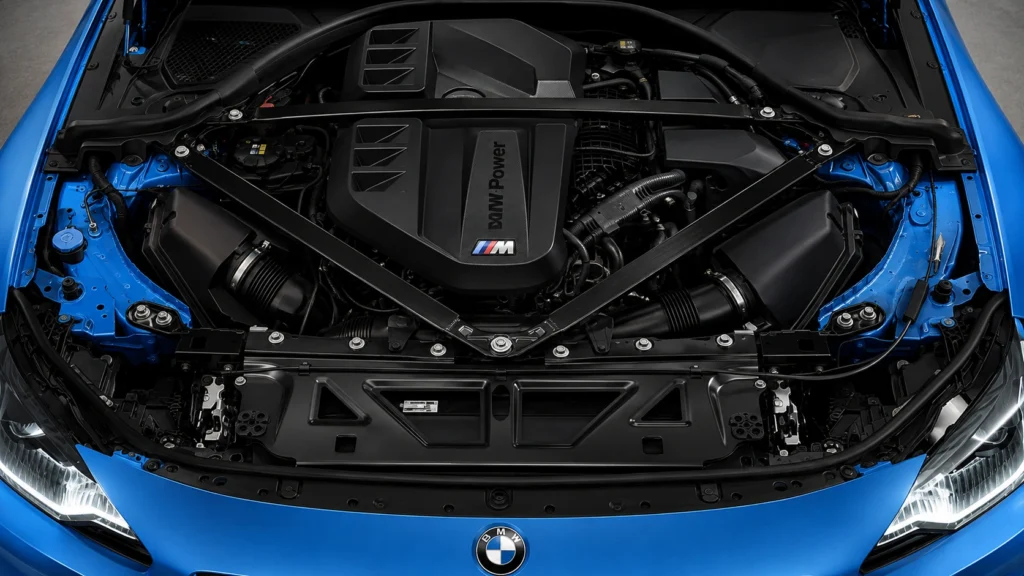
This is where the M2 earns its reputation. Under the hood sits the S58, a 3.0-liter twin-turbocharged inline-six shared in related tune with the M3 and M4. “Twin-turbocharged” means two smaller turbochargers, rather than one large one, spool up quickly and reduce the lag that older turbo engines were known for — the result is power that arrives with little hesitation once you’re past idle.
In standard trim, the S58 produces 473 horsepower at 6,250 rpm. Torque depends on transmission choice: 406 lb-ft with the six-speed manual, or 443 lb-ft with the eight-speed automatic, which is tuned to handle the extra twist without the same durability concerns a manual clutch would face.
Power goes exclusively to the rear wheels on the standard car, routed through an Active M Differential — an electronically controlled limited-slip differential that can vary how much power goes to each rear wheel individually. In practice, that means better traction putting power down out of corners, and more control when the rear tires do start to slip, rather than one wheel just spinning uselessly.
Suspension consists of BMW’s Adaptive M Suspension, with electronically controlled dampers that adjust firmness across Comfort, Sport, and Sport+ modes. Underneath, the geometry and forged aluminum control arms are shared with the M3 and M4, just tuned around the M2’s shorter wheelbase.
Braking hardware includes large M Sport brakes as standard, with an optional carbon-ceramic package available for track-focused buyers who want reduced unsprung weight and better fade resistance during repeated hard stops. Steering is electrically assisted, adjustable in weight through the driving modes, and precise enough that most drivers won’t miss the hydraulic setups of older M cars.
On real roads rather than a racetrack, that translates to a car that feels eager at any speed, not just when you’re pushing toward a redline. Mid-range torque means you rarely need to downshift for a quick pass, and the shorter wheelbase compared with the M3 or M4 makes the M2 feel more willing to change direction on a twisty back road, even though it’s grown heavier and larger than the original M2 it replaced. You can read BMW’s full technical rundown on the official BMW M2 page.
The M2 CS sharpens this formula further, with 523 hp, a stiffer engine mount for more direct throttle response, and suspension tuning unique to the CS. It’s a car built with lap times in mind first, everyday comfort second.
BMW M2 Specifications
| Specification | BMW M2 (Standard) | BMW M2 CS |
|---|---|---|
| Engine | 3.0L twin-turbo inline-6 (S58) | 3.0L twin-turbo inline-6 (S58) |
| Cylinders | 6 | 6 |
| Induction | Twin-turbocharged | Twin-turbocharged |
| Horsepower | 473 hp @ 6,250 rpm | 523 hp @ 6,250 rpm |
| Torque | 406 lb-ft (manual) / 443 lb-ft (auto) | 479 lb-ft |
| Transmission | 6-speed manual or 8-speed automatic | 8-speed automatic only |
| Drivetrain | RWD | RWD |
| Curb Weight | ~3,814 lbs (manual); ~3,867 lbs (auto) | ~3,770 lbs |
| Length | 180.6 in | 180.6 in |
| Width (incl. mirrors) | 74.3 in (81.4 in) | 74.3 in (81.4 in) |
| Height | 54.9 in | 54.9 in |
| Wheelbase | 108.1 in | 108.1 in |
| Seating Capacity | 4 | 4 |
| Cargo Capacity | 13.8 cu ft | 13.8 cu ft |
| Fuel Tank | 13.7 gal | 13.7 gal |
| Fuel Economy | 16/23/19 mpg (city/hwy/combined) | 16/23/19 mpg (city/hwy/combined) |
Curb weights are approximate and can shift depending on options like the Carbon Package or carbon-ceramic brakes. The upcoming M2 xDrive is expected to weigh roughly 120 to 185 pounds more than the equivalent automatic RWD model, according to early reporting, though BMW hadn’t published final certified figures at the time of writing.
BMW M2 Top Speed and Acceleration
BMW’s official figures put the standard M2 at 4.1 seconds to 60 mph with the manual transmission, or 3.9 seconds with the automatic. Independent testing by outlets like Car and Driver has recorded slightly quicker real-world results, which is typical of BMW’s traditionally conservative factory estimates. Top speed is electronically limited to 155 mph, or 177 mph if you add the optional M Driver’s Package, which also includes a half-day of instruction at a BMW performance driving school.
The M2 CS trims that further. BMW quotes 3.7 seconds to 60 mph, thanks to the extra power, reduced weight, and automatic-only drivetrain, along with a limited top speed of 188 mph — the M Driver’s Package is standard equipment on the CS rather than an option.
The forthcoming M2 xDrive, arriving for the 2027 model year, is expected to be the quickest M2 yet in a straight line. Early figures point to roughly 3.6 seconds to 60 mph (3.3 seconds with a one-foot rollout, the method some publications use to better match how drag strips measure elapsed time), even though it will only be offered with the eight-speed automatic.
It’s worth remembering that 0-60 numbers are useful for comparison shopping, but they don’t tell you much about how a car feels at legal speeds on a public road, where the M2’s mid-range torque and quick-witted chassis matter more than a stoplight sprint most owners will rarely attempt.
BMW M2 Price
U.S. pricing for the 2026 BMW M2 starts at $69,375 MSRP for the standard rear-drive car, whether you choose the manual or the automatic — BMW doesn’t charge extra for either gearbox. That figure typically climbs quickly once you start adding options like the Carbon Package, upgraded audio, or the M Driver’s Package, with well-equipped examples commonly landing in the high $70,000s to low $80,000s.
Step up to the M2 CS and the starting price rises to roughly $98,600 before destination charges, putting the out-the-door price close to $100,000 once fees and any options — like the available carbon-ceramic brake package — are added. That’s a meaningful premium over the standard car for 50 additional horsepower, a weight reduction, and unique styling and suspension tuning.
The upcoming 2027 M2 xDrive is expected to start at roughly $74,950 including destination, according to early BMW pricing information, positioning it a few thousand dollars above the standard rear-drive automatic.
All of this is U.S. pricing; buyers in other markets should expect different figures once local taxes, VAT, and market-specific equipment are factored in. Compared with the step up to a base M3 sedan, which starts tens of thousands of dollars higher, the M2 remains BMW M’s most accessible way to get genuine M-car performance, even after a few option boxes are checked.
BMW M2 Pros and Cons
| Pros | Cons |
|---|---|
| Strong, responsive twin-turbo inline-six with real mid-range torque | Heavier than earlier M2 generations, which blunts some outright agility |
| Six-speed manual still available — increasingly rare in this class | Ride is firm, especially in Sport and Sport+ modes |
| Compact footprint makes it easy to place on tight roads | Rear seats are cramped for adults on longer trips |
| M3/M4-sourced chassis, brakes, and differential hardware | CS and upcoming xDrive models push close to, or past, $100K |
| Usable 13.8-cubic-foot trunk for a performance coupe | Fuel economy (19 mpg combined) trails some four-cylinder rivals |
BMW M2 vs Competitors
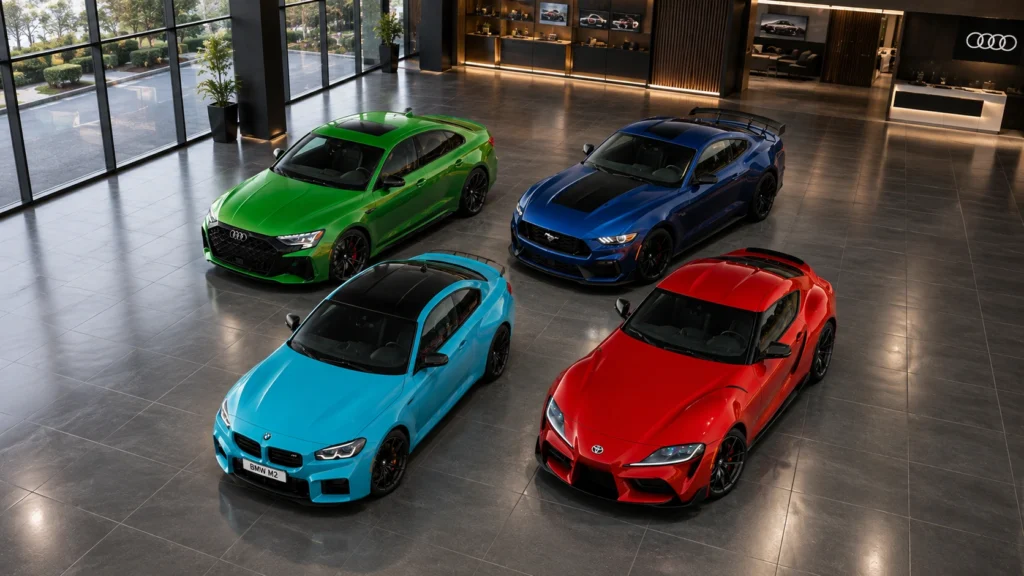
The M2’s most relevant rivals aren’t just “sports cars” in general — they’re specifically compact, six-figure-adjacent performance cars aimed at drivers who want serious pace without stepping up to something like a Porsche 911 or Chevrolet Corvette.
| Model | Engine | Power | 0–60 mph | Starting Price | Character |
|---|---|---|---|---|---|
| BMW M2 | 3.0L twin-turbo I6 | 473 hp | 3.9–4.1 sec | $69,375 | RWD purist’s coupe, manual available |
| Audi RS3 | 2.5L turbo I5 | 394 hp | 3.6–3.8 sec | $67,395 | AWD sedan, all-weather grip, no manual |
| Toyota GR Supra | 3.0L turbo I6 | 382 hp | ~4.0 sec | $57,500 | RWD coupe, manual optional, best value |
| Ford Mustang Dark Horse | 5.0L V8 | 500 hp | ~4.1 sec | $63,080 | RWD muscle coupe, V8 character, manual optional |
The Audi RS3 takes a completely different approach: all-wheel drive, a five-cylinder engine with a genuinely unique exhaust note, and four doors instead of two. It’s quicker off the line thanks to Quattro traction, but it lacks a manual option and doesn’t offer the same rear-drive playfulness enthusiasts associate with the M2.
The Toyota GR Supra undercuts the M2 by roughly $12,000 and still offers a related BMW-sourced turbocharged inline-six along with a no-cost manual option. It’s a strong value pick for buyers who want most of the M2’s driving character for meaningfully less money, though it trails in outright power and lacks a usable back seat entirely.
The Ford Mustang Dark Horse swaps forced induction for a naturally aspirated 5.0-liter V8, delivering the most horsepower of this group along with an old-school soundtrack the turbocharged cars can’t replicate. It’s roomier inside, too, though its chassis, while genuinely good, doesn’t quite match the M2’s precision on a tight, technical road.
Buyers cross-shopping something larger and more expensive often look toward BMW’s own lineup, too — anyone curious how the M2 compares with the brand’s flagship sedan should check out our full BMW M5 Review for a sense of what the extra money and size buys you.
It’s also worth noting that the Cadillac CT4-V Blackwing, long mentioned alongside the M2 as a compact rear-drive rival with a manual option, was discontinued after the 2026 model year as Cadillac winds down the CT4 lineup entirely. Shoppers can still find remaining new and low-mileage used examples, but it’s no longer a car you can order fresh from a dealer.
Who Should Buy the BMW M2?
The M2 makes the most sense for drivers who want genuine, motorsport-adjacent performance in a package they can still park in a normal garage and drive to work most days. If you value the feel of a manual transmission and rear-wheel drive over outright all-weather capability, this is one of the last new cars built specifically around that experience.
Weekend track-day enthusiasts will appreciate the M2 CS in particular, with its extra power and reduced weight aimed squarely at lap times rather than daily comfort. Buyers who live somewhere with real winters, or who simply want more security in poor weather, should keep an eye on the 2027 M2 xDrive once it arrives, or consider the all-wheel-drive Audi RS3 in the meantime.
Families needing regular rear-seat space, or buyers prioritizing a plush ride over outright handling sharpness, will likely be happier in a 3 Series or a standard 2 Series coupe. And anyone cross-shopping based on value alone owes it to themselves to test drive the Toyota GR Supra, which delivers a similar core experience for noticeably less money, even if it can’t quite match the M2’s power or brand cachet.
Conclusion
The BMW M2 succeeds by staying focused. It doesn’t try to be a luxury cruiser or a do-everything family car — it’s built around a strong twin-turbo inline-six, rear-wheel drive, and a chassis that rewards a driver who actually wants to be involved in the process, manual gearbox included if you choose it.
Its biggest strengths are that engine’s flexibility, genuine M3/M4-derived hardware, and a size that makes it easier to enjoy on a real road than its bigger siblings. The trade-offs are a firmer ride than most daily drivers, tight rear seats, and a starting price that climbs quickly once the CS or a loaded options list enters the picture.
For drivers cross-shopping the Audi RS3, Toyota GR Supra, or Ford Mustang Dark Horse, the right choice really comes down to priorities: all-weather grip, outright value, or old-school V8 character, respectively. But for anyone who wants a compact, driver-focused coupe with real motorsport roots, the BMW M2 remains one of the most complete answers on sale, and with the M2 CS and upcoming xDrive model, BMW is only widening that answer’s range.
Frequently Asked Questions (FAQs)
Yes, based on both manufacturer specifications and independent testing, the M2 delivers strong performance, a well-built interior, and genuine driving engagement for its price point within the M lineup. Its main trade-offs are a firm ride and tight rear seats, which are common compromises in this class.
The standard 2026 BMW M2 starts at $69,375 MSRP in the U.S. The M2 CS starts at roughly $98,600 before destination charges, and the upcoming 2027 M2 xDrive is expected to start around $74,950 including destination.
BMW quotes 3.9 to 4.1 seconds depending on transmission for the standard car, 3.7 seconds for the M2 CS, and roughly 3.6 seconds for the upcoming M2 xDrive.
The standard M2 makes 473 horsepower. The M2 CS produces 523 horsepower, and the 2027 M2 xDrive is expected to carry over the standard 473-hp tune.
Yes, a six-speed manual is standard on the base rear-wheel-drive M2, with an eight-speed automatic offered at no extra cost. The M2 CS and the upcoming M2 xDrive are automatic-only.
The M2 uses the same S58 engine family found in the M3 and M4, which has a solid track record among current BMW M engines, though as with any high-performance turbocharged car, regular maintenance and use of the recommended premium fuel matter for long-term durability. Extended warranty coverage is worth considering for owners planning to keep the car well past the factory warranty period.
Not yet on the current model, which is rear-wheel drive only. BMW has confirmed an M xDrive all-wheel-drive variant will join the lineup for the 2027 model year, marking the first time AWD has been offered on an M2.
It’s more usable day-to-day than most performance coupes in its class, thanks to a real trunk and reasonably compact dimensions, but the firm suspension and tight rear seats mean it’s best suited to drivers without a regular need to carry rear passengers.