BMW M5 Review: Price, Specs, and Performance Guide
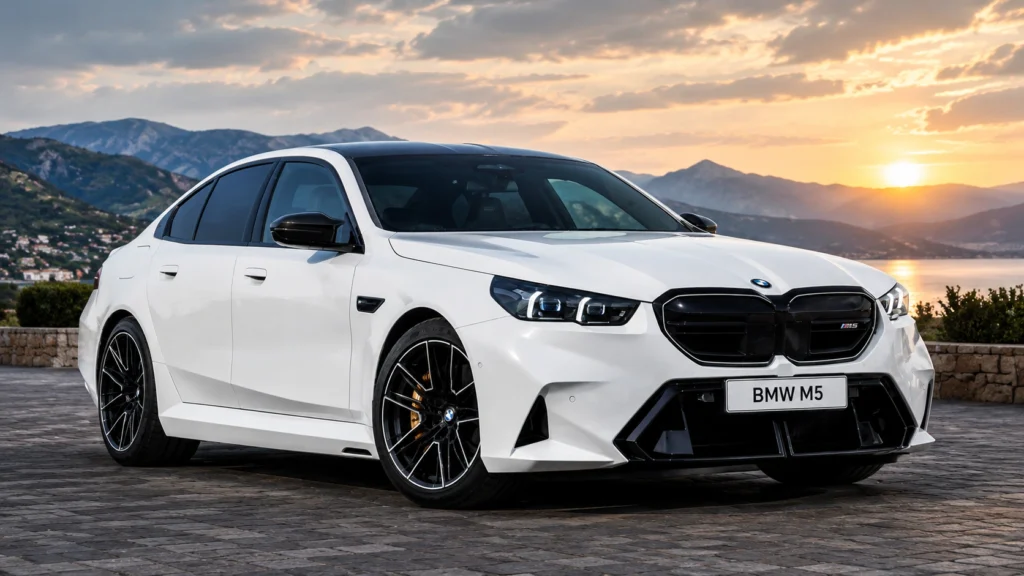
The BMW M5 has spent four decades proving that a family sedan can also be a genuine performance car, and the current model pushes that idea further than ever. It’s now a plug-in hybrid, pairing a twin-turbo V8 with an electric motor for a combined 717 horsepower, yet it still seats five and carries groceries without complaint.
That combination is exactly why the BMW M5 remains relevant in a segment full of capable rivals. Buyers shopping this class want explosive acceleration, all-weather traction, a genuinely comfortable cabin, and enough daily usability to justify a six-figure price tag, and the BMW M5 checks every one of those boxes.
In this guide, you’ll find the current M5’s official specifications, pricing, real-world performance figures, and how it stacks up against the Audi RS6 Avant, the Mercedes-AMG E53, and the Cadillac CT5-V Blackwing. We’ll also cover interior tech, ownership costs, and who this car actually makes sense for.
Quick Specifications
| Specification | BMW M5 |
|---|---|
| Model | BMW M5 (G90 Sedan / G99 Touring) |
| Engine | 4.4L twin-turbo V8 + electric motor (M Hybrid) |
| Power | 717 hp combined |
| Torque | 738 lb-ft combined |
| Drivetrain | M xDrive all-wheel drive |
| Transmission | 8-speed M Steptronic automatic |
| 0–60 mph | 3.4 sec (Sedan) / 3.5 sec (Touring) |
| Top Speed | 155 mph (190 mph with M Driver’s Package) |
| Fuel Economy | 14 mpg combined (gas only); roughly 47–50 MPGe (hybrid) |
| Seating Capacity | 5 |
| Starting Price | Around $123,300 (Sedan, U.S.; varies by model year and market) |
What Is the BMW M5?
The BMW M5 is the high-performance version of the 5 Series, built by BMW M GmbH rather than BMW’s regular engineering teams. It shares its basic shape and cabin architecture with the standard 5 Series, but almost everything mechanical underneath has been reworked for speed.
Where a regular 5 Series prioritizes comfort and efficiency, the BMW M5 adds a more powerful hybrid drivetrain, a stiffer chassis, bigger brakes, and all-wheel drive tuned for performance rather than just foul-weather grip. The result is a sedan that can carry four adults in comfort on a Tuesday commute and still hold its own on a track day.
That dual identity is the whole point of the M5. It’s aimed at buyers who don’t want to choose between a practical daily driver and a genuinely quick car, and who are willing to pay a premium for a vehicle that does both convincingly.
BMW M5 History and Background
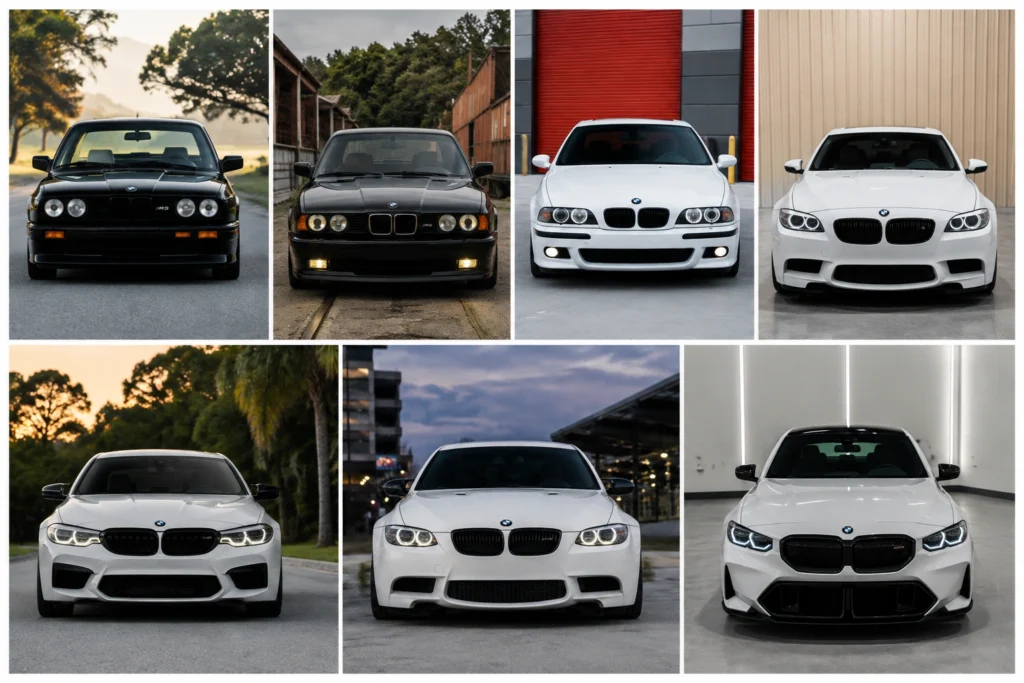
The BMW M5 nameplate dates back to 1985, when BMW dropped a 3.5-liter inline-six from the M1 supercar into a 5 Series body. That first-generation E28 M5 was quick for its era, but modest by today’s standards, and it was built in far smaller numbers than the M5 is today.
Subsequent generations tell the story of the model’s evolution. The E34 introduced a Touring wagon variant, the E39 switched to a naturally aspirated V8, and the E60 famously used a high-revving 5.0-liter V10. BMW then moved to turbocharged V8 power with the F10 in 2011, which also marked the shift away from purely naturally aspirated M engines.
The F90 generation, launched in 2017, was the first M5 with all-wheel drive through BMW’s M xDrive system, a change that improved traction without eliminating the option to send power to the rear wheels only. That generation also spawned the ultra-focused BMW M5 CS, a lighter, more powerful special edition built in limited numbers for drivers who wanted an even sharper version of the car.
The current M5, built on the G90 (sedan) and G99 (Touring) platforms, represents the biggest shift yet: it’s the first M5 sold exclusively as a plug-in hybrid. That change brings a significant jump in horsepower and a genuine electric-only driving mode, though it also adds a considerable amount of weight compared to older, gasoline-only M5s.
BMW M5 Design and Exterior
Exterior Styling
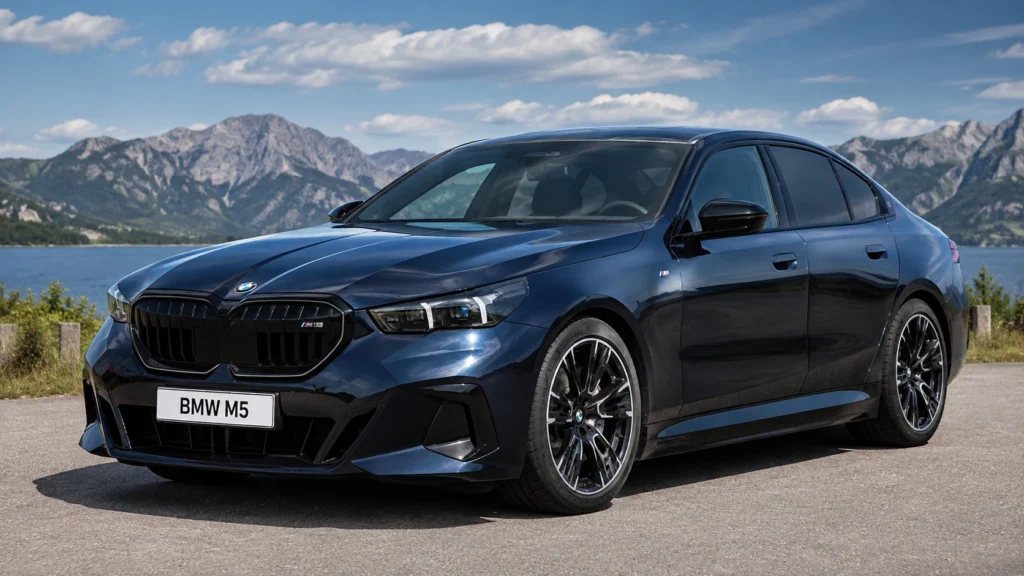
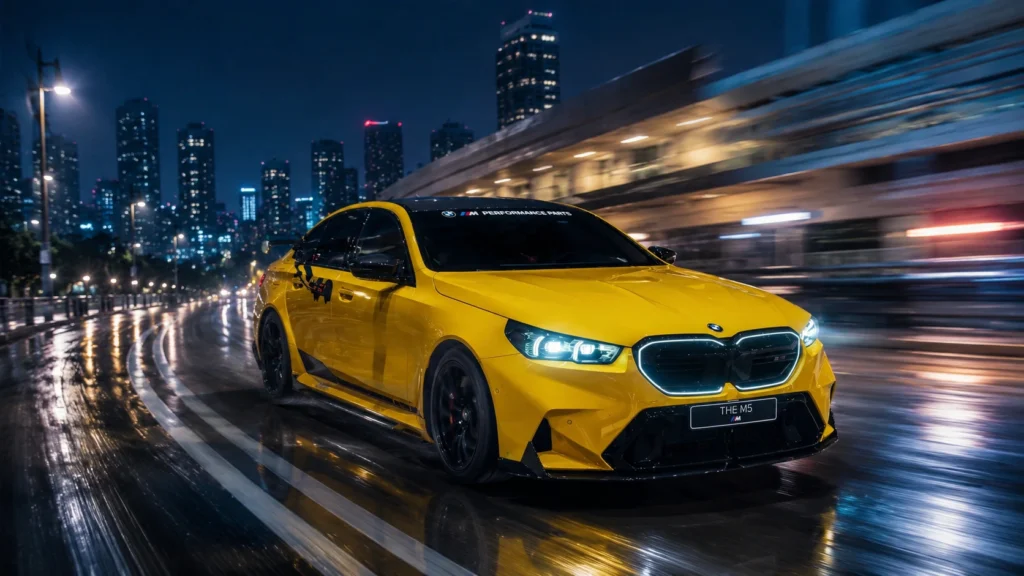
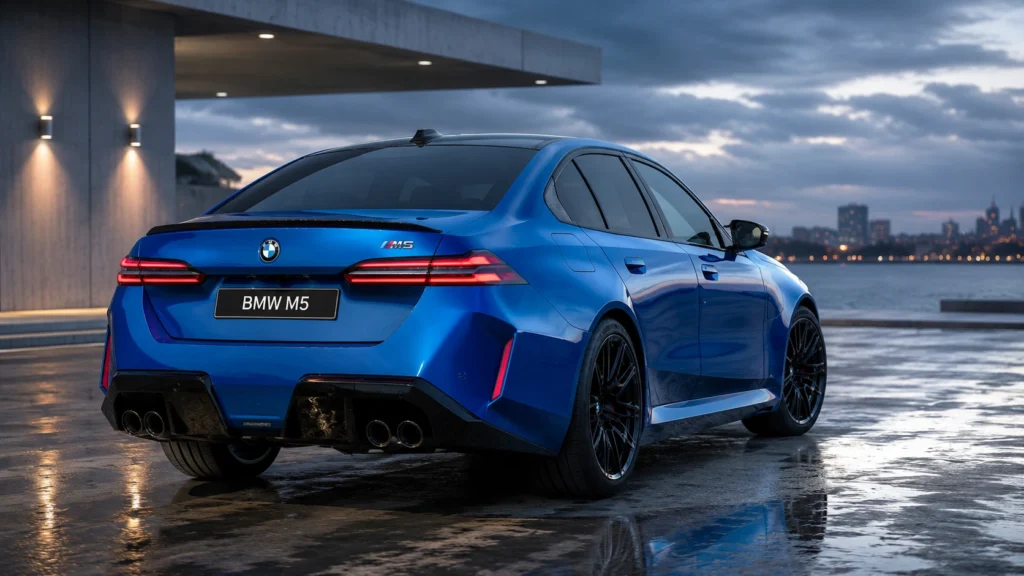
The M5 wears the same basic silhouette as the standard 5 Series, but nearly every panel has been changed to fit its performance mission. Flared front and rear wheel arches widen the body noticeably, giving the car a planted, muscular stance that’s easy to spot from a distance.
Up front, the BMW M5 gets its own take on BMW’s kidney grille, along with reshaped bumpers and larger air intakes that feed the engine and brakes. The double-outline headlights are shared with other 5 Series models, but the M-specific front fascia gives the car a more aggressive face.
Around back, a two-section diffuser frames quad exhaust outlets, and an M-specific trunk lid spoiler helps manage airflow at speed. Wheel sizes typically run 20 inches up front and 21 inches at the rear, wrapped in sport-oriented tires that visually fill out the flared arches.
Buyers who want to push the look further can opt for the M Carbon Exterior Package, which replaces the roof, mirror caps, and rear spoiler with lightweight carbon fiber. It’s a styling choice as much as a functional one, though it does shave a modest amount of weight from a car that could use it.
Dimensions and Practicality
The M5 Sedan measures roughly 200.6 inches long, 77.6 inches wide (about 84.8 inches with mirrors extended), and 59.4 inches tall, riding on a 118.3-inch wheelbase. Those are substantial dimensions for what’s still classified as a midsize sedan, and they translate into genuinely usable rear-seat space for adults.
Trunk space lands in the neighborhood of 16 to 18 cubic feet depending on how it’s measured, which is respectable for a performance sedan but not class-leading among wagon-bodied rivals. The M5 Touring wagon, sold in the U.S. for the first time with this generation, adds meaningfully more cargo room and a folding rear seat, making it the practical choice for buyers who need to haul more than a couple of suitcases.
BMW M5 Interior and Technology
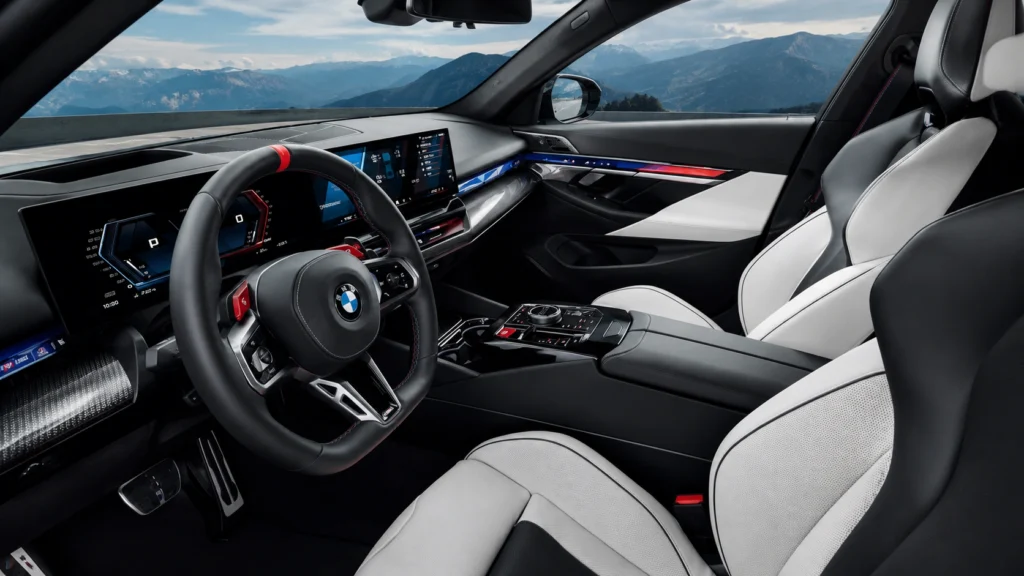
Step inside the M5 and the differences from a standard 5 Series become obvious immediately. M Multifunction seats grip the driver and front passenger firmly during hard cornering while still offering enough adjustability, including backrest width and seat heating, for daily comfort.
The M-specific leather steering wheel includes a red 12 o’clock marker, along with M1 and M2 buttons that recall two fully customizable drive-mode presets. That’s a genuinely useful feature in practice: one press can switch the car from a soft, quiet commuting setup to a firm, loud, rear-biased configuration for a canyon road.
BMW’s iDrive 8.5 software runs across a 14.9-inch curved center touchscreen and a 12.3-inch digital instrument cluster, both controlled by touch, voice command, or the physical iDrive controller on the center console. The system supports Apple CarPlay and Android Auto wirelessly, along with built-in navigation and real-time traffic data.
An M-specific head-up display adapts its layout depending on the selected M Mode, showing extensive information in Road mode and stripping down to essentials in Track mode. That’s a small but thoughtful touch: it means the car isn’t overwhelming the driver with data during a track session when reaction time matters most.
Driver-assistance features come standard with forward collision mitigation, lane-keeping assistance, and blind-spot monitoring, while an available Driving Assistance Professional package adds adaptive cruise control with stop-and-go capability and hands-free driving on select highways at speeds up to 40 mph. Comfort options include four-zone climate control, massaging front seats, and a premium Bowers & Wilkins-branded sound system, all of which push the M5 closer to luxury-flagship territory than a stripped-down sports sedan.
BMW M5 Engine, Hybrid System and Performance
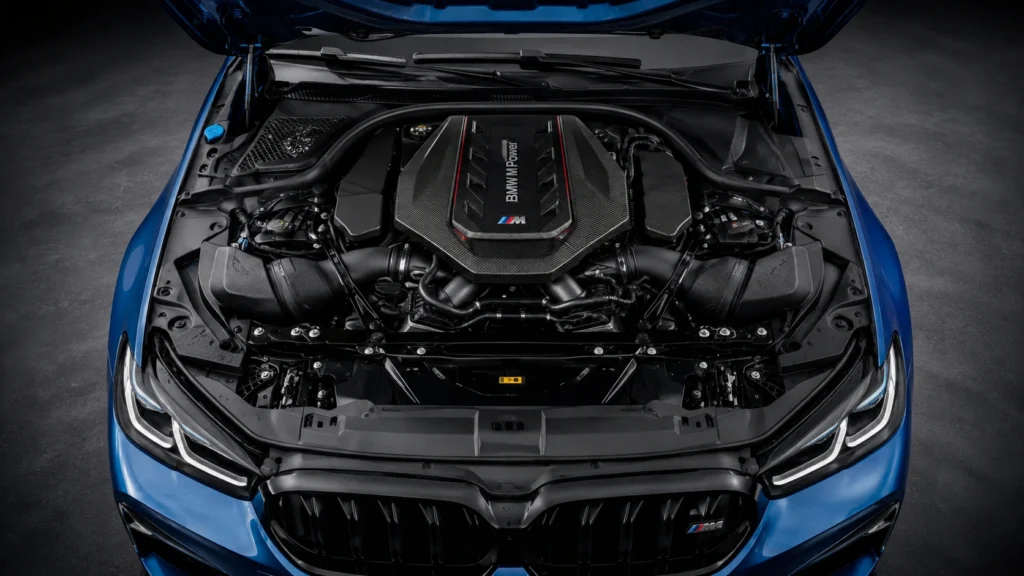
At the heart of the current M5 sits the S68, a 4.4-liter twin-turbocharged V8 built with 90 degrees between cylinder banks. On its own, that engine is already a strong performer, but BMW pairs it with a 194-horsepower electric motor built into the housing of the eight-speed transmission.
Combined, the gasoline engine and electric motor produce 717 horsepower and 738 lb-ft of torque. That combined figure isn’t simply the two components’ outputs added together; hybrid systems blend power delivery so the electric motor fills in torque at low RPM while the V8 takes over as revs climb, smoothing out what would otherwise be classic turbo lag.
Power reaches the road through an eight-speed M Steptronic automatic transmission, the only gearbox offered on this generation of M5. There’s no manual option here, which will disappoint some purists, but the automatic shifts quickly enough that few drivers will feel shortchanged in everyday use.
All of that power flows through M xDrive, BMW’s performance-tuned all-wheel-drive system. It’s adjustable rather than fixed: drivers can select a balanced all-wheel-drive mode for daily use, a rear-biased 4WD Sport mode for a more playful feel, or a full rear-wheel-drive 2WD mode with stability control disabled for track use. In practical terms, this means the M5 can behave like a secure, confidence-inspiring daily driver in the rain and still let an experienced driver rotate the car through a corner on demand.
Underneath, adaptive M suspension continuously adjusts damping based on road conditions and drive mode, while standard four-wheel steering improves both low-speed maneuverability and high-speed stability. Optional carbon-ceramic brakes cut unsprung weight and resist fade better than steel rotors during repeated hard stops, which matters if the M5 ever sees track duty.
The result is a car that manages to feel composed on a daily commute while still delivering genuine performance-car sensations when pushed. You can find the complete official BMW M5 specifications directly from the manufacturer for the most current figures by trim and package.
BMW M5 Specifications
| Specification | Detail |
|---|---|
| Engine | 4.4L twin-turbo V8 (S68) + electric motor |
| Displacement | 4,395 cc |
| Cylinders | 8 (V configuration) |
| Turbochargers | 2 |
| Electric Motor | 194 hp, integrated into transmission housing |
| Combined Horsepower | 717 hp |
| Torque | 738 lb-ft combined |
| Transmission | 8-speed M Steptronic automatic |
| Drivetrain | M xDrive AWD (4WD, 4WD Sport, 2WD modes) |
| Battery Capacity | Approximately 14.8 kWh usable |
| 0–60 mph | 3.4 sec (Sedan) / 3.5 sec (Touring) |
| Top Speed | 155 mph standard / 190 mph with M Driver’s Package |
| Curb Weight | Approximately 5,390 lbs |
| Length | About 200.6 in |
| Width | About 77.6 in (84.8 in with mirrors) |
| Wheelbase | About 118.3 in |
| Seating Capacity | 5 |
| Cargo Capacity | Roughly 16–18 cu ft (Sedan); more in the Touring |
| Fuel Economy | 14 mpg combined (gas only) |
| Electric Range | About 25 miles (EPA-estimated, varies by conditions) |
Figures come from BMW’s official specifications and reflect the current G90/G99 generation. Some third-party sources report slightly different curb weight and range figures depending on trim, options, and testing method, so treat these as representative rather than absolute for every configuration.
BMW M5 Top Speed and 0–60 MPH
BMW’s official figures put the M5 Sedan at 3.4 seconds from 0 to 60 mph, with the Touring wagon just a tenth behind at 3.5 seconds. Both numbers come from BMW’s own preliminary testing, and independent outlets have recorded similarly quick, sometimes marginally faster, results under ideal conditions.
Top speed is electronically limited to 155 mph in standard trim. Buyers who want more can add the M Driver’s Package, which raises that limiter to 190 mph and includes a day of instruction at a BMW performance driving school.
Real-world acceleration depends on more than the spec sheet. Tire temperature, road surface, ambient temperature, and how the driver executes a launch all affect the result, and BMW’s own disclaimers note that its figures shouldn’t be treated as guaranteed outcomes on public roads. A cold tire on a wet morning simply won’t replicate a manufacturer’s controlled test conditions.
It’s also worth noting that the M5’s straight-line pace, while genuinely quick, isn’t actually the fastest in the model’s own history. The previous-generation M5 CS, a lighter, non-hybrid special edition, has been independently timed slightly quicker to 60 mph despite lower peak horsepower, simply because it weighed over 1,200 pounds less than the current hybrid car.
BMW M5 Fuel Economy and Electric Range
The current BMW M5 is a plug-in hybrid, which means its efficiency story has two very different sides depending on how it’s driven. On electricity alone, BMW rates the EPA all-electric range at about 25 miles, enough for many commuters to complete a round trip without the V8 firing at all.
While running purely on its battery, the M5 is EPA-rated at roughly 50 MPGe, a figure that measures energy efficiency in electric mode using a gasoline-equivalent scale. Once the battery is depleted and the V8 takes over full-time, fuel economy drops sharply to around 14 mpg combined, which is typical for a car with this much power and weight.
Charging happens through a standard Level 2 connection, and BMW includes a portable charger compatible with both 120V and 240V outlets. An upgraded onboard charger on the current model year allows for somewhat faster replenishment than earlier versions offered.
Real-world efficiency will vary based on driving style, climate, and how consistently the battery gets charged between trips. A driver who plugs in nightly and mostly covers short distances will see dramatically better real-world fuel economy than one who never charges and relies on the V8 exclusively; treat BMW’s combined figures as a helpful benchmark rather than a guarantee.
BMW M5 Price
BMW currently lists a starting MSRP of around $123,300 for the M5 Sedan in the United States, based on the manufacturer’s official configurator. The M5 Touring wagon typically starts a bit higher, generally in the $125,000 to $128,000 range depending on the model year.
These figures do not include destination charges, taxes, title, registration, or dealer-adjusted market pricing, all of which can move the final number. Pricing has also shifted somewhat year to year as BMW updates trim content and responds to market conditions, so treat any single number as a snapshot rather than a permanent figure.
Major options can add substantially to the bottom line. The Executive Package brings four-zone climate control and additional comfort features, the M Carbon Exterior Package swaps several body panels for carbon fiber, and carbon-ceramic brakes are a costly but genuinely useful upgrade for drivers who plan to track the car. Fully loaded configurations regularly climb past $145,000.
Pricing outside the U.S. varies significantly by market due to differing tax structures, equipment requirements, and currency factors, so buyers researching the M5 in other countries should consult their local BMW configurator rather than relying on U.S. figures.
BMW M5 Pros and Cons
| Pros | Cons |
|---|---|
| 717 hp combined output with strong all-weather traction | Curb weight around 5,390 lbs blunts outright agility |
| Genuine short-commute EV range from the plug-in hybrid system | Gas-only fuel economy is poor once the battery depletes |
| Comfortable, tech-rich cabin suited to daily driving | No manual transmission is offered |
| Adjustable xDrive modes for both security and playfulness | Options can push the price well past $145,000 |
| Touring wagon adds genuine cargo practicality | Ride can feel firm on larger wheel and tire packages |
BMW M5 vs Competitors
The M5 competes in a small but fierce class of high-performance luxury sedans and wagons. The most relevant rivals are the Audi RS6 Avant Performance, the Mercedes-AMG E53 Hybrid, and the Cadillac CT5-V Blackwing, each of which takes a distinctly different approach to the same basic brief.
| Factor | BMW M5 | Audi RS6 Avant Performance | Mercedes-AMG E53 Hybrid | Cadillac CT5-V Blackwing |
|---|---|---|---|---|
| Power | 717 hp | 621 hp | Up to 604 hp | 668 hp |
| Torque | 738 lb-ft | 627 lb-ft | 553 lb-ft | 659 lb-ft |
| 0–60 mph | 3.4 sec | About 3.2–3.3 sec | About 3.8–4.0 sec | 3.4 sec (auto) |
| Top Speed | 155 mph (190 mph optional) | Up to 190 mph (optional) | 155–174 mph | Over 200 mph |
| Drivetrain | M xDrive AWD | Quattro AWD | 4Matic+ AWD | Rear-wheel drive |
| Starting Price | Around $123,300 | Around $130,700 | Around $89,150–$94,500 | Around $98,900 |
| Body Style | Sedan or wagon | Wagon only | Sedan or wagon | Sedan only |
| Key Advantage | Most power, hybrid efficiency | Best cargo space and wagon-only presence | Lowest price, longest EV range | Manual gearbox, highest top speed |
The Audi RS6 Avant is the closest thing to a direct rival in spirit: it’s only sold as a wagon in the U.S., and its 621-hp twin-turbo V8 delivers similarly explosive acceleration with genuinely useful cargo space. It’s priced close to the M5 but doesn’t offer a plug-in hybrid powertrain or an electric-only driving mode.
The Mercedes-AMG E53 Hybrid effectively fills the role once held by the AMG E63, since that nameplate has been on hiatus following the E-Class redesign. It’s noticeably down on power compared with the M5, but it costs tens of thousands of dollars less and offers a longer electric-only range, making it the value-focused choice in this comparison.
The Cadillac CT5-V Blackwing stands apart by sticking with a naturally supercharged V8 and offering a six-speed manual transmission, a rarity in this class. It’s rear-wheel drive only, which limits its all-weather usability compared with the M5, but it undercuts the BMW on price while matching or beating it on raw acceleration and top speed.
BMW M5 vs BMW M3
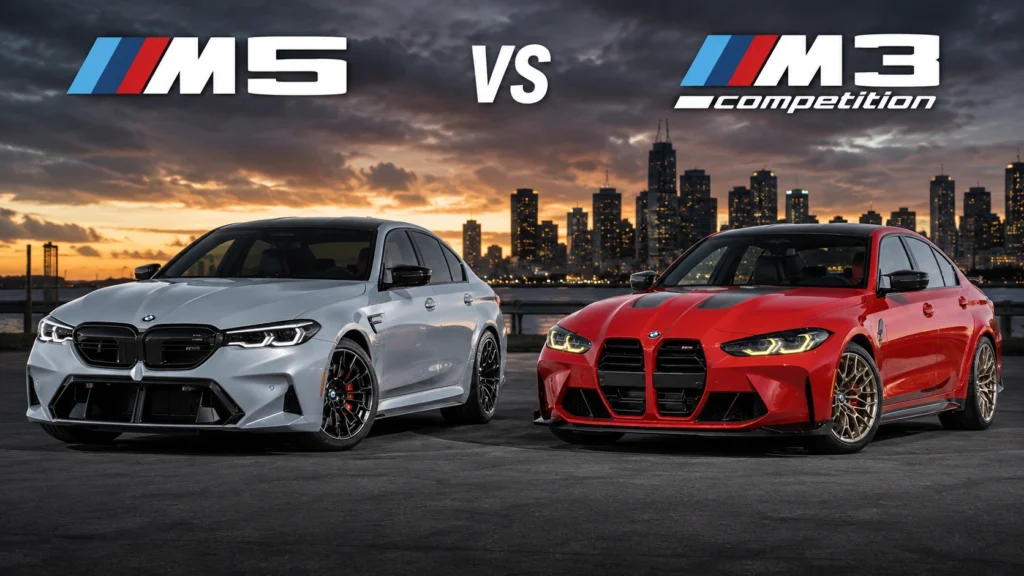
The BMW M3 is the M5’s smaller sibling, built on the compact 3 Series platform rather than the midsize 5 Series. It uses a twin-turbo 3.0-liter inline-six instead of a V8, with outputs ranging from 473 hp in base trim to 523 hp in Competition xDrive form.
Because the M3 is smaller and lighter, weighing roughly 3,840 to 3,990 pounds depending on trim, it can feel noticeably more agile and responsive through tight corners than the heavier M5. Its base model even retains a six-speed manual transmission, something the current M5 doesn’t offer at all.
The M5, on the other hand, brings more outright power, a more spacious cabin, and a genuinely usable back seat for adult passengers on longer trips. Pricing reflects the size difference too: the M3 starts around $79,575, tens of thousands of dollars below the M5’s starting point.
Buyers who prioritize a raw, engaging driving experience and don’t need extra rear-seat space will likely prefer the M3. Those who want maximum power, a hybrid powertrain, and true four-adult comfort should lean toward the M5.
BMW M5 vs BMW M4
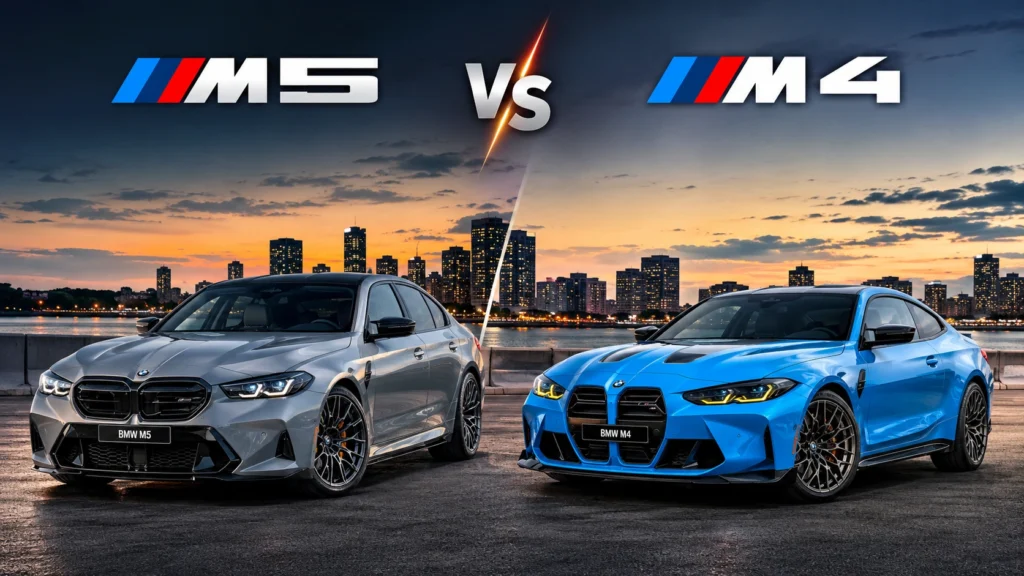
The BMW M4 shares its engine family with the M3, using the same twin-turbo 3.0-liter inline-six in outputs from 473 hp to 523 hp, but wraps it in a two-door coupe or convertible body instead of a four-door sedan.
That body style comes with trade-offs. The M4 seats four rather than five, offers less rear headroom and legroom, and provides noticeably less trunk space than the M5. In exchange, it’s lighter, starts at a lower price point (around $82,200 for the base Coupe), and delivers a sportier, more focused driving character.
The M5 wins clearly on outright power, all-weather grip from its hybrid xDrive system, and everyday practicality for a family that needs real back seats. The M4 wins on price, visual drama, and the kind of tossable feel that comes from carrying less weight.
Choosing between them usually comes down to lifestyle. Someone who regularly drives with rear-seat passengers or wants maximum performance will gravitate toward the M5, while someone shopping for a weekend driver or a stylish daily coupe without back-seat obligations will likely prefer the M4.
Who Should Buy the BMW M5?
The M5 makes the most sense for buyers who genuinely need one car to do two jobs: serve as a comfortable daily driver and deliver serious performance when the mood strikes. Someone who commutes in traffic during the week and wants a properly quick car for weekend drives fits that profile well.
It’s also a strong choice for buyers who value all-weather confidence. The standard M xDrive system means the M5 doesn’t need to sit in the garage during winter the way a rear-wheel-drive-only performance car might, which matters in regions with genuine seasonal weather.
Families who need rear-seat space and a usable trunk, but don’t want to give up serious horsepower, are another obvious audience, especially with the Touring wagon now available in the U.S. market.
The M5 is a poor fit, however, for buyers who want a manual transmission, since none is offered on this generation. Drivers chasing the lightest, most track-focused feel in BMW’s lineup should look at the M3 or M4 instead, since the M5’s extra weight works against it on a tight circuit. And anyone shopping primarily on price should strongly consider the Cadillac CT5-V Blackwing or the Mercedes-AMG E53, both of which undercut the M5 substantially.
BMW M5 Ownership: What to Consider
Running costs for the M5 reflect its dual nature as both a hybrid and a high-performance V8. Owners who charge regularly and use the electric range for short trips can meaningfully reduce fuel spending, while those who rarely plug in will see fuel costs closer to a traditional performance sedan, with combined gas-only economy sitting around 14 mpg.
Home charging is straightforward through a Level 2 connection, and BMW includes a portable charger for both 120V and 240V outlets. A dedicated home charging station will speed things up but isn’t strictly required for owners who mainly rely on the gasoline engine.
Maintenance costs tend to run higher than a mainstream sedan, as is typical for performance cars with complex hybrid systems, large brakes, and high-performance tires. Tire wear can be a genuine ongoing expense given the M5’s power output and wide, sticky rubber, and owners who opt for the carbon-ceramic brake package should budget for its higher replacement cost if it’s ever needed, despite its long-term durability advantages.
Insurance premiums generally reflect the car’s high performance, high price, and repair complexity, so it’s worth getting a quote before committing to a purchase rather than assuming it will track with a standard 5 Series.
Day to day, the M5 is genuinely comfortable. Adaptive suspension keeps the ride reasonably composed even on larger wheels, rear-seat space is usable for adult passengers on real trips, and the cabin’s tech and comfort features hold up well against luxury sedans that don’t offer anywhere near the same performance. Long-term owners should simply go in with realistic expectations about running costs that come with 717 horsepower and a hybrid system this complex.
Conclusion
The BMW M5 remains one of the most complete performance sedans on sale, combining 717 hybrid horsepower with genuine daily-driver comfort and all-weather traction from its M xDrive system. Its blend of luxury, technology, and outright speed is hard to match, and the addition of a U.S.-market Touring wagon only broadens its appeal.
That said, it’s not without trade-offs. The M5’s weight works against it compared with lighter rivals, gas-only fuel economy is unremarkable, and there’s no manual transmission for drivers who want one. Buyers focused purely on value or track-day agility have credible alternatives to consider.
For the right buyer, though, the case is straightforward: if you want a single car that can handle a daily commute, a family road trip, and a genuinely quick run down a back road, the BMW M5 remains one of the best answers in its class. Anyone cross-shopping this segment should test-drive it alongside the RS6 Avant, the AMG E53, and the CT5-V Blackwing before deciding, since each brings a meaningfully different character to the same basic mission.
Frequently Asked Questions (FAQs)
The BMW M5 is the high-performance version of BMW’s 5 Series, built by BMW’s M division. The current generation pairs a twin-turbo V8 with an electric motor for a combined 717 horsepower.
BMW’s official U.S. configurator currently lists a starting MSRP around $123,300 for the Sedan, with the Touring wagon starting somewhat higher. Well-optioned examples can exceed $145,000.
The current M5 produces 717 horsepower combined from its 4.4-liter twin-turbo V8 and 194-hp electric motor, along with 738 lb-ft of torque.
Top speed is electronically limited to 155 mph in standard trim, or 190 mph with the optional M Driver’s Package.
BMW’s official figures show 3.4 seconds for the Sedan and 3.5 seconds for the Touring wagon, based on the manufacturer’s preliminary testing.
Yes. The current-generation BMW M5 is a plug-in hybrid, combining a V8 engine with an electric motor and offering roughly 25 miles of electric-only range.
Yes, for most buyers. Adaptive suspension, a comfortable cabin, and usable rear-seat space make it practical for daily use, though its firm ride on larger wheels and its size may not suit everyone.
For buyers who want one car that handles both daily commuting and serious performance, the M5 is a strong choice, though rivals like the Cadillac CT5-V Blackwing and Mercedes-AMG E53 offer some of that same experience at a lower price.