BMW i8 Review: Stunning Design & Hybrid Performance
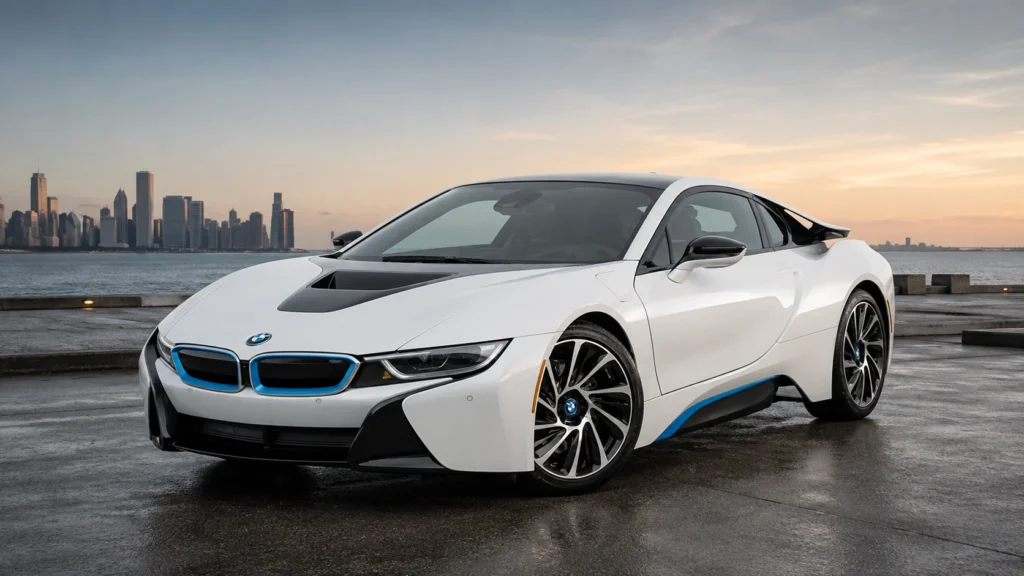
The BMW i8 arrived as one of the most distinctive sports cars of its era. Produced from 2014 to 2020, this plug-in hybrid combined a turbocharged three-cylinder gasoline engine with electric motors, carbon-fiber construction, and dramatic styling that still turns heads years after production ended. It was never about raw horsepower records. Instead, the i8 focused on efficiency, technology, and a driving experience that blended silent electric running with sharp sports-car responses.
Its butterfly doors, low-slung profile, and futuristic lighting made it an instant design statement. On the road, the all-wheel-drive hybrid system delivered quick acceleration and respectable electric range for short trips while the gasoline engine handled longer journeys. Today the BMW i8 lives on in the used market, where lower prices have made this once-expensive halo car more accessible to buyers who value innovation and looks over pure track performance.
This review examines the i8’s history, design, powertrain, real-world performance figures, ownership costs, and what to check before buying one in 2026.
Quick Specifications
| Specification | BMW i8 |
|---|---|
| Production | 2014–2020 |
| Powertrain | Plug-in hybrid |
| Engine | 1.5L turbocharged 3-cylinder |
| Combined Power | 357 hp (early) / 369 hp (later) |
| Torque | 420 lb-ft |
| Transmission | 6-speed automatic |
| Drivetrain | All-wheel drive |
| 0–60 mph | 4.2–4.4 seconds |
| Top Speed | 155 mph (limited) |
| Electric Range | 15–18 miles (EPA) |
| Battery | 7.1 kWh / 11.6 kWh |
| Seating | 2+2 |
| Body Styles | Coupe / Roadster |
What Is the BMW i8?
The BMW i8 was the performance flagship of BMW’s i sub-brand. While the i3 focused on urban electric mobility, the i8 aimed to prove that a sports car could deliver strong dynamics with far better efficiency than traditional gasoline models of similar price and presence.
It used BMW’s LifeDrive architecture: a carbon-fiber-reinforced plastic (CFRP) passenger cell paired with an aluminum chassis that housed the battery, suspension, and powertrain. The result was a relatively light car for its class with a low center of gravity. The plug-in hybrid system allowed pure-electric driving for short distances, blended operation for everyday efficiency, and full system output when the driver demanded performance.
Unlike conventional sports cars that relied solely on large engines, the BMW i8 treated electrification as a core performance tool. Instant electric torque filled in the gaps of the small turbo three-cylinder, and the all-wheel-drive layout improved traction without the weight of a traditional mechanical system. The BMW i8 was never designed to beat traditional sports cars on horsepower alone. Its appeal came from combining electric assistance, lightweight construction, everyday efficiency, and exotic-car styling in one package.
BMW i8 History and Background
The story begins with the 2009 Vision EfficientDynamics concept. Shown at the Frankfurt Motor Show, the concept previewed many of the production car’s themes: dramatic aerodynamics, lightweight materials, and a hybrid powertrain focused on both performance and low emissions. Positive reaction helped push the project toward series production.
BMW launched the i sub-brand around the same time to develop electrified vehicles separately from the mainstream lineup. The production i8 Coupe was revealed in 2013 and went on sale in 2014. Early cars used a 7.1 kWh battery and delivered a combined 357 horsepower.
In 2018 BMW introduced a significant update for the 2019 model year. Battery capacity rose to 11.6 kWh, the front electric motor gained power, and total system output reached 369 horsepower. At the same time the company launched the i8 Roadster, which traded the coupe’s fixed roof and tiny rear seats for a power soft top and pure two-seat layout.
Production ended in June 2020 after roughly 20,500 units had been built. The majority were coupes; the Roadster remained the rarer variant. BMW cited a shift in strategy toward higher-volume electrified models and full electric vehicles. The i8 had served its purpose as a technology demonstrator and brand halo, but its complex carbon-intensive construction and relatively low sales volume made continuation less attractive.
Even so, the car left a clear mark. It proved a plug-in hybrid sports car could look exotic, drive engagingly, and deliver efficiency figures closer to a small hatchback than a traditional grand tourer. For many enthusiasts it remains a landmark of the early electrification era.
BMW i8 Design and Exterior
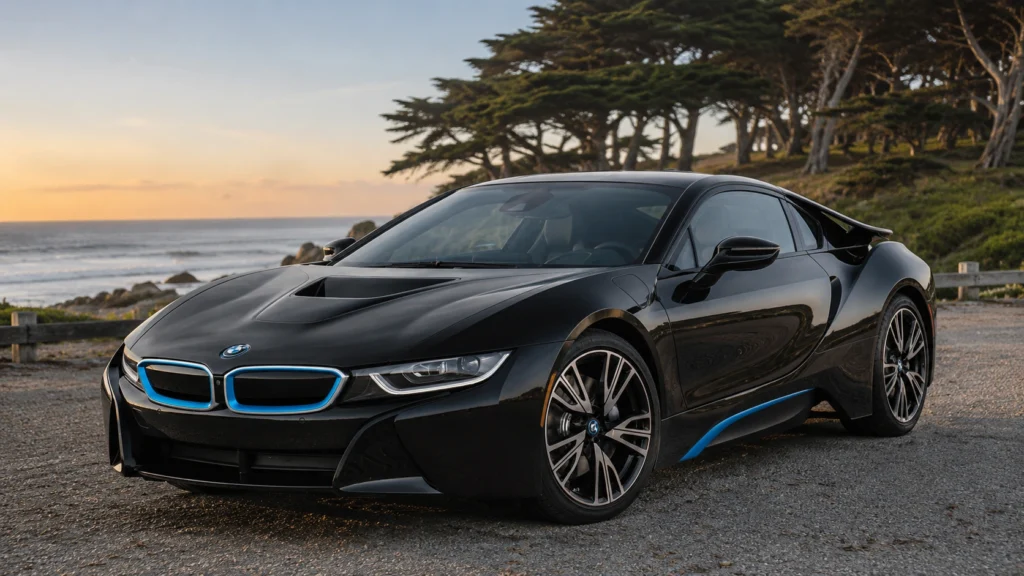
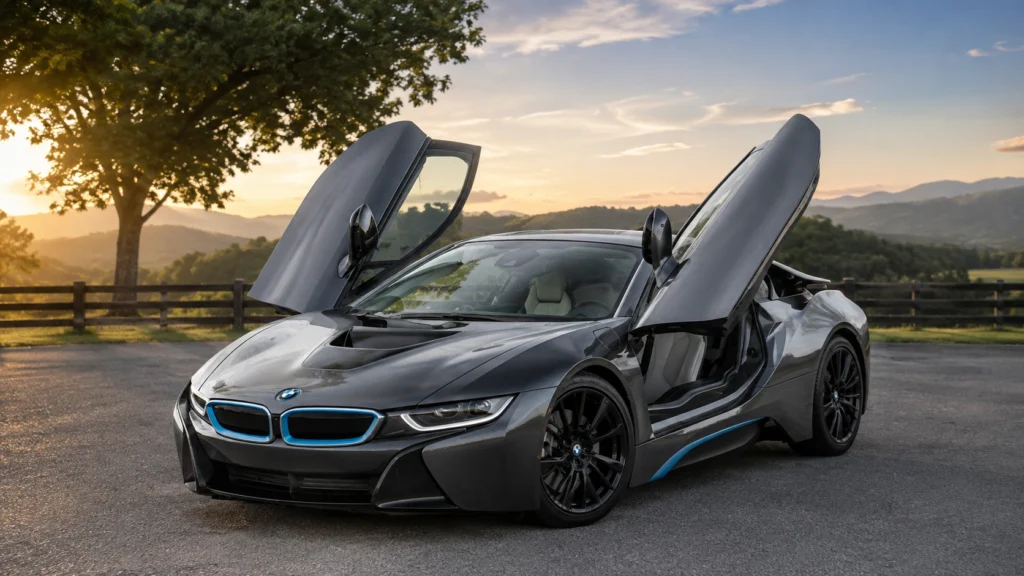
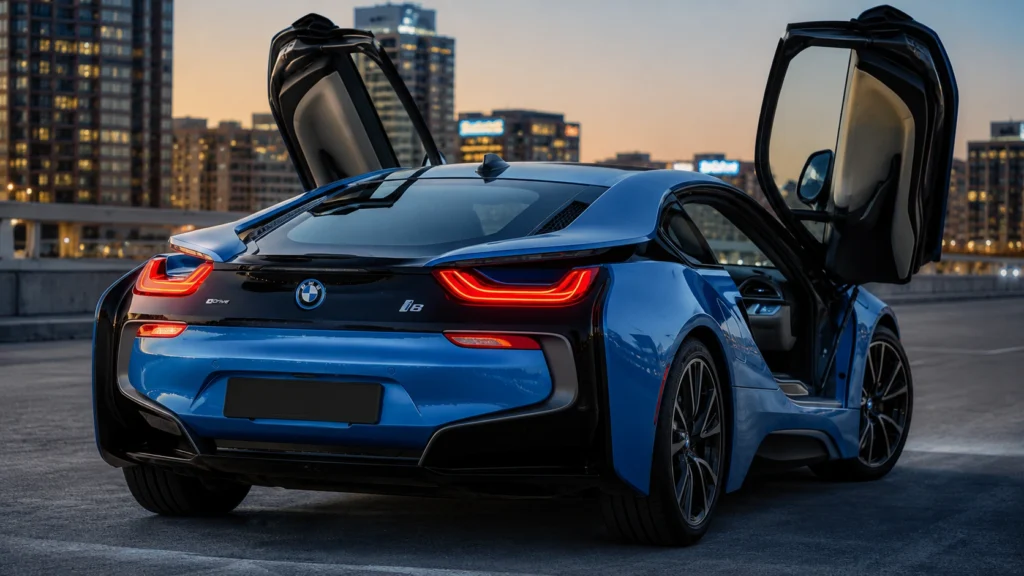
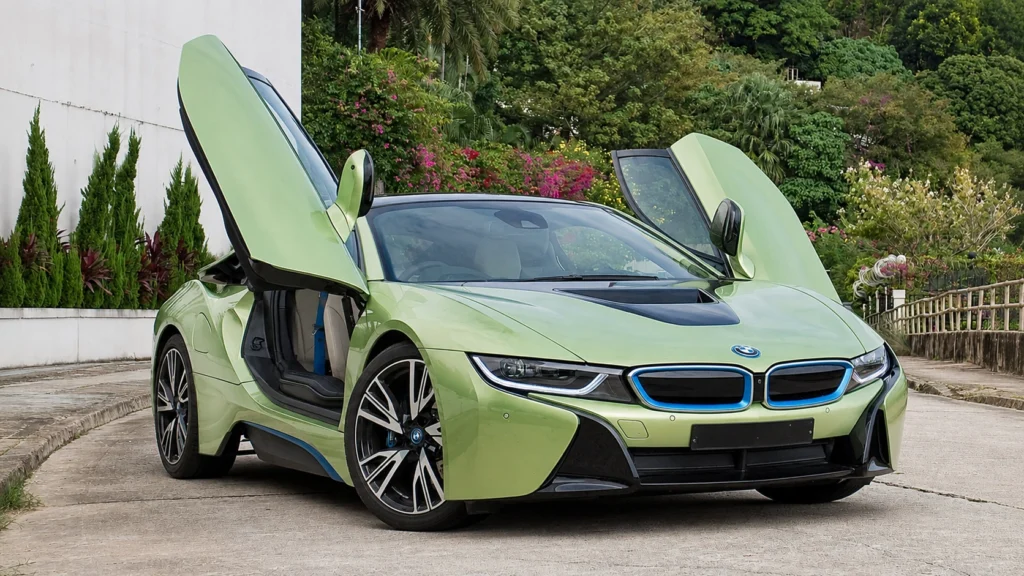
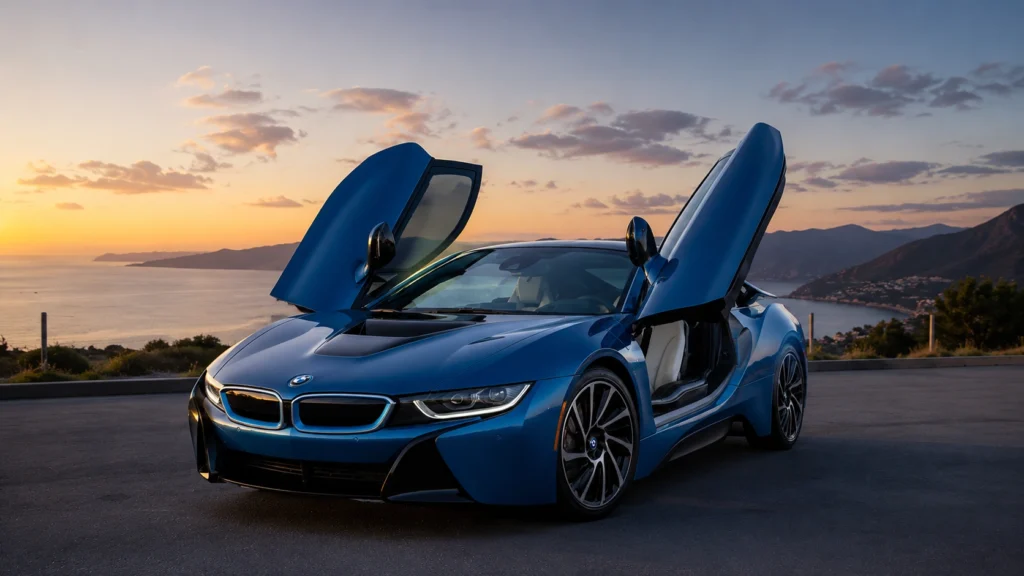
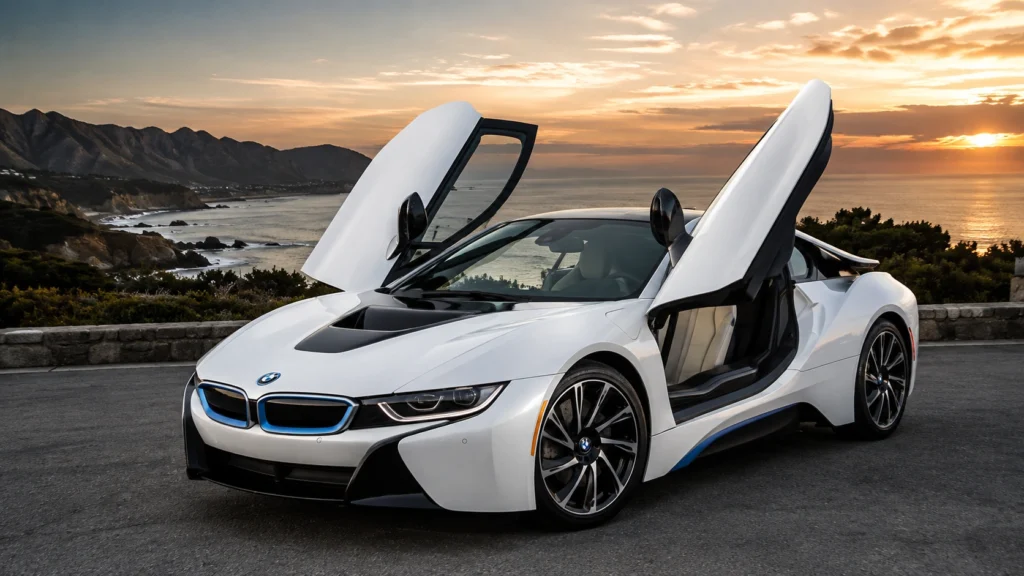
Few production cars from the 2010s still look as fresh as the i8. The long, low silhouette, pronounced rear haunches, and floating roof create a strong visual presence. Blue accents on the grille, wheels, and trim signal its electrified identity without shouting.
The signature feature is the pair of upward-opening doors. Often called butterfly or scissor-style doors, they hinge forward and rise, making entry theatrical and requiring more side clearance than conventional doors. The carbon-fiber structure contributes to both strength and the distinctive layered appearance of the body panels.
Aerodynamics were carefully managed. The coupe’s drag coefficient of 0.26 helped efficiency and high-speed stability. Air curtains, carefully shaped underbody panels, and the low stance all contribute. Laser headlights (available on later cars) provided a distinctive signature and strong illumination. Standard 20-inch wheels filled the arches and completed the aggressive stance.
Dimensions are compact for the visual drama: roughly 185 inches long, 76.5 inches wide, and just under 51 inches tall, with a 110.2-inch wheelbase. The Roadster keeps nearly identical proportions but sits slightly different with the soft top mechanism. Both body styles remain eye-catching in 2026 traffic, which is part of their continued appeal on the used market.
BMW i8 Interior and Technology
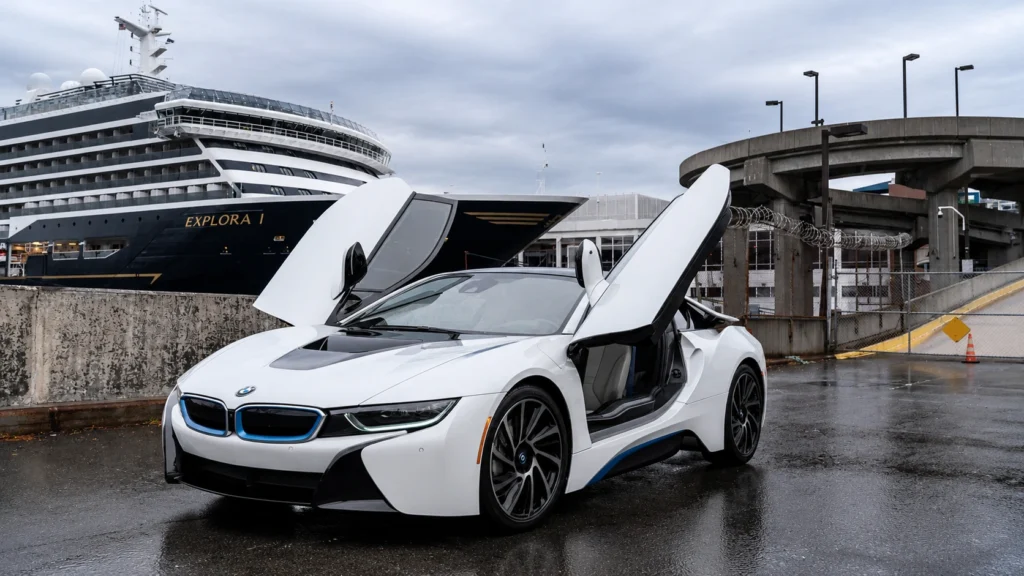
Step inside and the cabin continues the futuristic theme. The driver sits low in a supportive seat with good lateral support. Materials mix leather, Alcantara-like fabrics, and contrasting stitching. Blue accents and high-quality plastics reinforce the tech-forward image. Fit and finish generally match BMW standards of the period.
The coupe offers a 2+2 layout. The rear seats are best suited to children or very short trips; adults will find them cramped. The Roadster is strictly a two-seater. Front seating is comfortable for longer drives, though the low roof line limits headroom for taller drivers.
Digital displays and iDrive handle most functions. Later cars gained improved connectivity, including Apple CarPlay compatibility in many markets. Navigation, climate controls, and driving mode selection are straightforward once familiar. Driver assistance features of the era—lane departure warning, forward collision alerts, and parking sensors—are present but less comprehensive than modern systems.
Cargo space is limited. The coupe offers about 4.7 cubic feet behind the seats; the Roadster has even less once the top is down. This is a sports car, not a daily multi-purpose vehicle. Practicality is secondary to the driving and design experience.
BMW i8 Engine, Hybrid System and Performance
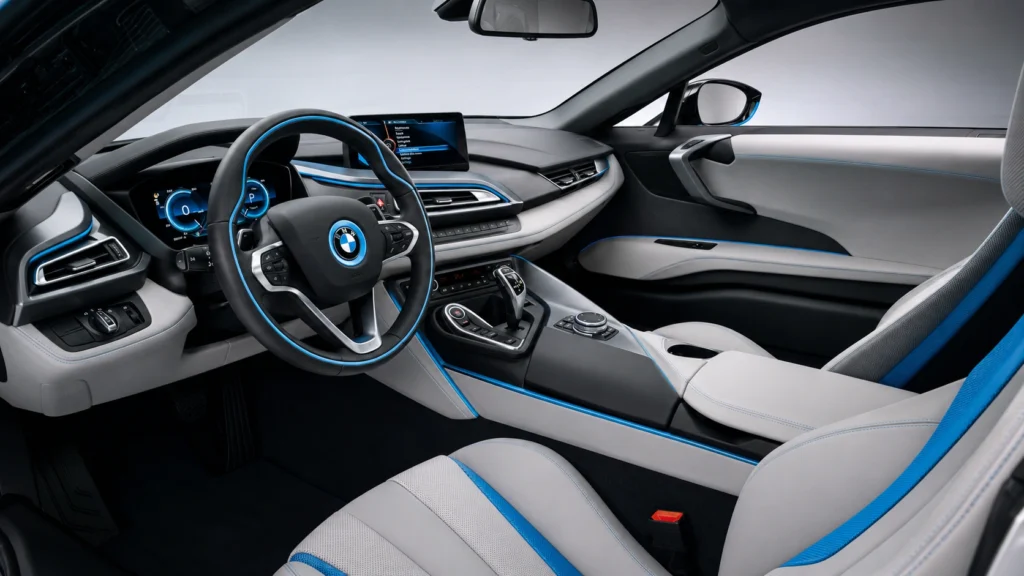
At the heart of the BMW i8 is a 1.5-liter turbocharged three-cylinder gasoline engine producing 228 horsepower and 236 lb-ft of torque. Mounted longitudinally behind the passenger cell, it drives the rear wheels through a six-speed automatic transmission. A small electric motor/generator is integrated with the engine for starting, boosting, and regeneration.
The front axle is powered by a permanent-magnet synchronous electric motor. Early cars delivered 129 horsepower and 184 lb-ft; the 2018 update raised motor output to 141 horsepower while torque stayed the same. Combined system output is 357 horsepower and 420 lb-ft on pre-update cars and 369 horsepower with the same torque figure on later models.
The lithium-ion battery sits in a central tunnel for optimal weight distribution. Capacity was 7.1 kWh (about 5.2 kWh usable) on early cars and 11.6 kWh on later ones. The system operates as a plug-in hybrid: the car can drive on electric power alone at speeds up to about 75 mph, blend electric and gasoline power, or use the engine primarily while the motors assist and recover energy.
Regenerative braking captures energy during deceleration and feeds it back to the battery. Driving modes let the driver prioritize efficiency (ECO PRO), balanced operation (Comfort), or maximum performance (Sport). In Sport mode the system keeps the battery charged for full boost availability and sharpens throttle response and shift points.
The lightweight CFRP structure and low center of gravity give the i8 agile handling. Steering is precise, body control is good, and the all-wheel-drive layout provides strong traction out of corners. Compared with pure gasoline sports cars of the period, the i8 feels different—less visceral exhaust note, more instant low-end response from the electric motors, and a quieter cabin when operating in electric mode. It is quick and engaging rather than raw or theatrical.
BMW i8 Specifications
| Category | Details |
|---|---|
| Engine | 1.5L turbocharged inline-3 |
| Displacement | 1,499 cc |
| Cylinders | 3 |
| Turbocharging | Yes |
| Electric Motors | Front permanent-magnet synchronous + integrated generator |
| Combined Horsepower | 357 hp (2014–2017/18) / 369 hp (2018–2020) |
| Combined Torque | 420 lb-ft |
| Transmission | 6-speed automatic (rear) + 2-speed (front) |
| Drivetrain | All-wheel drive |
| Battery | 7.1 kWh (early) / 11.6 kWh (later) |
| Electric Range (EPA) | ~15 miles early / ~18 miles later |
| 0–60 mph | 4.2–4.4 seconds (coupe); slightly slower for Roadster |
| Top Speed | 155 mph (electronically limited) |
| Curb Weight | Approx. 3,400–3,650 lbs depending on version |
| Length / Width / Height | 184.9 / 76.5 / ~50.8 in |
| Wheelbase | 110.2 in |
| Seating | 2+2 (Coupe) / 2 (Roadster) |
| Cargo Capacity | ~4.7 cu ft (Coupe) |
| Fuel Economy | ~28 mpg gasoline / 69–76 MPGe combined (EPA) |
Figures vary slightly by model year, body style, and testing method. Later cars with the larger battery offer more electric capability and slightly higher system output.
BMW i8 Top Speed and 0–60 MPH
BMW quoted 0–60 mph times of approximately 4.4 seconds for early coupes and around 4.2 seconds for updated versions. Independent tests sometimes recorded slightly quicker results under ideal conditions. The Roadster is a tenth or two slower due to extra weight from the soft-top mechanism.
Top speed is electronically limited to 155 mph in all versions. In pure electric mode the limit drops to about 75 mph. Acceleration feels strong from low speeds thanks to electric torque, then remains progressive as the gasoline engine comes in. Real-world performance depends on battery charge state, ambient temperature, tire condition, and driver technique. A fully charged battery and Sport mode deliver the quickest times.
BMW i8 Electric Range and Fuel Economy
Official EPA electric range is roughly 15 miles for early 7.1 kWh battery cars and about 18 miles for later 11.6 kWh models. European test cycles produced higher figures. Real-world electric range typically falls in the 12–20 mile range depending on temperature, driving style, and terrain. Cold weather and aggressive acceleration reduce it noticeably.
When the battery is depleted the car operates as a conventional hybrid. EPA combined gasoline ratings sit around 28 mpg, with overall MPGe (including electric operation) in the high 60s to mid-70s depending on model year. Owners who charge regularly and use electric mode for short trips can achieve excellent overall efficiency. Those who rarely plug in will see more conventional hybrid economy.
Charging is straightforward. A Level 2 charger can fully replenish the battery in a few hours; a standard household outlet takes longer. Regenerative braking helps maintain charge during mixed driving. The small fuel tank (about 11.1 gallons) limits pure gasoline range, so the total system range is typically 300-plus miles under normal conditions.
BMW i8 Price
Original BMW i8 MSRP
When the coupe launched in the United States in 2014, base MSRP started around $135,700–$140,000 before destination and options. By the 2019 model year the updated coupe began near $147,500. The Roadster carried a significant premium, starting at approximately $163,300. Fully optioned examples with laser headlights, special paint, and interior packages often exceeded $160,000–$175,000.
BMW i8 Used Price
Because production ended in 2020, all examples are now used. Current market prices vary widely according to model year, mileage, condition, service history, body style, accident history, location, battery health, and modifications.
As of 2026, lower-mileage later cars and Roadsters command the highest prices, sometimes approaching or exceeding $80,000–$100,000 for exceptional examples. Higher-mileage early coupes can be found in the $40,000–$60,000 range. Average transaction prices often fall between roughly $50,000 and $70,000, but individual cars deviate based on the factors above. Always verify current listings and consider a pre-purchase inspection, as battery condition and complete service records significantly affect value.
BMW i8 Reliability and Ownership
The i8 has generally held up well when properly maintained, though ownership costs reflect its complexity and original exclusivity. The 1.5-liter three-cylinder shares architecture with other BMW and Mini engines and has proven durable with regular oil changes. As mileage increases, buyers should pay close attention to the engine’s service history and have the powertrain inspected for abnormal noises, leaks, or stored fault codes.
The hybrid system and high-voltage battery are more specialized. Most packs retain good capacity years later if the cooling system has been maintained, but replacement outside warranty is expensive. Common owner reports include occasional hybrid sensor or software issues, 12-volt battery drain (which can affect high-voltage system behavior), and door actuator problems. Suspension components, brakes, and tires wear at typical sports-car rates; 20-inch performance tires are costly.
Insurance premiums tend to be higher than for mainstream sports cars due to repair costs and limited parts availability at independent shops. Specialist or BMW dealer servicing is recommended for hybrid and high-voltage work. Parts availability remains reasonable through BMW channels, though some carbon-fiber and electronic components carry premium pricing.
Before buying, inspect for complete service history, battery state-of-health documentation if available, evidence of proper hybrid system maintenance, and any accident or structural repairs. A diagnostic scan and professional pre-purchase inspection by a technician familiar with BMW hybrids are strongly advised.
BMW i8 Pros and Cons
| Pros | Cons |
|---|---|
| Striking, still-fresh design | Limited cargo and rear-seat practicality |
| Unique plug-in hybrid sports-car character | Higher maintenance and repair costs |
| Strong efficiency for the performance | Electric range is modest by modern standards |
| Agile handling and AWD traction | Butterfly doors need extra parking space |
| Lower used prices than original MSRP | Specialist knowledge required for service |
| Strong visual and technological appeal | Parts and insurance can be expensive |
BMW i8 vs Competitors
In its day the i8 competed more on innovation and efficiency than on pure power against cars such as the second-generation Acura NSX, Porsche 911, Audi R8, and Chevrolet Corvette. The NSX offered a more powerful hybrid system and sharper dynamics. The 911 delivered superior handling purity and a broader performance range. The R8 and Corvette provided higher horsepower and more traditional sports-car theater.
The i8 prioritized design, technology demonstration, and efficiency. Its combined output and acceleration figures were competitive for the era but not class-leading. Buyers choosing an i8 typically valued the distinctive appearance, plug-in capability, and forward-looking character more than maximum straight-line speed or track times.
| Model | Approx. Power | 0–60 mph (era) | Character Focus |
|---|---|---|---|
| BMW i8 | 357–369 hp | 4.2–4.4 s | Efficiency, design, hybrid tech |
| Acura NSX | ~573 hp | ~3.0 s | Hybrid performance, dynamics |
| Porsche 911 | Varies | 3.5–4.5 s | Handling purity, versatility |
| Audi R8 | 540+ hp | ~3.5 s | V10 character, all-weather grip |
| Chevrolet Corvette | 450–650+ hp | 3.0–4.0 s | Value performance, power |
BMW i8 vs Other BMW Models
Within the BMW family the i8 stood apart from M cars and conventional sports models. An M4 or M6 of the same period delivered more traditional high-output performance and a louder, more emotional character. The i8 traded some of that visceral feedback for efficiency, silence in electric mode, and a far more radical design language. It remains the clearest expression of BMW’s early i-brand ambitions rather than a direct rival to the M lineup.
For a broader look at the brand’s models and history, see the BMW complete guide.
Who Should Buy a Used BMW i8?
The BMW i8 suits enthusiasts who want a distinctive, conversation-starting sports car with genuine technological interest. Technology-focused buyers and design-oriented owners will appreciate the carbon construction, hybrid system, and still-modern appearance. Collectors interested in early electrification milestones may also find long-term appeal.
It is less ideal for buyers who need practical rear seats or substantial cargo space, those seeking the lowest possible ownership costs, or drivers whose priority is maximum horsepower and track performance. Prospective owners should be comfortable with hybrid-specific maintenance and the possibility of higher repair bills for specialized components.
BMW i8 Used-Car Buying Checklist
- Complete service history with hybrid-system records
- Battery state-of-health or range verification
- Engine and transmission operation under load
- Suspension, brakes, and tire condition
- Carbon-fiber structure for damage or prior repairs
- Door hinges and actuators for smooth operation
- Electronics, iDrive, and charging system function
- Accident and flood history
- Full diagnostic scan for hybrid and chassis codes
- Professional pre-purchase inspection by a BMW hybrid specialist
Conclusion
The BMW i8 remains one of the most interesting sports cars of the 2010s. Its combination of carbon-fiber construction, plug-in hybrid powertrain, and striking design set it apart from conventional performance cars of the period. While production ended in 2020 and electric range is modest by today’s standards, the car still delivers engaging performance, strong efficiency when charged regularly, and visual drama that has not faded.
Ownership requires attention to hybrid-system maintenance and acceptance of higher specialist costs, but many examples continue to provide reliable service. In the used market the i8 has become more attainable, offering a distinctive alternative for drivers who want something different from mainstream sports cars or pure electric models. For buyers who understand its compromises, a well-maintained BMW i8 can still offer something genuinely unusual: exotic styling, hybrid technology, and everyday drivability in a package that feels unlike almost any modern sports car. For more background on the model’s place in BMW history, see the official BMW i8 information.
Frequently Asked Questions (FAQs)
The BMW i8 is a plug-in hybrid sports car produced from 2014 to 2020. It combines a 1.5-liter turbo three-cylinder engine with electric motors, carbon-fiber construction, and dramatic styling in coupe and roadster body styles.
Original MSRP ranged from roughly $136,000 for early coupes to over $163,000 for the Roadster. Used prices in 2026 typically fall between the mid-$40,000s and low six figures depending on year, mileage, condition, and body style.
Combined system output is 357 horsepower on early models and 369 horsepower on 2018–2020 cars. Torque is 420 lb-ft across the range.
Official 0–60 mph times are approximately 4.2 to 4.4 seconds. Top speed is limited to 155 mph.
No. It is a plug-in hybrid. It can drive on electric power alone for short distances but relies on the gasoline engine for extended range and higher performance.
EPA estimates are about 15 miles for early cars and 18 miles for later models with the larger battery. Real-world results vary with conditions and driving style.
With proper maintenance the mechanicals and hybrid system have generally proven durable. Specialized components can be expensive to repair, so service history and a thorough inspection are important.
For buyers who value its unique design, hybrid character, and historical significance, a well-maintained example at current used prices can be rewarding. Those seeking maximum practicality or lowest running costs should consider alternatives.