BMW X6 Review 2026: Price, Specs & Performance Guide
Introduction
Few SUVs generate as much debate at the dinner table as the BMW X6. It’s the vehicle that convinced BMW — and eventually the rest of the luxury industry — that a coupe roofline and an SUV chassis weren’t mutually exclusive. Almost two decades after the idea first landed in showrooms, the X6 still splits opinion: some buyers see a stylish alternative to a conventional SUV, others see a compromised one.
Both camps have a point, and that’s really what this review is about. The X6 shares its bones with the BMW X5, borrows engineering from BMW’s M performance division, and asks buyers to trade some rear-seat space and cargo room for a lower, more dramatic silhouette. Whether that trade makes sense depends entirely on what you actually need from an SUV.
This guide walks through current X6 pricing, specs, performance, technology, and real ownership trade-offs, along with honest comparisons to its closest siblings and rivals — so you can decide whether the X6’s particular blend of style and substance is worth the premium it commands.
Quick Specifications
| Specification | BMW X6 |
|---|---|
| Starting Price | Roughly $77,000–$79,000 MSRP for the xDrive40i, before destination charge |
| Engine Options | 3.0L turbocharged inline-six; 4.4L twin-turbo V8 (M60i); higher-output twin-turbo V8 (M Competition) |
| Horsepower | 375 hp (xDrive40i) to 617 hp (M Competition) |
| Torque | Approximately 398 lb-ft (xDrive40i) to 553 lb-ft (M60i); M Competition rated higher still |
| Transmission | 8-speed Steptronic Sport automatic, standard across the lineup |
| Drivetrain | xDrive all-wheel drive, standard on every trim |
| 0–60 mph | 5.2 sec (xDrive40i) to roughly 3.7 sec (M Competition) |
| Top Speed | Electronically limited to around 130 mph on most trims; higher with performance packages |
| Fuel Economy | Roughly 23–24 mpg combined (xDrive40i); high teens on V8 trims, mid-teens on M Competition |
| Seating Capacity | 5 (two rows only — no third-row option) |
| Cargo Capacity | About 27 cu-ft behind the rear seats; approximately 60 cu-ft with seats folded |
What Is the BMW X6?
BMW markets the X6 as a “Sports Activity Coupe,” which is corporate speak for an SUV wearing a coupe’s roofline. Mechanically, it sits on the same CLAR platform as the X5, sharing engines, suspension architecture, and most of the interior electronics. Visually, the two couldn’t be more different.
The roof begins dropping toward the rear right around the B-pillar, cutting into headroom and cargo volume in exchange for a shape that looks faster standing still than most SUVs look moving. BMW isn’t hiding that trade — it’s the entire premise of the vehicle.
The X6 is aimed at buyers who want SUV ride height and all-weather traction but don’t want their SUV to look like a grocery-getter. It’s less about maximizing interior volume and more about maximizing curb appeal, which is precisely why some buyers will find it irresistible and others will find it frustrating.
BMW X6 History and Background
BMW didn’t enter an existing segment with the X6 — it invented one. The first-generation BMW X6 (internal code E71) launched for the 2008 model year with two engines: a 300-hp inline-six in the xDrive35i and a 400-hp V8 in the xDrive50i. At the time, pairing a coupe roofline with SUV proportions was a genuinely unusual idea, and plenty of critics assumed it wouldn’t sell. It did, and rivals eventually built their own versions of the same concept.
The second-generation BMW X6 (F16) arrived for 2015, moving to a platform shared with that era’s X5 and introducing a sharper, more upscale cabin along with the high-performance X6 M variant.
The current, third-generation BMW X6 (G06) debuted for the 2020 model year and has received styling and technology refreshes since, including the adoption of BMW’s Curved Display and iDrive 8 software. It continues to ride on BMW’s CLAR architecture — the same modular platform underpinning the X5, X7, and several 5 Series and 7 Series sedans, which is why the X6 drives so much like its boxier sibling despite looking completely different.
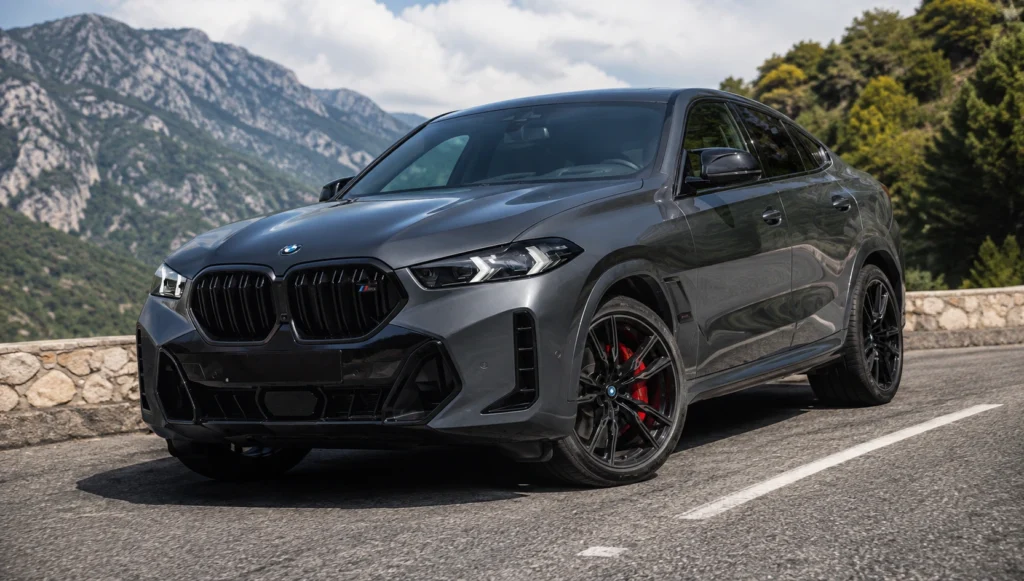
BMW X6 Design and Exterior
Roofline and Overall Silhouette
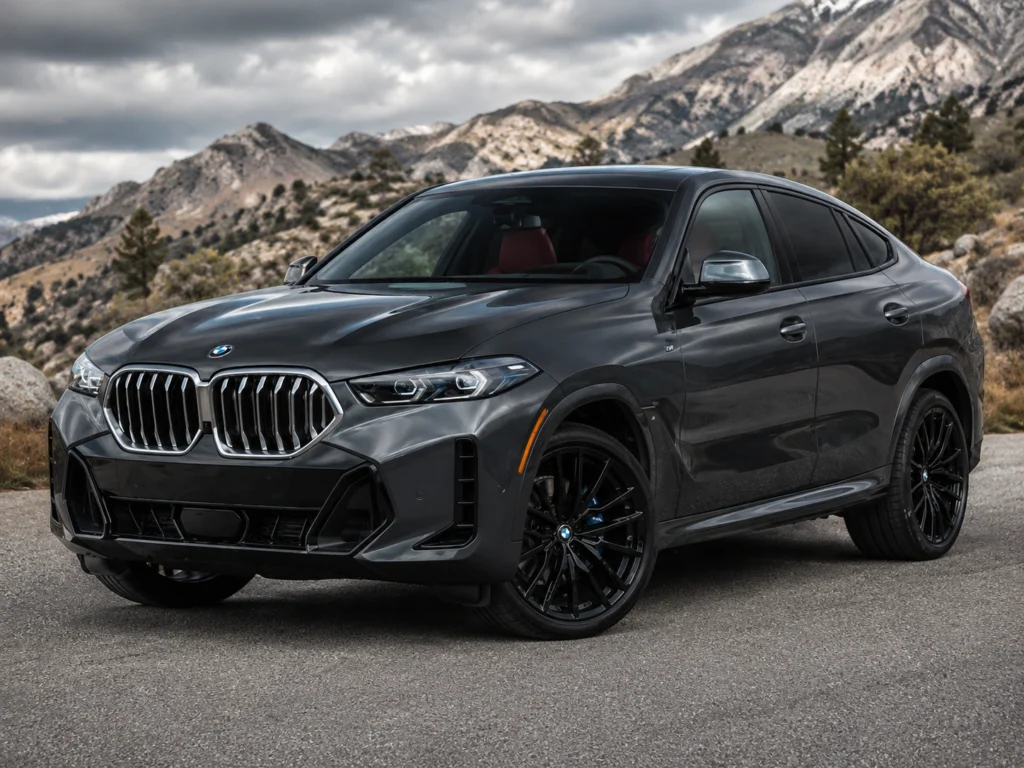
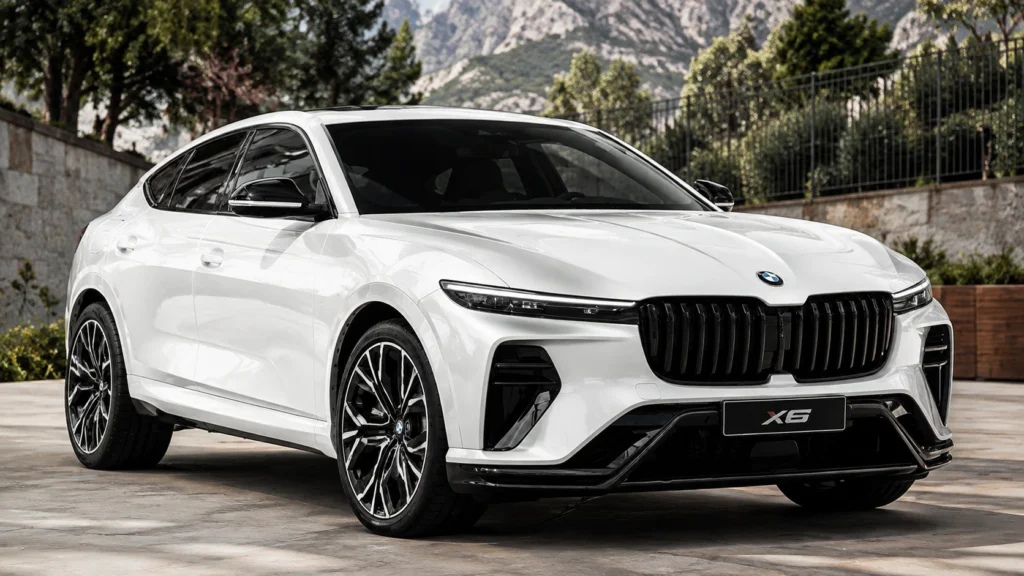
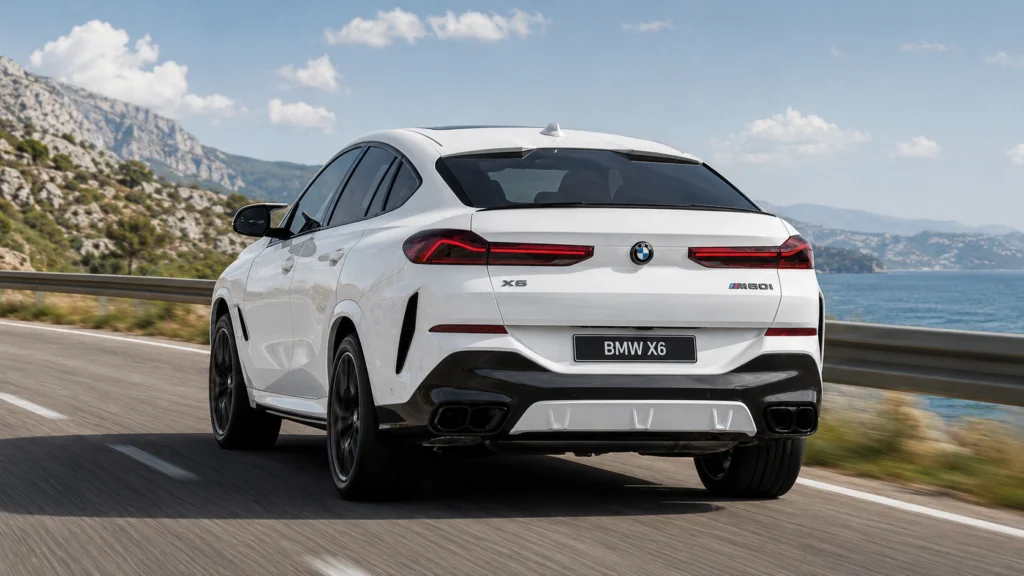
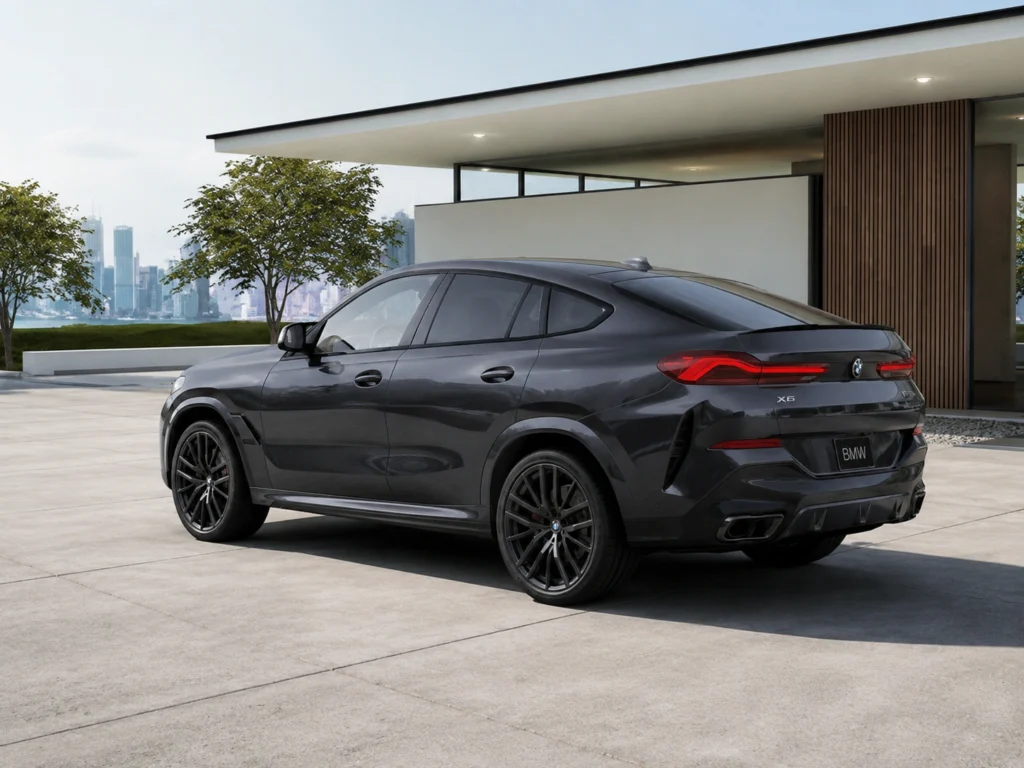
The X6’s defining feature is still that roofline. It sweeps down from the B-pillar into an integrated rear spoiler, giving the profile a sense of forward lean even parked in a driveway. Front-on, it reads as an SUV. From the side, it reads as something else entirely — and that duality is the whole point of the design.
Front End and Kidney Grille
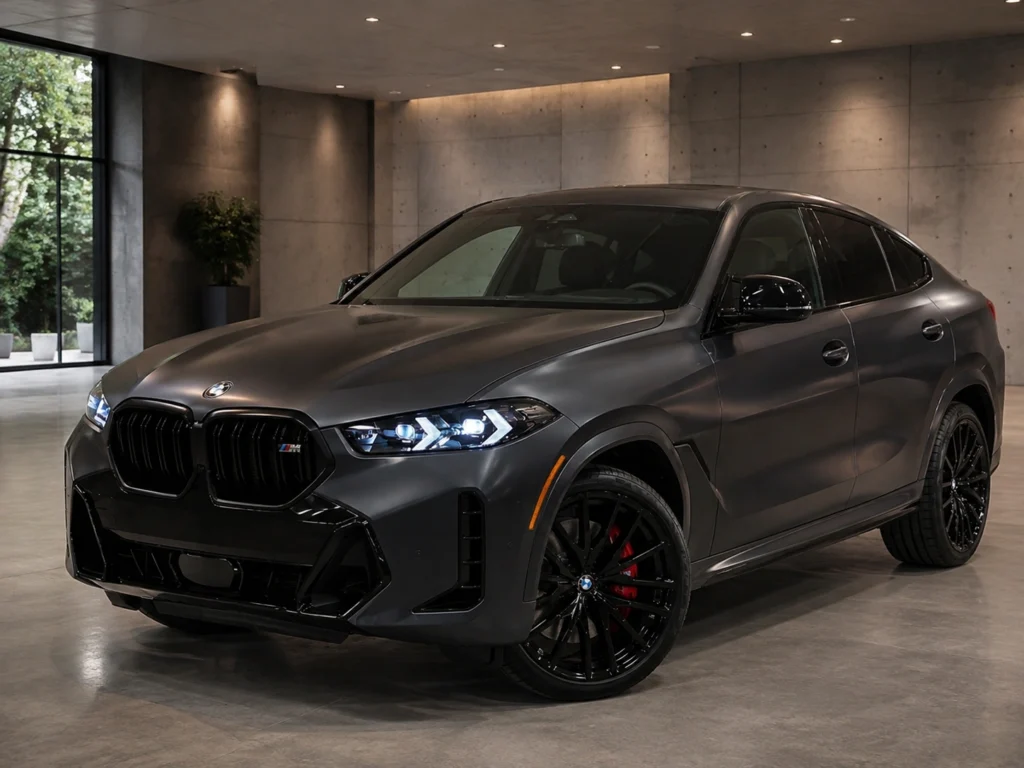
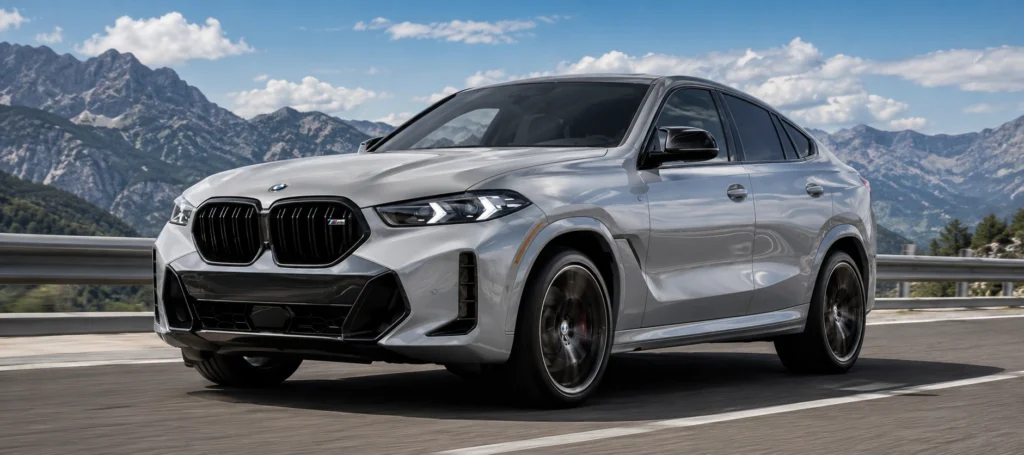
The upright kidney grille dominates the nose, a design language BMW has pushed larger across its lineup in recent years — a choice that remains divisive among longtime BMW owners but suits the X6’s assertive personality better than it does some of BMW’s sedans. Adaptive LED headlights are standard, automatically adjusting the beam pattern to avoid dazzling oncoming drivers while maximizing visibility on unlit roads.
Wheels and Rear Treatment
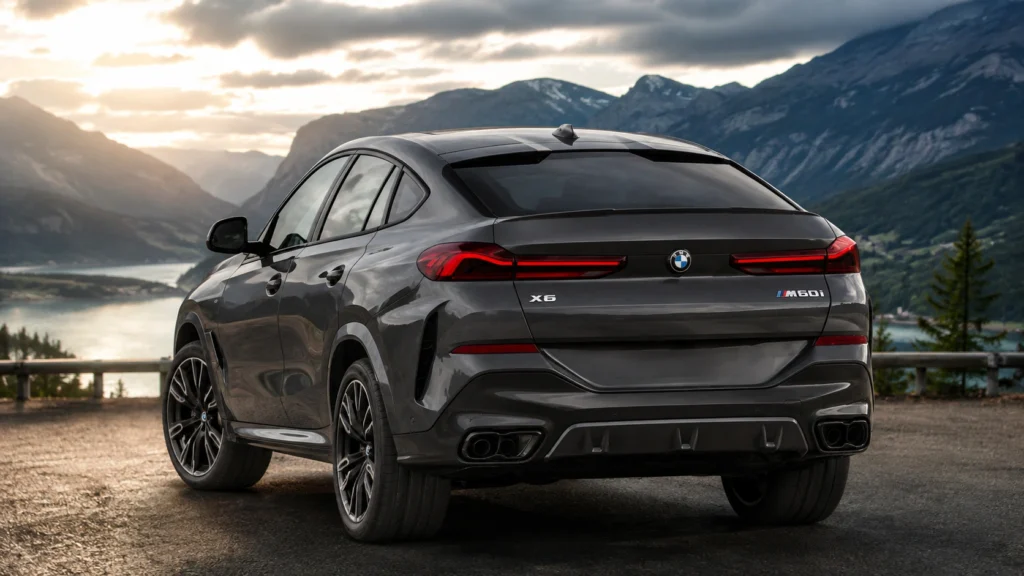
Wheel sizes typically start around 20 inches on the xDrive40i and step up on M60i and M Competition models, filling the arches in a way that visually reinforces the X6’s wide stance. Around back, slim LED taillights and — on M-badged trims — a more aggressive diffuser and quad exhaust tips tie the design together.
Dimensions
The BMW X6 measures close to 195 inches long and roughly 87 inches wide including mirrors, with a height that lands noticeably lower than the X5 despite both riding on essentially the same wheelbase. That lower roofline is deliberate, but as with most design choices, it isn’t free.
The Trade-Off, Explained
A lower roof can modestly lower the vehicle’s center of gravity, which is part of why the BMW X6 feels a touch more composed through corners than its height would suggest. The cost is rear headroom and rear visibility — both take a real hit compared to the X5, and that’s not a minor footnote. It’s the central compromise anyone cross-shopping these two vehicles needs to understand upfront.
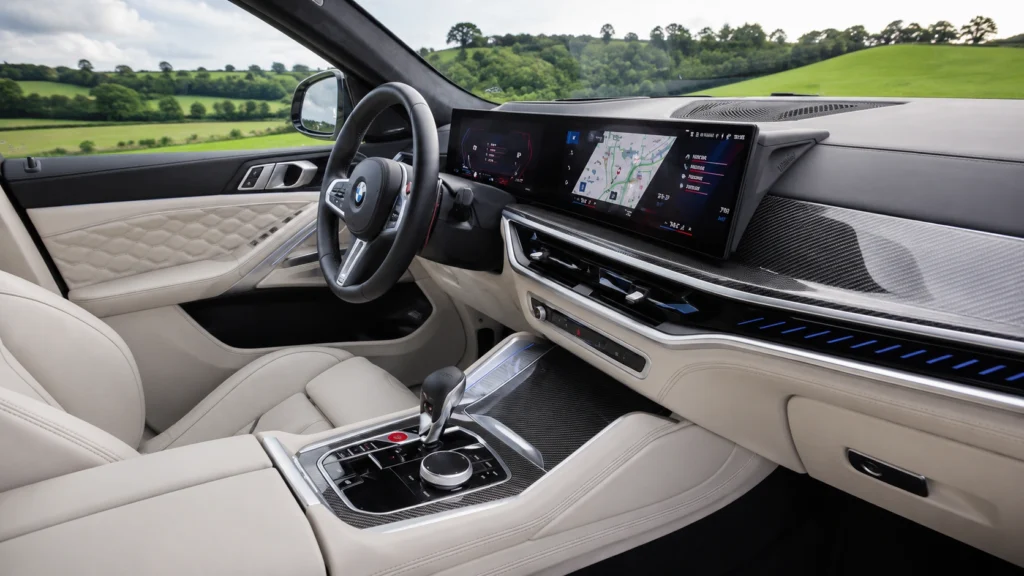
BMW X6 Interior and Technology
Cabin Materials and Build Quality
Sensafin synthetic leather is standard, with genuine Merino leather available as an upgrade. Panel gaps are tight, switchgear has a satisfying, damped feel, and the overall fit and finish matches what buyers expect at this price point.
Front and Rear Seating
Front seats offer generous adjustment and available multi-stage heating and ventilation, and there’s no shortage of comfort up front. The rear seat is where the coupe roofline shows its hand most clearly — headroom is tighter than in the X5, and taller passengers may feel the roofline curve in during longer drives. It’s comfortable for most adults on shorter trips, just less accommodating than a conventionally shaped SUV.
Infotainment: BMW Curved Display and iDrive
The BMW X6 uses BMW’s Curved Display, which merges the digital instrument cluster and the central touchscreen into one continuous glass panel ahead of the driver. In practical terms, that means speed, navigation, and infotainment controls all live on a single connected display rather than separate screens — and it runs the latest generation of BMW’s iDrive software, which supports both touch and voice input.
Connectivity
Wireless Apple CarPlay and Android Auto come standard, along with an in-car Wi-Fi hotspot. Voice control has become genuinely useful in recent BMW models, letting drivers adjust cabin temperature or set a navigation destination without touching a screen.
Climate Control
Four-zone automatic climate control is standard, meaning front and rear occupants can each dial in their own temperature — a small feature, but a genuinely useful one on longer trips with passengers who never agree on cabin temperature.
Driver Assistance and Safety Technology
Standard safety equipment includes forward collision warning, automatic emergency braking, blind-spot monitoring, and lane departure warning. Optional driver-assistance packages can add adaptive cruise control with steering assistance, a surround-view camera system, and semi-automated parking assistance for tight urban spaces.
Cargo Space and Everyday Practicality
Cargo capacity runs around 27 cubic feet behind the rear seats, expanding to roughly 60 cubic feet with the 40/20/40 split-folding rear seatbacks down. That’s workable for weekly errands, weekend trips, or golf clubs, but it trails the X5 and several rivals with more upright rooflines. Buyers who regularly haul bulky cargo should factor that in before falling for the styling.
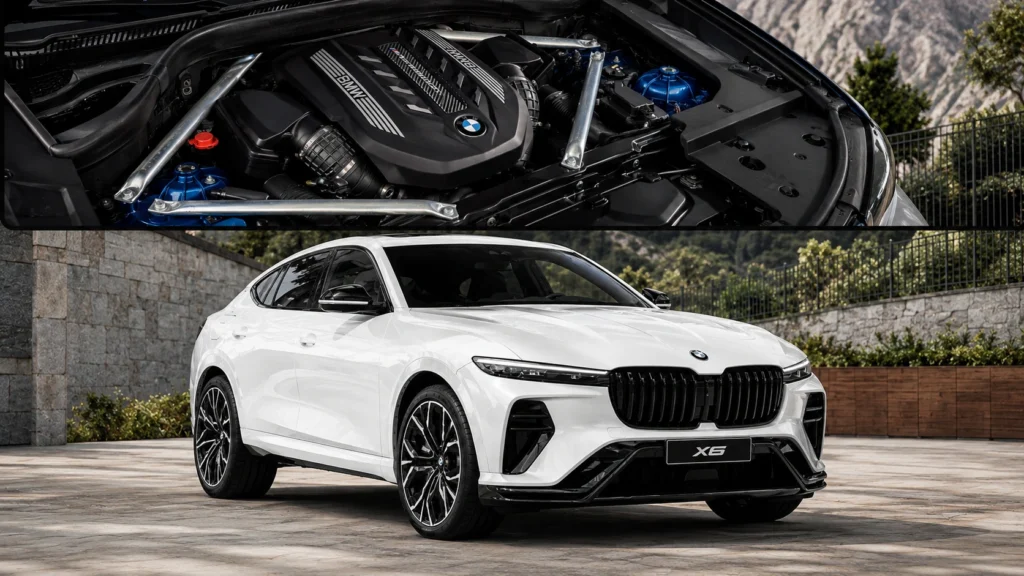
BMW X6 Engine and Performance
Engine Lineup and Horsepower
The BMW X6 range is built around a clear performance hierarchy. The xDrive40i uses a turbocharged 3.0-liter inline-six producing 375 horsepower and roughly 398 lb-ft of torque — smooth, quiet at idle, and quick enough to never feel like the “base” engine it technically is.
The M60i steps up to a turbocharged 4.4-liter V8 producing 523 horsepower and around 553 lb-ft of torque. It’s a more theatrical engine in every sense — deeper exhaust note, stronger mid-range pull, and a noticeably different personality behind the wheel.
At the top of the range, the BMW X6 M Competition pushes that same twin-turbo V8 architecture to 617 horsepower, drawing on the same M-division engineering philosophy that underpins BMW’s dedicated performance cars.
Transmission and xDrive All-Wheel Drive
Every X6 pairs its engine with an 8-speed Steptronic Sport automatic transmission and BMW’s xDrive all-wheel-drive system. In real-world terms, xDrive continuously shifts power between the front and rear axles based on available grip — which matters most in wet weather, light snow, or when accelerating hard out of a corner, rather than on a dry highway commute where most drivers will never notice it working. All trims also add 48-volt mild-hybrid assistance, a small electric boost that smooths stop-start driving and adds a bit of low-speed torque fill without turning the X6 into an actual hybrid.
Driving Modes, Handling and Ride Quality
Drive mode selectors toggle between Comfort, Sport, and Personal settings, adjusting throttle mapping, steering weight, and transmission behavior. An available two-axle air suspension lets owners fine-tune ride height and firmness for different conditions. Despite its performance-leaning image, the X6 stays composed and comfortable at highway speeds — firmer than the X5, but rarely harsh over broken pavement.
Braking and Real-World Behavior
Braking performance is strong throughout the lineup, with the M60i and M Competition benefiting from larger, more heat-resistant brake hardware built to handle repeated hard stops rather than fade after a couple of aggressive canyon runs. Enthusiasts drawn to that kind of engineering focus might also want to look at the BMW M3 review or the BMW M4 review, both of which apply similar M-division thinking in smaller, more track-oriented packages.
Fuel Economy
Fuel economy naturally tracks with engine choice. The xDrive40i is the efficiency leader of the range, while the V8-powered M60i and M Competition trade mileage for outright output, and both require premium fuel to deliver their rated performance.
BMW X6 Specifications
| Specification | xDrive40i | M60i | M Competition |
|---|---|---|---|
| Engine | 3.0L Turbo Inline-6 | 4.4L Twin-Turbo V8 | 4.4L Twin-Turbo V8 (higher output) |
| Horsepower | 375 hp | 523 hp | 617 hp |
| Torque | ~398 lb-ft | ~553 lb-ft | Higher, M-tuned output |
| Transmission | 8-speed automatic | 8-speed automatic | 8-speed automatic |
| Drivetrain | xDrive AWD | xDrive AWD | xDrive AWD |
| Fuel Economy (combined, approx.) | 23–24 mpg | High teens mpg | Mid-teens mpg |
| Seating | 5 | 5 | 5 |
| Cargo Capacity | ~27 cu-ft / ~60 cu-ft seats folded | Same | Same |
| Towing Capacity | Up to ~7,200 lbs with factory hitch | Up to ~7,200 lbs with factory hitch | Not typically rated for towing |
| Curb Weight | Lightest in the lineup | Heavier due to V8 | Heaviest, north of 5,400 lbs |
| Warranty | BMW’s standard new-vehicle limited warranty | Same coverage | Same coverage |
Confirm exact figures for your specific model year — BMW periodically revises output ratings, standard equipment, and efficiency numbers.
BMW X6 0–60 MPH, Top Speed and Acceleration
Acceleration varies enough by trim that quoting a single number for “the X6” would be misleading:
- xDrive40i: 0–60 mph in approximately 5.2 seconds — quick for a two-ton SUV, and the baseline the rest of the lineup builds on.
- M60i: 0–60 mph in approximately 4.2 seconds, with the V8’s extra torque making itself felt most in mid-range passing situations.
- M Competition: 0–60 mph in approximately 3.7 seconds, putting a five-seat SUV into genuine sports-sedan territory.
Top speed is electronically limited on most trims, typically around 130 mph, with higher limiters available on certain M Competition configurations. Launch control and paddle shifters come standard across the range, which matters less for bragging-rights acceleration runs and more for consistent, predictable power delivery when merging onto fast-moving highways.
BMW X6 Price and Trims
Starting MSRP by Trim
Current X6 pricing roughly breaks down as follows, though exact figures shift by model year and region:
- xDrive40i: Starting in the high-$70,000s
- M60i: Starting in the high-$90,000s to around $100,000
- X6 M Competition: Starting in the mid-$130,000s
These figures exclude destination charges, dealer market adjustments, taxes, and regional fees, all of which can meaningfully move the out-the-door price. Treat any number here as a starting point, not a quote — confirm current pricing directly with a dealer or on the official BMW X6 page.
Worthwhile Options
The M Sport Package, Merino leather upgrade, Bowers & Wilkins premium audio, and adaptive suspension are among the more popular additions. Several of these come bundled standard on M60i and M Competition trims, which partly explains their higher base pricing relative to the xDrive40i.
Ownership Costs to Budget For
Beyond the sticker price, plan for premium fuel across every engine option, insurance premiums typical of performance SUVs in this price bracket, and BMW’s scheduled maintenance costs, which generally run higher than mainstream brands. Depreciation is also worth researching before buying new — luxury SUVs in this segment often shed a significant chunk of value in the first five years, which is part of why the used market can be an attractive entry point for buyers willing to skip the newest model year.
BMW X6 Pros and Cons
Pros
- Strong engine lineup, from a refined inline-six to a genuinely fast V8 in Competition trim
- Distinctive exterior styling that stands apart from conventional SUVs
- High-quality cabin materials and tight build quality
- Comprehensive, intuitive infotainment via BMW’s Curved Display and iDrive software
- Composed handling for a vehicle of this size and weight
- Standard xDrive all-wheel drive for year-round traction
Cons
- Reduced rear headroom and rear visibility versus the BMW X5
- Cargo space trails more conventionally shaped rivals
- Premium fuel required across the board, with a real mileage penalty on V8 trims
- High starting price that climbs quickly once options are added
- No third-row seating, unlike BMW’s own X7 or the optional third row on the X5
BMW X6 vs BMW X5
The BMW X6 and X5 share a platform, most engine choices, and much of their interior technology, so this comparison usually comes down to priorities rather than raw specifications.
Space and practicality: the X5 wins clearly, with more rear headroom, more outright cargo volume, and better outward visibility thanks to its taller, more conventional roofline. It’s also the more forgiving choice for taller rear-seat passengers or families juggling car seats.
Design and driving feel: the BMW X6 counters with a lower center of gravity and a sportier visual presence, translating to a marginally more engaging feel behind the wheel, even though the two share most of their mechanical hardware.
Price and value: the X5 typically starts lower than an equivalent X6 trim, making it the stronger value proposition if styling isn’t the deciding factor.
Bottom line: buyers who prioritize interior space, family practicality, or maximum cargo room should read our full BMW X5 review before deciding. Buyers who want a bolder road presence and don’t mind a tighter back seat will find the X6’s premium justified.
BMW X6 vs BMW X7
The BMW X7 plays an entirely different role in the lineup — a full-size, three-row SUV built for families who genuinely need seating for six or seven, not a coupe-styled alternative to the X5.
Interior space: the X7 offers significantly more room throughout, including a usable third row for kids or occasional adult passengers, something the two-row X6 simply doesn’t offer.
Comfort and character: the X7 leans into a more upright, limousine-like driving position and a plusher overall demeanor, while the X6 stays focused on a lower, sportier stance and a firmer connection to the road.
Performance and pricing: the two overlap in certain trims, but a well-equipped X7 can match or exceed X6 pricing once options are added, so the decision typically comes down to how many seats you actually need rather than which one costs less.
Bottom line: families who occasionally need extra seating capacity, or who prioritize outright comfort over sporting looks, should compare the X6 against the BMW X7 guide before committing to either.
BMW X6 vs Its Main Competitors
| Vehicle | Body Style | Notable Strength | Notable Trade-off |
|---|---|---|---|
| BMW X6 | Coupe-SUV | Balanced blend of performance and style | Reduced rear space and cargo room |
| Mercedes-Benz GLE Coupe | Coupe-SUV | Plush ride, tech-forward cabin | Softer, less involving handling |
| Audi Q8 | Coupe-SUV | Refined interior, strong quattro AWD grip | Less aggressive performance character |
| Porsche Cayenne Coupe | Coupe-SUV | Sharper, more athletic driving dynamics | Firmer ride, pricier options list |
The X6’s closest rivals — the Mercedes-Benz GLE Coupe and the Audi Q8 — chase the same “SUV with attitude” formula from different angles. The GLE Coupe tends to prioritize ride comfort and a tech-heavy cabin over outright sportiness, while the Q8 leans into understated luxury backed by strong all-weather grip. The Porsche Cayenne Coupe sits at the sharper end of the spectrum, frequently outhandling the X6 in exchange for a firmer ride and a steeper options list.
None of these rivals is objectively “better” — they simply prioritize different things. The X6 lands in a genuinely well-rounded middle ground: not the plushest, not the sportiest, but rarely the wrong answer either.
Who Should Buy the BMW X6?
The BMW X6 makes the most sense for buyers who want SUV capability without blending into traffic, and who are genuinely willing to trade some rear-seat space and trunk volume for that lower, more dramatic roofline. It suits professionals, couples, or small families who don’t regularly need to carry more than one or two rear passengers on longer drives or haul bulky cargo on a routine basis.
Buyers who need maximum rear-seat room or cargo space are better served by the BMW X5. Larger families needing three rows of seating should look at the BMW X7 instead. And buyers who want BMW’s driving character in a smaller, more efficient, more affordable package should consider the BMW X3 review or the entry-level BMW X1 — both deliver a similar driving personality without the X6’s size or price premium.
Conclusion
The BMW X6 hasn’t changed its core mission since it created this segment nearly two decades ago: deliver SUV capability wrapped in a shape that looks nothing like a typical SUV. That mission still comes with real trade-offs — tighter rear headroom, less cargo space, and a higher price than the mechanically similar X5.
What buyers get in return is a genuinely strong engine lineup, from the smooth and efficient xDrive40i to the properly quick 617-hp M Competition, along with a cabin that feels every bit as premium as its badge suggests and technology that holds up well against newer rivals.
If style matters as much to you as space, the BMW X6 earns its premium and remains one of the most distinctive vehicles in its class. If interior room and cargo capacity top your priority list, it’s worth cross-shopping the X5 or X7 before signing. For a broader look at how the X6 fits within the rest of BMW’s SUV range, the BMW Complete Guide 2026 is a useful next stop.
Frequently Asked Questions (FAQs)
For the right buyer, yes. It combines a strong engine lineup, a well-built cabin, and genuinely distinctive styling — but it asks you to accept less rear-seat and cargo space than a conventional SUV in return.
Pricing typically starts in the high-$70,000s for the xDrive40i and climbs past $130,000 for the M Competition, before options, taxes, and destination fees. Confirm current figures with a local dealer, since pricing shifts by model year and region.
Reliability generally mirrors other BMW SUVs built on the same platform. As with most luxury vehicles, expect higher maintenance costs than a mainstream brand, and consider a pre-purchase inspection or extended warranty if buying used.
It depends entirely on trim. The xDrive40i reaches 60 mph in roughly 5.2 seconds, while the M Competition does it in approximately 3.7 seconds — nearly a 1.5-second gap between the two ends of the lineup.
Horsepower ranges from 375 hp in the xDrive40i to 617 hp in the M Competition, with the M60i sitting in between at 523 hp.
It works for smaller families comfortable with a two-row layout, but families needing more rear headroom or a third row are better served by the X5 or X7.
They share a platform and most engines, but the X6’s sloped, coupe-style roofline reduces rear headroom and cargo space in exchange for sportier styling and a slightly lower center of gravity.
For most buyers, the xDrive40i strikes the strongest balance of performance, efficiency, and standard equipment. Buyers who want more outright power should look at the M60i, while the M Competition suits those prioritizing performance above all else.