Mercedes-Benz S-Class 2026: The Flagship Sedan Redefines Its Own Standard
Few cars carry the weight of expectation quite like the Mercedes-Benz S-Class. For seven decades it has been the car other luxury sedans are measured against, and the 2026 model doesn’t coast on that reputation. It arrives with a refreshed MBUX Superscreen, a broader spread of electrified powertrains, and cabin technology that pushes further into what a rear seat can actually do for its passengers.
If you’re cross-shopping the full-size luxury sedan segment this year, the Mercedes-Benz S-Class remains the car every rival is quietly benchmarked against — and understanding exactly why takes more than a glance at a spec sheet. This guide breaks down what’s genuinely new, what each trim actually delivers on the road, and who should — and shouldn’t — write the check.
Quick Specifications
| Specification | Mercedes-Benz S-Class 2026 |
|---|---|
| Vehicle type | Full-size, four-door luxury sedan |
| Seating capacity | 5 (4-seat Executive layout optional) |
| Engine options | 3.0L turbo I6 mild hybrid; 4.0L twin-turbo V8 mild hybrid; 3.0L turbo I6 plug-in hybrid; 4.0L twin-turbo V8 plug-in hybrid (AMG); 6.0L twin-turbo V12 (Maybach) |
| Transmission | 9-speed automatic (9G-TRONIC / AMG SpeedShift MCT) |
| Drivetrain | Standard 4MATIC all-wheel drive |
| Horsepower | 442–791 hp, depending on trim |
| Torque | 413–1,055 lb-ft, depending on trim |
| 0–60 mph | 3.0–4.8 seconds, depending on trim |
| Fuel economy | 17–20 mpg combined (gas trims); up to 68 MPGe (S 580e) |
| Starting MSRP | $119,500 (S 500 4MATIC, destination included) |
What Is the Mercedes-Benz S-Class?
The Mercedes-Benz S-Class is the brand’s flagship sedan — the model that introduces technology years before it trickles down to the C-Class or GLE. It sits above the E-Class in size, price, and intent. Where the E-Class is a well-rounded executive sedan built for drivers, the Mercedes-Benz S-Class is built with the rear seat treated as equally important as the front, and its engineering budget reflects that.
Buyers tend to fall into a few camps: business owners and executives who want a car that projects success without shouting about it, chauffeur-driven passengers who spend serious time in the back seat, and enthusiasts who simply want the most technically advanced sedan Mercedes builds. It’s also the car dealerships use to introduce features — new safety systems, new suspension hardware, new infotainment architecture — that later appear across the rest of the lineup.
If you’re weighing the S-Class against other models in the range, it helps to see how the rest of the brand’s 2026 lineup is positioned; our Mercedes-Benz 2026 guide breaks down how the Mercedes-Benz S-Class relates to the E-Class, the EQS, and the SUV range.
History and Background
The S-Class name became official in 1972, but its engineering lineage traces back further, to Mercedes sedans that quietly introduced ideas the entire industry now takes for granted. Mercedes engineer Béla Barényi patented the crumple zone concept in the 1950s, and it debuted on Mercedes sedans before becoming standard practice everywhere. The Mercedes-Benz S-Class continued that pattern of firsts: it introduced series-production anti-lock brakes in 1978, the driver’s airbag and seatbelt pretensioner in 1981, and PRE-SAFE anticipatory occupant protection in 2002.
That history matters because it explains the current car’s personality. The 2026 Mercedes-Benz S-Class, internally coded W223 and now in its seventh generation since 1972, isn’t chasing trends — it’s protecting a reputation for introducing things first and doing them properly. The MBUX Superscreen, the expanded rear-seat technology, and the electrified powertrain lineup covered below are simply the latest entries in that tradition.
Design and Exterior
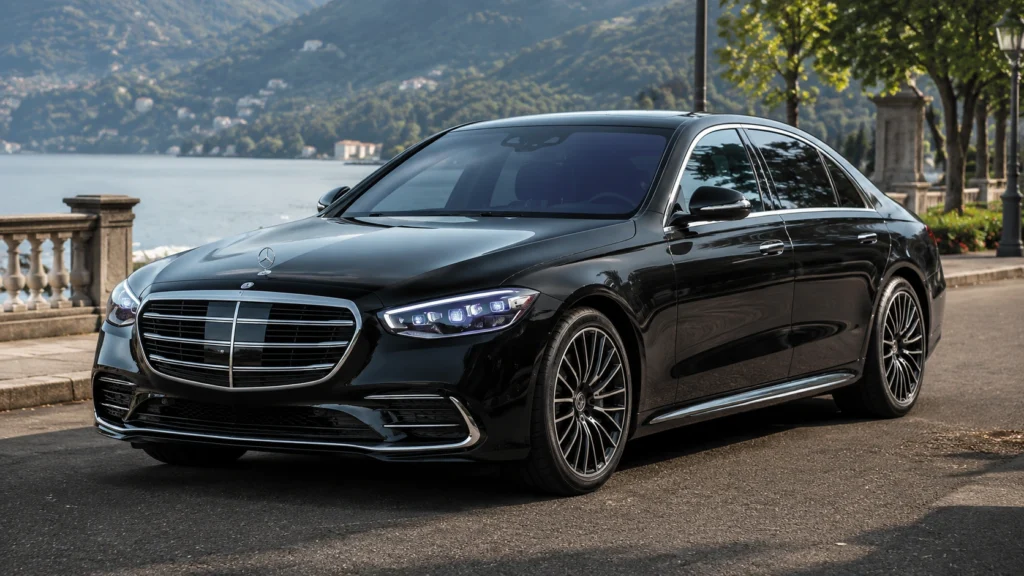
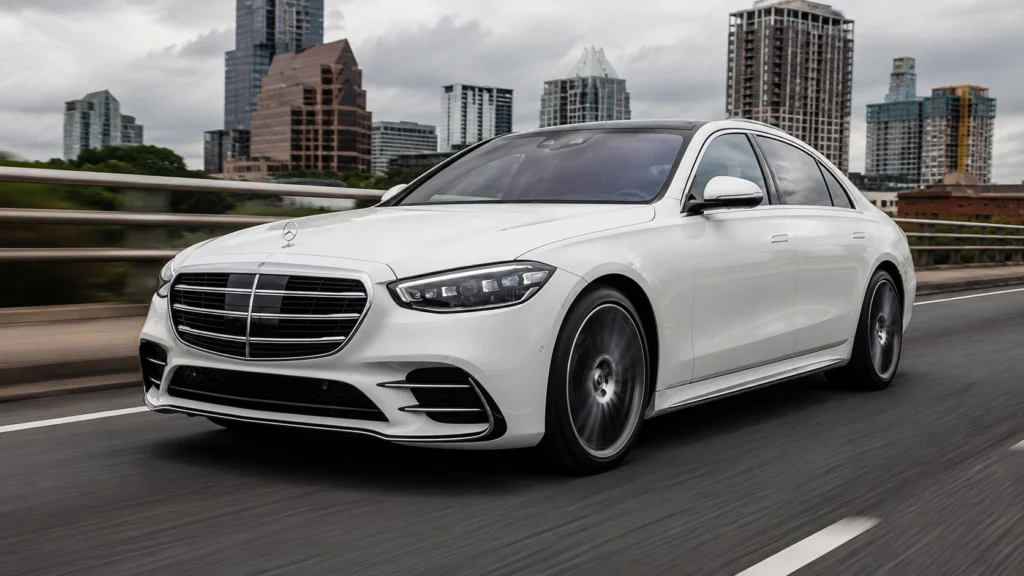
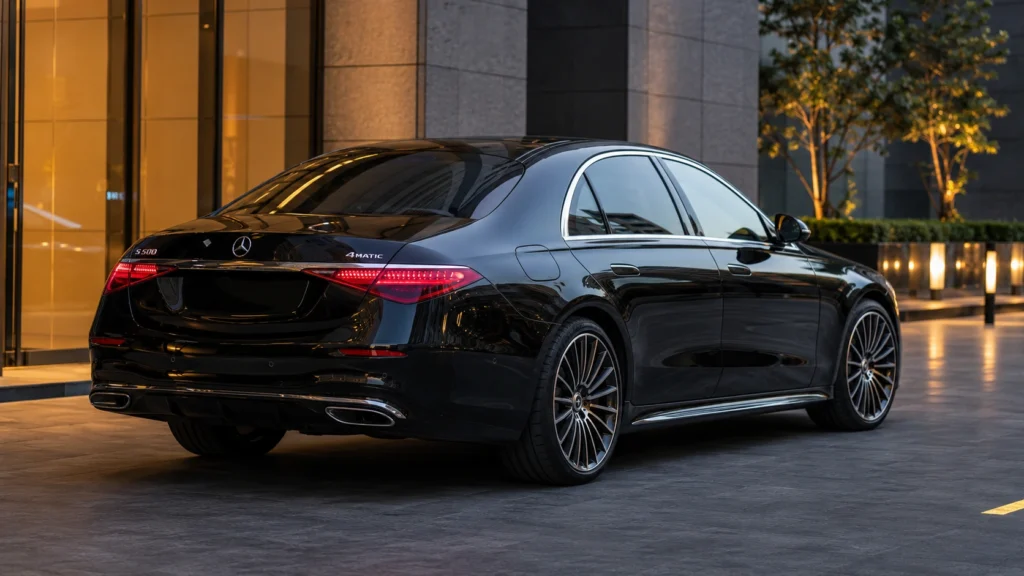
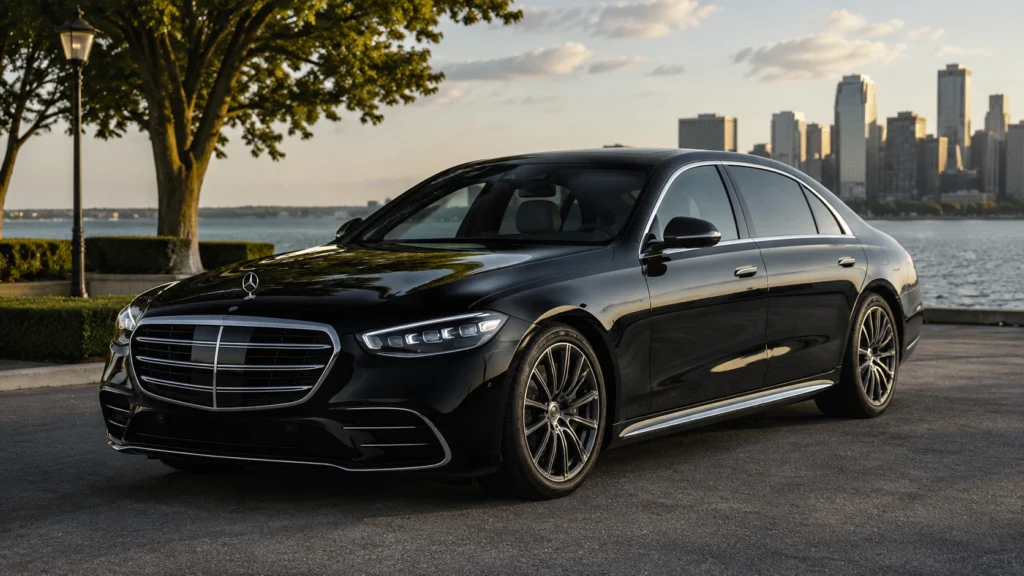
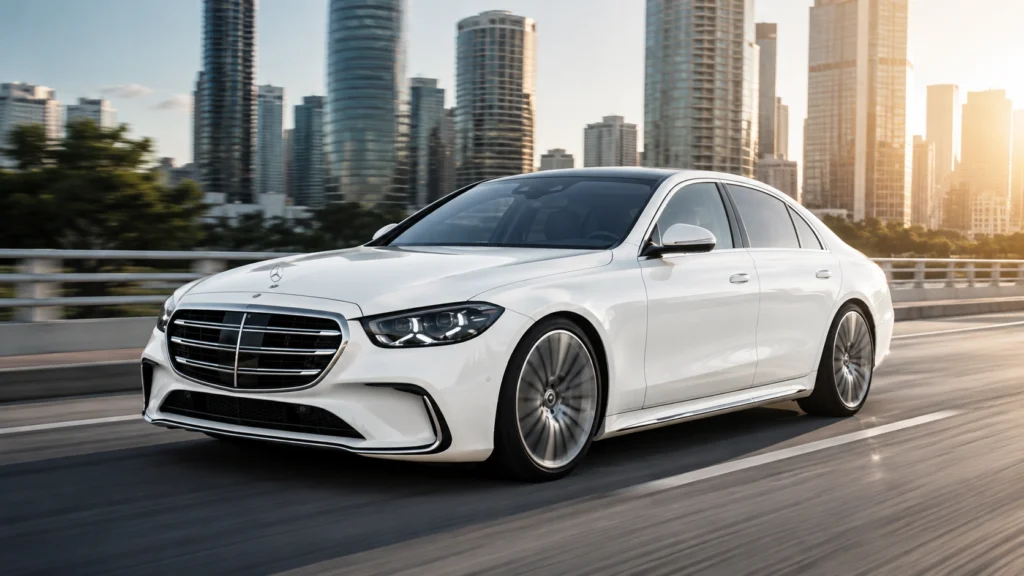
The 2026 S-Class doesn’t reinvent its silhouette, and that’s deliberate. The proportions — a long hood, a cabin pushed rearward, a low, uninterrupted beltline — are unmistakably S-Class from a hundred yards away, which is exactly the point for buyers who want quiet recognition rather than a loud statement.
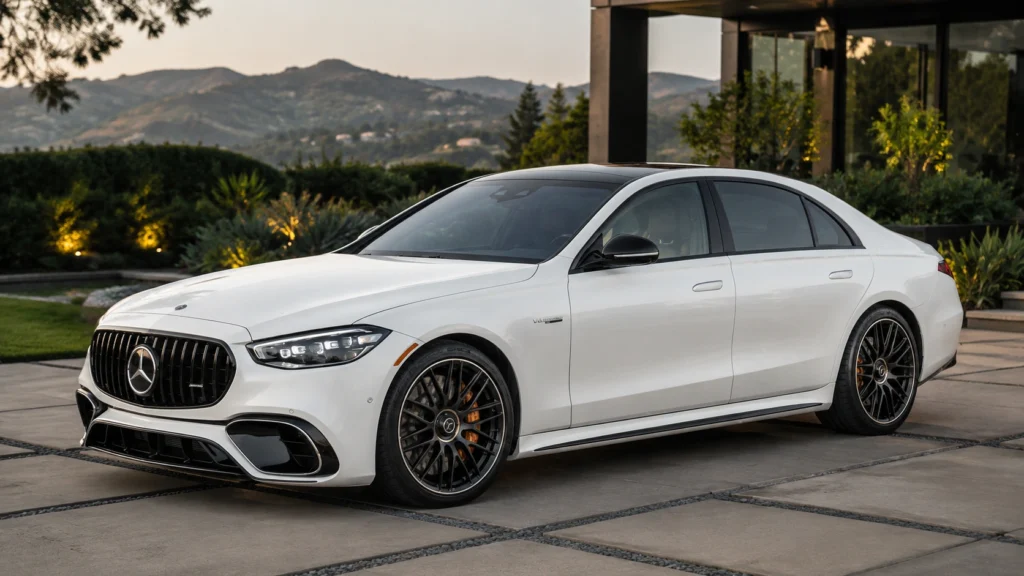
Up front, the standard S 500 and S 580 wear a chrome-surrounded grille with horizontal crossbars, while the AMG S 63 E PERFORMANCE swaps in a more aggressive shark-nose grille with vertical slats. For 2026, an illuminated grille surround and an optionally illuminated hood star are available for the first time, a genuinely new visual signature after decades of Mercedes resisting front-end lighting flourishes. The headlights carry a distinctive triangular LED signature with an illuminated outline, and twin-star detailing further separates this generation from its predecessor.
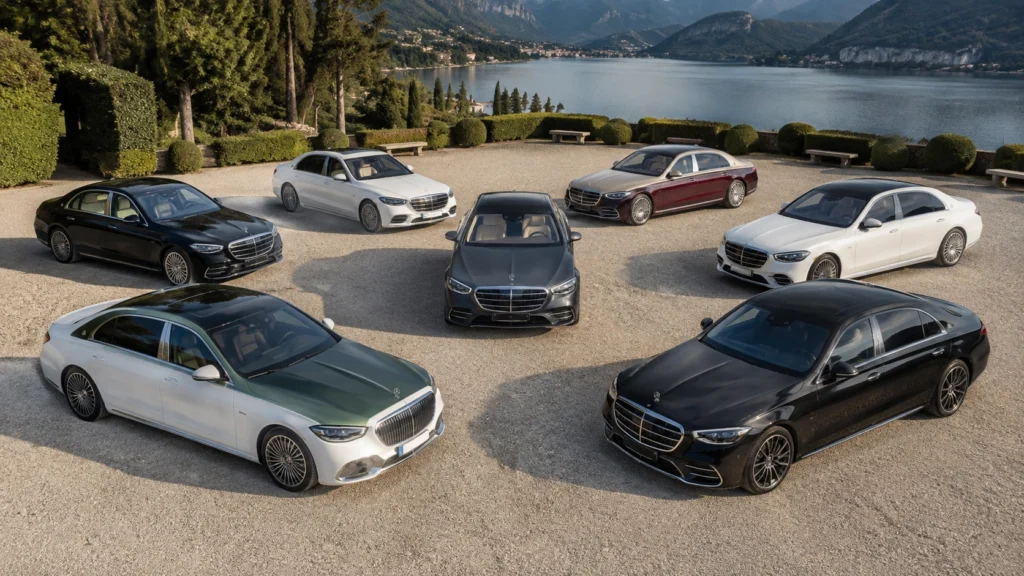
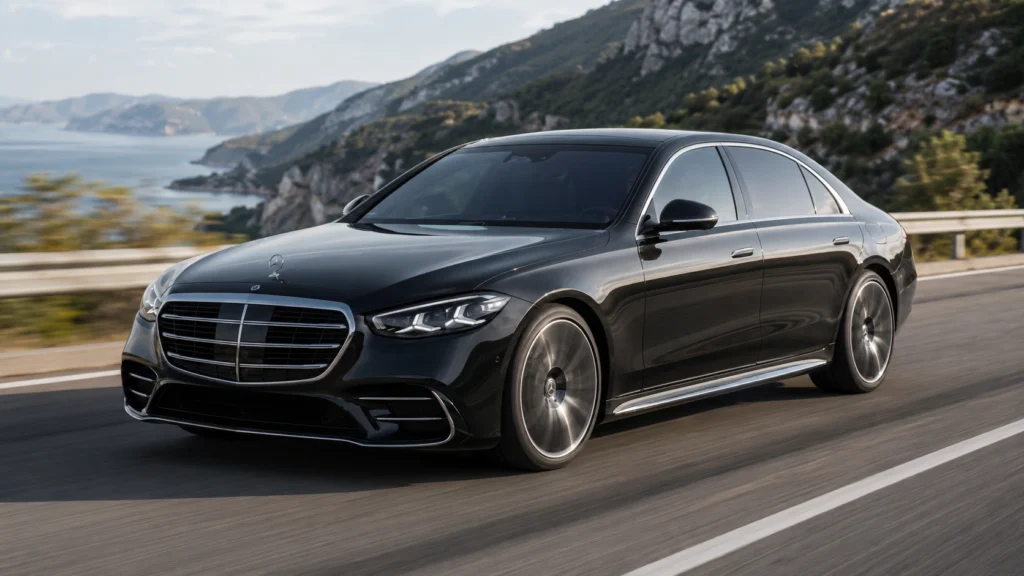
Along the flanks, Mercedes keeps ornamentation minimal — no fender vents, no fake air intakes — relying instead on a subtle character line and the semi-circular shape of the rear side windows, a cue the brand has used since the 1970s. Wheel sizes run from 19-inch multi-spoke designs on standard trims up to 21-inch AMG wheels, and buyers can choose from roughly 40 exterior colors, including several genuinely distinct blues, greens, and browns for anyone who doesn’t want their S-Class to look like the other black ones in the parking lot.
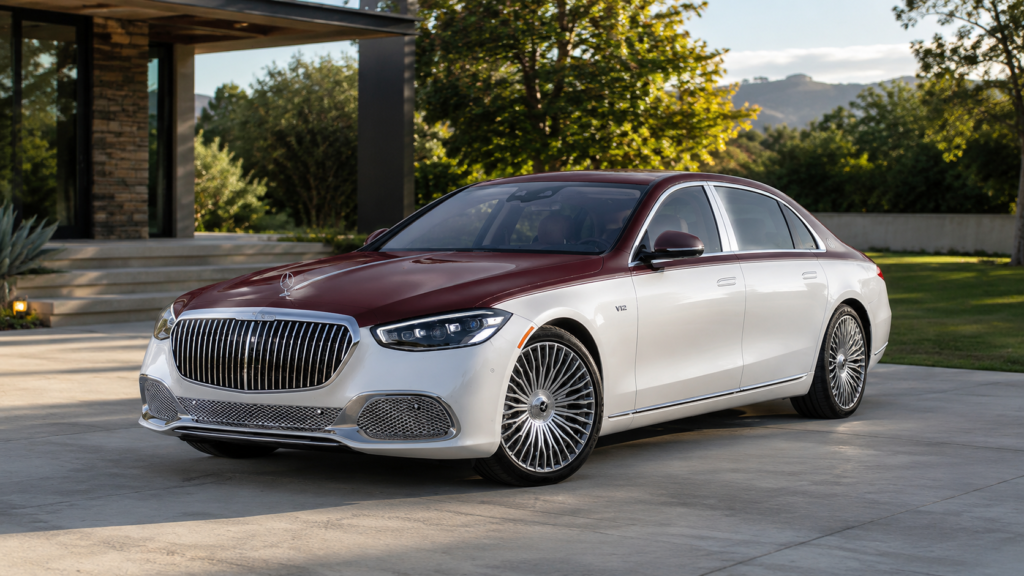
The Mercedes-Maybach models ride on a stretched wheelbase and add their own two-tone paint schemes and unique wheel designs, reinforcing their position above the standard car without abandoning the family look.
Interior and Technology
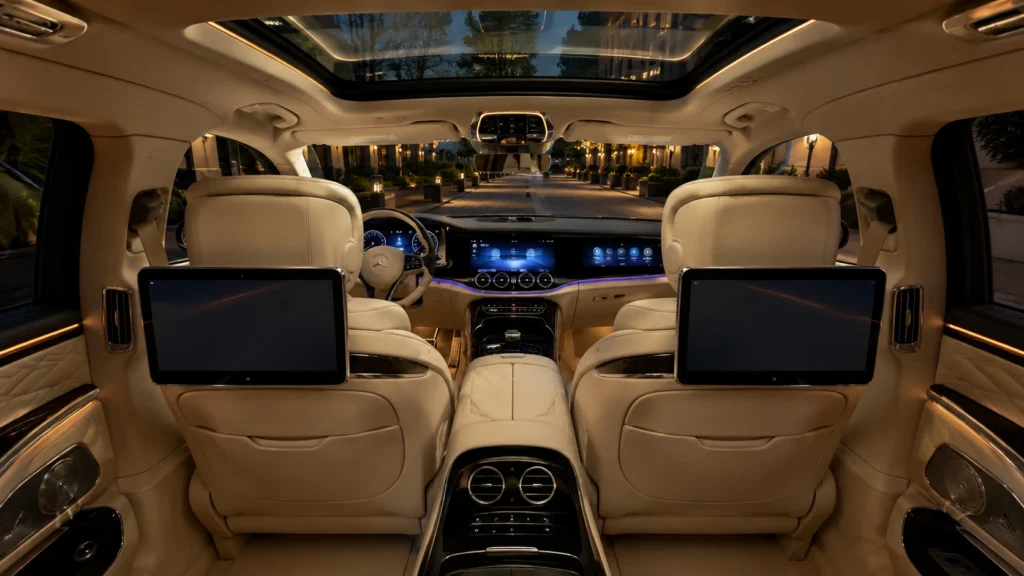
This is where the 2026 Mercedes-Benz S-Class earns its price tag, and Mercedes has made real, tangible changes rather than software tweaks alone. The standard MBUX Superscreen merges the driver display and the central touchscreen beneath a single continuous glass panel that spans from the driver’s side toward the passenger, replacing the previous generation’s separated screen layout. The front passenger gets their own display with a camera-based privacy mode, so they can watch video while the system automatically dims that content from the driver’s sightline — a small detail that solves a real distraction problem rather than just adding another screen for its own sake.
The fourth-generation MBUX software introduces a virtual assistant built on generative AI, so natural conversational requests — not rigid command phrases — control climate, navigation, and media.
Rear-seat passengers get the bigger upgrade. Available High-End Rear Seat Entertainment uses dual 13.1-inch displays with detachable remote-control tablets, letting each passenger control entertainment, climate, massage, and power sunshades independently. Integrated cameras support video conferencing — a feature built for the executive who treats the back seat as a mobile office. Materials lean on real wood trims, Nappa leather, and, on Maybach models, quilted upholstery few production interiors can match.
Comfort technology goes deeper than most buyers realize. Available ENERGIZING Comfort programs coordinate massage, seat heating, ambient lighting, cabin fragrance, and audio into unified wellness routines. Heated seatbelts — thin conductive filaments woven into the webbing — warm up in cold climates, a detail that sounds like a gimmick until you’re wearing it on a January morning. A 64-color ambient lighting system ties visual mood to driving mode and can flash as a subtle collision-warning cue.
On safety, every 2026 Mercedes-Benz S-Class comes with long-range radar and stereo camera sensors feeding Active Distance Assist DISTRONIC, Active Steering Assist, Active Brake Assist, and Active Lane Change Assist. Rear-seat airbags are standard — a genuinely rare feature in this class — and PRE-SAFE technology tightens seatbelts and closes windows automatically when a collision looks unavoidable.
The optional E-ACTIVE BODY CONTROL system can raise the body by up to three inches in a fraction of a second if it detects an imminent side impact, redirecting crash forces toward the car’s stronger lower structure. None of this is decoration; it’s the kind of engineering that justifies calling a car a flagship rather than just an expensive sedan.
Engine and Performance
The 2026 lineup spans six configurations, and each one has a distinct personality rather than simply offering “more power for more money.”
S 500 4MATIC is the entry point, using a 3.0-liter turbocharged inline-six with 48-volt mild-hybrid assistance and an electric auxiliary compressor. It produces 442 horsepower and 413 lb-ft of torque, reaching 60 mph in about 4.5 seconds, and the mild-hybrid system smooths stop-start driving without a full hybrid system’s added weight.
S 580 4MATIC steps up to a twin-turbocharged 4.0-liter V8, still mild-hybrid assisted, making 496 horsepower and 516 lb-ft of torque. It shaves the 0–60 sprint to roughly 4.3 seconds and adds the low-end shove a big V8 brings — useful for effortless highway passing rather than drag-strip bragging rights.
S 580e 4MATIC pairs the same turbocharged inline-six with a plug-in hybrid system, producing a combined 503 horsepower and 553 lb-ft of torque with up to 47 miles of EV-only range. Despite having the most torque of the non-AMG models, its added battery weight pushes the 0–60 time to around 4.8 seconds — a reminder that horsepower alone doesn’t determine acceleration once curb weight enters the equation.
Mercedes-AMG S 63 E PERFORMANCE is the outlier, and deliberately so. Its handcrafted, twin-turbocharged 4.0-liter V8 pairs with a rear-mounted electric motor drawing from a 13.1-kWh battery — an architecture borrowed conceptually from Mercedes’ Formula 1 program. Combined output reaches 791 horsepower and 1,055 lb-ft of torque, enough to hit 60 mph in about 3.0 seconds in a car that still seats five in genuine comfort. It uses a 9-speed AMG SpeedShift MCT transmission rather than the standard 9G-TRONIC, and 4MATIC+ all-wheel drive rather than the standard 4MATIC system.
Mercedes-Maybach S 580 uses the same twin-turbo V8 as the standard S 580, tuned for smooth delivery rather than outright urgency, and reaches 60 mph in about 3.9 seconds thanks in part to its integrated starter-generator’s extra torque fill.
Mercedes-Maybach S 680 trades that V8 for a hand-built 6.0-liter twin-turbo V12 producing 621 horsepower and 664 lb-ft of torque — genuinely rare engineering in 2026, when almost every rival has abandoned twelve-cylinder engines entirely. Every S-Class, regardless of trim, uses a 9-speed automatic transmission and standard all-wheel drive.
Driving Experience
Every S-Class rides on AIRMATIC air suspension with adaptive damping as standard, and it’s the single biggest reason this car feels different from anything short of a Rolls-Royce or Bentley. Broken pavement, expansion joints, and highway seams simply get filtered out before they reach the cabin. The optional E-ACTIVE BODY CONTROL system adds Road Surface Scan, which reads the road ahead with a stereo camera and pre-adjusts the dampers before a bump arrives, along with a Curve function that leans the body into corners like a motorcycle rider, reducing lateral forces on passengers.
Steering is light and accurate rather than sporty — appropriate for a car whose mission is comfort first. Optional rear-axle steering, standard on higher trims and available on others, turns the rear wheels opposite the fronts at low speed to shrink the effective wheelbase for tight parking maneuvers, then turns them in the same direction at highway speed for added stability during lane changes.
The character shifts noticeably between models. The S 500 and S 580 prioritize hushed, isolated cruising — this is a car that makes 80 mph feel like 40. The S 580e adds near-silent electric-only driving for daily commuting, with the gasoline engine cutting in so seamlessly that many owners genuinely can’t tell when it activates without checking the tachometer. The AMG S 63 E PERFORMANCE is a different animal entirely: its adaptive suspension can lower the body further in Sport+ mode, Active Roll Stabilization virtually eliminates body lean in corners, and the rear-axle steering sharpens turn-in in a way that makes a nearly three-ton sedan feel genuinely eager rather than merely capable.
It’s proof that Mercedes can build a performance flagship without sacrificing the comfort the nameplate is known for — you simply choose which side of that balance you want emphasized.
Specifications
| Category | S 500 / S 580 / S 580e / AMG S 63 E (standard wheelbase) |
|---|---|
| Engine | 3.0L turbo I6 / 4.0L twin-turbo V8 / 3.0L turbo I6 PHEV / 4.0L twin-turbo V8 PHEV |
| Cylinders | 6 or 8, depending on trim |
| Horsepower | 442–791 hp |
| Torque | 413–1,055 lb-ft |
| Transmission | 9-speed automatic |
| Drivetrain | 4MATIC / 4MATIC+ all-wheel drive |
| Wheelbase | 126.6 in |
| Length | 209.5 in |
| Width (excl. mirrors) | 76.9 in |
| Height | 59.2 in |
| Seating capacity | 5 (4-seat Executive layout optional) |
| Cargo capacity | 12.8 cu ft (10.7 cu ft on AMG S 63 E) |
| Curb weight | 4,696 lbs (S 500) up to nearly 5,700 lbs (AMG S 63 E) |
| Fuel economy | 17–20 mpg combined (gas); 55/68 MPGe city/highway (S 580e) |
| Battery (S 580e) | Plug-in hybrid pack enabling up to 47 miles EV range |
| Battery (AMG S 63 E) | 13.1-kWh performance-oriented battery, ~16 miles EV range |
Mercedes-Maybach models ride on a longer wheelbase for additional rear legroom and are reviewed separately from the standard-wheelbase figures above. For full, always-current specifications by configuration, Mercedes-Benz publishes official Mercedes-Benz S-Class information directly on its build-and-price tool.
Top Speed and Acceleration
Acceleration across the lineup ranges from brisk to genuinely startling. The S 500 covers 0–60 mph in about 4.5 seconds, the S 580 in roughly 4.3 seconds, and the S 580e — despite having more horsepower than either — needs about 4.8 seconds because of its added hybrid-system weight. The Mercedes-Maybach S 580 is quicker still at around 3.9 seconds, while the V12-powered Maybach S 680 needs a touch longer, around 4.4 seconds, since its extra weight offsets the bigger engine’s advantage.
The Mercedes-AMG S 63 E PERFORMANCE is the story here: 0–60 mph arrives in roughly 3.0 seconds, a figure that would have been supercar territory a decade ago and is remarkable in a five-passenger sedan that also seats rear occupants in genuine comfort. Standard Mercedes-Benz S-Class models are electronically limited to 130 mph, which is more than enough for any legal road use; the AMG variant’s limiter can be raised via an optional AMG Driver’s Package for buyers who genuinely intend to use a higher top speed on a track or derestricted autobahn.
In practice, these numbers matter less for bragging rights than for what they represent: effortless passing power. Whether you’re merging onto a highway or overtaking on a two-lane road, every Mercedes-Benz S-Class trim has more than enough reserve power that acceleration never feels like it requires planning.
Mercedes-Benz S-Class Price
U.S. pricing for the 2026 S-Class spans a wide range depending on trim and powertrain, and understanding where each model sits helps clarify what you’re actually paying for.
The S 500 4MATIC starts at $119,500, including destination charge, making it the most accessible entry point into the lineup. The S 580 4MATIC starts at $130,700, while the plug-in hybrid S 580e 4MATIC starts at $130,400 — essentially a wash against the V8 model, with the trade-off being electric range instead of outright power delivery. The Mercedes-AMG S 63 E PERFORMANCE commands $189,800 for its single available configuration, reflecting its hand-built engine and Formula 1-derived hybrid hardware.
Mercedes-Maybach pricing moves into a different tier entirely. The Mercedes-Maybach S 580 starts at roughly $203,500, and the V12-powered Mercedes-Maybach S 680 starts at approximately $240,500 — nearly double the standard S 580’s price for the extra cylinders, the stretched wheelbase, and considerably more rear-cabin opulence.
Options escalate quickly across every trim. Packages like Pinnacle Trim, the Manufaktur Interior package, and the High-End Rear Seat Entertainment system can each add several thousand dollars, and a well-optioned S-Class of any trim routinely lands $15,000–$30,000 above its base sticker. Buyers should also budget for the destination charge already reflected in these figures and confirm current regional pricing, since dealer markups and incentive programs vary. For build-and-price accuracy on the exact configuration you want, Mercedes-Benz’s own configurator remains the most reliable source.
Fuel Economy and Ownership Cost
Fuel economy varies meaningfully by powertrain. The S 500 returns roughly 20 mpg city and 29 mpg highway, while the heavier, more powerful S 580 comes in lower, around 17 mpg city and 27 mpg highway — a fair trade for V8 thrust in a car this size. The S 580e plug-in hybrid is the efficiency standout: the EPA rates it at roughly 55 MPGe in the city and 68 MPGe on the highway, and drivers who charge nightly and keep commutes under 47 miles may rarely visit a gas station.
The Mercedes-AMG S 63 E PERFORMANCE prioritizes performance over efficiency; its plug-in system exists primarily to boost acceleration rather than stretch range, though it does offer a short electric-only range for quiet neighborhood exits.
All non-Maybach, non-AMG trims run comfortably on regular premium fuel infrastructure, though Mercedes recommends premium unleaded across the board. Maintenance costs track with the segment: scheduled service, tires sized for a nearly 4,700-pound sedan, and any bodywork all run above mainstream luxury-brand averages, and insurance premiums reflect both the car’s value and its repair complexity.
Industry cost-to-own estimates put five-year ownership costs for a base 2026 Mercedes-Benz S-Class in the neighborhood of $170,000 when factoring depreciation, insurance, fuel, and maintenance together — with depreciation alone accounting for roughly half that figure. None of this should surprise a buyer shopping in this segment, but it’s worth budgeting for beyond the sticker price, particularly if you’re financing rather than paying cash.
Pros and Cons
| Pros | Cons |
|---|---|
| Class-leading ride comfort and cabin isolation | Options can inflate the price by tens of thousands |
| Genuinely useful rear-seat technology, not gimmicks | AMG and PHEV trims sacrifice trunk space for batteries |
| Wide powertrain range, from efficient hybrid to 791-hp AMG | Depreciation is steep, as with most luxury flagships |
| Standard rear-seat airbags and advanced driver assistance | MBUX Superscreen and top packages add real cost |
| Available V12 Maybach for buyers who want ultimate exclusivity | Maintenance and insurance costs exceed mainstream luxury norms |
Mercedes-Benz S-Class vs BMW 7 Series and Audi A8
| Category | Mercedes-Benz S-Class | BMW 7 Series | Audi A8 |
|---|---|---|---|
| Luxury | Broadest range, from S 500 to V12 Maybach | Strong, tech-forward cabin | Understated, driver-focused luxury |
| Comfort | Benchmark ride quality, AIRMATIC standard | Excellent, slightly firmer tuning | Very good, quattro-based stability |
| Performance | 442–791 hp across six configurations | 375–536 hp across four configurations | 335–563 hp across two configurations |
| Technology | MBUX Superscreen, generative-AI assistant | Latest BMW Operating System, Highway Assistant | MMI touch response, Audi connect |
| Rear-seat experience | Class-leading; dual screens, video conferencing | Strong Executive Lounge options | Comfortable but less feature-dense |
| Driving character | Comfort-first, AMG variant genuinely sporty | More engaging steering feel | Composed, quattro grip advantage |
| Pricing | $119,500–$240,500+ | $99,300–$124,700 (i7 EV separate) | $95,100–$172,420+ (S8) |
| Best for | Buyers wanting the widest range of luxury and power | Buyers who still want some driving engagement | Buyers who prioritize tech clarity and AWD confidence |
No single car wins outright here. The BMW 7 Series undercuts the Mercedes-Benz S-Class on price and offers a more engaged driving feel for buyers who still want to enjoy the wheel occasionally. The Audi A8 is the value play in this trio, with quattro all-wheel drive and a genuinely excellent cabin at a lower entry price, though its single-trim simplicity means less flexibility than Mercedes or BMW offer. The Mercedes-Benz S-Class earns its premium through sheer range — nowhere else can you move from a fuel-sipping hybrid to a 791-hp AMG to a hand-built V12 Maybach under one nameplate.
Who Should Buy the Mercedes-Benz S-Class?
The Mercedes-Benz S-Class makes the most sense for buyers who genuinely value the back seat as much as the driver’s seat — executives who work from the car, families who chauffeur regularly, or anyone who wants a sedan that feels as special to ride in as it does to drive. Long-distance drivers benefit enormously from the ride isolation and driver-assistance suite, which meaningfully reduce fatigue on multi-hour trips. Technology enthusiasts will appreciate the MBUX Superscreen and generative-AI assistant more than almost anything else in this segment offers today.
Performance-minded buyers shouldn’t overlook the AMG S 63 E PERFORMANCE, which delivers genuine sports-sedan capability without abandoning the comfort the nameplate is built on. And buyers who want the absolute pinnacle of chauffeur-driven luxury — video conferencing, dual rear displays, a V12 option — should look directly at the Mercedes-Maybach range.
That said, not everyone needs this much car. Buyers who primarily drive themselves, prioritize agility over isolation, or don’t need the extended feature set may be better served — and better matched — by a Mercedes-Benz E-Class, which delivers much of the same core engineering and technology at a considerably lower price and in a size that’s easier to park and maneuver day to day.
Conclusion
The 2026 Mercedes-Benz S-Class doesn’t need to reinvent itself to stay relevant — it simply keeps refining what already works. The MBUX Superscreen, the expanded rear-seat technology, and a powertrain lineup running from an efficient plug-in hybrid to a hand-built V12 give this generation genuine range, not just incremental updates. Ride comfort remains the benchmark for the full-size luxury sedan class, safety technology continues to lead rather than follow, and the cabin experience — especially in the back seat — is difficult for any rival to match at any price.
It isn’t the cheapest way into this segment, and options can push the final price well beyond the sticker. But for buyers who want the most complete expression of what a modern flagship sedan can be, the Mercedes-Benz S-Class remains the car to beat. If you’re deciding between trims, start with how you’ll actually use the car: choose the S 500 or S 580 for effortless daily luxury, the S 580e if efficiency matters, the AMG S 63 E PERFORMANCE if you want genuine speed, or a Maybach if the back seat is where you’ll spend most of your time.
Frequently Asked Questions (FAQs)
The 2026 S-Class starts at $119,500 for the S 500 4MATIC, including destination charge. Pricing climbs through the S 580, S 580e, and AMG S 63 E PERFORMANCE, reaching roughly $240,500 for the range-topping Mercedes-Maybach S 680 with its V12 engine.
Output ranges from 442 horsepower in the S 500 4MATIC to 791 horsepower in the Mercedes-AMG S 63 E PERFORMANCE. The S 580 makes 496 hp, the S 580e plug-in hybrid makes 503 hp combined, and the Maybach S 680’s V12 produces 621 hp.
Yes. The S 580e 4MATIC is a plug-in hybrid offering up to 47 miles of electric-only range, while the S 500 and S 580 use mild-hybrid systems that improve efficiency without plug-in charging. The AMG S 63 E PERFORMANCE is also a plug-in hybrid, tuned for performance rather than range.
Acceleration ranges from about 4.8 seconds for the S 580e to roughly 3.0 seconds for the Mercedes-AMG S 63 E PERFORMANCE. The S 500 and S 580 land in between, at approximately 4.5 and 4.3 seconds respectively.
The S-Class offers a broader powertrain range and more advanced rear-seat technology, while the BMW 7 Series undercuts it on price and offers a slightly more engaging driving feel. Both are excellent choices; the right pick depends on whether technology or driving character matters more to you.
Yes, but only through the Mercedes-Maybach S 680, which uses a hand-built 6.0-liter twin-turbo V12 producing 621 horsepower. The standard S-Class and AMG S 63 E PERFORMANCE use six- or eight-cylinder engines instead.
The biggest change is the standard MBUX Superscreen, which merges the driver and passenger displays under one glass panel, along with a generative-AI virtual assistant. Rear-seat entertainment also gains larger dual displays with detachable controls and integrated video-conferencing cameras.
Like most luxury flagships, the S-Class depreciates significantly over five years, and options can add substantially to both purchase price and running costs. It remains an excellent car to own and drive, but buyers should treat it as a lifestyle purchase rather than a value-retention investment.