BMW i4 Review: Impressive Performance & Range
BMW built its reputation on the idea that a car should feel alive in your hands, and the BMW i4 is the clearest proof yet that electrification hasn’t erased that philosophy. Underneath the sloped roofline and the familiar kidney grille sits a battery-electric Gran Coupe that drives, brakes, and steers with the same intent BMW has chased in its combustion sedans for decades. For anyone cross-shopping a Tesla Model 3, a Polestar 2, or even a traditional 4 Series Gran Coupe, the i4 deserves a serious look.
This review breaks down what the i4 actually offers in 2026: how it drives, what the range and charging experience looks like day to day, where the interior shines and where it doesn’t, and who is genuinely better served by choosing this car over its closest rivals.
Quick Specifications
Figures below vary by trim and model year — treat this as a snapshot rather than a single universal spec sheet. Full trim-by-trim numbers appear later in this article.
| Spec | Details |
|---|---|
| Body style | 5-door Gran Coupe (fastback sedan) |
| Powertrain | Single motor RWD (eDrive40) or dual motor AWD (xDrive40, M60) |
| Battery | Approximately 84-kWh high-voltage lithium-ion pack |
| Range | Roughly 232–333 miles depending on trim and wheel size |
| Horsepower | 335 hp (eDrive40) to 593 hp (M60) |
| 0–60 mph | 3.6–5.5 seconds depending on trim |
| Top speed | 118 mph (eDrive40/xDrive40); up to 130 mph on M60 |
| Charging capability | Up to 200 kW DC fast charging; 11 kW AC home charging |
| Seating capacity | 5 |
| Cargo space | 470 liters standard, up to roughly 1,290 liters with seats folded |
What Is the BMW i4?
The BMW i4 is a fully electric Gran Coupe, BMW’s term for a four-door sedan with a sloping, coupe-like roofline and a practical hatchback-style trunk hiding underneath. It rides on the same CLAR platform as the 3 Series and 4 Series Gran Coupe, so proportions and cabin layout feel familiar to anyone stepping out of a conventional BMW.
What sets the i4 apart is what’s missing: no engine, no exhaust, no transmission tunnel eating into interior space. In its place is an electric motor (or two, depending on trim) paired with a battery pack mounted low in the floor, which drops the center of gravity and frees up cabin volume without changing the exterior dimensions much.
Within BMW’s electric lineup, the BMW i4 sits below the larger i5 and i7 sedans, occupying the same market space the 3 Series and 4 Series Gran Coupe hold among gas models. It’s aimed at buyers who want a BMW electric car that still drives like a BMW, not a repackaged crossover with a badge stuck on it.
BMW i4 History and Background
BMW introduced the i4 for the 2022 model year as part of a broader push to electrify its core sedan lineup rather than confine EVs to standalone models like the i3 and i8. The BMW i4 borrowed heavily from the existing 4 Series Gran Coupe’s architecture, which let BMW bring it to market faster and keep costs in check.
Since launch, the lineup has evolved steadily. An entry-level eDrive35 trim came and went in the U.S. market, the xDrive40 arrived to add all-wheel drive, and the performance-oriented M50 was renamed M60 for 2026 with a meaningful jump in output. Each update has focused on incremental gains in range, efficiency, and power rather than reinvention — a sign BMW got the fundamentals right the first time.
BMW i4 Design and Exterior
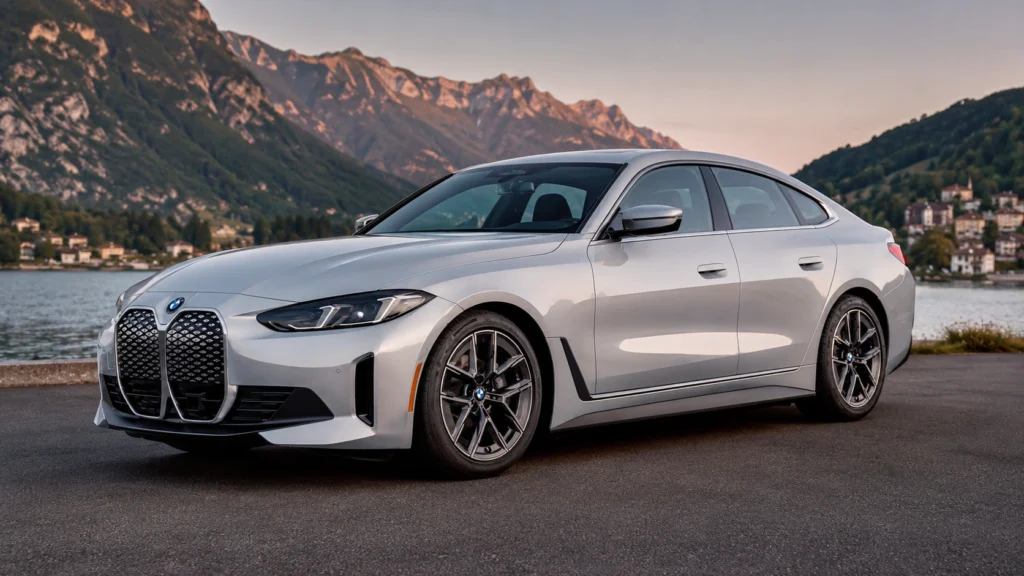
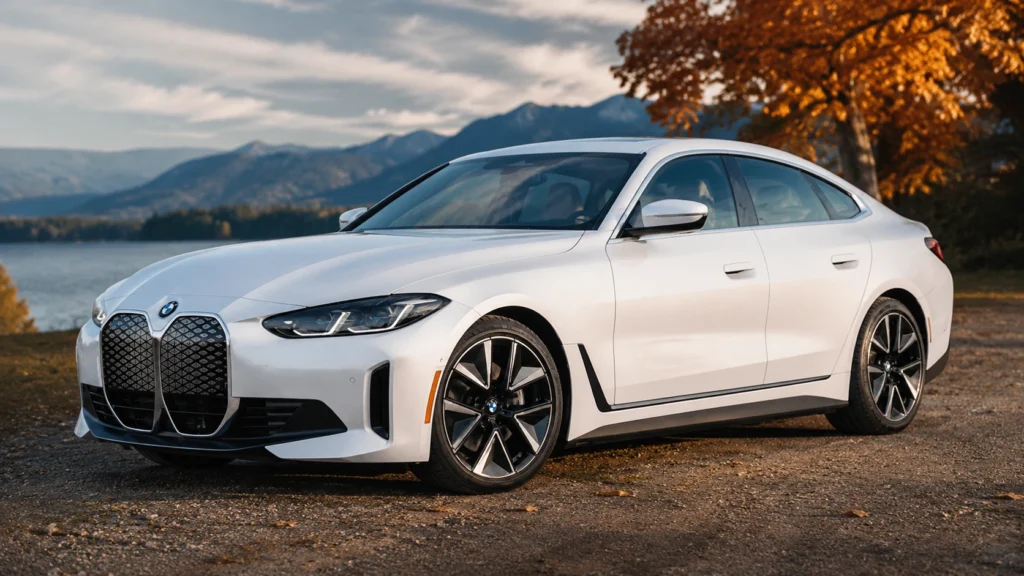
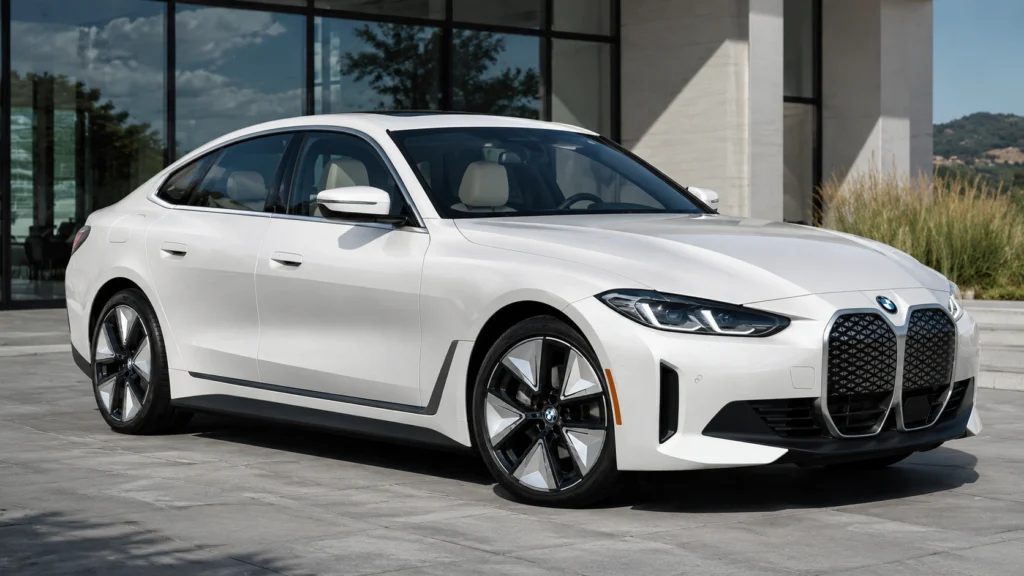
Photos don’t fully capture how low and wide the i4 looks in person. The roofline drops aggressively toward the rear, giving it a silhouette closer to a two-door coupe than a typical four-door sedan, even though it comfortably seats five.
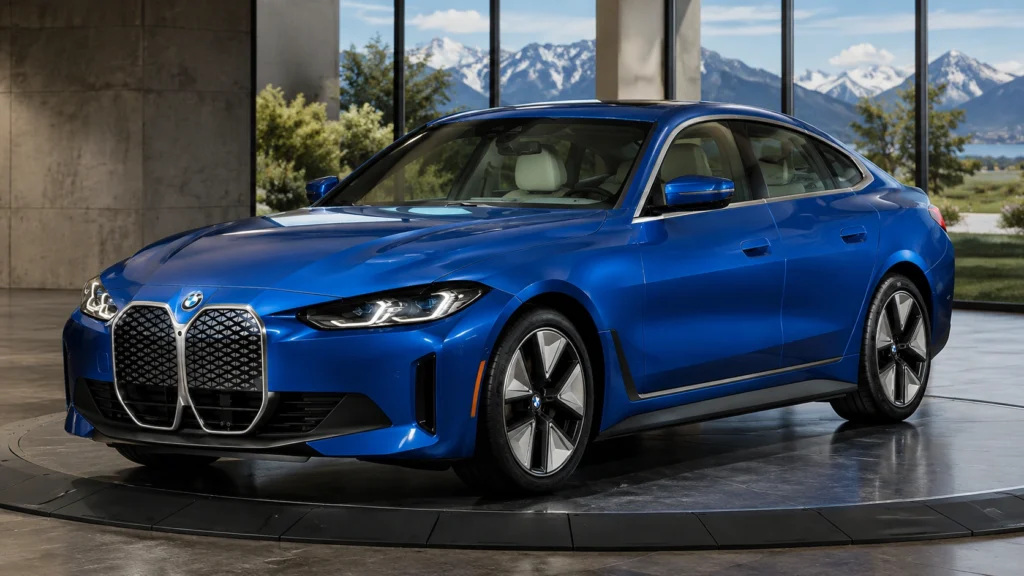
The front end carries BMW’s familiar oversized kidney grille, mostly closed off since there’s no engine to cool. Slim LED headlights flank the grille, and the face reads as more aggressive than the standard 4 Series Gran Coupe, especially on M Sport-equipped cars with larger intakes and sculpted bumpers.
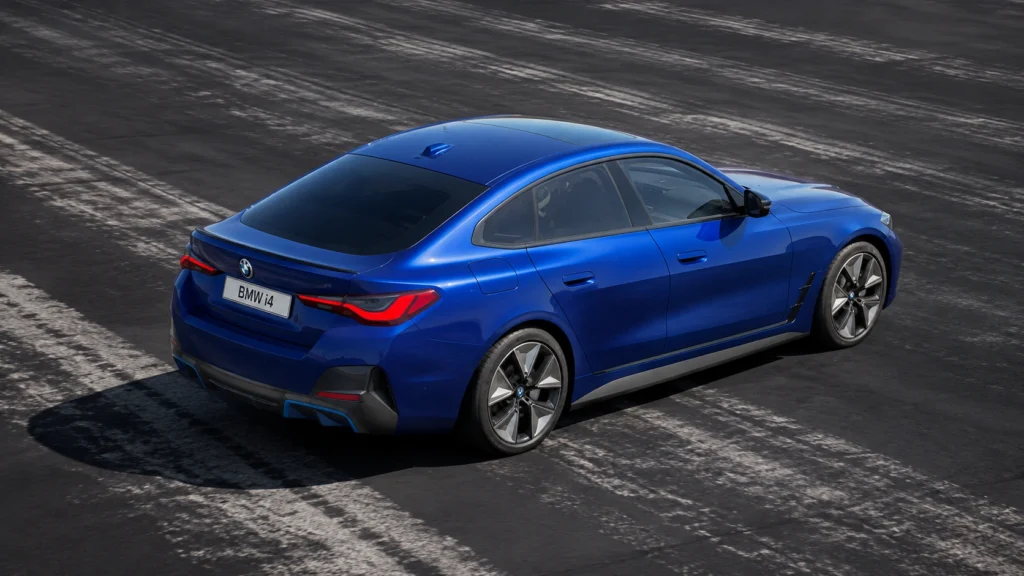
Aerodynamics matter more on an EV because drag directly eats into range, and BMW clearly treated the i4’s shape as a range strategy rather than pure style. Tapered rear glass, flush door handles on some trims, and aero-optimized wheels all help it slip through the air more efficiently than its muscular stance suggests.
Around back, slim LED taillights and a subtle integrated spoiler finish off the fastback profile. The Gran Coupe body style is the real practicality trick: the trunk lid is actually a hatch, so loading long or awkward items is easier than it looks. On the road, the BMW i4 has genuine presence — it doesn’t shout “electric” the way some EVs do, and that understated confidence is intentional.
BMW i4 Interior and Technology
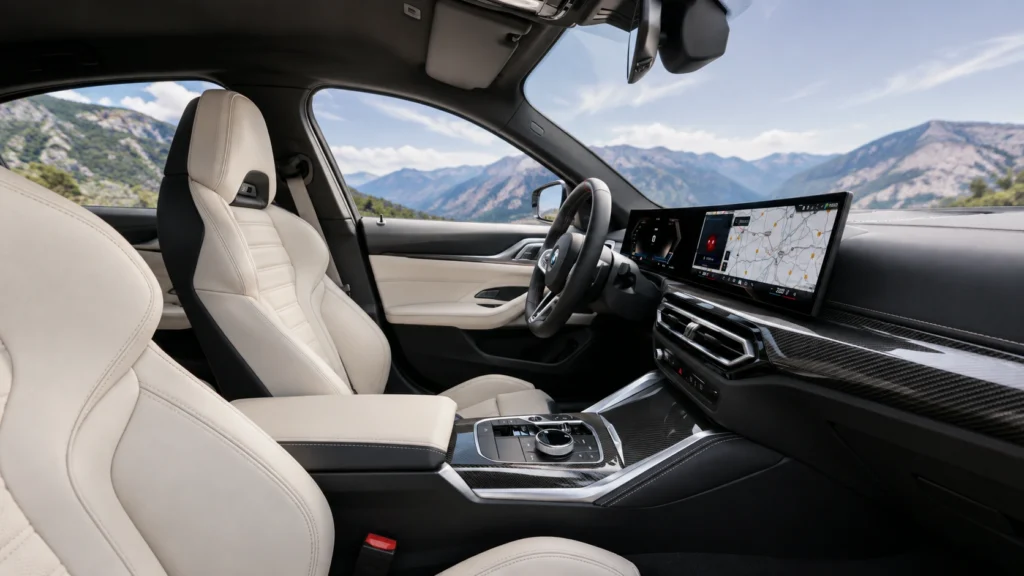
Step inside and the i4’s cabin feels instantly familiar to anyone who has sat in a modern 3 Series or 4 Series. That’s a deliberate choice, and it works in the car’s favor — there’s no learning curve, no gimmicky EV-only interface to decode.
The centerpiece is BMW’s curved display, merging a 12.3-inch digital instrument cluster with a 14.9-inch touchscreen running the iDrive infotainment system into a single sweeping panel angled toward the driver. It’s sharp, responsive, and supports both Apple CarPlay and Android Auto wirelessly, so you’re not locked into BMW’s native apps.
Front seat comfort is a genuine strength. The standard sport seats hold you in place through corners without feeling punishing on a long highway stretch, and the driving position — lower and more sedan-like than most electric crossovers — will appeal to buyers who miss that in rival EVs. Material quality trends upscale throughout, though BMW’s habit of gating features like ventilated seats and upgraded leather behind option packages means the base car doesn’t feel quite as loaded as the price suggests.
Rear-seat space is adequate rather than generous. Taller adults will notice the sloping roofline eating into headroom, a trade-off for that coupe-like exterior profile. Cargo space fares better: the hatchback trunk holds a genuinely useful amount of luggage, and folding the rear seats opens up room for larger items like flat-pack furniture or bike gear that a traditional sedan trunk can’t match.
Driver assistance features — adaptive cruise control, lane-keeping assistance, blind-spot monitoring — come standard at a basic level, with more advanced hands-off highway driving available as an option on higher trims.
BMW i4 Electric Powertrain and Performance
This is where the i4 separates itself from most electric sedans. BMW didn’t just drop a motor into an existing chassis; the company tuned the steering, suspension, and throttle response to preserve the driving character BMW enthusiasts expect, rather than defaulting to the numb, isolated feel common in many EVs.
The eDrive40 uses a single electric motor driving the rear wheels, producing 335 horsepower and 317 lb-ft of torque. The xDrive40 adds a second motor up front for all-wheel drive, pushing combined output to 396 horsepower and 443 lb-ft. At the top, the M60 (the renamed successor to the M50) uses dual motors tuned by BMW M for up to 593 horsepower, a substantial jump over the outgoing M50’s 536 horsepower.
Instant torque is the defining trait of any EV, and the BMW i4 uses it well. There’s no lag waiting for a turbocharger to spool or a transmission to kick down — throttle response is immediate, making the car feel quicker in everyday merging or overtaking than the acceleration numbers alone suggest.
Handling is where BMW’s engineering pedigree shows. The battery pack’s low, central placement keeps the center of gravity noticeably lower than a comparable gas-powered 4 Series, translating into flatter cornering. Steering feel is well-weighted and communicative by EV standards, even if it can’t fully replicate the feedback of BMW’s best combustion-powered sedans.
Ride quality leans firm but controlled, particularly on M Sport suspension setups, though the optional adaptive M suspension smooths things out for buyers who want comfort without losing composure. Braking, historically an EV weak spot, is well sorted here — pedal feel stays consistent rather than grabby, a detail that matters more than it sounds.
BMW’s own performance-focused EV history traces back to the low-slung, carbon-fiber BMW i8, and reading a BMW i8 review alongside this one shows how differently BMW has approached electrification over time — from a halo hybrid sports car to a genuinely practical, everyday performance sedan in the BMW i4.
BMW i4 Range, Battery and Charging
Every i4 trim uses a version of the same roughly 84-kWh lithium-ion battery pack, though usable capacity and efficiency tuning differ slightly by configuration. Official range figures vary by trim, wheel size, and drive type, so treat any single number with some skepticism.
The eDrive40 delivers the strongest range in the lineup, rated up to roughly 333 miles on smaller 18-inch wheels and around 307 miles on the larger 19-inch option. The xDrive40, carrying the weight and drag of a second motor, typically lands somewhat lower. The M60 trades range for performance most aggressively, with BMW’s own figures putting it at 232 to 278 miles depending on wheel selection.
Real-world range rarely matches the official estimate exactly, and that’s true of every EV. Highway driving at sustained speed pulls range down faster than city driving, where regenerative braking does more of the work. Cold weather is the other major factor: battery chemistry is less efficient in low temperatures, and cabin heating draws extra power, so winter range can drop below the rated figure.
Charging speed matters just as much as range for daily livability. On a DC fast charger, the BMW i4 can accept up to roughly 200 kW, enough to add close to 90 miles of range in about 10 minutes under ideal conditions. A 10–80% fast-charging session typically takes around 30 to 40 minutes, shifting based on charger output, battery temperature, and starting charge level.
For home charging, a Level 2 (240V) setup using the i4’s 11 kW onboard charger will typically bring a depleted battery to full overnight. A standard household outlet works in a pinch but is genuinely slow, better suited for occasional top-ups.
BMW i4 Specifications
Because output, range, and weight shift meaningfully by trim, the table below breaks down the three U.S. configurations side by side rather than presenting one blended figure.
| Spec | eDrive40 | xDrive40 | M60 |
|---|---|---|---|
| Drive type | Rear-wheel drive | All-wheel drive | All-wheel drive |
| Motors | Single | Dual | Dual |
| Horsepower | 335 hp | 396 hp | Up to 593 hp |
| Torque | 317 lb-ft | 443 lb-ft | Higher, dual-motor tuned output |
| Battery | ~84 kWh | ~84 kWh | ~84 kWh |
| Range (est.) | Up to ~333 miles | Roughly 270–290 miles | 232–278 miles |
| 0–60 mph | ~5.3–5.5 sec | ~4.9 sec | ~3.6 sec |
| Top speed | 118 mph | 118 mph | Up to 130 mph |
| Transmission | Single-speed automatic | Single-speed automatic | Single-speed automatic |
| Wheelbase | ~112.4 in | ~112.4 in | ~112.4 in |
| Length | ~188.4–188.5 in | ~188.4–188.5 in | ~188.4–188.5 in |
| Seating | 5 | 5 | 5 |
| Cargo capacity | 470L / ~1,290L max | 470L / ~1,290L max | 470L / ~1,290L max |
| Curb weight | ~4,700 lb | ~4,850 lb | ~5,050 lb |
Treat the acceleration and range figures as manufacturer estimates for the current model year rather than fixed constants — BMW has adjusted both in prior updates and will likely continue to do so as battery and inverter technology improves.
BMW i4 0–60 MPH and Top Speed
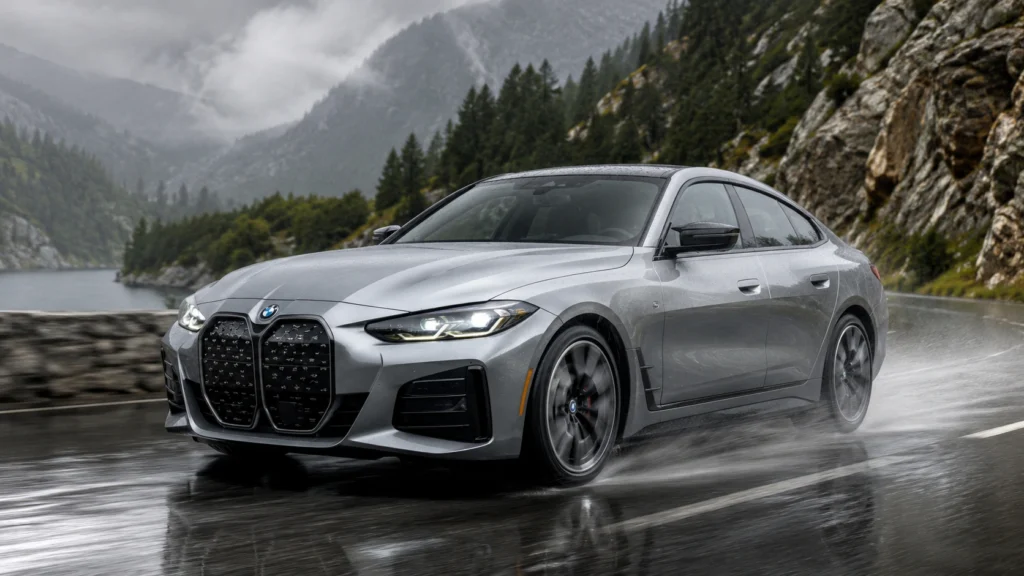
Acceleration is one of the clearest ways to feel the difference between trims. The eDrive40, despite being the “base” model, is genuinely quick, reaching 60 mph in the mid-5-second range according to BMW, with independent testing from Edmunds landing slightly quicker at around 5.3 seconds.
Step up to the xDrive40 and the added front motor cuts that time to roughly 4.9 seconds, helped by the traction advantage of all-wheel drive off the line. The M60 is in a different category entirely — a 3.6-second 0-60 time puts it firmly in sports car territory.
Top speed tells a different story than acceleration. The eDrive40 and xDrive40 are electronically limited to 118 mph, plenty for anything short of a European autobahn run. The M60, benefiting from its M-tuned chassis and more aggressive tires, is capable of up to 130 mph. These figures can vary slightly by wheel and tire selection, so treat them as a reasonable ceiling rather than a guarantee across every configuration.
BMW i4 Price and Value
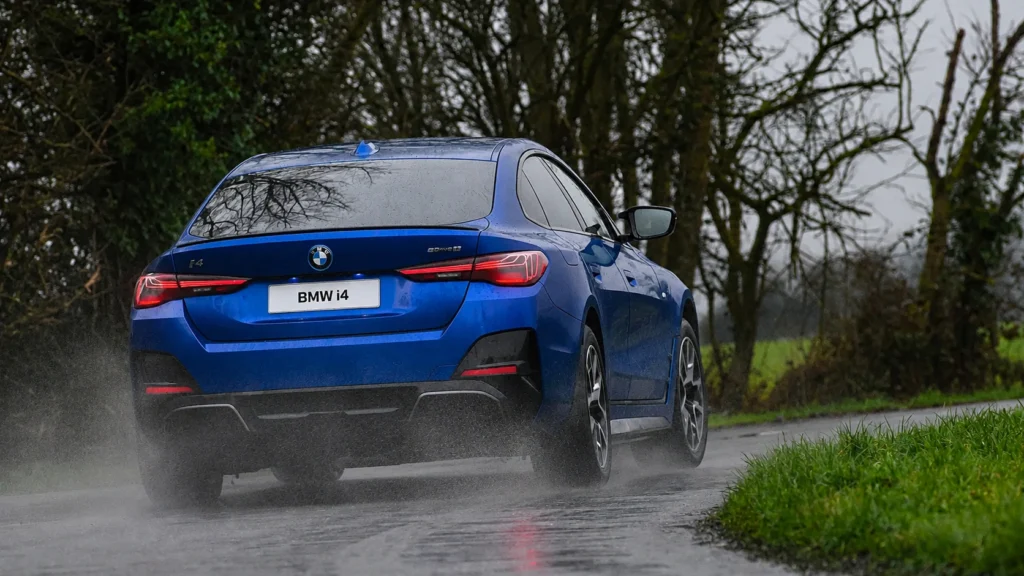
Pricing for the current model year starts at $57,900 for the eDrive40, before destination fees. The xDrive40 moves that up to $62,300, and the range-topping M60 starts at $70,700. These figures apply to the U.S. market for the current model year — pricing varies by region and incentives, so confirm current figures directly with BMW or a local dealer.
Where the i4 gets expensive is the options list. Features that come standard on some rival EVs — advanced driver assistance packages, upgraded leather, ventilated seats — are frequently optional extras here. It’s easy to option a “base” eDrive40 well past $60,000 without trying particularly hard.
Ongoing costs tell a more favorable story. Electricity is typically far cheaper per mile than gasoline, especially charging at home overnight. EV maintenance also tends to run lower than a comparable gas-powered BMW, since there’s no oil to change and fewer moving parts subject to wear, with brake wear often reduced by regenerative braking.
Tax incentives and rebates change frequently and vary by country, state, and household income, so this article won’t quote specific figures — verify current eligibility through official government or BMW resources first.
Judged purely on sticker price, the BMW i4 isn’t cheap next to a Tesla Model 3. Judged on interior quality, driving dynamics, and ownership costs, the value case holds up considerably better.
BMW i4 Pros and Cons
Pros
- Genuinely engaging handling and steering feel for an electric sedan
- Strong range on the eDrive40 trim, especially with smaller wheels
- Fast DC charging that keeps pace with road-trip use
- Practical hatchback-style trunk despite the coupe styling
- Familiar, high-quality interior that doesn’t feel experimental
- M60 offers legitimate performance-car acceleration
Cons
- Options pricing adds up quickly, and useful features often cost extra
- Rear headroom is tight for taller passengers
- xDrive40 and M60 trade meaningful range for power and traction
- Slower-selling in the used market than Tesla, so resale value trails somewhat
- Some competitors offer more standard driver-assistance tech for less money
BMW i4 vs Tesla Model 3 and Other Competitors
| Category | BMW i4 | Tesla Model 3 | Polestar 2 |
|---|---|---|---|
| Starting price (approx.) | $57,900 | Roughly $46,000+ | Roughly $48,000+ |
| Range (approx.) | Up to ~333 miles (eDrive40) | Up to ~341 miles (Long Range AWD) | Up to ~270 miles (Long Range Single Motor) |
| 0–60 mph | 3.6–5.5 sec depending on trim | Varies by trim, generally quick | Varies by trim |
| Charging network | CCS fast charging, NACS adapter available | Access to Tesla’s Supercharger network | CCS fast charging |
| Interior quality | Upscale, traditional BMW feel | Minimalist, screen-centric | Scandinavian, driver-focused |
| Software/infotainment | iDrive with CarPlay/Android Auto | Tesla’s own OS, mature and fast | Android Automotive with native Google apps |
| Driving character | Most traditional “driver’s car” feel | Quick and efficient, less tactile | Balanced, slightly firmer ride |
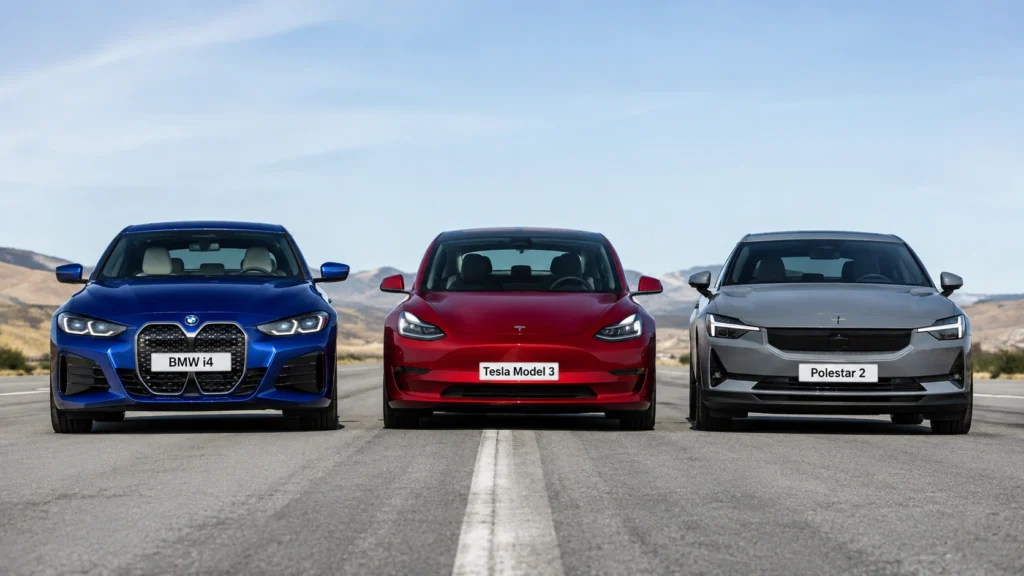
The Tesla Model 3 remains the benchmark for outright range and charging network maturity — Supercharger access is still the most extensive fast-charging network in North America, which matters for road-trip confidence. The BMW i4 counters with noticeably better interior materials and physical controls some buyers prefer over Tesla’s screen-first approach.
The Polestar 2 leans into a different strength: Android Automotive with genuine Google Maps and Assistant built in natively, appealing to buyers who want the most open software experience. It generally undercuts the i4 on price but doesn’t match BMW’s interior polish or driving dynamics.
Buyers cross-shopping Audi’s electric sedans will find a similar story — strong build quality and a premium cabin, with the final decision often coming down to brand preference and which car feels right during a test drive.
Who Should Buy the BMW i4?
The i4 makes the most sense for someone who already loves how a BMW drives and doesn’t want to give that up when switching to electric. Daily commuters will appreciate the smooth, quiet ride and the instant torque that makes stop-and-go traffic and highway merging genuinely effortless.
BMW enthusiasts moving from a 3 Series or 4 Series will feel at home almost immediately — the interior layout, seating position, and proportions carry over closely enough that the switch to electric power feels evolutionary rather than jarring. Buyers who want performance without compromise should look hard at the xDrive40 or M60, both of which deliver genuine quickness alongside all-weather traction.
On the other hand, buyers whose top priority is maximum range on a budget, or the deepest public fast-charging network available, may find better value in a Tesla Model 3. Anyone who wants the most tech-forward, software-open EV experience might lean toward the Polestar 2 instead. The i4 rewards buyers who prioritize driving feel and interior quality over the lowest possible price per mile of range.
Conclusion
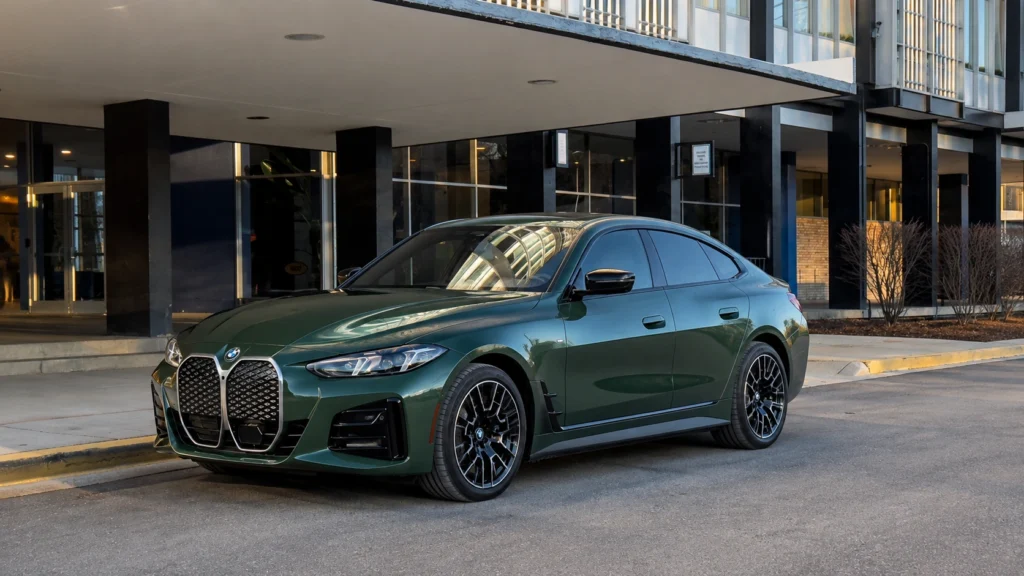
The BMW i4 succeeds because it doesn’t try to reinvent what a BMW sedan should feel like — it simply removes the engine and keeps everything that made these cars satisfying to drive in the first place. Across the eDrive40, xDrive40, and M60, buyers get a real spread of range, performance, and price to choose from, rather than a one-size-fits-all EV.
Strengths center on handling, interior quality, and a genuinely quick charging experience when you need it. Weaknesses show up mainly in options pricing and tighter rear headroom than some rivals offer. Compared with the Tesla Model 3 and Polestar 2, the BMW i4 doesn’t win on every spec sheet number, but it wins convincingly on how it feels from behind the wheel.
Anyone deciding between a familiar BMW driving character and outright range-per-dollar should test drive an i4 alongside its closest rivals before deciding — on paper the numbers are close, but the difference in feel is where this car actually earns its price tag. For more detail on trims, current offers, and configuration options, BMW’s own BMW i4 page is the best starting point.
Frequently Asked Questions (FAQs)
Yes, for buyers who value driving dynamics alongside daily EV practicality. It combines engaging handling, a well-built interior, and strong performance across its trim lineup. It isn’t the cheapest or longest-range option in its class, but few electric sedans match its balance of comfort and driving feel.
Current U.S. pricing starts at $57,900 for the eDrive40, $62,300 for the xDrive40, and $70,700 for the M60, before destination fees and options. Pricing varies by market and model year, so confirm current figures directly with BMW.
Range depends heavily on trim and wheel size. The eDrive40 offers the most, at up to roughly 333 miles on 18-inch wheels. The xDrive40 lands somewhat lower, and the M60 ranges from about 232 to 278 miles. Real-world range is typically somewhat lower than these official estimates.
It depends on trim. The eDrive40 reaches 60 mph in roughly 5.3 to 5.5 seconds, the xDrive40 does it in about 4.9 seconds, and the M60 needs just 3.6 seconds — genuinely quick for any car, electric or otherwise.
On a DC fast charger capable of up to 200 kW, a 10-80% charge typically takes around 30 to 40 minutes. A Level 2 home charger will usually fully charge the battery overnight, while a standard household outlet is far slower and better suited for occasional top-ups.
BMW’s electric powertrain, built on a proven combustion-car platform, has generally reported solid dependability in owner and industry surveys, though EVs as a category are newer with less long-term data available. Standard warranty coverage adds protection during the ownership period.
It depends what you value. The Model 3 generally offers more range for less money and access to Tesla’s extensive Supercharger network. The i4 counters with a more traditional, upscale interior and a driving experience that feels more distinctly “BMW.” Neither is objectively better — they suit different priorities.
For buyers who prioritize driving feel, interior quality, and brand loyalty to BMW, yes — the i4 delivers a genuinely satisfying electric driving experience without sacrificing daily usability. Buyers chasing maximum range per dollar may be better served elsewhere, but as an EV that still feels like a proper driver’s car, the i4 earns its price.