BMW M8: A Complete Review of BMW’s Discontinued Flagship Grand Tourer
For six model years, the BMW M8 sat at the very top of BMW’s performance pyramid — a twin-turbo V8 grand tourer built to out-muscle supercars while still carrying four adults to dinner in Merino leather comfort. If you’re researching the BMW M8 today, there’s one detail you need going in: BMW has stopped building it. Production wound down through 2025, and there’s no 2026 M8 on any configurator.
That doesn’t make the M8 irrelevant — quite the opposite. With production over, the M8 has shifted from a six-figure new-car purchase into a genuinely interesting used-market proposition, and depreciation has been kind to buyers who missed it the first time around.
This guide covers everything a prospective owner or curious enthusiast actually needs: what the M8 is, how it drives, what it costs today, how it stacks up against rivals like the Mercedes-AMG GT 63 S E Performance and Audi RS 7, and whether it still makes sense to own one now that BMW has moved on.
Quick BMW M8 Specifications
These figures reflect the final-generation M8 Competition, the only version BMW sold in its last few production years. Some numbers vary slightly by body style and model year — that’s flagged where relevant.
| Specification | BMW M8 Competition |
|---|---|
| Engine | 4.4L twin-turbocharged V8 (S63) |
| Power | 617 hp (600 hp on earlier non-Competition models) |
| Torque | 553 lb-ft |
| 0–60 mph | Approx. 3.0 seconds (as tested by some outlets, as low as high-2-second range) |
| Top Speed | 155 mph standard; 190 mph with M Driver’s Package |
| Drivetrain | M xDrive all-wheel drive (rear-biased, with 2WD drift mode) |
| Transmission | 8-speed automatic (ZF 8HP) |
| Body Styles | Coupe, Convertible, Gran Coupe (Coupe ended production first) |
| Seating Capacity | 4 |
The BMW M8 is no longer sold new. All current transactions are used, certified pre-owned, or dealer-remaining-inventory sales.
What Is the BMW M8?
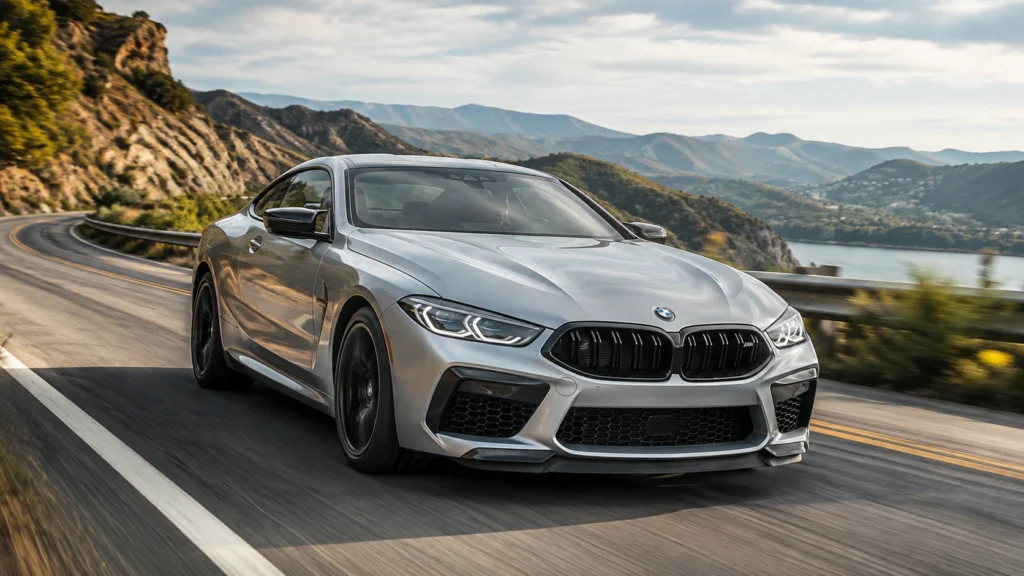
The BMW M8 is the high-performance flagship built by BMW M GmbH, based on the 8 Series grand tourer. Think of it as what happens when BMW’s M division takes its most luxurious, most expensive body style and drops in the same twin-turbo V8 architecture found in the M5.
Where the standard 8 Series — badged 840i or M850i — prioritizes refined cruising, the M8 exists to blend that same long-legged comfort with genuinely explosive performance. It’s less a sports car and more a very fast luxury coupe that happens to embarrass actual sports cars at a stoplight.
Within BMW’s current lineup, the M8 no longer has a direct in-production sibling. The closest thing enthusiasts cross-shop against it today is the BMW M5, which now uses a hybridized version of a similar V8 platform in sedan and wagon form. The M5 is faster on paper, but the M8 offers something the M5 doesn’t: a lower, wider, two-door GT silhouette (or, in Gran Coupe form, four doors wrapped in coupe-like styling).
For readers who want to explore BMW’s official specifications and historical model details, BMW’s official press release for the M8 Competition remains a useful, authoritative reference point.
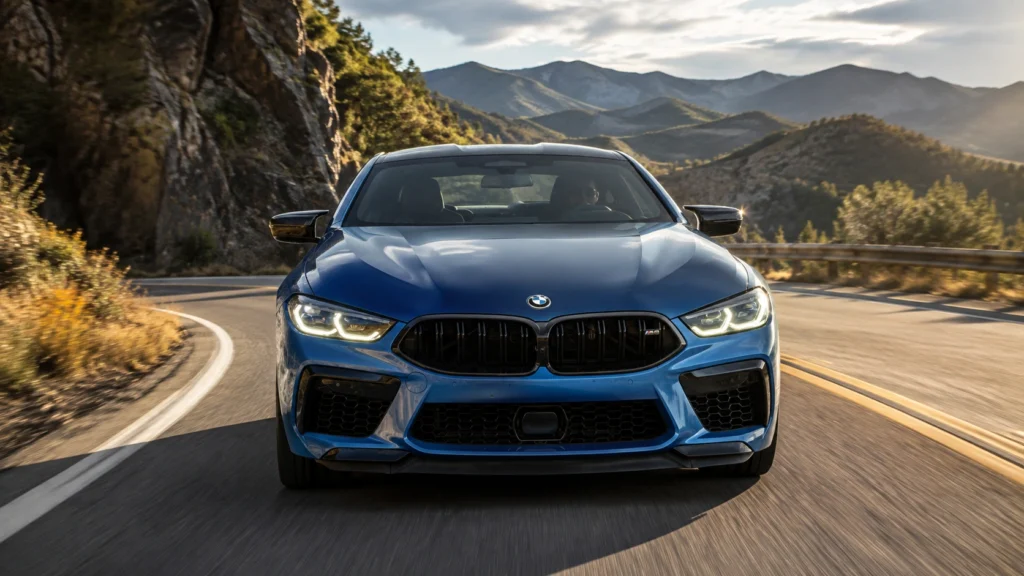
BMW M8 History and Background
BMW’s relationship with 8-series performance cars actually predates the M8 nameplate by decades. The E31 8 Series ran through the 1990s, but BMW never built a true M version of it — the closest thing was the 850CSi, an S70-powered halo car that BMW’s own M division helped develop without slapping an “M” badge on it.
The modern 8 Series returned in 2018 after a 20-year absence, and BMW M followed quickly. The M8 Coupe and Convertible launched for the 2020 model year, arriving with a twin-turbo 4.4-liter V8 shared with the F90-generation M5. A four-door Gran Coupe variant joined the lineup shortly after, giving buyers a practical alternative to the two-door body styles.
Early M8s were offered in both a standard tune (600 hp) and a Competition tune (617 hp). By 2022, BMW simplified things by making Competition the only trim available across all three body styles — if you wanted a new M8 from that point forward, 617 hp was the only number on the table.
The M8’s production run turned out to be shorter than most BMW M models. BMW ended M8 Coupe production in early 2025, closing order books and pulling the coupe from its online configurator. The Convertible and Gran Coupe carried on for a while longer, but by late 2025 the entire M8 lineup had wound down, closing out a production run that began in 2019.
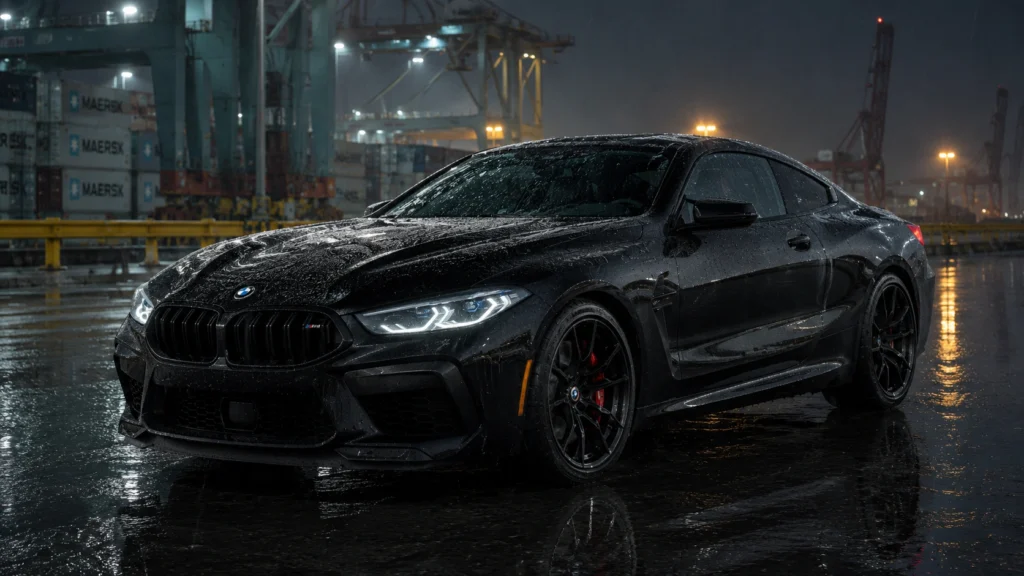
BMW M8 Trim Levels and Body Styles
Because the M8’s availability changed over its life, it’s worth being precise about what existed and when — especially if you’re shopping used and want to know what you’re actually looking at.
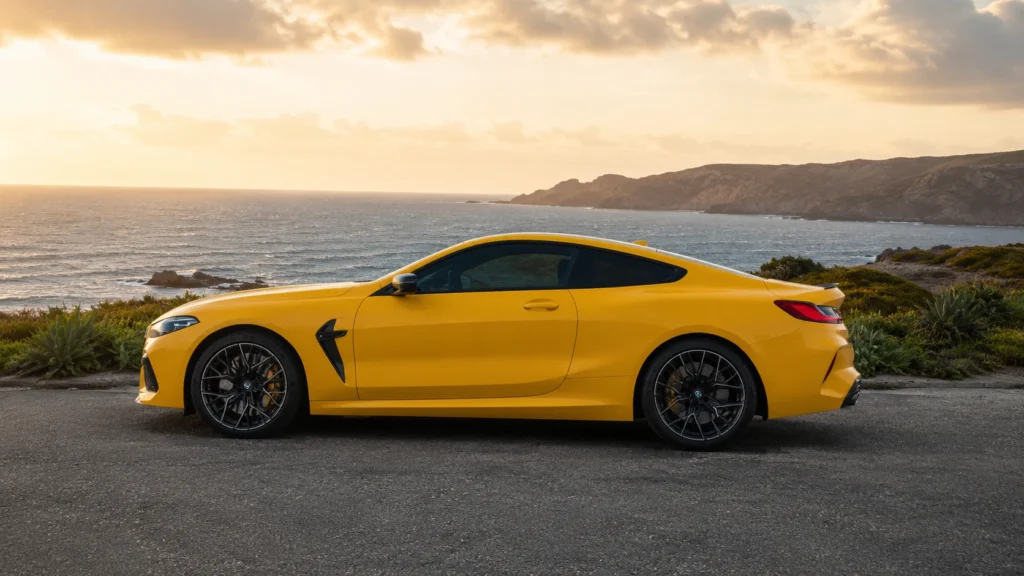
M8 Coupe (F92): The two-door hardtop, and arguably the purest expression of the M8’s grand-touring mission. BMW discontinued the Coupe first, ending production in early 2025 with no 2026 model planned.
M8 Gran Coupe (F93): A four-door version that shares the M8’s drivetrain and most of its character while adding real back-seat usability. By most accounts, this was the best-selling of the three body styles, which is part of why it survived longer than the two-door Coupe.
M8 Convertible (F91): A soft-top droptop version of the two-door Coupe, running roughly a $10,000 premium over Coupe pricing when new. It continued alongside the Gran Coupe after the Coupe was axed.
By the end of 2025, all three body styles had finished their production runs. If you’re shopping today, you’re shopping the used and certified pre-owned market exclusively — model years typically range from 2020 through 2025, with Competition-spec cars (617 hp) dominating anything from roughly 2022 onward.
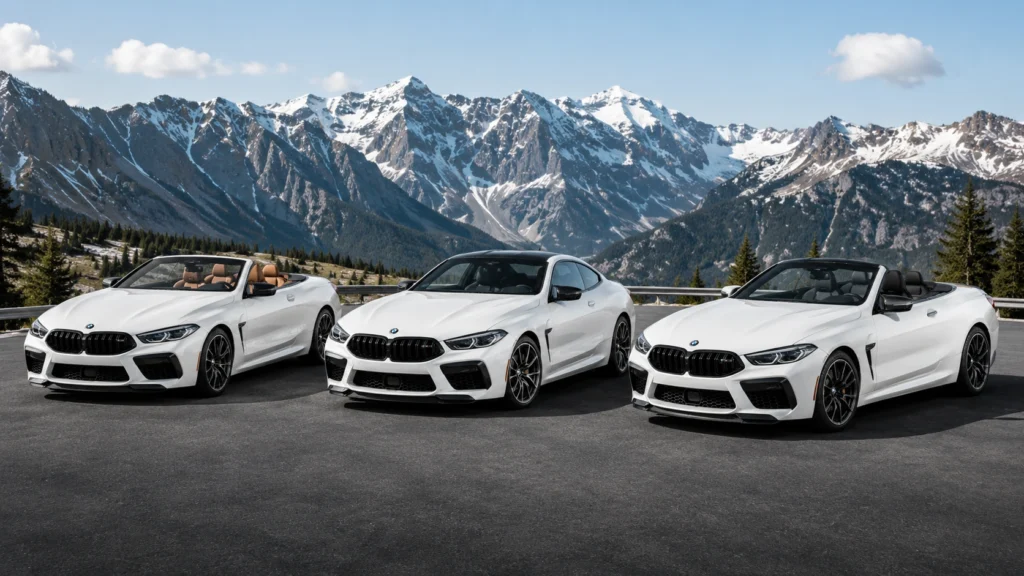
BMW M8 Design and Exterior
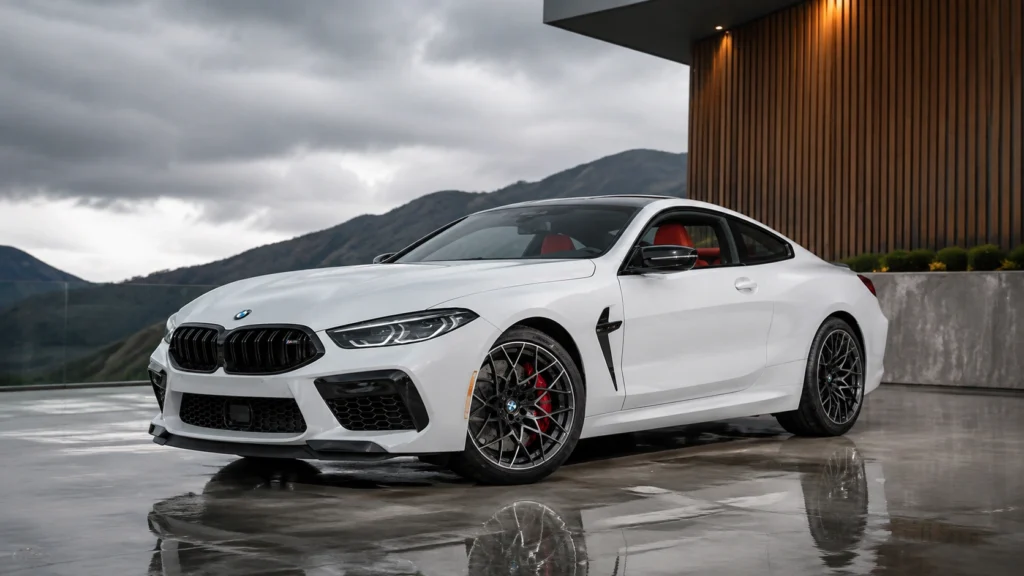
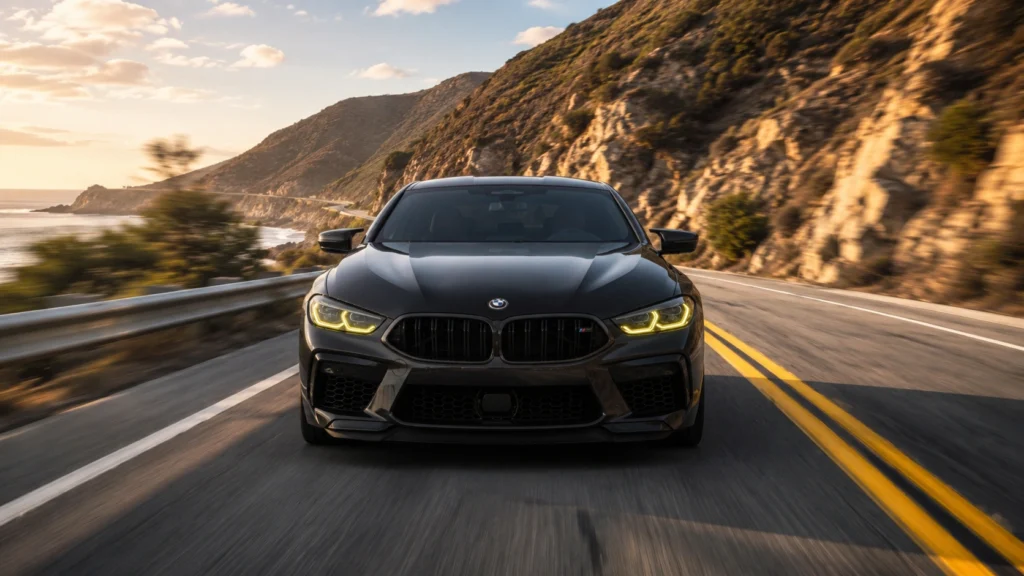
The M8 doesn’t try to hide what it is. The oversized kidney grille, aggressive front air intakes, and wide rear haunches all signal M-division involvement before you even notice the quad exhaust tips.
Compared to a standard 840i or M850i, the M8 sits on a subtly different visual footing: wider front and rear fenders to cover its larger wheel-and-tire package, a more pronounced front splitter, gloss-black exterior trim in place of chrome, and an available carbon-fiber roof on Coupe and Convertible models that both looks purposeful and shaves weight from the car’s highest point.
The standard wheel sizing runs in the 20-inch range, wrapped around blue M-specific brake calipers (with an optional black or red finish, and gold for the optional carbon-ceramic setup). Adaptive LED headlights and laser light elements were available depending on model year and market, giving the M8 a distinctive lighting signature at night.
Aerodynamically, the changes are functional rather than decorative — every additional vent and lip is there to manage cooling airflow or reduce lift at speed, not just to look aggressive. The overall effect is a car that reads as elegant from a distance and unmistakably serious up close, which is exactly the balance a flagship grand tourer should strike.
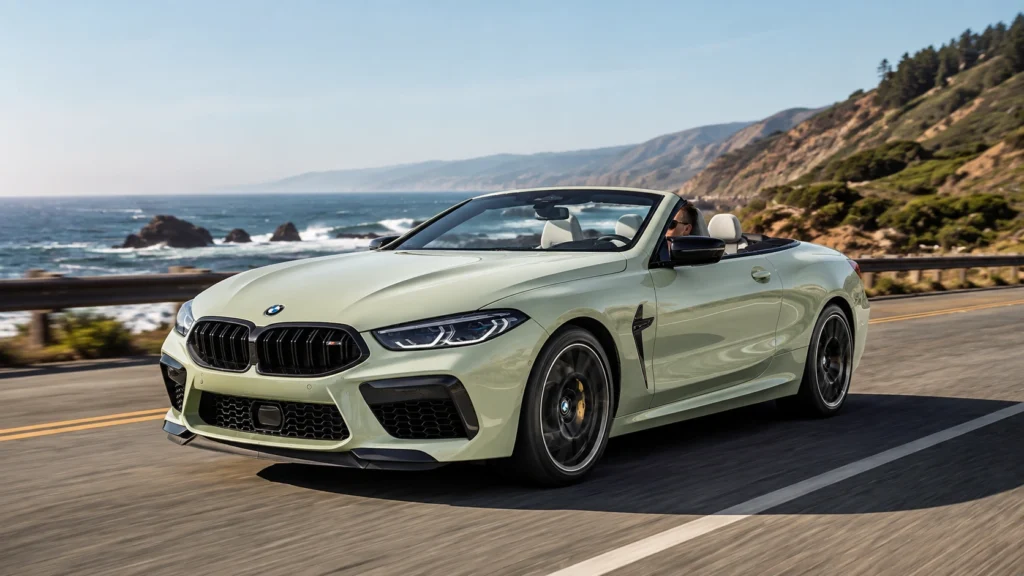
BMW M8 Interior and Technology
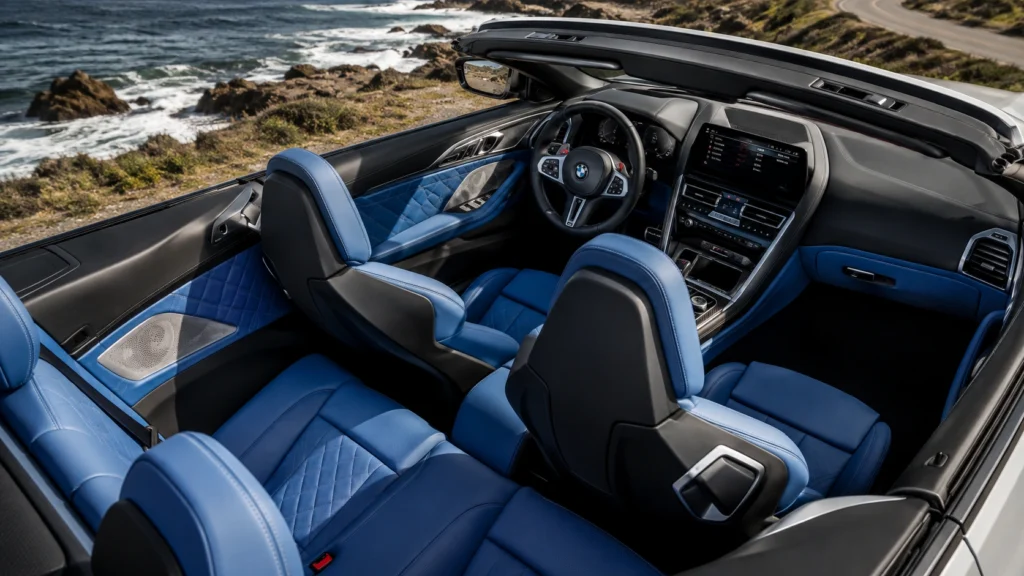
Step inside, and the M8 leans noticeably toward luxury GT rather than stripped-down performance car. Merino leather upholstery, extended leather trim on the dash and door panels, and real carbon-fiber accents were all part of the standard or optional interior experience depending on trim year.
The front seats are M-specific — deeply bolstered, multi-way adjustable, and available with illuminated M badging and adjustable side bolsters for track use. They manage the rare trick of being supportive during hard cornering while remaining genuinely comfortable on a three-hour highway run.
Technology centers on BMW’s iDrive infotainment system, paired with a digital instrument cluster and, on later model years, BMW’s curved display setup that merges the gauge cluster and center screen into a single glass unit. Wireless Apple CarPlay and Android Auto compatibility, a head-up display, and a Bowers & Wilkins surround-sound system were all part of the M8’s tech story, particularly on higher trims and option packages.
Driver-assistance features — adaptive cruise control, lane-keeping assistance, blind-spot monitoring, and parking assistance — were all available, putting the M8 roughly in line with what you’d expect from a modern six-figure BMW, even if it’s not the primary reason anyone bought one.
So does it feel more GT than performance car inside? Largely, yes. The cabin prioritizes comfort and materials quality over motorsport minimalism, which fits the M8’s identity as a car you could genuinely drive across a continent, not just around a track.
BMW M8 Engine and Performance
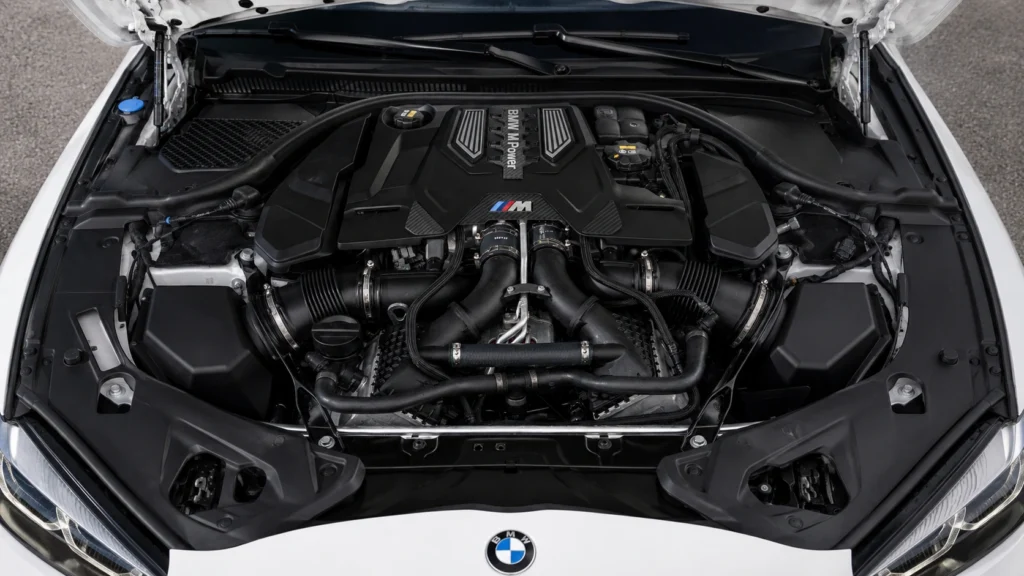
At the heart of every M8 sits the S63 engine: a 4.4-liter twin-turbocharged V8 with a 90-degree bank angle and turbochargers mounted inside the “vee” of the engine for quicker throttle response. Displacement-wise, it’s not huge by American V8 standards, but forced induction does the heavy lifting here.
In its final production form, the M8 Competition made 617 horsepower and 553 lb-ft of torque. Earlier, non-Competition M8s produced 600 horsepower — a smaller gap than the numbers might suggest, since both versions feel enormously fast in the real world.
Power routes through an eight-speed automatic transmission to BMW’s M xDrive all-wheel-drive system. Unlike a conventional AWD setup, M xDrive can shift almost all of its torque to the rear wheels, including a dedicated 2WD mode for drivers who want old-school, rear-drive M-car behavior on a track.
What do these numbers mean day to day? In practice, it means the M8 never feels like it’s working hard. Highway passing happens instantly, uphill acceleration doesn’t sap momentum the way it does in lesser cars, and the engine has enough low-end torque that you rarely need to wring it out to feel the performance. It’s the kind of power delivery that makes a car feel effortless rather than frantic — which is exactly the point of a grand tourer.
BMW M8 Driving Experience
Professional reviewers have consistently described the BMW M8 as a car that manages an unusual trick: it’s genuinely quick in the way a proper performance car should be, while still being comfortable enough for daily use — provided you can live with its fuel bills and firm-ish ride.
Acceleration is the headline. In Competition spec, the BMW M8 rockets to 60 mph in roughly three seconds, and it does so with a consistency that makes repeated launches feel almost boring in their reliability. Braking is similarly strong, with standard M compound brakes and an optional carbon-ceramic setup for owners who plan to spend real time on track.
Handling benefits from adaptive M suspension, which can shift from a genuinely comfortable Comfort mode to a taut, buttoned-down Sport mode with a twist of a dial. Steering is precise and appropriately weighted, though — in keeping with most modern M cars — it prioritizes accuracy and consistency over the kind of chatty road feel enthusiasts loved in older, unassisted BMW steering racks.
On the highway, the BMW M8 settles into a relaxed, quiet cruiser, helped by strong wind and road noise suppression for a car with this much performance hardware underneath it. Around town, it’s noticeably big — this is not a small car — but visibility and driver-assistance tech keep it from feeling unwieldy.
Push it into a corner, and the M8’s weight (north of two tons in most configurations) becomes more noticeable than in a lighter sports coupe, but the chassis and all-wheel-drive system do a genuinely impressive job of disguising it. It’s not a lightweight, razor-edged track car — it’s a heavyweight that fights well above its class.
BMW M8 Specifications
The table below expands on the earlier quick-reference specs with additional technical detail. Figures reflect the final-generation Competition-spec M8; exact numbers can vary slightly by body style, model year, and optional equipment.
| Category | Detail |
|---|---|
| Engine | 4.4L twin-turbo V8, S63 (600 hp) or Competition-tuned S63 (617 hp) |
| Torque | 553 lb-ft (Competition) |
| Transmission | 8-speed ZF automatic |
| Drivetrain | M xDrive AWD with rear-biased torque split, 2WD mode available |
| 0–60 mph | Approx. 3.0 seconds (Coupe quickest; Convertible slightly behind) |
| Top Speed | 155 mph standard; 190 mph with M Driver’s Package |
| Fuel Economy (EPA) | Roughly 15 city / 21–22 highway / 17 combined mpg |
| Curb Weight | Approximately 4,150–4,550 lbs depending on body style |
| Cargo Capacity | Approx. 14.8 cu ft (Coupe/Convertible); 15.5 cu ft (Gran Coupe) |
| Seating | 4 occupants across all body styles |
| Brakes | Standard M compound brakes; optional carbon-ceramic |
Fuel economy figures and curb weight vary by source and equipment level, so treat them as representative rather than exact for any individual car.
BMW M8 Top Speed and Acceleration
Officially, BMW quotes a 3.0-second 0-60 mph time for the M8 Competition, though several independent road tests over the years have recorded slightly quicker runs — some in the high-2-second range — under ideal launch conditions. That’s not unusual for a modern performance car; official manufacturer figures tend to be conservative compared to what a skilled driver, good tires, and cool ambient temperatures can produce on a prepped surface.
Top speed is electronically capped at 155 mph in standard trim, a self-imposed limit shared by most German performance brands. Buyers who ordered the optional M Driver’s Package could raise that ceiling to 190 mph — though reaching it obviously requires a closed course, not a public highway.
It’s worth remembering that real-world acceleration always depends on more than the spec sheet. Tire choice, ambient temperature, launch technique, road surface, and even elevation can shift a 0-60 run by several tenths of a second in either direction. Treat published numbers as a reliable point of comparison between cars, not a guarantee of what any individual M8 will do in your driveway.
BMW M8 Price
Because the M8 is no longer sold new, pricing now falls into two very different categories: what it cost when new, and what it costs today on the used market.
When new, M8 pricing generally started in the low-to-mid $130,000s for the Coupe, with the Gran Coupe and Convertible commanding modest premiums over that base figure. By its final production years, well-equipped Competition models with popular options — carbon-ceramic brakes, the M Driver’s Package, extended leather — regularly pushed past $150,000 before taxes and fees.
Today’s story is different, and arguably more interesting for buyers. Used M8 values have fallen substantially since production ended, with clean examples now commonly trading in the $50,000–$60,000 range in the U.S. market — putting a 617-hp flagship GT within reach of buyers cross-shopping something as ordinary as a new BMW 3 Series or M340i.
Actual pricing will vary widely based on model year, body style, mileage, accident history, and how the car was optioned from the factory. A high-mileage early Coupe and a low-mileage, late-production Gran Coupe with carbon-ceramic brakes can differ by tens of thousands of dollars even though both wear the same M8 badge. As with any used performance car, a pre-purchase inspection and a full service history are worth far more than the listing price alone.
BMW M8 Running Costs and Practicality
Owning an M8 — new or used — comes with the running costs you’d expect from a 617-hp twin-turbo V8 wrapped in a luxury body.
Fuel economy sits in the mid-teens to low-20s mpg range, with EPA combined ratings around 17 mpg. Premium fuel is required, not optional, and spirited driving will push real-world consumption noticeably lower than the window sticker.
Maintenance follows typical high-performance German-car patterns: services aren’t cheap, and the S63 engine’s twin-turbo, direct-injection design means things like spark plugs, coils, and turbo-related components carry higher-than-average parts and labor costs compared to a mainstream car.
Tires and brakes wear faster than on a comparable sedan, especially if the car sees any track time. The M8’s staggered wheel setup means front and rear tires wear (and need replacing) at different rates, and performance rubber at this size isn’t cheap.
Insurance tends to run higher than a standard luxury coupe, reflecting both the car’s performance potential and its repair costs — shop around, since quotes can vary significantly between insurers for cars in this segment.
Day-to-day usability is genuinely good for a car in this class. Cargo space (roughly 14.8 to 15.5 cubic feet depending on body style) is respectable for a GT, and the Gran Coupe’s rear seats are usable by adults on shorter trips, even if the Coupe and Convertible are more strictly four-seat-on-paper propositions.
None of this makes the M8 a cheap car to own. But relative to its performance ceiling, and especially at today’s depreciated used prices, the ownership math is more reasonable than the original sticker price would suggest.
BMW M8 Pros and Cons
Pros
- Genuinely supercar-quick, with a 617-hp Competition-spec V8 and sub-3.5-second 0-60 capability across body styles
- Comfortable, high-quality interior that works as well for long highway trips as it does for weekend blasts
- Three distinct body styles (when new) meant buyers could choose practicality without giving up performance
- Values have dropped substantially since production ended, making a used example far more accessible than its original price suggested
Cons
- No longer sold new — every purchase today is a used or CPO transaction, with all the due-diligence work that involves
- High running costs: premium fuel, expensive tires and brakes, and pricier-than-average maintenance
- Heavier than most true sports cars, which shows up the moment you push hard into a corner
- No confirmed direct successor from BMW at this time, leaving a gap in the brand’s flagship GT lineup
BMW M8 vs Competitors
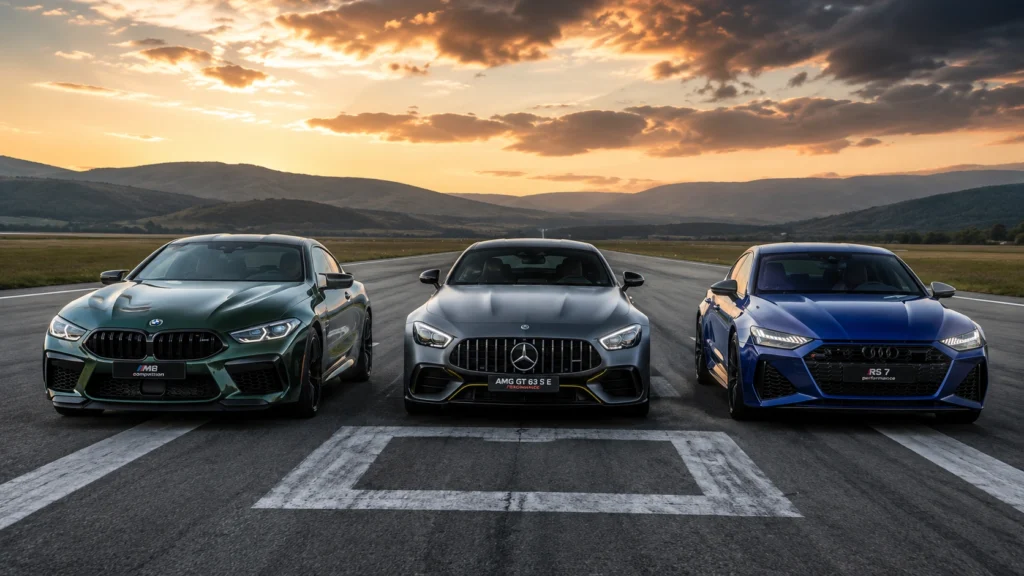
The M8’s closest rivals occupy a similar space: high-performance V8 (or hybrid V8) sedans and coupes built for buyers who want supercar pace without giving up luxury and usability.
| Factor | BMW M8 Competition | Mercedes-AMG GT 63 S E Performance | Audi RS 7 Performance |
|---|---|---|---|
| Power | 617 hp | 831 hp (plug-in hybrid) | 621 hp |
| 0–60 mph | Approx. 3.0 sec | Approx. 2.8 sec | Approx. 3.3 sec |
| Drivetrain | M xDrive AWD | AMG 4Matic+ AWD (hybrid) | Quattro AWD |
| Body Styles | Coupe, Convertible, Gran Coupe (discontinued) | 2-door coupe or 4-door sedan | 5-door liftback |
| Status | Discontinued; used market only | Currently in production | Currently in production |
| Character | Balanced luxury GT | Tech-heavy, hybrid-boosted performance | Practical, hatchback-flexible performance |
The Mercedes-AMG GT 63 S E Performance out-guns the M8 on paper thanks to its plug-in-hybrid boost, and it’s quicker in a straight line — but it’s also considerably pricier and leans harder into complexity, with a hybrid system that prioritizes performance over efficiency.
The Audi RS 7 Performance is arguably the M8’s most natural rival in spirit: similar horsepower, a twin-turbo V8, Quattro all-wheel drive, and — notably — genuine hatchback practicality thanks to its liftback body style. It’s also still in production, though reportedly in its own final model year as Audi rationalizes its lineup.
The Porsche Panamera, while not detailed in the table above, is also frequently cross-shopped by M8 buyers looking for German engineering with a sportier driving character, though pricing and configuration vary widely by trim.
For buyers specifically drawn to BMW’s own lineup, the current M5 sedan is the closest thing to a spiritual successor — you can read our full BMW M5 review for a detailed look at how BMW’s hybridized flagship sedan compares.
Who Should Buy the BMW M8?
The BMW M8 makes the most sense for a specific kind of buyer: someone who wants genuine supercar-rivaling performance but refuses to sacrifice comfort, usability, or long-distance refinement to get it.
If you’re an enthusiast who values outright speed and doesn’t mind hunting the used market, tolerating higher running costs, and doing careful due diligence on a pre-owned high-performance car, the M8 — especially at today’s depreciated prices — is a compelling way into a genuine flagship GT experience.
If you want a brand-new car with a full factory warranty, or you’re mainly focused on minimizing ownership costs, the M8 probably isn’t the right fit. A current BMW M5, an Audi RS 7, or even a well-optioned M850i (still in production, minus the M8’s extra power) would serve those priorities better.
Buyers who need genuine everyday practicality — a big back seat, maximum cargo room, or budget-conscious ownership — should also look elsewhere. The M8 rewards enthusiasts willing to trade some convenience for a driving experience that’s genuinely hard to replicate at this price point today.
Conclusion
The BMW M8 leaves behind a genuinely impressive legacy: a flagship grand tourer capable of supercar-rivaling acceleration, wrapped in a luxury interior comfortable enough for cross-country drives. Its discontinuation doesn’t diminish what it accomplished — it simply shifts the conversation from “should I order one new” to “should I buy one used.”
For buyers willing to navigate the used-car process carefully, today’s depreciated pricing makes the BMW M8 one of the more compelling performance bargains in the German luxury space. You’re getting 617 horsepower, all-wheel-drive security, and genuine everyday comfort for a fraction of its original sticker price.
It’s not the cheapest car to run, and it’s not for buyers who need a factory warranty or maximum practicality. But as a used purchase for someone who wants flagship-level performance without flagship-level pricing, the BMW M8 remains one of the more interesting cars in its class — discontinued or not.
Frequently Asked Questions (FAQs)
No. BMW ended M8 Coupe production in early 2025, and the Convertible and Gran Coupe followed by the end of that year. There is no 2026 BMW M8, and BMW has not confirmed a direct successor.
Yes, by most professional and owner accounts. It combines genuine supercar-level acceleration with a comfortable, well-built interior, though it comes with the higher running costs typical of any high-performance V8 GT.
BMW’s official claim for the Competition-spec M8 is a 0-60 mph time of roughly 3.0 seconds, with some independent tests recording slightly quicker results. Top speed is electronically limited to 155 mph standard, or 190 mph with the optional M Driver’s Package.
The final-generation M8 Competition produces 617 horsepower and 553 lb-ft of torque. Earlier, non-Competition M8 models made 600 horsepower.
Yes. Every M8 uses BMW’s M xDrive all-wheel-drive system, which can shift torque predominantly to the rear wheels and includes a dedicated 2WD mode for track use.
A 4.4-liter twin-turbocharged V8, internally coded S63, shared in earlier form with the previous-generation BMW M5.
New M8 pricing historically started in the low-to-mid $130,000s and rose past $150,000 for well-equipped Competition models. Since production ended, used examples now commonly trade in the $50,000–$60,000 range, though pricing varies by model year, condition, and options.
It can be, particularly in Gran Coupe form, which offers usable rear seats and slightly more cargo room. The Coupe and Convertible are more strictly two-plus-two propositions. All body styles come with the fuel and maintenance costs typical of a high-performance V8.