Mercedes-Benz G-Class: The Complete 2026 Buyer’s Guide
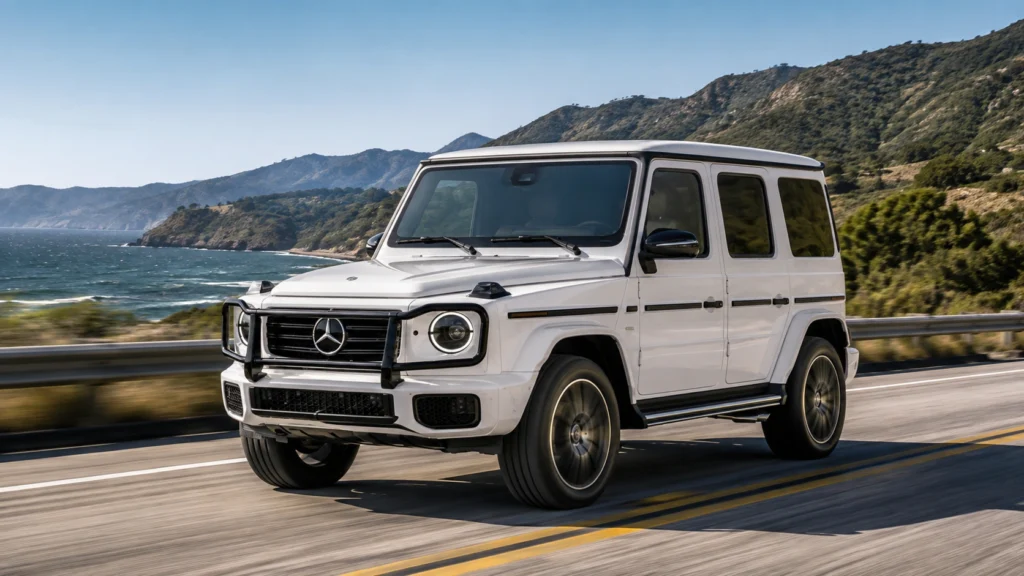
Few vehicles on sale today look like they could have driven straight out of the 1970s and still be relevant. The Mercedes-Benz G-Class manages exactly that. It’s a military-born, ladder-frame SUV that somehow shares valet lines with S-Classes and Bentleys, and it has done so without losing the boxy, upright shape that made it famous in the first place.
This guide breaks down everything a serious buyer needs to know about the G-Class in 2026: its design, interior, engines, off-road hardware, real-world performance, pricing, and how it stacks up against rivals like the Range Rover and Land Rover Defender. Whether you’re cross-shopping luxury SUVs or you’ve already decided the G-Class is the one, this is meant to answer the questions you’d actually ask before signing.
Quick Specifications
| Specification | Mercedes-Benz G-Class |
|---|---|
| Vehicle Type | Body-on-frame luxury SUV |
| Seating Capacity | 5 |
| Drivetrain | Permanent 4MATIC all-wheel drive |
| Engine | 3.0L turbo inline-6 mild hybrid (G 550), 4.0L twin-turbo V8 (AMG G 63), or quad electric motors (G 580 with EQ Technology) |
| Power | 443 hp (G 550) / 577 hp (AMG G 63) / 579 hp (G 580) |
| Torque | 413 lb-ft (G 550) / 627 lb-ft (AMG G 63) / 859 lb-ft (G 580) |
| 0–60 mph | 5.3 sec (G 550) / roughly 4.4 sec (AMG G 63) / 4.6 sec (G 580) |
| Fuel Economy | 18 mpg combined (G 550) / 15 mpg combined (AMG G 63) / 239 miles EPA range (G 580) |
| Cargo Space | Roughly 68 cubic feet maximum, varies by trim |
| Starting Price | Roughly $155,000–$197,000 depending on model, before options |
All figures vary by trim, model year, and market. Treat this table as a starting reference, not a final spec sheet — always confirm current numbers with a dealer or the official Mercedes-Benz configurator.
What Is the Mercedes-Benz G-Class?
The Mercedes-Benz G-Class is a full-size luxury SUV built on a genuine ladder-type frame, which is unusual in a market where nearly every competitor has switched to unibody construction. That frame, combined with solid axle influence at the rear and a boxy, near-vertical body, is what separates the Mercedes-Benz G-Class from a typical crossover-based luxury SUV.
Most luxury SUVs are essentially tall, comfortable road cars. The Mercedes-Benz G-Class is closer to a genuine off-roader that Mercedes-Benz has spent five decades dressing up in progressively nicer clothes. It still has real locking differentials and low-range gearing on gasoline models — hardware that a lot of “off-road styled” SUVs simply don’t offer anymore.
Within Mercedes-Benz’s current lineup, the Mercedes-Benz G-Class occupies a strange but deliberate position. It isn’t the most expensive Mercedes, and it isn’t the most technologically advanced. But it’s arguably the most recognizable, and that recognition is precisely why buyers keep choosing it over objectively more practical alternatives.
History and Background
The Mercedes-Benz G-Class started life in the late 1970s as a joint project between Mercedes-Benz and Austrian manufacturer Steyr-Daimler-Puch, built primarily for military and government use. Its job was simple: go anywhere, survive abuse, and keep running. Luxury wasn’t part of the brief.
Civilian demand changed that. Wealthy buyers in Europe and the Middle East began requesting the “Geländewagen” — literally “cross-country vehicle” — for private use, and Mercedes-Benz responded by slowly adding comfort features without touching the fundamental shape or the body-on-frame construction underneath.
By the 1990s and 2000s, the G-Class had fully crossed over into luxury territory, gaining leather interiors, V8 power, and eventually the AMG treatment. Mercedes-Benz made a deliberate choice throughout this evolution: keep the silhouette instantly recognizable, even as everything mechanical underneath was modernized.
The most significant recent chapter is electrification. The introduction of the Mercedes-Benz G 580 with EQ Technology proved that Mercedes-Benz sees a future for the Mercedes-Benz G-Class shape well beyond the internal combustion engine, without abandoning the off-road hardware that defines it.
Design and Exterior
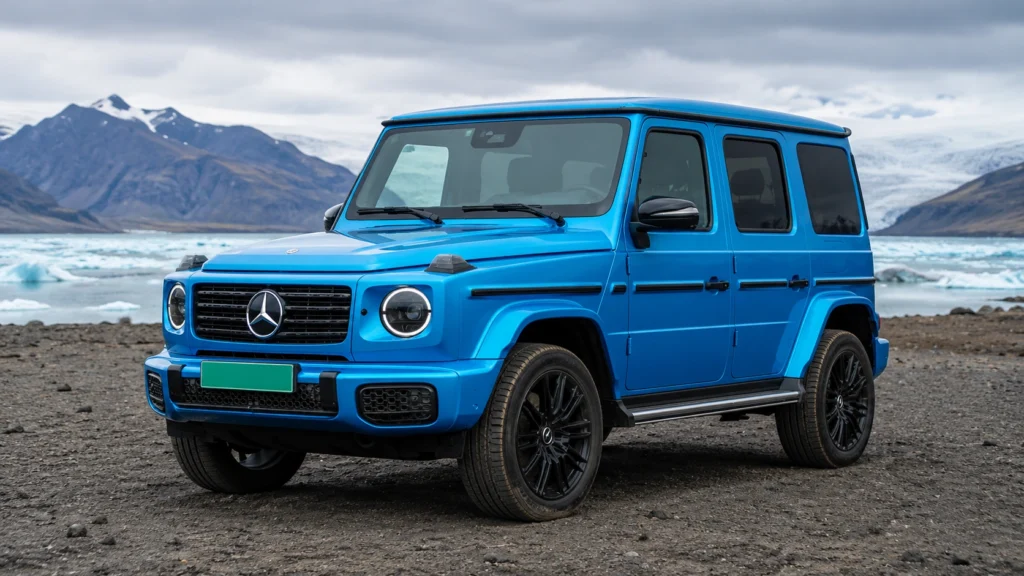
The G-Class SUV‘s design isn’t retro styling for its own sake — nearly every visual element serves a functional purpose rooted in its off-road origins. That’s a big part of why the shape has survived largely unchanged for so long.
The boxy body maximizes interior volume relative to footprint and keeps the greenhouse simple to manufacture and repair, which mattered enormously to its original military customers.
The upright windshield improves visibility on steep inclines and technical terrain, where a heavily raked windshield would distort the driver’s sense of the vehicle’s angle relative to the ground.
Round headlights, the flat grille, and exposed door hinges are all carryovers from the original design that Mercedes-Benz has deliberately preserved through every redesign, even as the engineering underneath moved on.
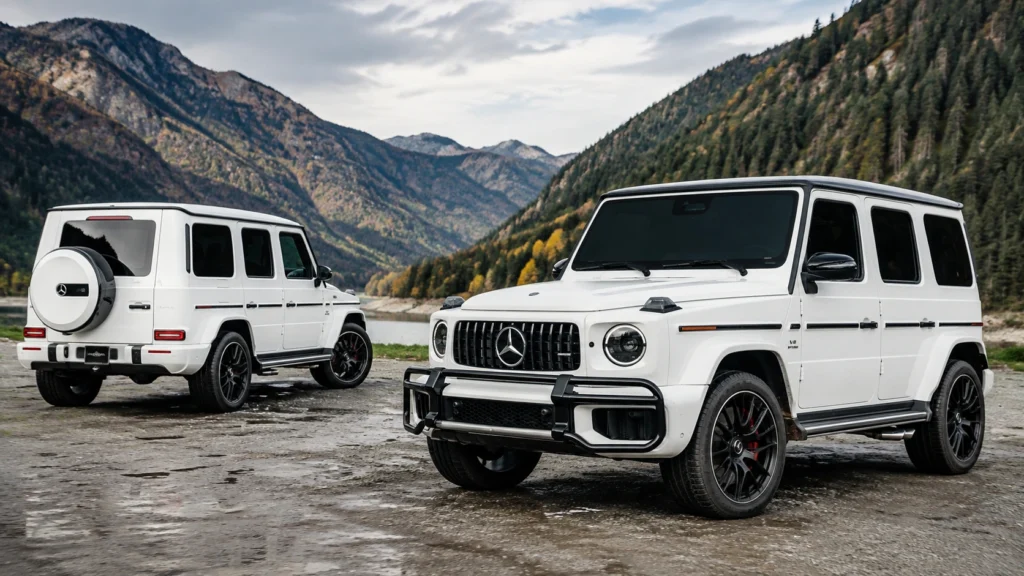
The side-mounted spare wheel keeps weight off the rear tailgate hinge and preserves departure angle, though it does eat into rear visibility and makes the tailgate heavier to swing open, a genuine everyday annoyance for some owners.
High ground clearance and a wide stance are pure function — they exist to clear obstacles and maintain stability on uneven terrain, not to look aggressive in a parking lot.
The trade-off is aerodynamics. A near-vertical windshield and flat panels are terrible for a drag coefficient, which is part of why the Mercedes-Benz G-Class is thirstier than its rivals and why the electric G 580 needed real engineering work just to bring its drag coefficient down to a still-unimpressive 0.44. Mercedes-Benz has made modern tweaks — reshaped mirrors, revised bumpers, a subtly smoothed hood on the G 580 — but nobody would call this an aerodynamically efficient vehicle, and Mercedes hasn’t tried to pretend otherwise.
Interior and Technology
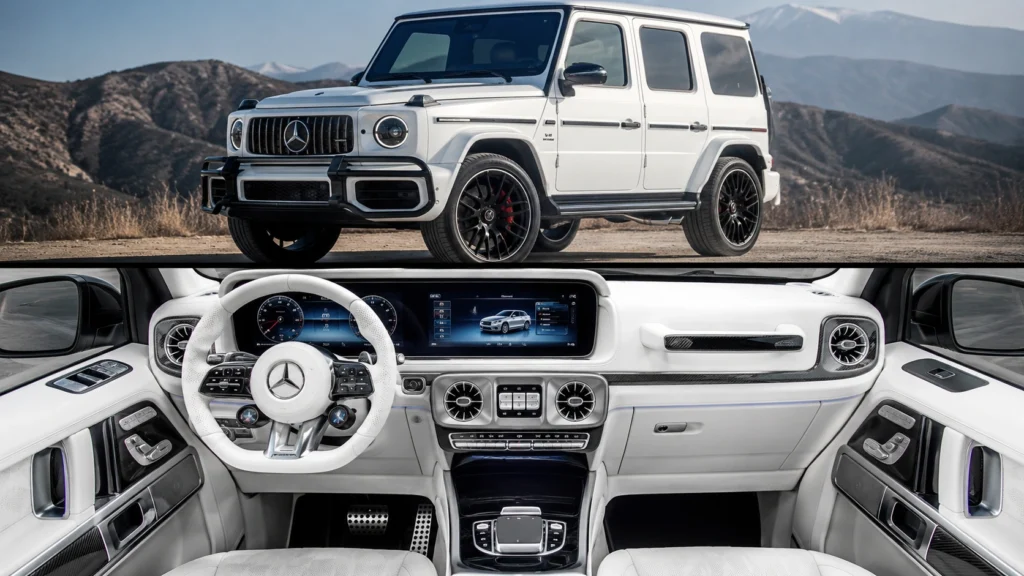
Step inside a current Mercedes-Benz G-Class interior and the contrast with the exterior is immediate. The dashboard is dominated by dual 12.3-inch displays — one for instrumentation, one for the MBUX infotainment system — set into a design that borrows heavily from the rest of the modern Mercedes-Benz range rather than the truck-like cabins of older G-Wagens.
Material quality is genuinely high. Nappa leather, real metal switchgear, and available options like active multicontour front seats with massage functions put the Mercedes-Benz G-Class solidly in line with what buyers expect from a six-figure luxury SUV, not just an expensive off-roader.
Technology includes adaptive cruise control, a comprehensive suite of driver-assistance systems, a surround-view camera system (genuinely useful given the poor rear visibility), wireless Apple CarPlay and Android Auto, and an available Burmester premium audio system.
Rear-seat comfort has improved substantially over older generations, though the Mercedes-Benz G-Class still isn’t as spacious inside as its imposing exterior suggests. Shoulder room and outright cargo volume trail full-size American and British rivals, a direct consequence of the narrower, taller body shape.
Cargo practicality is decent for weekend trips and typical family duty, but the side-hinged tailgate — heavy, and swinging outward into traffic or a tight garage — is a genuine everyday inconvenience that more conventional liftgate SUVs don’t have.
The honest answer to whether the cabin feels practical or primarily luxurious: it leans luxurious. Everyday usability is good, not great, and buyers cross-shopping from a three-row American SUV will notice the difference in outright interior space immediately.
Engine and Performance
Mercedes-Benz currently offers three distinct powertrain paths under the G-Class name, and they serve genuinely different buyers.
G 550
The G 550 uses a 3.0-liter turbocharged inline-six with 48-volt mild-hybrid assistance, producing 443 horsepower and 413 lb-ft of torque, with a temporary boost of up to an additional 20 hp and 184 lb-ft available from the integrated starter-generator. Power routes through a 9-speed automatic transmission to Mercedes-Benz’s 4MATIC all-wheel-drive system.
In everyday driving, this is the version most owners should actually want. It has more than enough power for real-world use, the mild-hybrid system smooths out low-speed response, and it doesn’t demand premium fuel consumption the way the V8 does.
Mercedes-AMG G 63
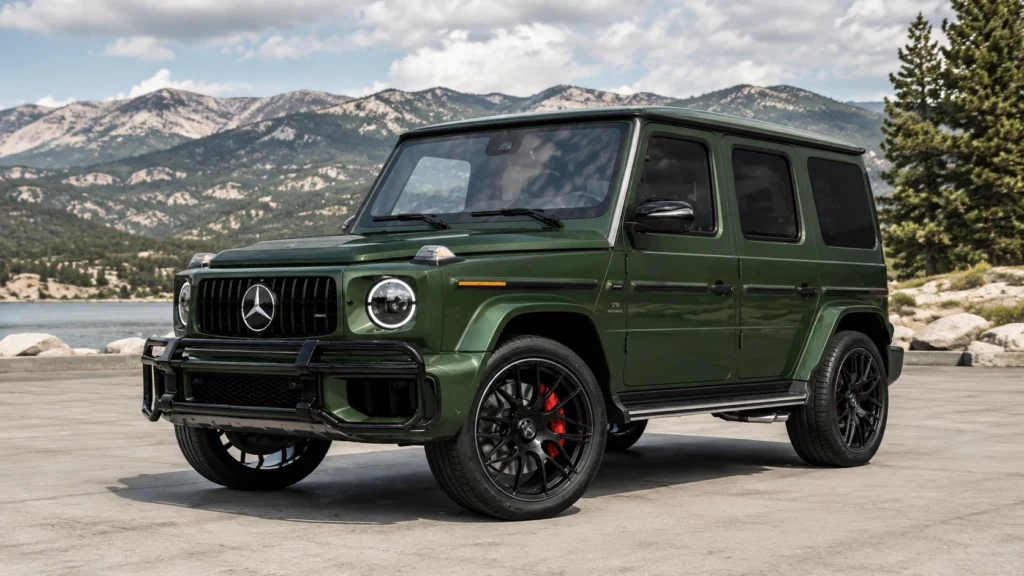
The Mercedes-AMG G 63 swaps in AMG’s handbuilt 4.0-liter twin-turbo V8, rated at 577 horsepower and 627 lb-ft of torque, paired with AMG Performance 4MATIC all-wheel drive and a 9-speed AMG SPEEDSHIFT transmission tuned for quicker shifts.
The character is completely different from the G 550. The exhaust note is loud and deliberately theatrical, throttle response is sharper, and the whole vehicle feels far more eager to be pushed — which is a strange sensation in something this tall and heavy. This is the G-Class built for buyers who want performance-car theater layered on top of off-road capability, and it commands a significant price premium for exactly that.
Mercedes-Benz G 580 with EQ Technology
The Mercedes-Benz G 580 with EQ Technology replaces the engine entirely with four permanently excited synchronous electric motors, one per wheel, delivering a combined 579 horsepower and roughly 859 lb-ft of torque. A 116-kWh usable battery pack feeds the system.
Instant torque from four independently controlled motors gives the G 580 genuinely different off-road capability than its gasoline siblings — Mercedes-Benz built in a party trick called G-Turn, which can rotate the vehicle nearly in place by spinning the wheels on each side in opposite directions, something no combustion G-Class can do.
Range and charging are the real trade-offs. EPA-estimated range sits around 239 miles, and the G 580’s efficiency is genuinely poor for an EV given its weight and terrible aerodynamics. DC fast charging at up to 200 kW can take the battery from 10% to 80% in about 32 minutes, but this isn’t a vehicle built for effortless long-distance road trips the way a more aerodynamic EV is.
Off-Road Capability
This is where the Mercedes-Benz G-Class earns the right to look the way it does, and it’s worth explaining what these numbers actually mean rather than just listing them.
4MATIC all-wheel drive on gasoline models is permanent, not part-time, meaning power is always being sent to all four wheels rather than switching in only when slip is detected. Combined with three 100% locking differentials (front, center, and rear), the G-Class can keep moving even when one or more wheels completely lose traction — a capability most “off-road styled” luxury SUVs simply don’t have.
Ground clearance sits in the neighborhood of 9.5 to 10.6 inches depending on the measurement point, which lets the vehicle clear rocks, ruts, and trail obstacles that would ground a lower SUV.
Approach and departure angles — roughly 31 degrees approaching and 30 degrees departing on gasoline models — describe how steep an incline the vehicle can climb or descend without the bumpers scraping the ground first. Higher numbers mean steeper terrain is accessible without body damage.
Breakover angle, around 26 degrees, measures the vehicle’s ability to crest a sharp ridge or hump without the undercarriage getting hung up in the middle, which matters far more on genuine trails than in a dealership parking lot.
Low-range gearing, standard on the gasoline models, multiplies torque at low speeds for controlled crawling over technical terrain — something that simply doesn’t exist on most crossover-based luxury SUVs, which rely purely on electronic traction control instead.
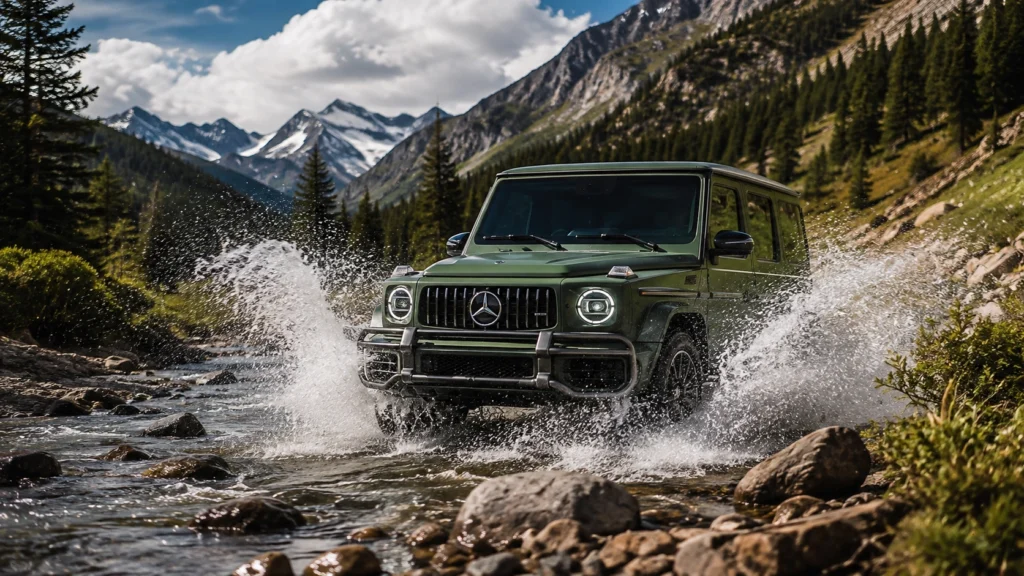
Wading depth of around 27.6 inches on gasoline models (and rated higher on the G 580, whose sealed electric drivetrain changes the calculation) lets the G-Class cross moderately deep water without stalling out.
It’s worth being honest about the gap between real off-road capability and the image of an off-road SUV. The G-Class genuinely has the hardware to back up its looks — locking differentials, low range, real ground clearance — in a way that plenty of “rugged-looking” SUVs on dealer lots do not. But most Mercedes-Benz G-Class owners will never use more than a fraction of this capability, and that’s fine. The point is that the capability exists if you need it, not that every buyer will.
Specifications
| Specification | G 550 | AMG G 63 | G 580 with EQ Technology |
|---|---|---|---|
| Engine/Powertrain | 3.0L turbo inline-6, mild hybrid | 4.0L twin-turbo V8 | Four electric motors |
| Horsepower | 443 hp | 577 hp | 579 hp |
| Torque | 413 lb-ft | 627 lb-ft | 859 lb-ft |
| Transmission | 9-speed automatic | 9-speed AMG SPEEDSHIFT | 2-speed direct-drive |
| Drivetrain | 4MATIC AWD | AMG Performance 4MATIC | Four-motor AWD |
| 0–60 mph | 5.3 sec | ~4.4 sec | 4.6 sec |
| Top Speed | 130 mph | 137 mph | 112 mph |
| Ground Clearance | ~9.5 in | ~9.5 in | ~9.8 in |
| Curb Weight | ~5,600 lb | ~5,800 lb | ~6,800 lb |
| Fuel Economy/Range | 18 mpg combined | 15 mpg combined | ~239 miles EPA range |
| Towing Capacity | 7,000 lb | 7,000 lb | Not rated for towing |
Figures are approximate and sourced from published manufacturer and third-party specification data current for the 2026 model year. Exact numbers can shift with option packages, wheel size, and regional certification standards, so always verify against the current window sticker before purchase.
Top Speed and Acceleration
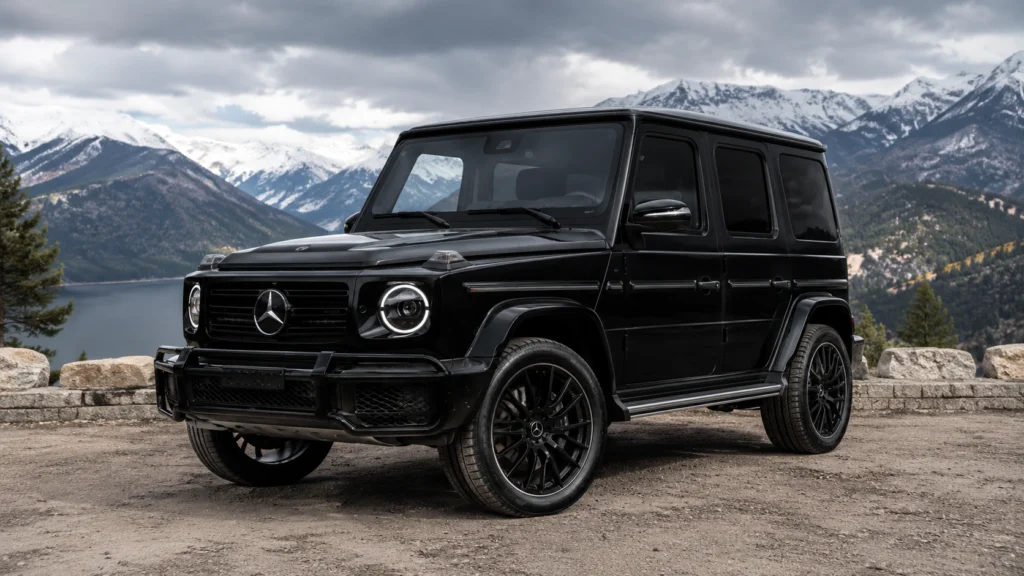
None of this should be normal for a vehicle shaped like a filing cabinet. The G-Class’s performance numbers only make sense once you remember how much engineering Mercedes-Benz has quietly poured into a body style that fights aerodynamics at every turn.
The G 550’s 5.3-second 0-60 mph time and 130 mph top speed are genuinely quick for something this tall, heavy, and aerodynamically compromised — a testament to how much power modern turbocharging extracts from a relatively modest inline-six.
The AMG G 63 is the outlier. A 0-60 mph time in the mid-4-second range and a 137 mph top speed put it in territory usually reserved for sport sedans, not 5,800-pound off-roaders. It’s genuinely fast in a straight line, even if the tall center of gravity means it never feels like a sports car in the corners.
The G 580’s 4.6-second 0-60 mph run demonstrates the usual EV advantage of instant torque, but its 112 mph top speed — deliberately limited — reflects a different priority. Mercedes-Benz clearly decided range and motor longevity mattered more than outright top speed for the electric variant, which makes sense given how much energy pushing this shape through the air already costs.
Price
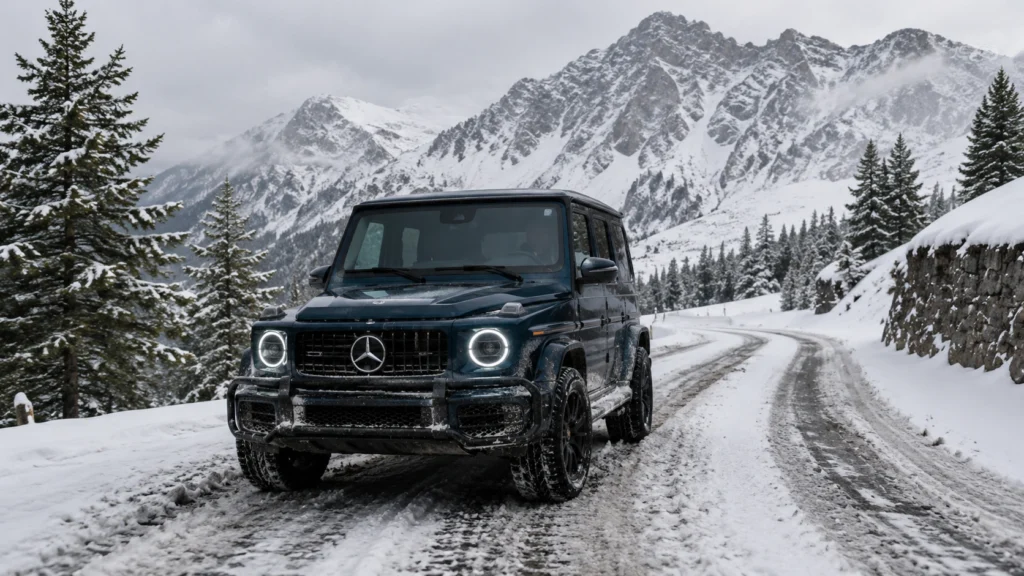
Mercedes G-Class price figures vary meaningfully by model, model year, market, and how heavily a buyer options the vehicle — and Manufaktur personalization can push any G-Class well past its base sticker.
The G 550 currently starts at roughly $153,900 to $155,000 in the U.S. market, depending on the source and timing of the quote. That base price includes 4MATIC AWD, three locking differentials, dual 12.3-inch displays, heated front and rear seats, and a power sunroof as standard equipment.
The AMG G 63 starts significantly higher, generally in the neighborhood of $196,850, reflecting the handbuilt AMG V8, unique suspension tuning, and additional performance hardware.
The G 580 with EQ Technology slots in between, with a starting price generally cited around $162,000 to $165,000 depending on the exact trim and destination charges.
Optional equipment can move these numbers substantially. Manufaktur packages — bespoke paint, interior materials, and design packages — regularly push well-equipped G-Class models past $200,000, and used listings for heavily optioned examples routinely appear in that range or higher.
Ownership costs deserve honest mention too. Fuel economy on the gasoline models is poor by modern standards, tires and brakes wear at a rate consistent with the vehicle’s weight, and routine maintenance at a Mercedes-Benz dealer isn’t cheap. On the used market, well-kept Mercedes-Benz G-Class models — particularly AMG G 63s — have historically held their value unusually well compared to most luxury SUVs, though that isn’t a guarantee for any individual vehicle going forward.
For a broader look at where the G-Class fits within Mercedes-Benz’s full 2026 range, the Mercedes-Benz 2026 guide covers pricing and positioning across the brand’s other SUVs and sedans.
Buyers wanting official current specifications and configurator pricing directly from the manufacturer should check the official Mercedes-Benz G-Class website.
Pros and Cons
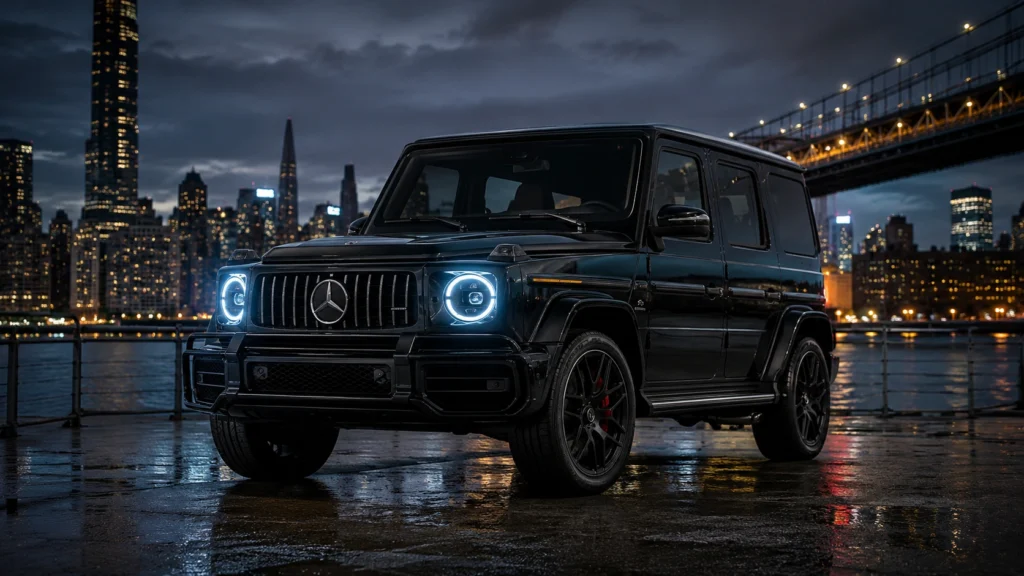
| Pros | Cons |
|---|---|
| Genuine off-road hardware (locking diffs, low range) | High starting price across the entire lineup |
| Instantly recognizable, decades-old design | Options and Manufaktur packages add up fast |
| High-quality, genuinely luxurious interior | Poor aerodynamics hurt efficiency and highway refinement |
| Strong straight-line performance, especially AMG G 63 | Fuel consumption is high on gasoline models |
| Excellent road presence and resale value history | Tight rear visibility, heavy side-hinged tailgate |
| G 580 offers unique instant-torque off-road tricks | G 580’s range and charging speed lag behind sleeker EVs |
Comparison With Competitors
The Mercedes-Benz G-Class doesn’t have a true one-to-one rival — most competitors are stronger in some areas and weaker in others, rather than direct equivalents.
| Factor | G-Class | Range Rover | Defender | Lexus LX | Escalade | Wrangler Rubicon |
|---|---|---|---|---|---|---|
| Luxury | Very high | Highest | High | High | Very high | Low |
| Off-Road Capability | Very high | Moderate | High | High | Low | Very high |
| Performance | High (esp. AMG) | Moderate-High | Moderate | Moderate | Moderate | Low-Moderate |
| Interior Space | Moderate | Very high | High | High | Very high | Low |
| Practicality | Moderate | High | High | High | Very high | Moderate |
| Starting Price | ~$155K+ | ~$113K+ | ~$65K+ (Octa: six figures) | ~$108K+ | ~$94K+ | ~$60K+ |
| Best Use Case | Status + real capability | Ultimate on-road luxury | Do-it-all family off-roader | Reliable luxury off-roader | Family/tech-focused cruiser | Dedicated off-roading |
The Range Rover is more spacious, more luxurious inside, and rides more smoothly on-road, but it doesn’t offer the same locking-differential, low-range hardware that makes the G-Class genuinely trail-capable in stock form.
The Land Rover Defender is the closest thing to a direct rival in spirit — boxy, off-road focused, and available in a six-figure Octa performance trim that squarely targets AMG G 63 buyers — but it starts far cheaper in base form and uses unibody rather than body-on-frame construction.
The Lexus LX trades some outright charisma for Toyota Land Cruiser-derived reliability and a notably lower price, making it worth cross-shopping for buyers who want genuine off-road ability without the G-Class’s price tag or fuel bills.
The Cadillac Escalade isn’t really a competitor for off-road buyers at all — it’s a full-size luxury cruiser with far more interior space and tech, aimed at buyers who want presence and passenger room over trail capability.
The Jeep Wrangler Rubicon is, dollar for dollar, arguably more off-road capable than any G-Class — but it comes nowhere close on interior luxury, refinement, or brand prestige, and buyers cross-shopping the two are usually looking for very different things.
Who Should Buy the Mercedes-Benz G-Class?
The Mercedes-Benz G-Class makes the most sense for buyers who genuinely want a combination that’s hard to find elsewhere: real off-road hardware wrapped in a luxury interior and backed by unmistakable design.
Buyers prioritizing status and design will get exactly what they’re paying for — few vehicles turn heads the way a G-Class does, and that recognition doesn’t fade with each new model year the way it does with more conventionally styled SUVs.
Off-road enthusiasts who actually plan to use the locking differentials and low range will find the G-Class genuinely capable, not just capable-looking, though a Defender or even a well-built Wrangler will get there for considerably less money.
Performance-minded buyers should look hard at the AMG G 63, which delivers genuine sports-sedan-adjacent acceleration in a body that has no business being this quick.
Buyers who want everyday practicality above everything else — maximum interior space, easy cargo access, lower running costs — are probably better served by a Range Rover, Escalade, or even a more conventional three-row Mercedes-Benz GLS. The G-Class’s narrower cabin and heavy side tailgate are real compromises, not minor quirks.
Environmentally conscious buyers curious about the G 580 should go in with realistic expectations about range and charging speed — it’s a fascinating engineering exercise, but it’s not the most efficient way to go electric.
Mercedes-Benz G-Class: Is It Worth It?
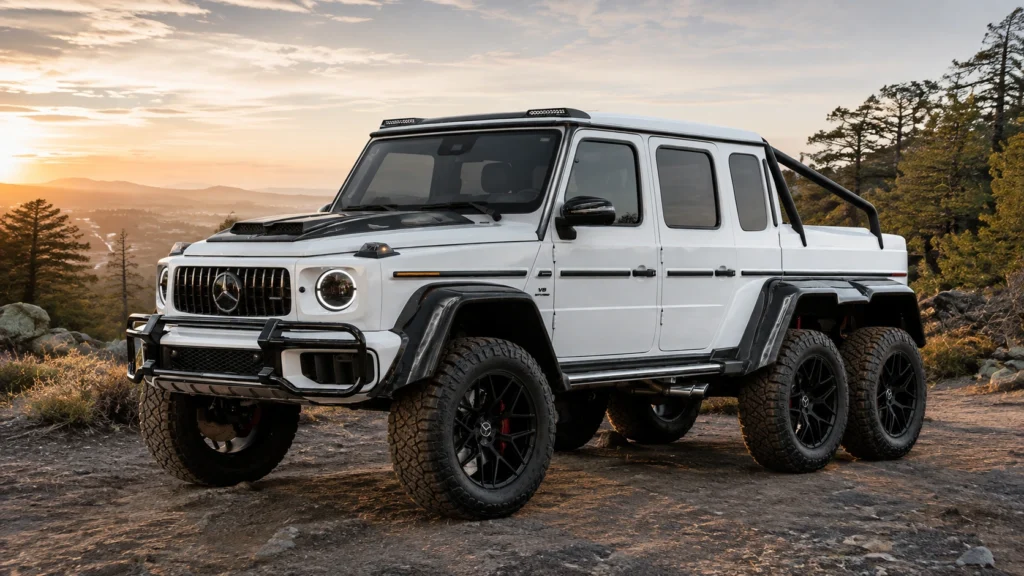
There’s no simple yes-or-no answer here, because the G-Class isn’t really competing on the same terms as most of its rivals.
Is it worth the money? For buyers who value the design, the badge, and genuine off-road hardware, yes — there’s very little else on sale that offers this specific combination. For buyers purely optimizing for interior space or cost per mile, no, there are better options.
Is it practical? Reasonably, but not exceptionally. Everyday usability is good, not class-leading, and buyers coming from larger three-row SUVs will notice the tighter cabin.
Is it genuinely capable off-road? Yes, more than the vast majority of luxury SUVs on sale, thanks to real locking differentials and low-range gearing rather than software-only traction management.
Is the G 63 worth upgrading to? For buyers who want the performance and the theater, absolutely — it transforms the character of the vehicle in a way few AMG upgrades manage. For buyers who mainly drive around town, the G 550 delivers most of the everyday experience for meaningfully less money.
Is the G 580 a compelling electric alternative? It’s a genuinely interesting engineering achievement and a capable off-roader, but its range and efficiency lag behind purpose-built EVs, so it suits buyers drawn to the concept more than buyers purely chasing electric practicality.
Conclusion
The Mercedes-Benz G-Class remains one of the few vehicles that can genuinely claim to be both a real off-roader and a luxury status symbol without either half of that equation feeling like an afterthought. Its biggest strengths — a design that has aged into an icon, honest-to-goodness locking differentials and low-range gearing, and an interior that matches its price tag — are backed by real engineering, not just styling.
Its weaknesses are just as real: poor aerodynamics, mediocre fuel economy, tighter interior space than the exterior suggests, and a price that climbs quickly once options enter the picture. The electric G 580 adds an intriguing new dimension without fully solving the efficiency problem the shape has always had.
Buyers who want the design, the capability, and the badge will find the Mercedes-Benz G-Class hard to replace with anything else. Buyers chasing outright interior space, efficiency, or value should look elsewhere in the segment. For the right buyer, though, the G-Class earns its price the same way it always has — by being unmistakably, unapologetically itself.
Frequently Asked Questions (FAQs)
Pricing starts around $153,900–$155,000 for the G 550, roughly $162,000–$165,000 for the G 580 with EQ Technology, and about $196,850 for the AMG G 63, before options. Manufaktur personalization and packages can push any model well past $200,000.
It depends on the model: the G 550 makes 443 hp, the AMG G 63 makes 577 hp, and the electric G 580 with EQ Technology produces a combined 579 hp from its four motors.
Yes. All gasoline models come with permanent 4MATIC all-wheel drive, three locking differentials, and low-range gearing, giving them genuine trail capability well beyond most luxury SUVs.
The AMG G 63 accelerates from 0-60 mph in roughly 4.4 seconds and reaches an electronically limited top speed of about 137 mph, figures that rival dedicated performance cars.
The G 550 uses a 443-hp mild-hybrid inline-six for a more relaxed, everyday character, while the AMG G 63 uses a 577-hp handbuilt V8 with sharper throttle response, unique suspension tuning, and a significantly higher price.
Yes. It replaces the combustion engine entirely with four electric motors and a 116-kWh usable battery, offering an EPA-estimated range of around 239 miles.
The gasoline-powered G 550 and AMG G 63 are rated to tow up to 7,000 pounds. The electric G 580 with EQ Technology is not currently rated for towing.
For buyers who want a genuine blend of luxury, status, and real off-road capability, yes. Buyers prioritizing interior space, efficiency, or lower running costs will likely find better value elsewhere.