Koenigsegg Jesko: The 1,600-HP Hypercar Chasing 330 MPH
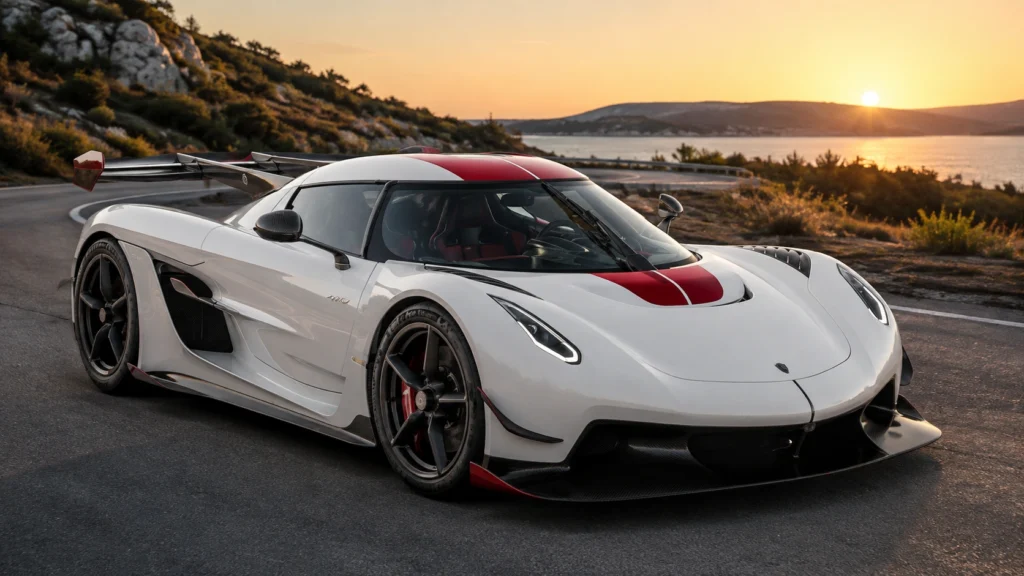
If you’ve spent any time in hypercar circles, you already know the name. The Koenigsegg Jesko isn’t just another eye-watering showpiece from a boutique Swedish workshop. It’s the car Christian von Koenigsegg built to answer a question he’d chased for two decades: how fast can a genuinely road-legal production car go?
The Jesko backs that ambition with a 5.0-liter twin-turbo V8 capable of 1,600 horsepower on E85 fuel, a nine-speed transmission unlike anything else on the road, and a carbon-fiber structure engineered down to the gram. It comes in two flavors: the track-honed Jesko Attack, built to carve corners, and the low-drag Jesko Absolut, built to chase a top speed few cars will ever threaten.
This guide covers what the Jesko actually is, what’s proven versus theoretical, and where it sits against Bugatti, Pagani, and Rimac in 2026.
Quick Specifications
| Specification | Koenigsegg Jesko |
|---|---|
| Engine | 5.0L (5,065cc) twin-turbo V8, flat-plane crank |
| Power | 1,280 hp (gasoline) / 1,600 hp (E85) |
| Torque | 1,000 Nm standard / 1,500 Nm max (E85) |
| Transmission | 9-speed Koenigsegg Light Speed Transmission (LST) |
| Drive | Rear-wheel drive |
| Weight | 1,420 kg curb (Attack) / 1,390 kg curb (Absolut) |
| 0–60 mph | Independently verified at 2.79 seconds |
| Top Speed | Claimed/simulated 330+ mph (531 km/h); unverified as of mid-2026 |
| Production | Limited to 125 units, fully allocated |
| Price | From approximately $3 million USD at launch |
Figures come from Koenigsegg’s official technical specifications and independently verified test data where noted. Unverified figures are labeled as claimed or estimated throughout.
What Is the Koenigsegg Jesko?
The Koenigsegg Jesko is a limited-production, mid-engine hypercar built by Koenigsegg Automotive AB in Ängelholm, Sweden. It succeeds the Agera as the company’s flagship and represents the most aerodynamically refined car Koenigsegg has ever sold.
Koenigsegg built it to push past the Agera RS, which held the two-way average top-speed record for a production car at 277.9 mph, set in 2017. Rather than tuning the same formula for more power, the company rebuilt the car around a new engine, a radically different transmission, and an aerodynamic package designed from scratch. The name honors Jesko von Koenigsegg, Christian’s father, who introduced him to motorsport as a child.
What separates the Jesko from a conventional supercar isn’t just the power figure — it’s how much is engineered in-house, from the transmission to the active aerodynamics, by a company with a few hundred employees rather than a legacy manufacturer’s global supply chain. That puts it in a tight cluster with the Bugatti Tourbillon, Pagani Utopia, and Rimac Nevera as one of the defining hypercars of this era. See the full official rundown, including current model availability, on Koenigsegg’s website.
History and Development
Koenigsegg unveiled the Jesko at the 2019 Geneva International Motor Show, and the entire production run reportedly sold out within days — demand that underscored how closely the market was watching the Agera’s replacement.
The development goal was simple to state and brutally hard to execute: build a car that could compete for the outright top-speed crown while also being one of the fastest cars around a racetrack, without forcing buyers to choose one identity. That’s why the Jesko split into two aerodynamic personalities rather than shipping as a single compromise.
Much of the Jesko’s DNA traces back to the Agera RS, particularly the twin-turbo V8 architecture, but nearly every component was reworked: a lighter flat-plane crankshaft, an entirely new in-house gearbox, and a carbon monocoque stretched and widened for cabin space without sacrificing rigidity.
Christian von Koenigsegg has stayed hands-on throughout, publicly documenting record attempts well into 2026. The Jesko’s significance is real: it’s the model that pushed Koenigsegg from a respected niche manufacturer into a genuine outright-speed rival to Bugatti.
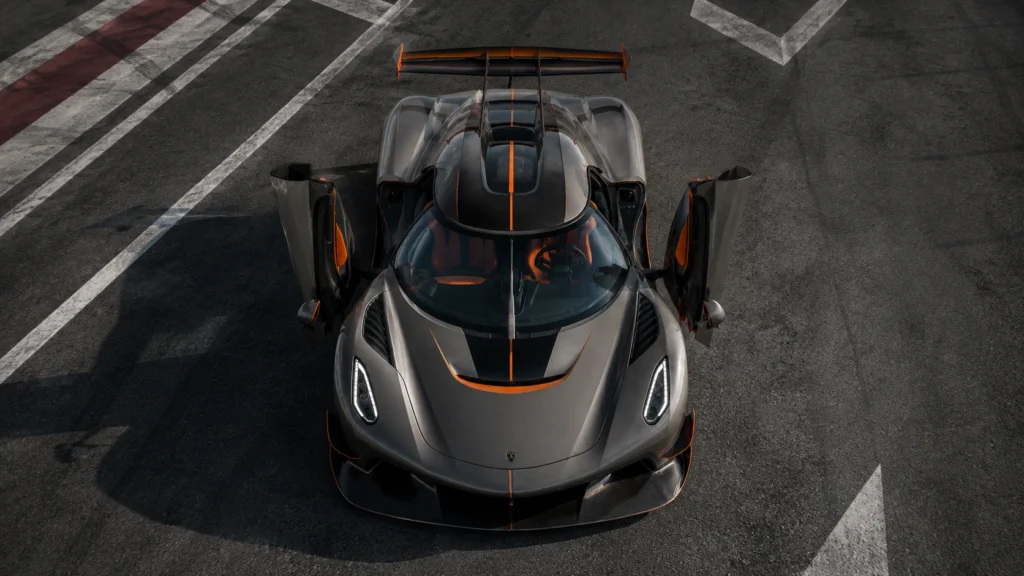
Jesko Attack vs Jesko Absolut
This is the single most important distinction to understand about the Jesko, since the two versions are built around opposite philosophies.
Jesko Attack is the high-downforce, track-focused version. It wears a large, active twin-profile rear wing, an enlarged front splitter with independent active aero flaps, and wheel-area diffusers that together generate up to 1,400 kg of downforce at maximum, per Koenigsegg’s official figures — translating directly into cornering grip. The Attack also uses Koenigsegg’s Triplex damper system front and rear, keeping ride height and aero balance consistent under hard acceleration and braking. This is the version built for lap times, not top-speed runs.
Jesko Absolut flips the formula entirely. Koenigsegg removed the large rear wing and reworked nearly every exterior surface to cut drag instead of adding grip, resulting in a drag coefficient of just 0.278 Cd and a frontal area of only 1.88 square meters. Its body is longer, with an extended tail designed purely to smooth airflow separation at extreme speed. Downforce drops from the Attack’s 1,400 kg to roughly 150 kg — a deliberate trade-off. Christian von Koenigsegg has said the Absolut is intended to be the fastest Koenigsegg the company will ever build.
| Feature | Jesko Attack | Jesko Absolut |
|---|---|---|
| Main Focus | Track performance | High-speed performance |
| Aerodynamics | High downforce | Low drag |
| Rear Wing | Large, active twin-profile wing | Removed for reduced drag |
| Downforce | Up to 1,400 kg | Approximately 150 kg |
| Drag Coefficient | Higher (not officially published) | 0.278 Cd |
| Intended Use | Circuit driving, lap times | Straight-line and record runs |
| Top-Speed Focus | Not the priority | Primary design goal |
Koenigsegg has not published an officially confirmed maximum top speed for either car. The Absolut’s headline figure — north of 330 mph — remains a simulation-based target rather than a verified result, a distinction covered further below.
Design and Exterior
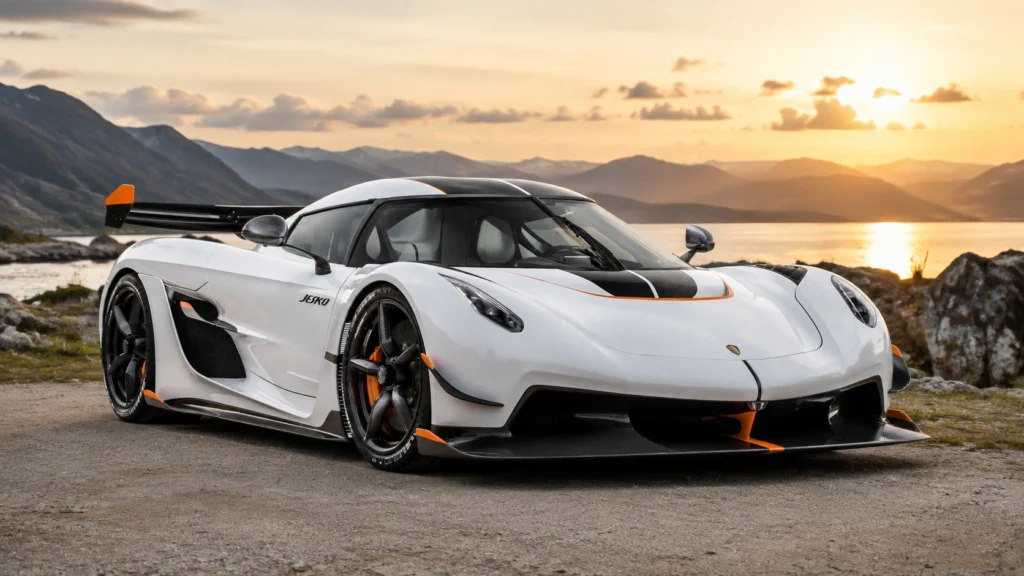
Every visible surface on the Koenigsegg Jesko exists to do a job. The carbon-fiber body is shaped almost entirely around airflow management, though form and function end up looking remarkably good together.
At the front, a low, wide nose feeds air into radiators and brake ducts while an active splitter balances downforce and drag. Large side intakes feed the engine and rear-mounted radiators, while the tail channels hot air out rather than trapping it, keeping the V8 cool under sustained high-speed loads.
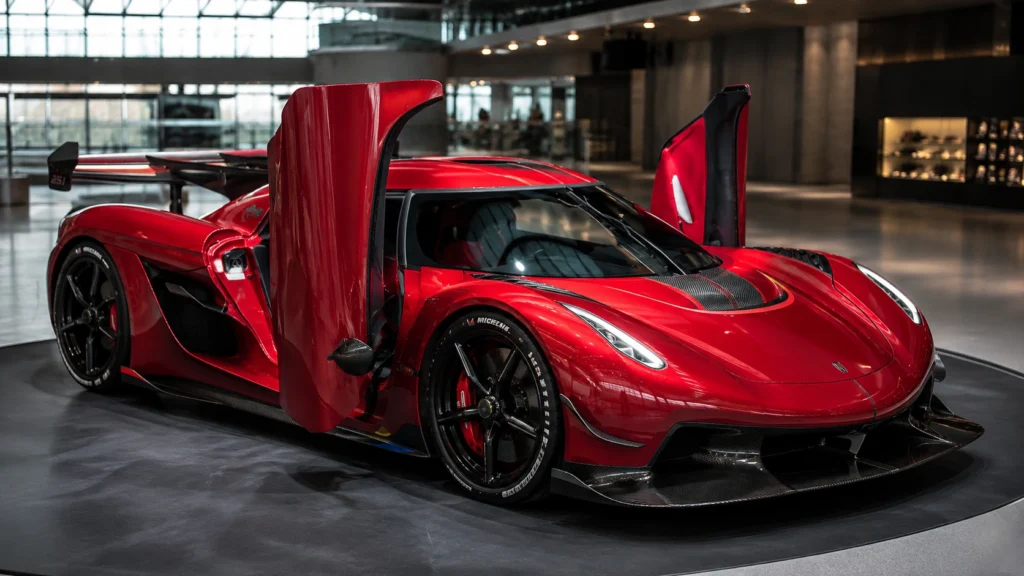
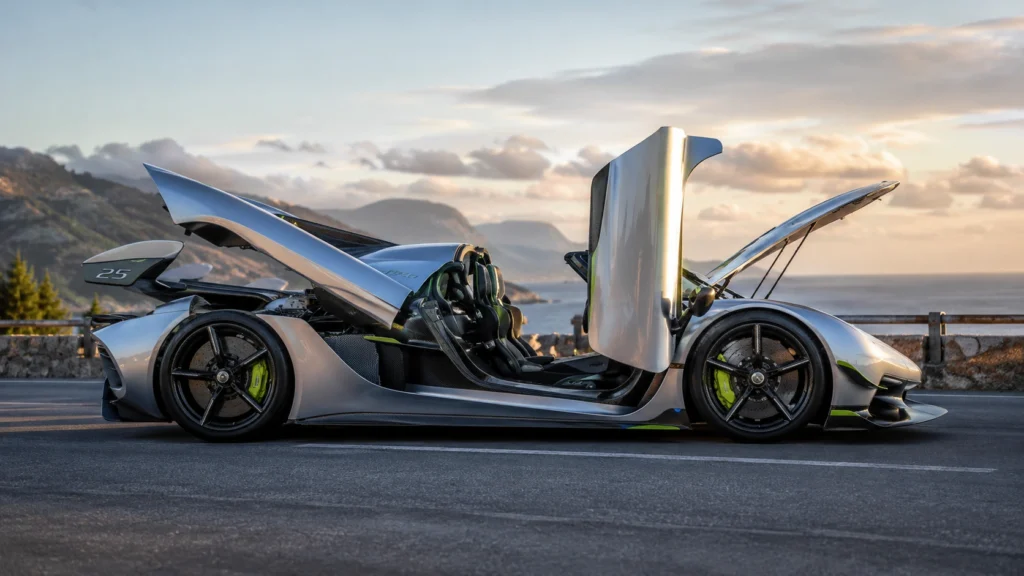
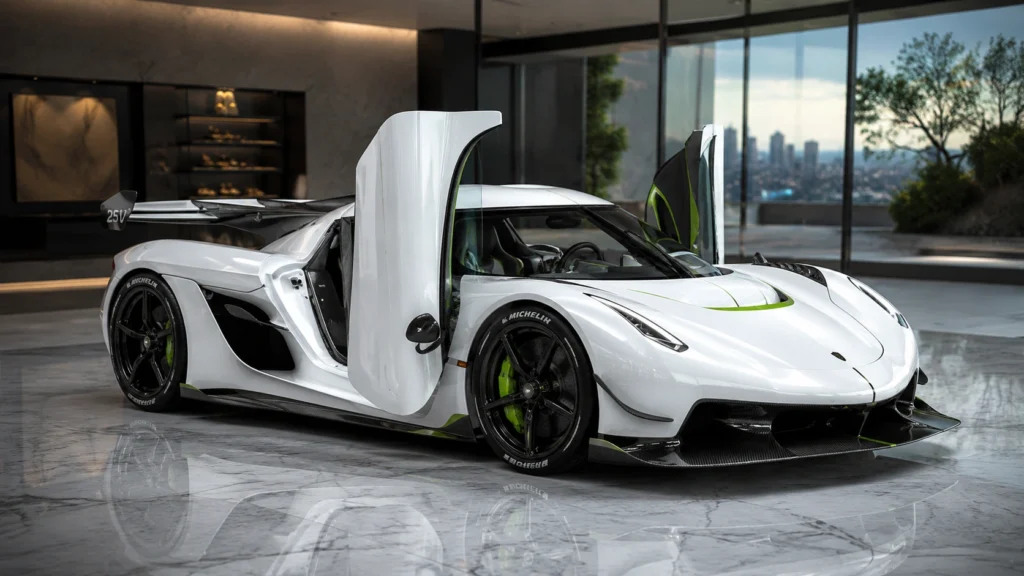
The signature dihedral synchro-helix doors are a Koenigsegg trademark, opening in a combined outward-and-upward motion that needs less clearance than a conventional dihedral door — genuinely useful in a tight garage, not just a party trick.
The Attack’s rear wing is a fully active component, adjusting its angle in real time based on speed, braking, and cornering load. From the hood air dam to the side skirt winglets, nearly every element contributes to downforce, drag reduction, or cooling — little here is purely decorative.
Aerodynamics
Aerodynamics sit at the center of what makes the Koenigsegg Jesko unusual, so the basics are worth defining. Downforce is the aerodynamic force pushing a car down onto the road as it moves, increasing grip and cornering ability. Drag is the resistance air creates pushing back against the car — more drag means more effort needed to gain or hold speed. Downforce helps a car turn faster; low drag helps it go faster in a straight line, and the two fight each other, which is why Koenigsegg built two packages instead of one compromise.
On the Attack, active aero does the heavy lifting: the rear wing and front flaps adjust automatically, generating a stated 700 kg of downforce at 250 km/h, 1,000 kg at 290 km/h, and a claimed 1,400 kg maximum, while cooling airflow is managed separately so radiators and brakes stay fed under peak load.
The Absolut strips this down almost entirely. Removing the wing and smoothing the tail drops both downforce and drag dramatically — the product of thousands of hours in computational fluid dynamics (CFD) simulation, the same technique used in Formula 1.
Interior and Technology
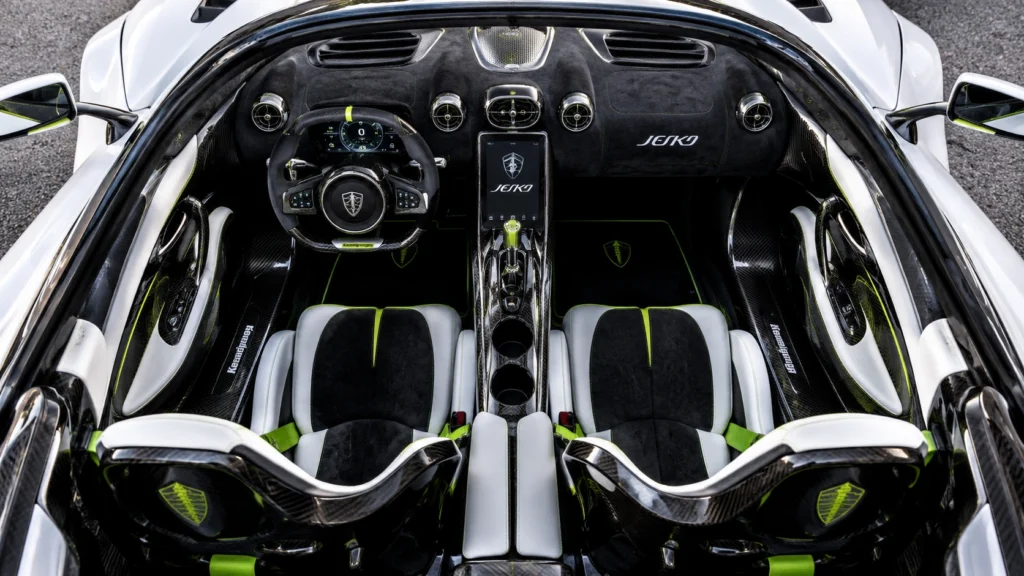
Despite everything happening outside the cabin, the Koenigsegg Jesko interior is built to be genuinely usable rather than a stripped-out shell bolted to a rocket.
The cockpit centers on a steering-wheel-mounted “SmartCluster” — a compact 5-inch display that rotates with the wheel so the driver’s view of speed and revs never tilts mid-corner. A separate 9-inch “SmartCenter” touchscreen handles infotainment and climate control, with Apple CarPlay and over-the-air updates via Koenigsegg’s cloud system. A hand-built analog G-force meter sits on the dashboard in a chronograph-style bezel, a nod to Christian von Koenigsegg’s interest in fine watchmaking.
The carbon-fiber bucket seats are fixed but shaped for support, with the pedal box and steering column moving to fit the driver instead. Materials run from leather to Alcantara with custom stitching, and buyers can specify exposed carbon weave, tinted finishes, or gold detailing. Safety kit includes smart airbags, parking sensors, a reversing camera, and bird’s-eye-view parking assistance — genuinely helpful given how low and wide the car sits.
Engine and Powertrain
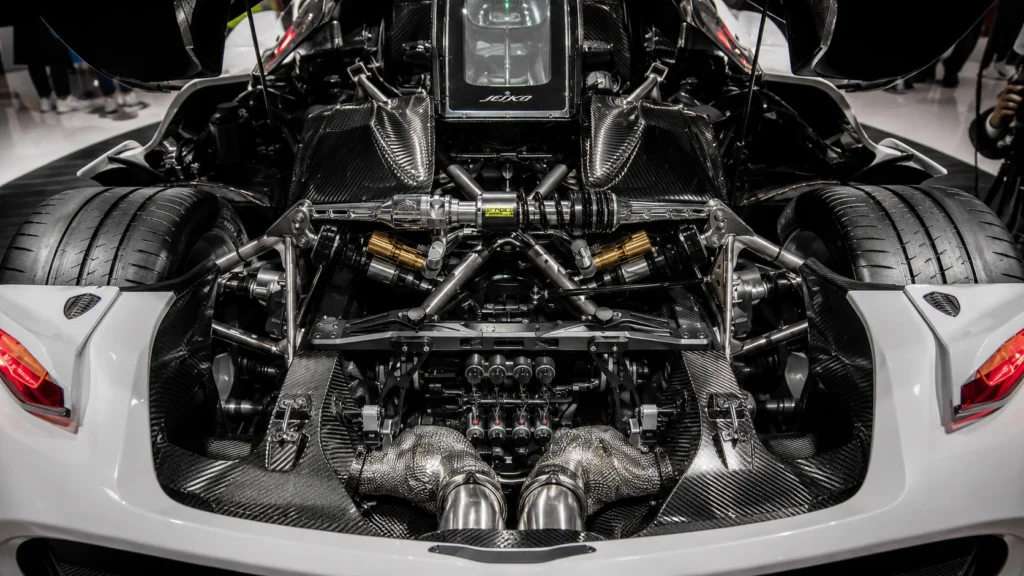
The heart of the Koenigsegg Jesko is a 5.0-liter (5,065cc) twin-turbocharged V8, built in-house with an aluminum block, four valves per cylinder, double overhead camshafts, and dry-sump lubrication — derived from the Agera’s engine but substantially reworked.
The biggest change is the crankshaft: a flat-plane, 180-degree design machined from a single steel billet and weighing just 12.5 kg, which Koenigsegg calls the lightest V8 crankshaft in the world. It allows a higher rev ceiling and sharper throttle response, pushing the redline to 8,500 rpm.
Twin ceramic ball-bearing turbochargers run up to 1.7 bar of boost on standard gasoline, rising to 2.2 bar on E85. On 95-octane pump gas, the engine makes 1,280 hp at 7,800 rpm and 1,000 Nm of torque. On E85, output climbs to 1,600 hp, with peak torque of 1,500 Nm at 5,100 rpm.
A genuinely novel piece of tech is the in-cylinder pressure sensor system — a claimed production-car first, monitoring each cylinder’s combustion in real time so the engine can run closer to its limits safely. This is a different tune from the same architecture used in Koenigsegg’s CC850 and Chimera, which run smaller turbochargers and lower outputs.
Light Speed Transmission (LST)
Koenigsegg’s Light Speed Transmission, or LST, may be the single most unusual piece of engineering on the car — arguably more central to the Jesko’s identity than the horsepower figure.
A conventional dual-clutch gearbox changes gears sequentially, using two clutches to pre-select the next gear up or down the line. The LST discards that model, using seven multi-disc clutches working together so the transmission can jump directly to any gear — first to seventh, ninth to fourth — without passing through the ones in between.
That matters practically: during hard braking into a corner, most transmissions step down through several gears in sequence, while the LST selects the ideal gear directly, keeping the engine in its power band exactly when needed. Koenigsegg calls the controlling software “Ultimate Power on Demand” (UPOD), calculating the optimal gear from road speed, engine speed, and driver input.
Despite doing more mechanically than a conventional gearbox, the nine-speed LST weighs around 90 kg and is roughly half the length of the unit it replaces — lighter than many rival dual-clutch transmissions, thanks to a compact architecture that drops the traditional layshaft design.
Performance and Driving Dynamics
Horsepower gets the headlines, but it’s only one piece of what makes the Koenigsegg Jesko fast. Power-to-weight ratio, chassis stiffness, tire technology, and braking all matter just as much once a car passes 1,000 horsepower. At a curb weight around 1,390–1,420 kg, that ratio is extraordinary, but raw power only helps if the chassis and tires can put it down — which is where the monocoque’s 65,000 Nm/degree torsional rigidity and double-wishbone suspension come in.
Braking uses carbon-ceramic discs — 410mm front with six-piston calipers, 395mm rear with four-piston calipers — paired with active rear-wheel steering that turns the rear wheels with the fronts at higher speeds for stability, and opposite them at low speeds to tighten the turning circle. Track performance benefits most from the Attack’s downforce, while high-speed stability is the Absolut’s specialty — neither car tries to do both jobs at once.
Full Specifications
| Specification | Koenigsegg Jesko |
|---|---|
| Engine | 5.0L twin-turbo V8, flat-plane crank |
| Displacement | 5,065 cc |
| Induction | Twin turbochargers, 1.7–2.2 bar boost |
| Cylinders | 8 (V8) |
| Power | 1,280 hp (gasoline) / 1,600 hp (E85) |
| Torque | 1,000 Nm / 1,500 Nm max (E85) |
| Transmission | 9-speed Koenigsegg LST |
| Drive | Rear-wheel drive |
| Curb Weight | 1,420 kg (Attack) / 1,390 kg (Absolut) |
| Wheelbase | 2,700 mm |
| Length | 4,626 mm (Attack) / 4,845 mm (Absolut) |
| Width | 2,030 mm |
| Height | 1,210 mm |
| Fuel Capacity | 72 liters |
Top Speed and Acceleration
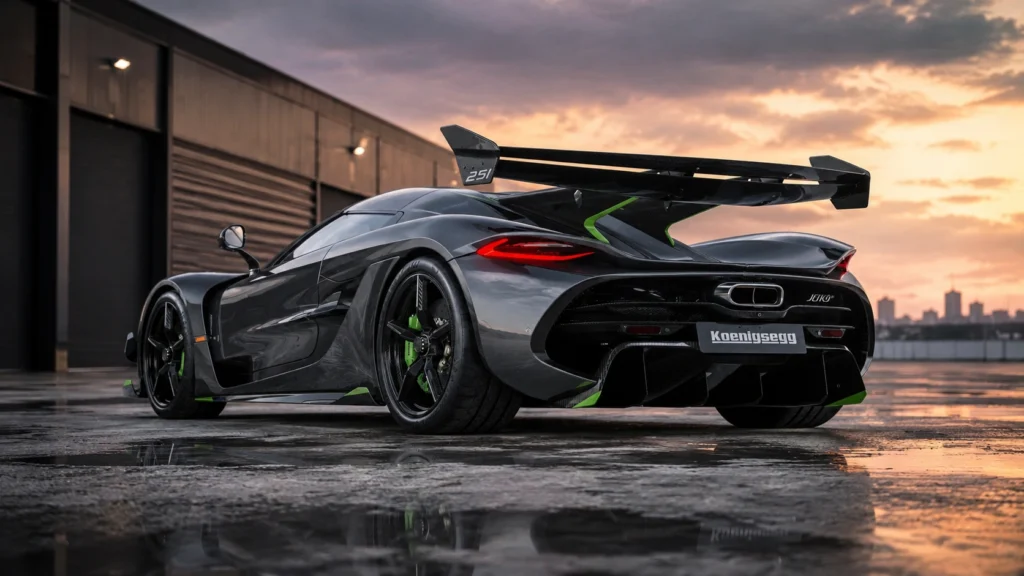
This is where clarity matters most, because the Jesko’s speed claims and its verified results are two different things.
Independently verified: In June 2026, factory test driver Markus Lundh piloted a Jesko Absolut to new production-car records over the quarter-mile and half-mile at Koenigsegg’s home airfield in Sweden, verified by Racelogic using VBOX equipment. The Absolut covered the quarter-mile in 8.54 seconds at 305 km/h (190 mph) — the first production car ever recorded exceeding 300 km/h in the quarter-mile — and the half-mile in 12.76 seconds at 373 km/h (232 mph), on an unprepped surface, production tires, rear-wheel drive only. A verified 0–62 mph time of 2.79 seconds was recorded during earlier runs, and the Absolut holds the 0–400–0 km/h world record at 25.21 seconds as of 2025, touching a verified 412.72 km/h (256.45 mph) mid-run.
Claimed but unverified: Based on the Absolut’s 0.278 Cd drag figure and gearing, Koenigsegg’s simulations suggest a theoretical top speed north of 500 km/h (310 mph), with Christian von Koenigsegg publicly targeting 330+ mph (531 km/h). As of mid-2026, this hasn’t been validated, largely because Koenigsegg has struggled to find a road long, straight, and safe enough to attempt it. Reaching that speed needs more than power: a long enough runway, tires rated for the loads, and precise gearing.
Until that run happens and is independently timed, treat the 330-mph figure as an engineering target, not a confirmed result.
Weight, Chassis and Suspension
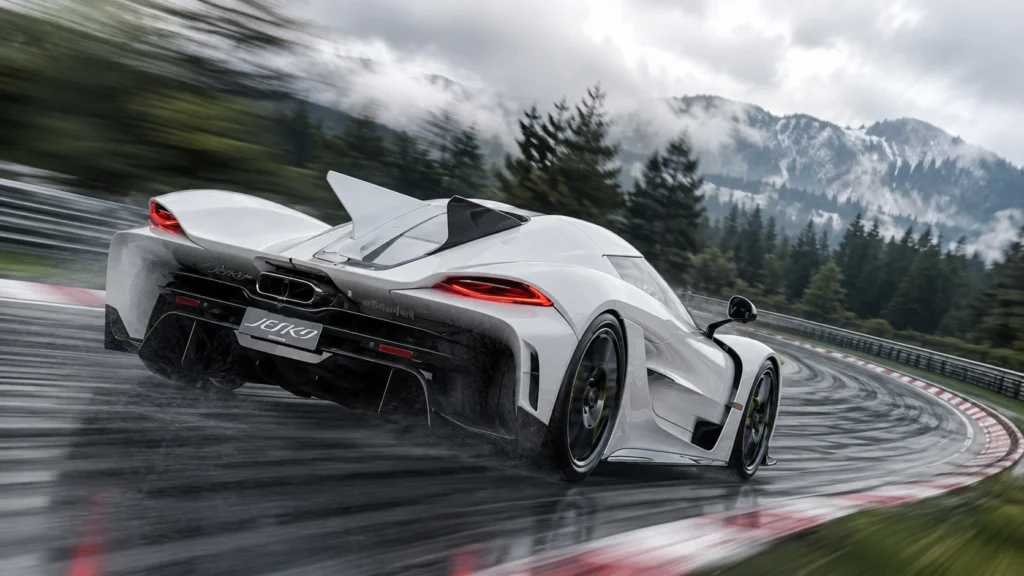
Koenigsegg’s approach to weight is less about stripping the car bare and more about building every component with the minimum material necessary, without compromising strength.
The foundation is a carbon-fiber monocoque reinforced with aluminum honeycomb and integrated fuel tanks, delivering 65,000 Nm/degree of torsional rigidity — stiff enough to let the suspension and aerodynamics work predictably at extreme speed. Suspension is double-wishbone at all four corners, with carbon-fiber rear upper wishbones and electronically adjustable, pushrod-operated dampers that let ride height and stiffness change on the fly. The Attack adds Koenigsegg’s Triplex damper system front and rear, resisting squat under acceleration and dive under braking.
Low mass matters beyond straight-line speed: a lighter car accelerates harder, stops shorter, and changes direction faster for the same grip — which is why Koenigsegg puts as much effort into shaving kilograms as chasing horsepower.
Koenigsegg Jesko Price
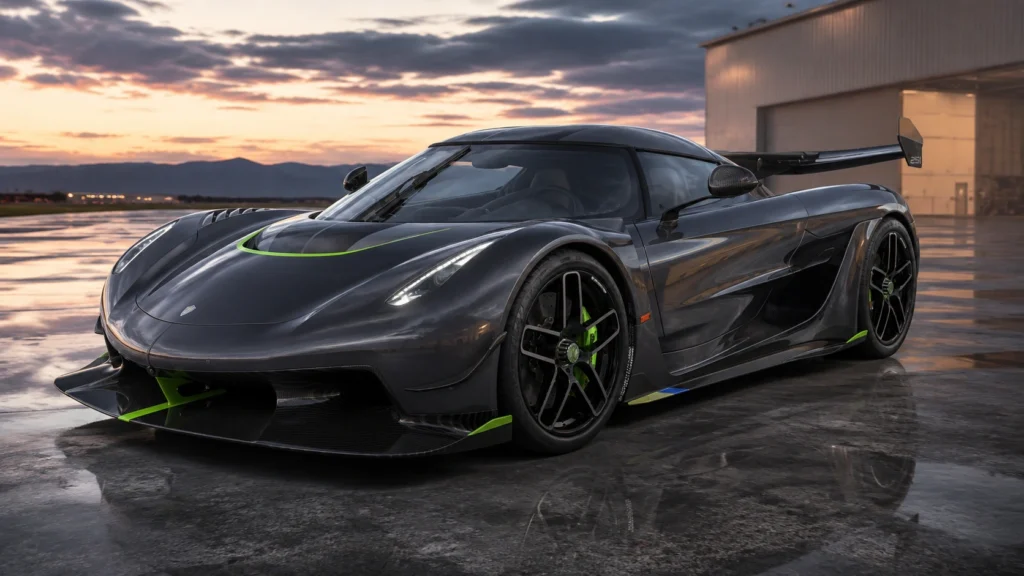
At launch in 2019, Koenigsegg set the Jesko’s starting price at roughly $3 million USD before options. That figure climbed for later build slots and heavily customized cars — some reports from 2021 onward put fully optioned examples closer to $4 million, with resale build slots reportedly changing hands for more.
The price reflects the build process: every Koenigsegg Jesko is made almost entirely from carbon fiber using labor-intensive methods, and the engine, transmission, and electronics are developed in-house by a company producing only a handful of cars a year. Extensive bespoke customization — exposed carbon weaves, gold detailing, unique paint and interior combinations — pushes many cars above the base figure.
The $3 million figure was Koenigsegg’s announced starting MSRP at the 2019 debut; prices well above that reflect optioned builds or resale transactions, not a revised factory price, and Koenigsegg hasn’t published an updated MSRP since the model is fully allocated. Given the exclusivity, the Koenigsegg Jesko has also become a genuine collector asset, much as earlier limited-run Koenigseggs like the Agera RS have at auction.
Production and Availability
Koenigsegg confirmed all 125 build slots sold within days of the March 2019 Geneva reveal, with roughly two-thirds reportedly reserved before the car was even shown publicly. Production has run at a deliberately slow pace of 40 to 50 cars a year, reflecting the hand-built work in each example.
Customer deliveries began later than planned — Koenigsegg initially targeted early 2022, but the first confirmed delivery landed in June 2023, not unusual for a low-volume manufacturer navigating homologation across multiple countries. Buyers who secured an allocation chose between Attack and Absolut, plus an extensive menu of finishes and materials.
As of 2026, the Koenigsegg Jesko is fully sold out, and Koenigsegg’s broader lineup — including the Gemera, CC850, and Chimera — has also reported being completely allocated. The realistic paths to ownership today are the resale market or a dealer-held allocation, both typically carrying a premium over the original price.
Pros and Cons
Pros
- Extreme, genuinely class-leading performance figures
- Almost entirely in-house engineering, from the engine to the transmission
- Exceptional power-to-weight ratio from extensive carbon-fiber construction
- Two distinct, purpose-built aerodynamic packages rather than one compromise
- The unique nine-speed Light Speed Transmission, unmatched by any rival
- Genuine exclusivity, with only 125 units ever built
- Deep, bespoke customization for every buyer
Cons
- Extraordinarily high purchase price, even by hypercar standards
- Production is completely sold out, with no new allocations available
- Specialized maintenance requirements and a very limited service network
- Minimal storage, a firm ride, and low ground clearance
- Difficult to source, whether buying new or on the resale market
- Ownership costs extend well beyond the purchase price
Koenigsegg Jesko vs Competitors
The Jesko doesn’t have many true rivals — the list of cars built to genuinely compete on outright speed and hypercar engineering is short.
| Model | Power | 0–60 mph | Top Speed | Approx. Price | Main Strength |
|---|---|---|---|---|---|
| Koenigsegg Jesko Absolut | 1,600 hp (E85) | 2.79 sec (verified) | 330+ mph claimed; unverified | ~$3M+ | Straight-line speed ambition |
| Bugatti Chiron Super Sport 300+ | 1,578 hp | ~2.4 sec | 304.77 mph (verified, 2019) | ~$3.9M | Verified two-way top-speed record |
| Bugatti Tourbillon | 1,800 hp (hybrid V16) | Sub-2 sec (claimed) | 276 mph (claimed) | ~$4.1M | Mechanical theater, hybrid V16 |
| Pagani Utopia | 852 hp | ~3 sec | 224 mph (claimed) | ~$2.5M | Analog-feel craftsmanship |
| Rimac Nevera | 1,914 hp (electric) | Under 2 sec | 258 mph (verified) | ~$2.4M | Fastest-accelerating production car |
| Hennessey Venom F5 | Up to 2,031 hp (Evolution) | Under 2 sec (claimed) | 330+ mph claimed | ~$2.1M | Rival top-speed ambitions |
The Bugatti Chiron Super Sport 300+ remains the only car here with an independently verified two-way top-speed record, set at 304.77 mph in 2019. The Jesko Absolut’s claimed figures would beat that outright, but until Koenigsegg completes a verified run, the Chiron’s record is the benchmark others chase.
Against the Rimac Nevera, it’s combustion versus electric — instant torque gives the Nevera an edge in outright 0–60 acceleration, but the Jesko’s quarter- and half-mile records show a properly engineered combustion hypercar can still beat the fastest EVs on some metrics. The Pagani Utopia prioritizes analog feel and craftsmanship over outright numbers, while the Hennessey Venom F5 shares the Jesko’s straight-line ambitions from a much smaller operation. No single car here is objectively “the best” — each optimizes for a different definition of what a hypercar should be.
Is the Koenigsegg Jesko Practical?
Realistically, no — and Koenigsegg has never pretended otherwise. The Koenigsegg Jesko is road legal in most major markets and more usable day-to-day than you might expect from a car chasing 300-plus mph, but “usable” is relative.
Ground clearance is low enough that speed bumps and driveways require caution, even with the optional front-axle lift engaged, and visibility over the shoulder is limited — where the standard reversing camera and parking sensors earn their keep. Ride comfort is firmer than a GT car but more forgiving than a stripped-out track special, thanks to the adjustable dampers.
Cabin usability beats most hypercars — climate control, Apple CarPlay, adjustable pedals and steering all help — but luggage space is minimal at 50 liters front and rear, and maintenance requires specialized technicians, narrowing the service network compared to a mainstream exotic. Worth noting: Koenigsegg issued a do-not-drive advisory for Jesko owners in 2024 after one car caught fire during a road rally in Greece, later traced to a hydraulic leak — a reminder that even meticulously engineered hypercars carry real-world risk.
Who Should Buy a Koenigsegg Jesko?
The Koenigsegg Jesko suits a specific buyer: serious hypercar collectors who’ve already owned cars from Bugatti, Pagani, or previous Koenigseggs, and who value engineering originality as much as exclusivity. It also appeals to performance enthusiasts who genuinely intend to track the car in Attack form, and technology-focused buyers drawn to the in-house transmission and active aero as much as the horsepower. High-net-worth collectors interested purely in rarity will find appeal too — 125 units worldwide is exceptionally tight.
Buyers who want a hypercar for comfortable touring, daily practicality, or an established service network should look elsewhere — a Bugatti, with its larger dealer footprint, suits that better. The Jesko rewards buyers who understand what they’re getting: a purpose-built speed machine first, and a road car second.
Conclusion
The Koenigsegg Jesko is one of the clearest examples of what a small, obsessively engineering-focused manufacturer can achieve when it refuses to compromise. Between the in-house Light Speed Transmission, the flat-plane V8 pushing up to 1,600 horsepower, and two genuinely different aerodynamic identities in the Attack and Absolut, it’s built around a very specific set of goals rather than a broad attempt to please everyone.
Just as notable is Koenigsegg’s continued willingness to chase verified records years after the car’s debut — the June 2026 quarter-mile and half-mile results prove the Jesko is still evolving, even as the outright top-speed target remains unclaimed. That honesty about what’s proven versus theoretical is rare in an industry that loves a big number.
Whether or not the Jesko Absolut ever completes its 330-mph run, it has already secured a place among the defining hypercars of this generation — a car that turned a small Swedish workshop into a legitimate rival to Bugatti, one meticulously engineered example at a time.
Frequently Asked Questions (FAQs)
The starting price was announced at approximately $3 million USD at its 2019 launch. Fully optioned and customized examples have run well beyond that.
Verified results include a quarter-mile of 8.54 seconds at 190 mph and a half-mile of 12.76 seconds at 232 mph, set by the Absolut in June 2026. The claimed 330+ mph top speed hasn’t yet been verified.
It produces 1,280 hp on standard gasoline and 1,600 hp on E85 biofuel.
A 5.0-liter, twin-turbocharged V8 with a flat-plane crankshaft, built in-house and derived from the Agera’s engine.
The Attack is a high-downforce version built for track performance, with a large active rear wing generating up to 1,400 kg of downforce. The Absolut is a low-drag version built for straight-line speed, with a 0.278 Cd drag coefficient.
Yes, it’s homologated for road use in most major markets, with minor local adjustments possible in certain regions.
Production is limited to 125 units, and all build slots have been sold.
The Bugatti Chiron Super Sport 300+ still holds the verified two-way top-speed record at 304.77 mph, set in 2019. The Jesko’s claimed top speed would exceed that, but it hasn’t been validated yet.