Koenigsegg: Inside the Swedish Hypercar Maker Redefining Performance
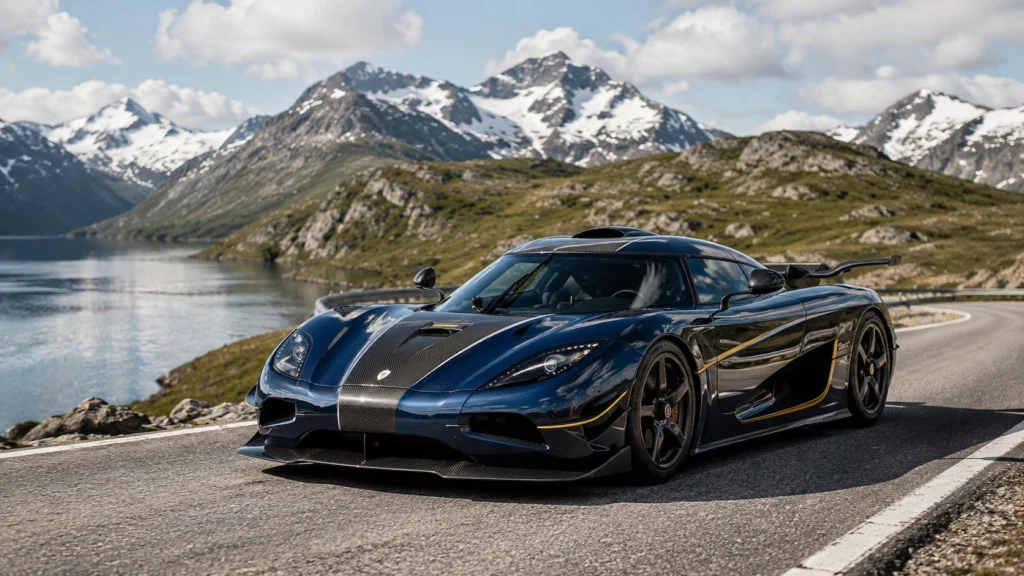
If there’s one name that makes even seasoned car enthusiasts pause mid-sentence, it’s Koenigsegg. What started as one young Swede’s stubborn dream in a small workshop has grown into one of the most technically audacious car companies on the planet. Koenigsegg doesn’t just build fast cars — it builds its own engines, its own transmissions, and even its own valve-control software, almost entirely in-house. That level of vertical integration is rare even among established supercar brands, let alone a company that began with a single prototype and no formal backing from the automotive establishment.
This guide covers everything that makes Koenigsegg tick: its origin story, engineering philosophy, the models that built its reputation, and what it actually costs to own one. Whether you’re a lifelong hypercar obsessive or just curious why a small Swedish factory keeps showing up in speed-record headlines, you’ll find a clear picture here of what Koenigsegg is — and isn’t.
Quick Specifications
Figures below vary by source, configuration, and fuel type. Where a number is a manufacturer claim rather than an independently verified result, it’s labeled accordingly.
| Model | Power | 0–60 mph | Top Speed | Starting Price |
|---|---|---|---|---|
| Jesko Absolut | 1,280 hp (gasoline) / 1,600 hp (E85, claimed) | Independently unverified; sub-3 sec estimated | Theoretical target near 330 mph (unverified) | Reported around $3 million+ |
| Jesko Attack | 1,280 hp / 1,600 hp (E85, claimed) | Independently unverified; sub-3 sec estimated | High-downforce setup, lower top speed than Absolut | Reported around $3 million+ |
| Gemera | 2,300 hp combined (claimed, production HV8 spec) | Under 2 sec (manufacturer claim) | Not officially published | Reported around $1.7–1.9 million (unconfirmed) |
| CC850 | Approx. 1,385 hp on E85 (claimed) | Not officially published | Not officially published | Reported around $3 million+ |
| Regera (2016–2022, discontinued) | Approx. 1,500 hp combined | Under 2.8 sec (claimed) | 255 mph, electronically limited (claimed) | Roughly $1.9–2 million when new (reported) |
| Agera RS (2015–2018, discontinued) | 1,160–1,360 hp depending on fuel | Not widely published | 277.87 mph — verified two-way average, 2017 | Roughly $2.5 million+ when new (reported) |
What Is Koenigsegg?
Koenigsegg Automotive AB is a Swedish manufacturer of ultra-limited, ultra-high-performance cars, based in Ängelholm in the Skåne region of southern Sweden. It isn’t a mainstream luxury automaker chasing volume; it’s a specialist engineering house that builds a handful of complete cars each year.
What separates Koenigsegg from most of the supercar world is how much it makes itself. Many performance brands source engines, transmissions, or electronics from larger parent companies. Koenigsegg instead develops its own V8 engines, its own multi-clutch transmissions, and even its own valve-actuation software through an in-house subsidiary — vertical integration that’s a defining trait of the brand.
Within the hypercar segment — the tier above traditional supercars, typically defined by seven-figure prices, extreme power-to-weight ratios, and production runs measured in dozens rather than thousands — Koenigsegg sits alongside brands like Bugatti, Pagani, and Rimac. It’s smaller than all of them by headcount, yet it has repeatedly punched above its weight in performance, technology, and world records.
History and Background
Koenigsegg’s story starts with Christian von Koenigsegg, who founded the company in 1994 at age 22. He had no formal engineering training and no backing from an existing car manufacturer — just a sketch, modest early funding, and a stubborn belief he could build “the perfect car.” Part of the inspiration reportedly traced back to a Norwegian animated film about building a race car that he’d watched as a child.
Development was slow and largely self-funded early on. It took roughly eight years to get a homologated, crash-tested production car on the road. That car, the CC8S, entered limited series production in 2002 and was notable enough that Guinness World Records recognized it as the most powerful production car of its time.
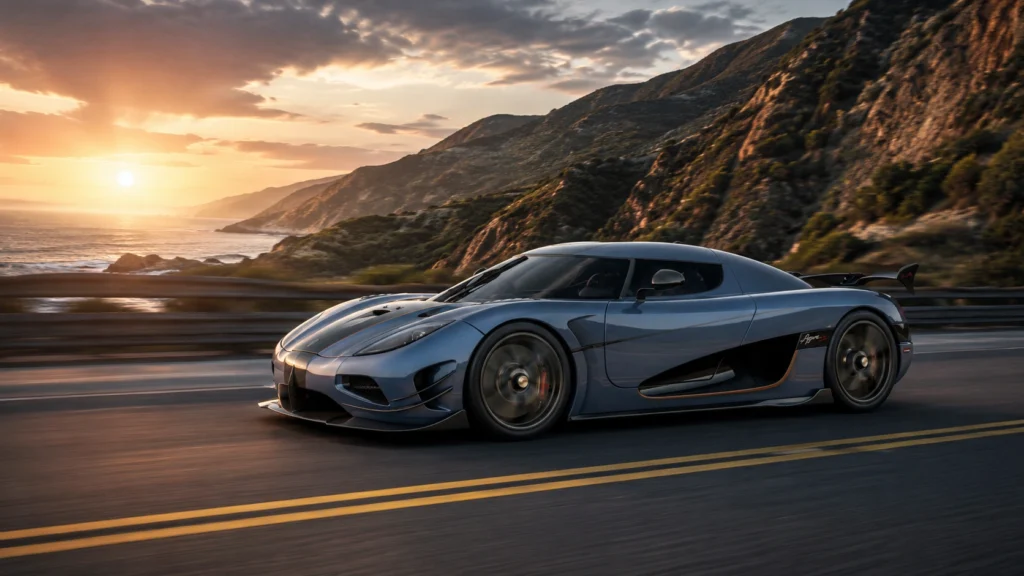
From there, Koenigsegg built its reputation model by model. The CCR and later the CCX pushed performance further and helped establish the brand internationally. The Agera line, introduced around 2010, became the company’s longest-running nameplate and eventually produced the Agera RS — the car that put Koenigsegg squarely in the global conversation about the world’s fastest production cars.
Today, Koenigsegg operates from a former Swedish Air Force base near Ängelholm, home to a squadron nicknamed the “Ghost Squadron” — the origin of the ghost emblem on Koenigsegg’s badge. The company has grown from a handful of employees to several hundred, and its founder still personally oversees engineering and design for every new model.
Koenigsegg’s Engineering Philosophy
Koenigsegg’s approach differs from most of the supercar establishment in a few specific ways. The clearest is lightweight construction: nearly every structural and body panel across the lineup uses carbon fiber, often paired with exotic reinforcement materials, to keep weight down without sacrificing rigidity.
Power-to-weight ratio is treated as more important than raw horsepower alone. A Koenigsegg with “only” 1,300 horsepower can still out-accelerate rivals with more power simply because the car weighs hundreds of kilograms less.
Aerodynamics is another pillar. Koenigsegg designs around airflow first, using active elements — movable wings, flaps, and underbody devices — that adjust automatically based on speed and driving mode, rather than relying on fixed bodywork.
Drivetrain innovation is arguably where Koenigsegg differs most from rivals. Instead of adapting existing gearbox designs, it has developed its own multi-clutch transmission technology, used across several models in different forms, and, in the Regera, dispensed with a multi-speed gearbox entirely in favor of a single-speed hybrid system. Each choice reflects the same goal: solve the engineering problem from first principles rather than copying convention.
Design and Exterior
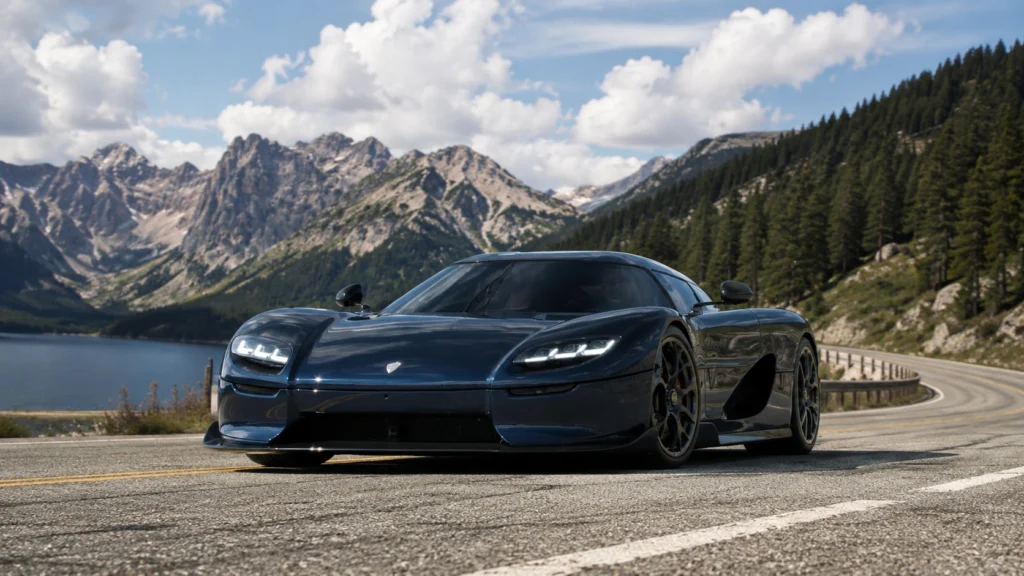
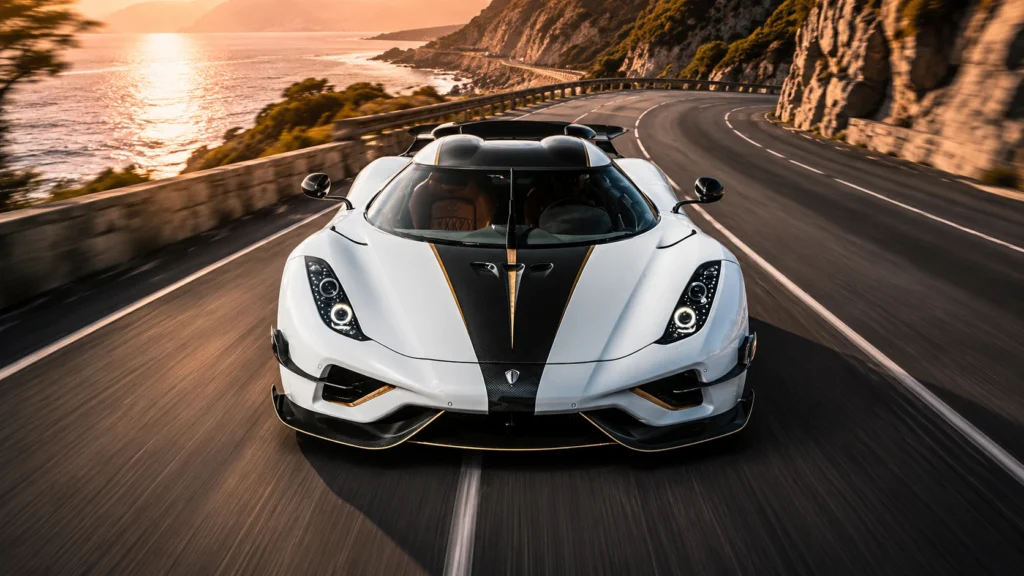
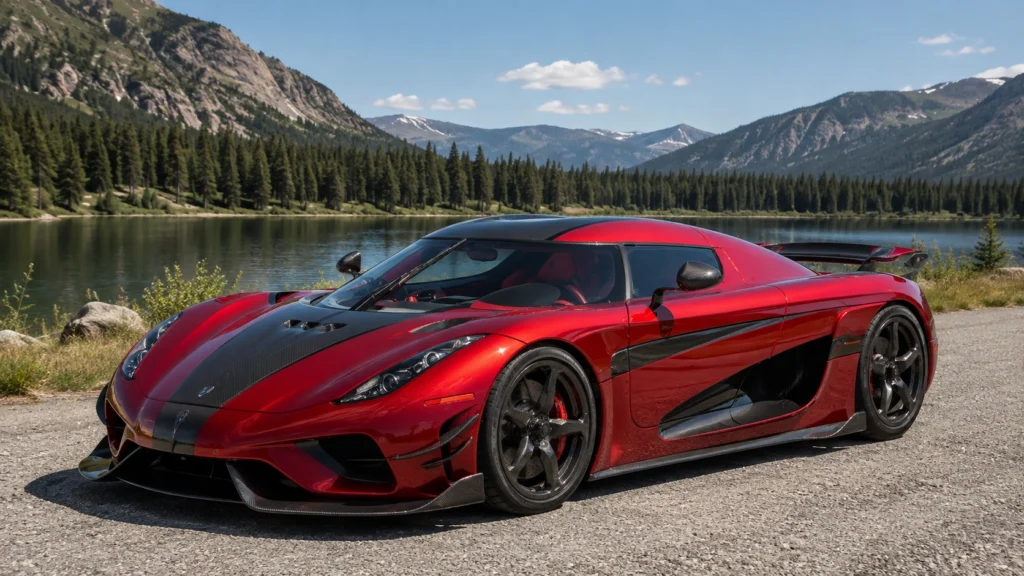
Every Koenigsegg is instantly recognizable by its dihedral synchro-helix doors — an opening mechanism that combines an upward swing with a slight rotation, letting the doors clear the body in tight parking spaces where a conventional dihedral door might not. It’s a Koenigsegg signature dating back to early models and still used today.
Bodywork is built almost entirely from carbon fiber, shaped as much by aerodynamic requirement as styling preference. Cooling is a constant challenge in cars producing well over 1,000 horsepower, so intakes and ducting are worked into the exterior as visual character lines rather than hidden away.
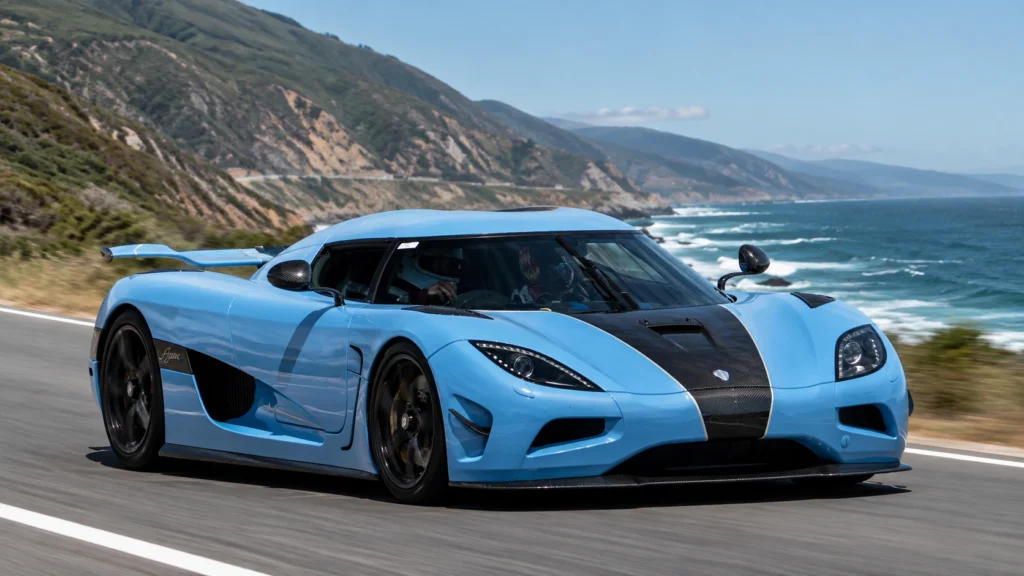
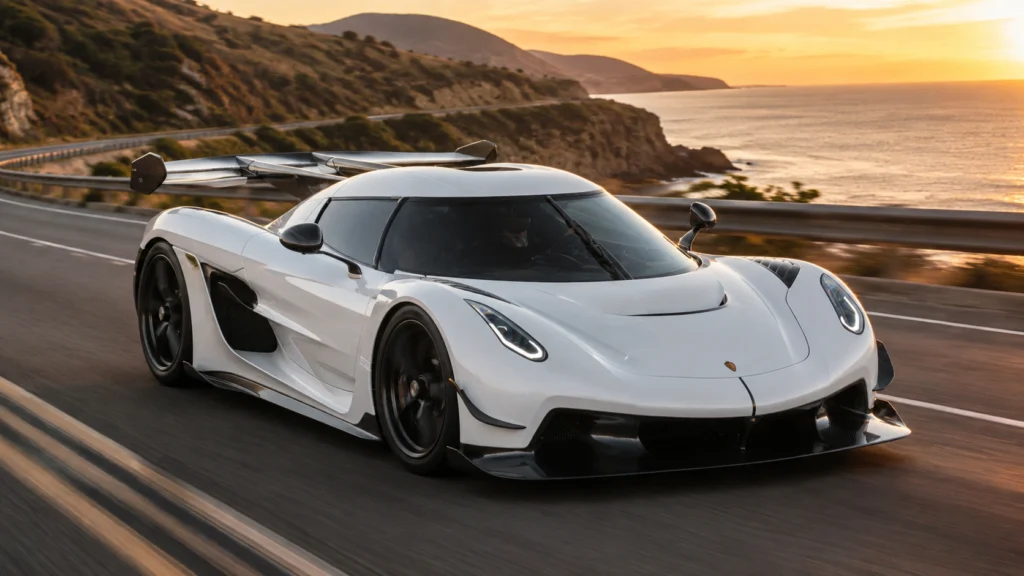
Active aerodynamic elements — most visibly the movable rear wings on models like the Regera and Jesko Attack — aren’t styling flourishes. They physically reposition at speed to balance downforce against drag depending on whether the car is accelerating, cornering, or chasing a top-speed run.
The result is a design language that looks aggressive but is rarely gratuitous: most visible surface details exist because they serve a specific aerodynamic or cooling function.
Interior and Technology
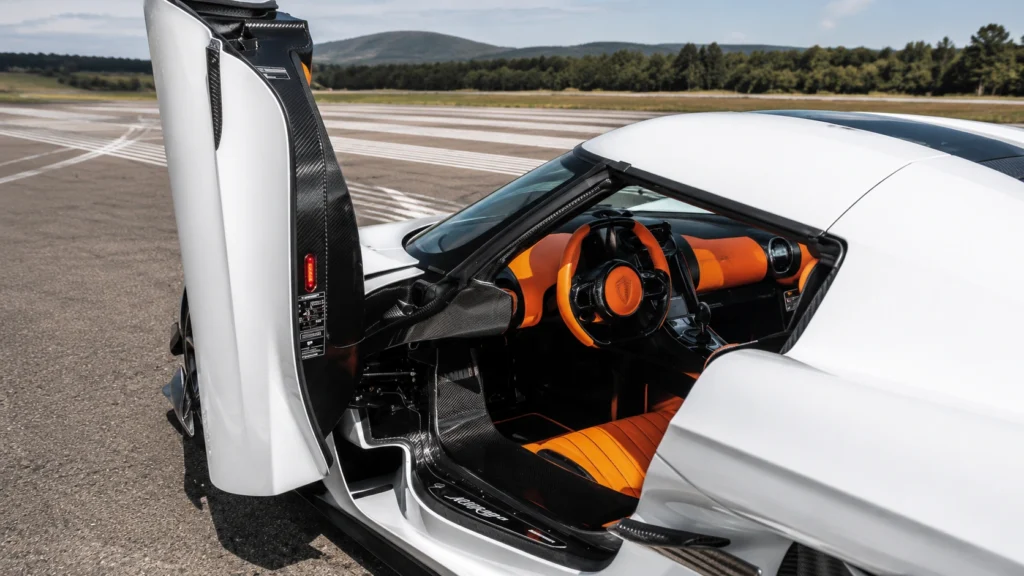
Koenigsegg cabins balance motorsport-level focus with genuine daily usability — something not every hypercar manages. Materials lean heavily on exposed carbon fiber and Alcantara, but seats, climate control, and infotainment are designed to make the car livable, not just track-capable.
Digital instrument clusters and touch displays are standard on current models, alongside features like Apple CarPlay, USB connectivity, and even heated and cooled cup holders on the Gemera. Customization runs deep: buyers can specify materials, finishes, and trim combinations that make virtually every car unique, down to exposed or tinted carbon weave options.
Where Koenigsegg stands apart from most hypercars is practicality. The Gemera seats four adults with genuine legroom and usable luggage space — a rarity in a segment where rivals are typically strict two-seaters. Even the two-seat models are engineered with more cargo capacity than buyers might expect from a car capable of 300+ mph.
Koenigsegg Models and Lineup
Koenigsegg’s history spans historic, limited-production, current, and newly announced models. Don’t treat every name below as something you can order today — most models sell out before the general public even hears about them.
Historic and discontinued models:
- CC8S (2002–2004): Koenigsegg’s first series-production car, once recognized by Guinness as the world’s most powerful production car.
- CCR (2004): A track-focused evolution of the CC8S that briefly held a top-speed record among production cars.
- CCX (2006–2010): Developed partly with the U.S. market in mind, improving on-road usability and homologation.
- Agera / Agera R / Agera S (2010–2015): The car that established Koenigsegg’s modern identity, offered across progressively more powerful variants.
- Agera RS (2015–2018): The record-breaker. In November 2017, an Agera RS achieved a verified two-way average top speed of 277.87 mph (447.19 km/h) on a closed public road in Nevada.
- One:1 (2014–2015): Billed as the first production “megacar,” referencing its roughly 1:1 horsepower-to-kilogram ratio, with output over 1,300 hp on E85 fuel.
- Regera (2016–2022, 80 built): A hybrid grand tourer pairing a twin-turbo V8 with three electric motors and no multi-speed gearbox, using Koenigsegg’s single-speed Direct Drive system instead.
Current production models:
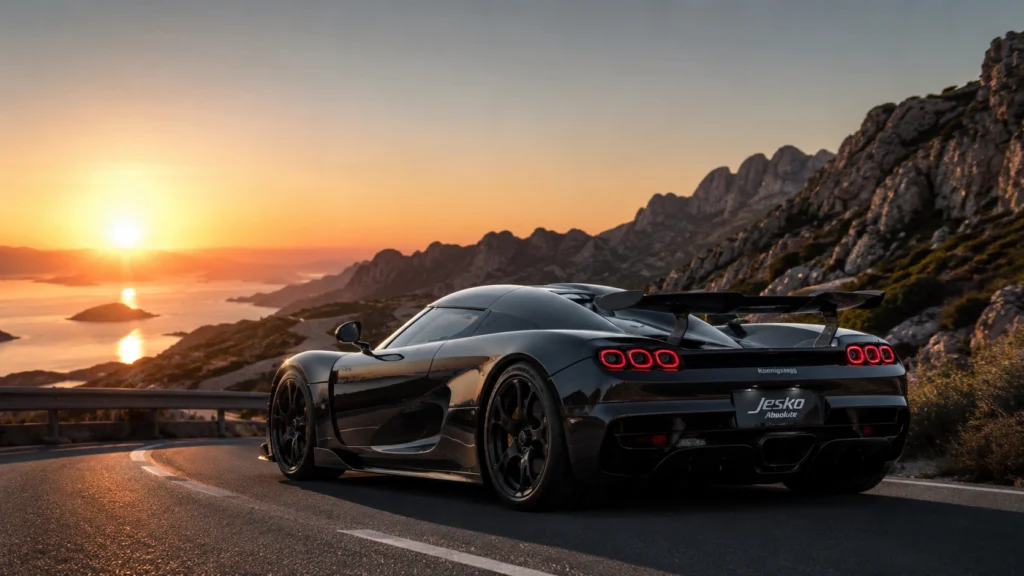
- Jesko (2020–present, limited to 125 units, sold out): The Agera’s successor, offered in high-downforce Attack and low-drag Absolut configurations, built around a 5.0-liter twin-turbo V8 and 9-speed multi-clutch transmission.
- Gemera (2024–present, limited to 300 units, sold out): Koenigsegg’s first four-seat model, described as a “Mega-GT,” combining a plug-in hybrid V8 powertrain with genuine four-seat practicality.
- CC850 (2022–present, limited run, sold out): A tribute to the original CC8S built for Koenigsegg’s 20th anniversary, notable for a transmission that switches between a real six-speed manual and a nine-speed automatic mode.
Newly announced model:
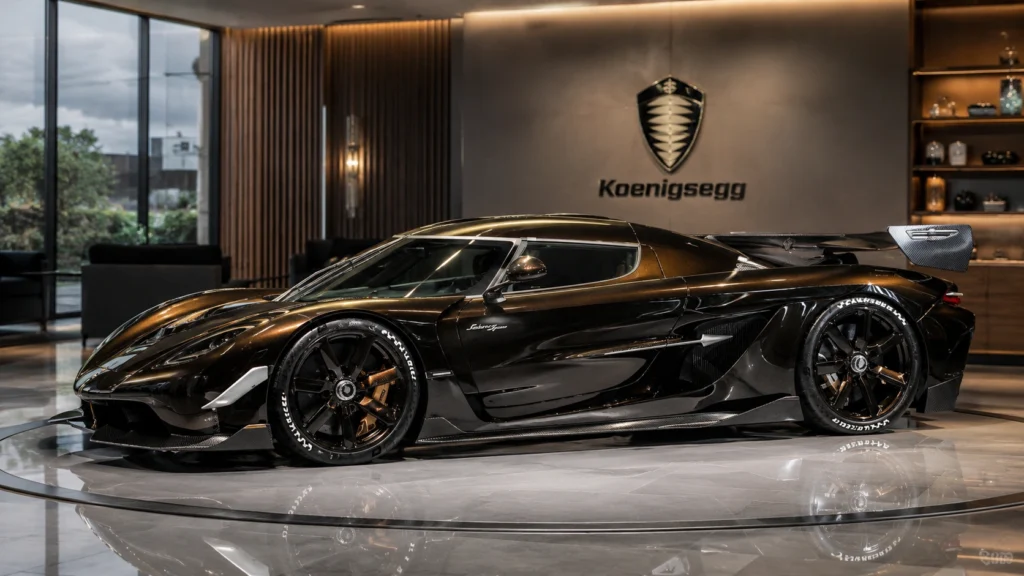
- Sadair’s Spear (announced 2026, limited to 30 units): A track-focused, Jesko-based hypercar named after a horse ridden by Christian von Koenigsegg’s father, featuring a more aggressive active aero package and a claimed output around 1,625 hp on E85.
Engine and Performance
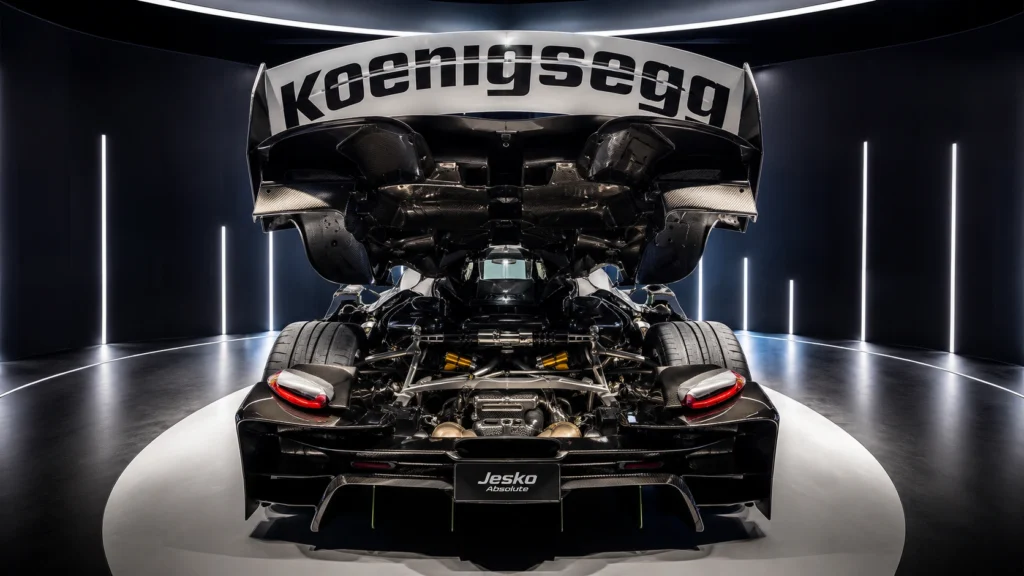
Koenigsegg’s modern lineup centers on one core building block: a 5.0-liter twin-turbocharged V8, developed in-house and shared, in various states of tune, across the Jesko, CC850, Regera, and Gemera. It’s an unusually light, high-revving engine for its displacement, thanks to a flat-plane crankshaft design.
Power outputs differ significantly by fuel. Most current engines are flex-fuel, running on standard pump gasoline or E85 ethanol blend, and typically produce meaningfully more horsepower on E85 due to its higher resistance to knock — hence the Jesko’s 1,280 hp on gasoline versus 1,600 hp on E85.
Transmission approach varies by model rather than following one formula. The Jesko uses a 9-speed multi-clutch transmission built for near-instantaneous shifts. The Regera skips a conventional gearbox entirely for a single-speed hybrid system. The CC850 offers a genuine manual-shift mode alongside a fully automatic one, in the same physical unit. Drive layouts differ too: most two-seat Koenigseggs are rear-wheel drive, while the four-seat Gemera uses all-wheel drive.
Specifications
Powertrain specifications (representative current and recent models):
| Model | Engine | Power | Transmission | Drive | Weight |
|---|---|---|---|---|---|
| Jesko Absolut | 5.0L twin-turbo V8 | 1,280 hp (gas) / 1,600 hp (E85, claimed) | 9-speed Light Speed Transmission | RWD | Approx. 1,390 kg (curb) |
| Gemera | 5.0L twin-turbo Hot V8 + Dark Matter electric motor (PHEV) | 2,300 hp combined (claimed) | 9-speed LSTT multi-clutch | AWD | Approx. 2,042 kg (curb) |
| CC850 | 5.0L twin-turbo V8 | Approx. 1,385 hp on E85 (claimed) | Engage Shift System (6-speed manual / 9-speed automatic) | RWD | Approx. 1,385 kg (curb) |
| Regera (discontinued) | 5.0L twin-turbo V8 + 3 electric motors (PHEV) | Approx. 1,500 hp combined | Single-speed Koenigsegg Direct Drive | RWD | Approx. 1,628 kg (curb) |
Figures are drawn from manufacturer specifications and independent automotive references, and may vary slightly between sources depending on measurement standard and configuration.
Top Speed and Acceleration
Koenigsegg’s performance claims fall into a few distinct categories, and it’s worth being precise about which is which.
Verified records: The Agera RS’s November 2017 result remains the clearest example — a two-way average of 277.87 mph (447.19 km/h) on a public road, measured with independent GPS equipment and averaged across both directions to account for wind and elevation. Koenigsegg still describes this as the record for a fully homologated production car achieved this way.
Officially tested, single-run figures: Some rivals, notably Bugatti’s Chiron Super Sport 300+, have posted officially tested one-direction top speeds exceeding 300 mph, though not under the same two-way averaging protocol.
Manufacturer claims, not yet attempted: The Jesko Absolut’s widely quoted top speed — figures as high as 330 mph appear in Koenigsegg’s own communications and press coverage — is based on aerodynamic simulation and engineering modeling rather than a completed test run. As of this writing, no official top-speed attempt has confirmed that number.
Acceleration tells a similar story. Koenigsegg has published extremely aggressive 0–60 mph and 0–400–0 km/h times, and has repeatedly broken its own 0–400–0 (0 to 249 mph and back to zero) record over the years — a benchmark that rewards braking and tire grip as much as raw power. Independent verification isn’t always available, so treat unlabeled acceleration figures from marketing materials with appropriate caution, especially for newly launched models.
Koenigsegg Technology and Innovations
Freevalve (camless valve technology): Rather than using a camshaft to open and close engine valves, Freevalve uses electronically controlled actuators for each valve individually. This isn’t a Koenigsegg invention outright — the underlying idea dates back decades and was developed by a separate Swedish firm, Cargine, which Koenigsegg acquired and renamed Freevalve in 2012. Without a fixed camshaft profile, an engine can adjust valve timing on the fly for better efficiency and emissions control across a wide range of conditions.
Light Speed Transmission (LST) and its variants: Koenigsegg’s multi-clutch transmission family uses overlapping gear clusters and multiple clutch packs instead of a conventional gear-selector shaft, enabling shift times measured in milliseconds. Variants power the Jesko’s 9-speed unit, the CC850’s dual-mode Engage Shift System, and the Gemera’s LSTT.
Koenigsegg Direct Drive (KDD): Used in the Regera, this system replaces a multi-speed gearbox with a single fixed gear ratio, relying on combined engine and motor torque to deliver smooth acceleration across the entire speed range.
Triplex suspension: A dual-damper arrangement developed for the Jesko Attack, designed to counteract how high-speed downforce compresses a car’s suspension unevenly, keeping the chassis stable at extreme velocities.
Active aerodynamics: Movable rear wings, front flaps, and adjustable ride height shift the balance between downforce and drag depending on whether the car is cornering, braking, or chasing top speed.
Each technology exists to solve a specific performance problem — cooling, shift speed, high-speed stability — rather than functioning as a marketing headline on its own.
Koenigsegg Price
There is no single “Koenigsegg price,” because pricing varies enormously by model, configuration, and how much bespoke customization a buyer requests. As a general guide, based on publicly reported figures, current and recent models start somewhere between roughly $1.7 million and $3 million or more before options, with heavily customized examples running well beyond that.
Several factors drive prices this high. Production is deliberately limited — often to well under 150 units per model — which concentrates enormous engineering and tooling costs across a tiny number of cars. Nearly every structural and cosmetic component is carbon fiber, machined, or hand-finished rather than mass-produced. Bespoke customization is standard practice, with buyers routinely specifying unique color, material, and trim combinations.
Collectibility also plays a role in the used market. Because production numbers are so low and demand consistently outstrips supply — several recent models sold out before deliveries even began — well-maintained used Koenigseggs can hold value strongly, and some historically significant examples, like early Agera RS units, have appreciated well above their original list price at auction.
| Model | Approximate Starting Price (Reported) | Notes |
|---|---|---|
| Jesko / Jesko Absolut | ~$3 million+ | Sold out; final units in production |
| Gemera | ~$1.7–1.9 million (unconfirmed) | Sold out; four-seat Mega-GT |
| CC850 | ~$3 million+ | Sold out; some later resale estimates run higher |
| Regera (when new) | ~$1.9–2 million | Production ended in 2022 |
Ownership and Availability
Buying a Koenigsegg isn’t like walking into a dealership. Production is limited by design, cars are typically built to individual customer specification, and popular models routinely sell out their entire run before being fully revealed to the public. Prospective buyers generally work directly with Koenigsegg or one of its small number of authorized regional dealers to secure an allocation, often years in advance.
Ownership brings genuinely specialized maintenance requirements. With hand-built engines, bespoke transmissions, and carbon-fiber structures, servicing isn’t something a typical high-end shop can handle — owners generally rely on the factory or a small network of trained specialists, and parts availability can require more lead time than with higher-volume exotic brands.
Insurance and running costs scale with the car’s value and rarity, though exact figures vary too much by owner, location, and usage to state as a fixed number. These are cars built primarily for performance and exclusivity rather than everyday convenience, and owners typically treat them as collector pieces and occasional-use machines — even though several models are technically road-legal and reasonably practical by hypercar standards.
Pros and Cons
Pros
- Genuine, first-principles engineering innovation rather than adapted off-the-shelf components
- Class-leading power-to-weight ratios and extreme straight-line performance
- Extensive bespoke customization on nearly every car
- Real exclusivity, with production runs often under 150 units
- A track record of setting legitimate, independently verified speed records
Cons
- Among the highest prices in the entire automotive world
- Extremely limited availability; most current models are already sold out
- Maintenance and servicing require specialist knowledge and factory support
- Limited practicality on most two-seat models compared with everyday cars
- High total cost of ownership, including insurance, storage, and specialized care
Comparison With Competitors
Koenigsegg competes in a small, rarified segment against a handful of manufacturers, each with a different philosophy.
| Brand | Example Model | Power | Approx. Price | Key Strength |
|---|---|---|---|---|
| Koenigsegg | Jesko Absolut | 1,280–1,600 hp | ~$3 million+ | In-house engineering, extreme top-speed potential |
| Bugatti | Tourbillon | ~1,800 hp (hybrid V16) | ~$4 million+ | Naturally aspirated V16 drama, luxury refinement |
| Rimac | Nevera | ~1,914 hp (electric) | ~$2.2–2.5 million | Electric acceleration and torque-vectoring precision |
| Pagani | Utopia | ~852–864 hp (V12) | ~$2.2 million+ | Hand-crafted artistry, analog driving experience |
Bugatti leans into naturally aspirated theater with its new V16-powered Tourbillon, prioritizing a sense of occasion and long-distance luxury alongside outright speed. Rimac takes the opposite approach, using four independent electric motors to deliver acceleration figures no combustion hypercar can currently match, at the cost of the emotional soundtrack purists crave. Pagani avoids the horsepower arms race altogether, focusing on hand-finished craftsmanship and a raw, mechanical feel — including an actual manual gearbox option.
Koenigsegg’s advantage tends to show up in outright top speed and in-house drivetrain innovation, where it has repeatedly out-engineered far larger, better-funded rivals. Where it can lag is brand heritage and dealer network size — no single brand here is objectively “better” across every category; the right choice depends on what kind of experience a buyer is after.
Who Should Buy a Koenigsegg?
Koenigsegg tends to appeal most to a specific type of buyer: established hypercar collectors who already own examples from Bugatti, Ferrari, or Pagani and want something with a distinctly different engineering story to tell. It also resonates strongly with technology-focused buyers who care as much about how the car works — the transmission design, the valve technology, the aerodynamics — as they do about the badge on the hood.
Performance purists chasing outright numbers, and buyers who specifically want a piece of genuine, independently verified automotive history (like an Agera RS with its 2017 record), are natural fits as well.
Koenigsegg is probably not the right choice for someone who wants a daily driver, values an extensive dealer and service network above all else, or is buying a hypercar mainly for brand recognition among people who aren’t already car enthusiasts — Koenigsegg’s badge, unlike Ferrari’s or Lamborghini’s, doesn’t carry the same instant recognition outside serious car circles.
Conclusion
Few car companies operate the way Koenigsegg does. A brand that started with one determined founder and a hand-drawn sketch now designs its own engines, its own transmissions, and its own valve-control technology — and backs that engineering with genuine, independently verified speed records rather than marketing claims alone. That combination of small-scale independence and outsized technical ambition is what makes Koenigsegg genuinely different from the rest of the hypercar world, not just another name chasing the same horsepower numbers.
Whether you’re drawn in by the Agera RS’s still-remarkable 2017 top-speed run, the Gemera’s unlikely blend of four-seat practicality and 2,300 horsepower, or the sheer mechanical audacity of the CC850’s dual-mode gearbox, Koenigsegg rewards the kind of attention enthusiasts love to give it. For full, up-to-date specifications and current model availability, Koenigsegg’s official website remains the most reliable source.
Koenigsegg isn’t trying to be everything to everyone. It’s trying to be the best possible answer to a very specific, very difficult engineering question — and three decades in, it’s still finding new ways to answer it.
Frequently Asked Questions (FAQs)
Koenigsegg is known for building extremely limited-production hypercars with in-house engines, transmissions, and technology, and for repeatedly setting legitimate speed and acceleration records, most notably the Agera RS’s 2017 top-speed run.
Prices vary by model but generally range from roughly $1.7 million to $3 million or more before customization, with heavily bespoke examples costing significantly more. There is no single fixed brand-wide price.
By verified, independently measured results, the Agera RS holds the company’s clearest record at 277.87 mph. The Jesko Absolut has a higher claimed theoretical top speed, but that figure has not yet been confirmed by an official test run.
The Gemera currently claims the highest output in the lineup, with a combined 2,300 horsepower from its hybrid V8-plus-electric-motor powertrain, according to Koenigsegg’s production specifications.
It depends on the measurement. Koenigsegg’s Agera RS holds a verified two-way public-road record that Bugatti hasn’t matched under identical conditions, while Bugatti’s Chiron Super Sport 300+ has posted a faster officially tested single-direction speed. Direct comparisons require specifying exactly which record and testing method is being used.
Most current models are built around Koenigsegg’s own 5.0-liter twin-turbocharged V8, developed in-house, though output and hybridization differ by model — from a purely combustion setup in the Jesko to a plug-in hybrid configuration in the Gemera and Regera.
Production is deliberately tiny. Individual model runs are typically limited to well under 150 units, and total annual output across the entire company is a small fraction of what a mainstream automaker produces in a single day.
Technically yes, but availability is extremely limited. Most current models sell out their full production allocation before or shortly after launch, so buyers typically need to work directly with Koenigsegg or an authorized dealer well in advance, or pursue a used example on the collector market.