Mercedes-Benz Vision Iconic: The Stunning Future of Luxury Cars
Every so often, a concept car shows up that isn’t really about the car itself. It’s about a statement. The Mercedes-Benz Vision Iconic is exactly that kind of vehicle — a show car unveiled in October 2025 that gives us the clearest look yet at where Mercedes-Benz Vision Iconic design and technology are heading. It borrows heavily from the brand’s 1930s golden era, wraps that heritage around a set of genuinely forward-looking technologies, and does it all without pretending to be something you can order from a dealership tomorrow.
That last part matters. A lot of coverage around concept cars blurs the line between “this exists” and “this might exist someday.” This article won’t do that. Everything here is grounded in what Mercedes-Benz has actually said about the Vision Iconic, with clear separation between confirmed design details, ongoing research, and pure speculation.
Quick Specifications
| Specification | Mercedes-Benz Vision Iconic |
|---|---|
| Vehicle type | Show car / concept |
| Brand | Mercedes-Benz |
| Debut | October 14, 2025 (Shanghai) |
| Body style | Grand-touring coupe |
| Powertrain | Future electric mobility concept |
| Key technology | Solar Paint |
| Automated driving | Level 2 standard; Level 4 concept |
| Steering technology | Steer-by-wire |
| Computing | Neuromorphic computing (research) |
| Production status | Concept / show car |
| Official price | Not announced |
What Is Mercedes-Benz Vision Iconic?
The Mercedes-Benz Vision Iconic is a show car, not a production model. Mercedes-Benz unveiled it in Shanghai on October 14, 2025, describing it as a vehicle that embodies “the freedom to think beyond convention.” The official Mercedes-Benz Vision Iconic media release frames the car as a creative impulse that opens new perspectives and builds a bridge between past and future.
Think of it less as a preview of a specific future Mercedes-Benz Vision Iconic and more as a mission statement. Automakers build show cars like this to explore design language, test public reaction, and demonstrate research projects that are still years away from a showroom floor. The Vision Iconic does all three at once.
Its most talked-about element is a reworked take on the classic Mercedes-Benz Vision Iconic grille. The car also serves as a showcase for Solar Paint, Level 4 automated driving research, and neuromorphic computing — three technologies that, individually, could shape how EVs are built, driven, and computed in the years ahead. None of them are confirmed production features today.
It’s worth being direct about this distinction because it’s easy for concept-car coverage to slide into treating “shown” as “shipping.” Mercedes-Benz Vision Iconic itself is careful about the language it uses, calling Vision Iconic a demonstration of research and design direction rather than a car you’ll be able to configure and buy.
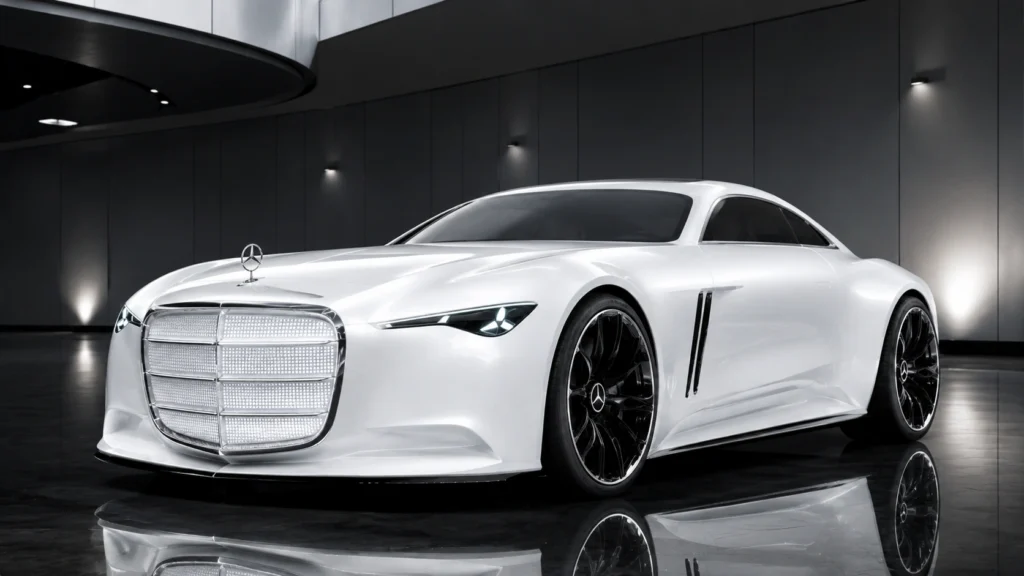
Why the Mercedes-Benz Vision Iconic Matters
The Mercedes-Benz Vision Iconic isn’t just another design exercise sitting in a studio — it’s a working preview of where the brand’s flagship electric models are headed next. Every detail of the Mercedes-Benz Vision Iconic, from the illuminated grille to the Solar Paint research underneath its body panels, was chosen to make a specific point about the company’s next design era.
For everyday readers, the Mercedes-Benz Vision Iconic answers a simple question: what happens to Mercedes-Benz design once combustion engines disappear for good? The Mercedes-Benz Vision Iconic argues that heritage and electrification don’t have to pull in opposite directions — they can reinforce each other. That’s part of why elements first shown on the Mercedes-Benz Vision Iconic, like the iconic grille, are already reaching production models such as the electric GLC, rather than staying locked away as a one-off concept.
History and Background
To understand why the Mercedes-Benz Vision Iconic looks the way it does, it helps to look backward before looking forward. Mercedes-Benz Chief Design Officer Gorden Wagener said the show car draws from the golden era of automotive design in the 1930s, aiming to capture the pure essence of the brand through a commanding hood, flowing sculpted lines, and Art Deco touches.
That era produced some of the most romantic shapes in automotive history — long hoods, upright grilles, and a sense of occasion that modern EVs, with their smooth and often anonymous fascias, have mostly lost. Mercedes-Benz is trying to reclaim some of that presence.
The grille itself has specific ancestors. Mercedes-Benz says the design draws inspiration from the upright grilles of historic models including the W 108, the W 111, and the Mercedes-Benz 600 Pullman — cars that projected formality and status through a tall, chromed front end long before “grille size” became a design talking point on modern SUVs.
There’s also a nod to a different kind of icon in the cabin. Wagener specifically connects the car’s continuous bench seat and elegant rear-end treatment to the legendary Mercedes-Benz 300 SL, one of the most celebrated sports cars the brand has ever produced. It’s a clever pairing: a 1950s icon informing the tail, a 1930s sensibility informing the nose.
This reinterpreted grille isn’t exclusive to a concept car sitting in a design studio, either. Mercedes-Benz notes that the so-called iconic grille first appeared on the all-electric GLC, introduced in September 2025, before the Vision Iconic pushed the idea further with an illuminated star and richer detailing. That timing matters for readers who want to know whether any of this design language is already reaching real, purchasable Mercedes-Benz vehicles — the answer is yes, at least in early form, on the new GLC.
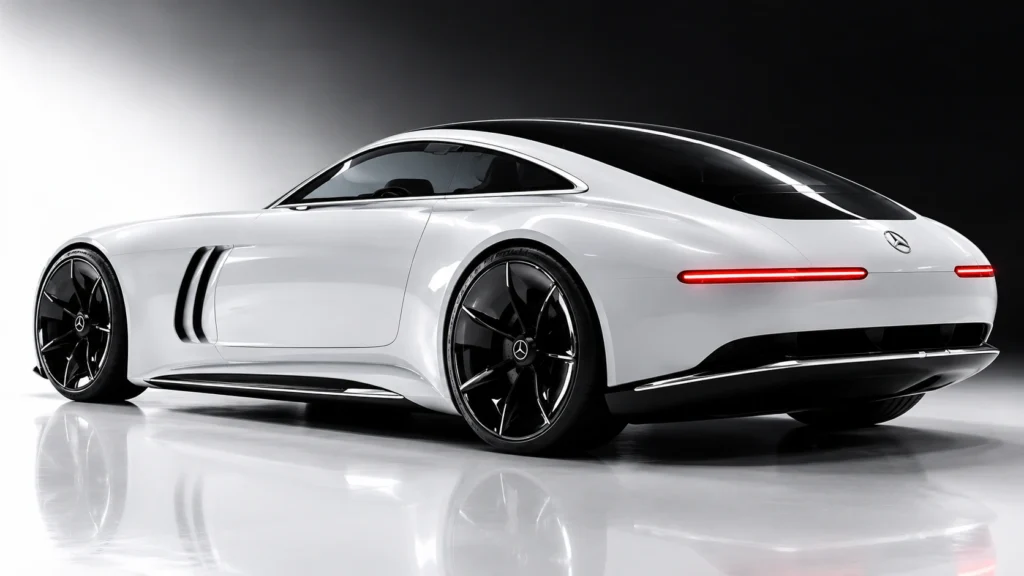
Design and Exterior
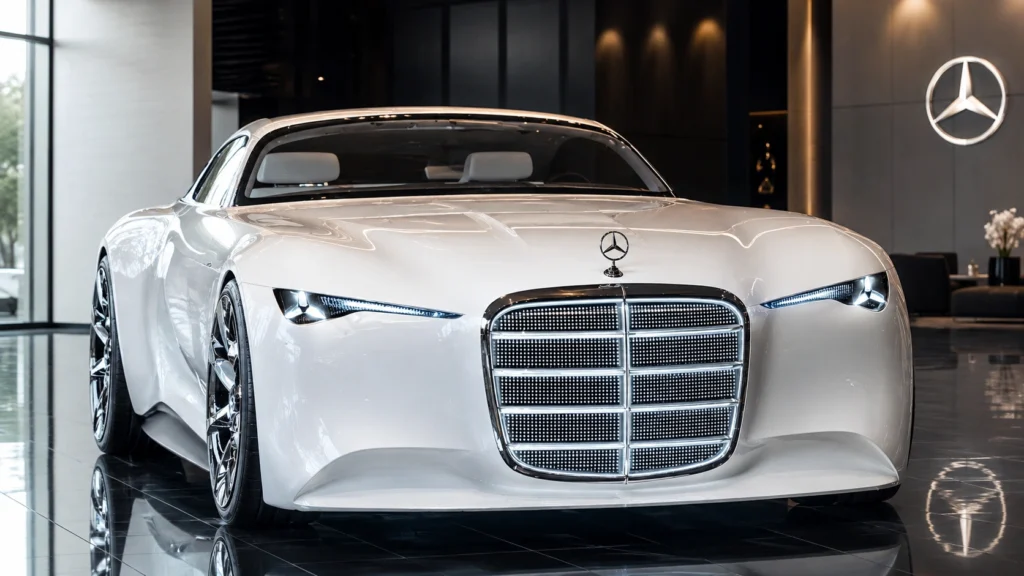
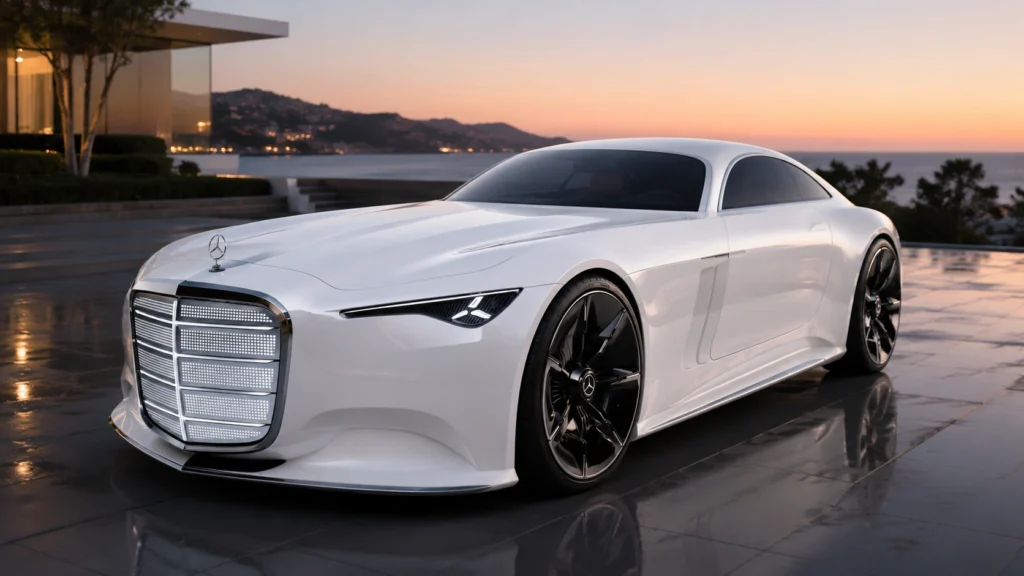
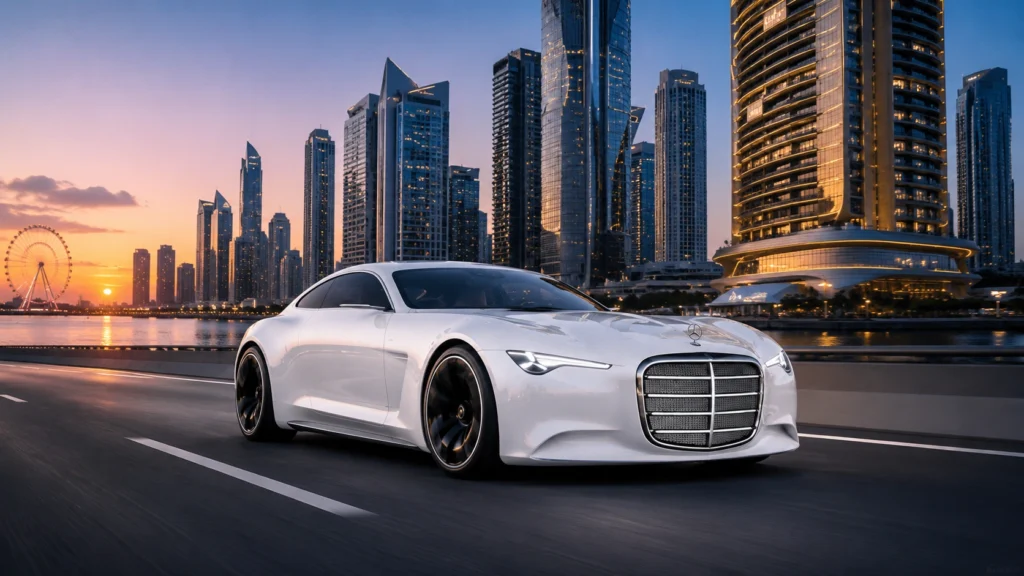
The exterior is where the Mercedes-Benz Vision Iconic makes its first impression, and it’s an unapologetically bold one. The centerpiece is what Mercedes-Benz calls the “iconic grille” — a wide, chromed frame wrapped around a smoked-glass lattice structure with contour lighting built in. According to Mercedes-Benz’s new iconic grille design page, this treatment is designed to merge brand heritage with digital modernity, giving the car a strong sense of presence, status, and identity.
Why does that matter beyond looking dramatic in photos? Grilles have historically served a functional purpose — cooling for a combustion engine. Electric vehicles don’t need that same airflow, which is part of why so many EV faces have become smooth and grille-less. Mercedes-Benz is making a different bet: that an upright, illuminated grille can become a piece of digital identity rather than a leftover from the combustion era, something the car “wears” rather than something it needs.
The illumination theme continues with the Mercedes star itself. Mercedes-Benz says the Vision Iconic illuminates the upright star on the bonnet, combining it with animation scenarios for the grille to emphasize how important lighting has become for emotional, digital-era design. On a dark street, that’s a very different kind of presence than a static chrome ornament.
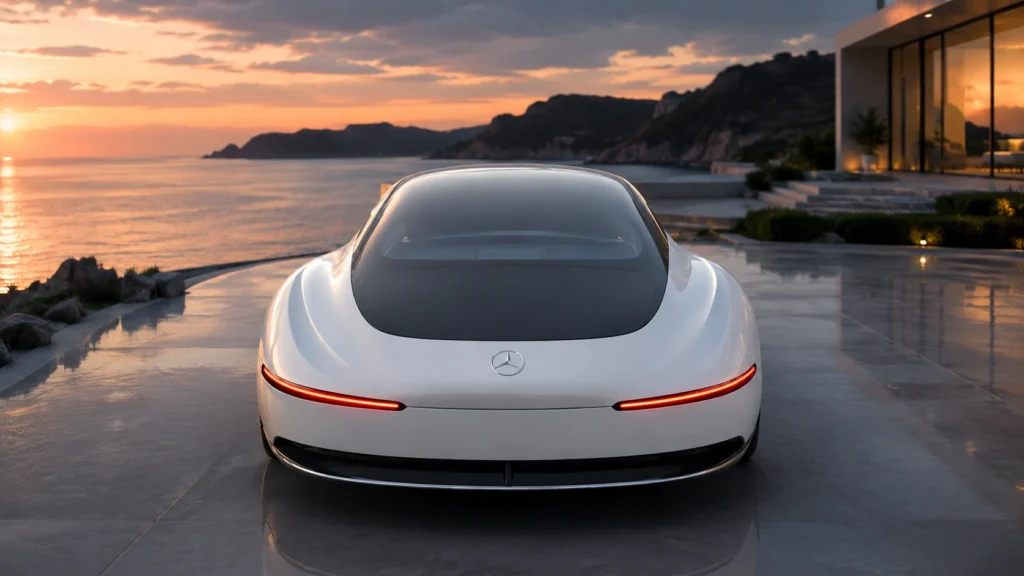
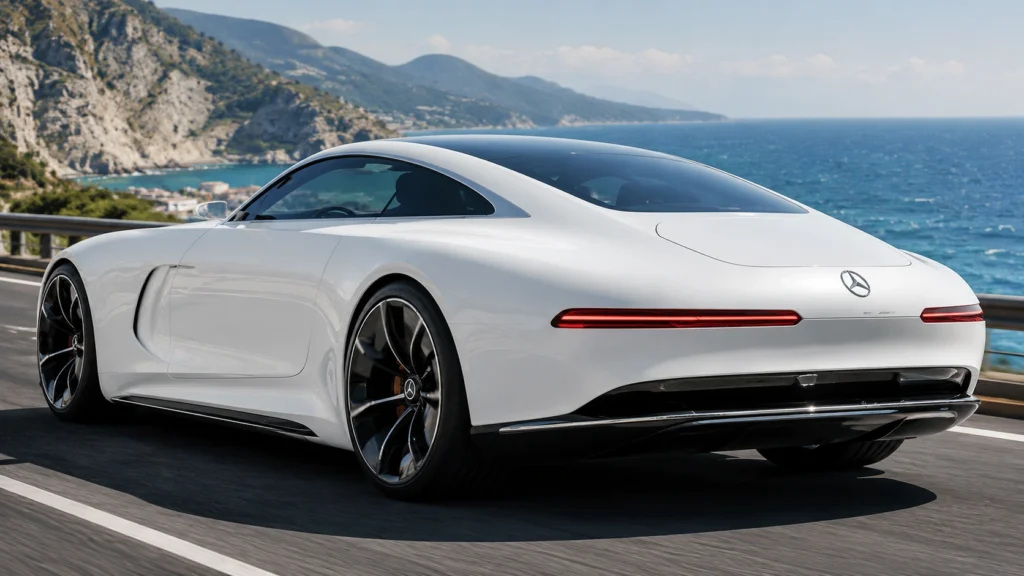
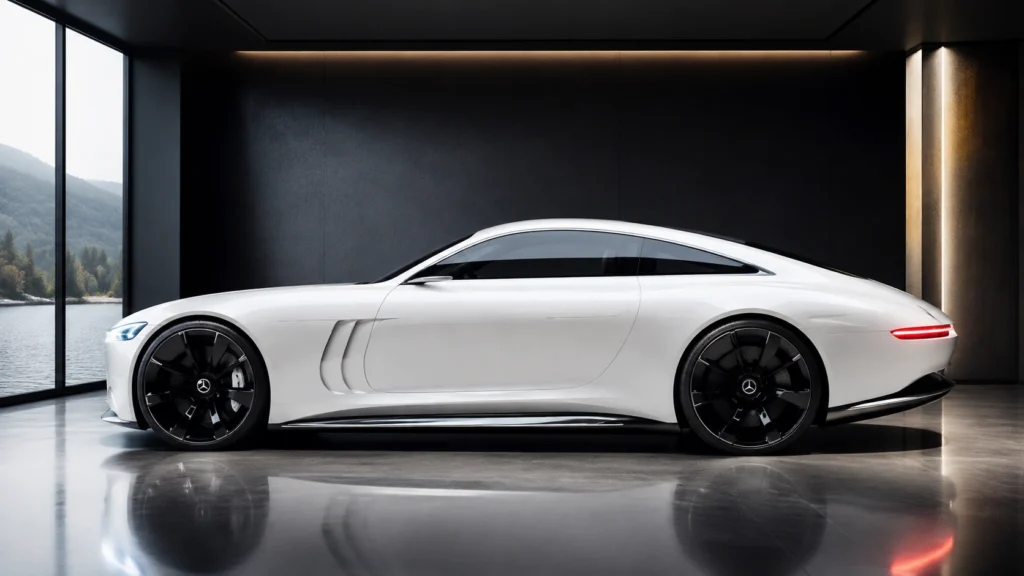
Beyond the face, the proportions lean into classic grand-touring cues: a long hood, a sculpted and flowing body, and a roofline that tapers toward the rear. Mercedes-Benz finished the car in a deep black high-gloss paint that emphasizes the sculptural exterior design, letting light play across the surfaces rather than relying on bright color to draw the eye.
The headlights are deliberately restrained by comparison — slim, modern units that Mercedes-Benz describes as self-confident rather than showy, built with current lighting technology but sized to let the grille and star do the talking. Taken together, the exterior isn’t just a styling exercise. It’s Mercedes-Benz testing whether a more formal, heritage-driven face can coexist with an electric and increasingly autonomous future, rather than assuming that future has to look minimalist by default.
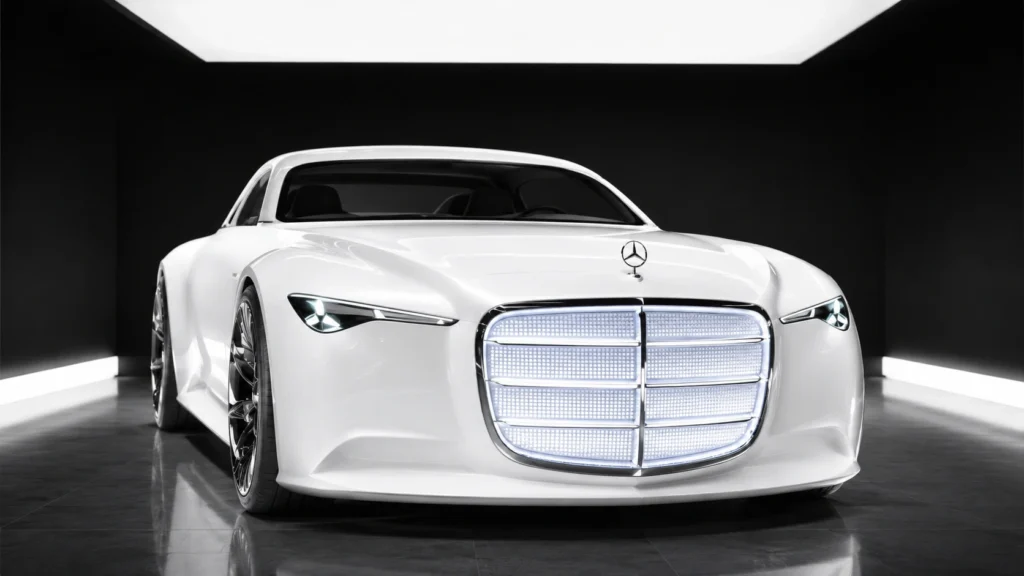
Interior and Technology
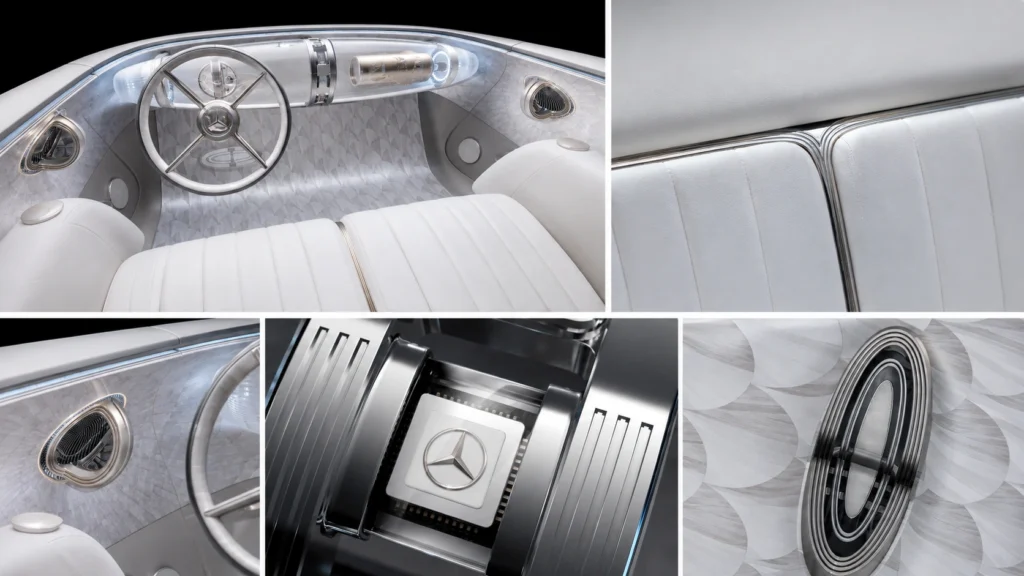
If the exterior is a heritage statement, the cabin is where Mercedes-Benz Vision Iconic gets genuinely experimental. The brand describes the interior experience as “hyper-analogue” luxury paired with lounge-like comfort — a phrase that sounds contradictory until you see how it’s applied.
The centerpiece of the dashboard is a floating glass structure Mercedes-Benz nicknames the “Zeppelin.” It’s a sculptural element that houses a mix of analogue and digital instruments, and it does something unusual when you open the door: the instrument cluster plays a cinematic animation inspired by high-end mechanical chronographs, all rendered in an entirely analogue style. Mercedes-Benz built a pillar-to-pillar display concept around it, and at the center sits one of four clock-style displays shaped like the brand’s logo, functioning as what Mercedes-Benz describes as an AI companion.
The materials lean hard into the Art Deco theme. Behind the Zeppelin structure, a decorative surface unfolds into an inlay with a lustrous mother-of-pearl look, and similar marquetry work wraps the door panels around polished brass door handles finished in silver-gold tones. The floor uses straw marquetry, a decorative craft technique that dates back centuries and saw a revival in the 1920s, arranged here in a fan-shaped Art Deco pattern.
Perhaps the most striking interior choice is the seating layout: instead of separate driver and passenger seats, the Mercedes-Benz Vision Iconic uses a single, sumptuously upholstered front bench seat trimmed in deep blue velvet, meant to foster a shared sense of relaxation rather than a strict driver-focused cockpit.
Solar Paint
Mercedes-Benz is researching a solar coating technology it calls Solar Paint — a photovoltaic-active surface applied like a thin paste rather than installed as rigid panels. Unlike a conventional solar roof, which is limited to one panel bolted to the roofline, this coating is designed to be adaptable across the vehicle’s body panels.
Mercedes-Benz has published figures for this research: the coating reportedly reaches a solar efficiency of around 20 percent and can generate energy continuously, even while the car is parked and switched off. As an illustration of scale, Mercedes-Benz suggests that an 11-square-meter surface — roughly the size of a mid-size SUV’s body — could theoretically produce enough energy for up to 12,000 kilometers of driving per year under ideal conditions, based on light conditions in Stuttgart. That’s a best-case research figure, not a guaranteed real-world outcome, since actual output would depend heavily on geography, weather, and how much of the vehicle’s surface is actually coated.
The company also notes the coating avoids rare earth materials and silicon, and is designed to be easily recyclable. It’s a genuinely interesting piece of materials science, but it remains a research project rather than an ordering option.
Neuromorphic Computing
This is one of the more technical concepts tied to the Vision Iconic, and it’s worth breaking down in plain language. Traditional computer chips process information sequentially, step by step. Neuromorphic computing is a different architecture that tries to mimic how neurons in the human brain fire and communicate, processing information in a more parallel, event-driven way.
Why does that matter for a car? Autonomous driving systems need to process huge amounts of sensor data — cameras, radar, lidar — in real time, and that takes a lot of energy and computing power. Mercedes-Benz says its research suggests neuromorphic-based safety systems could recognize traffic signs, lane markings, and other road users roughly 10 times more efficiently than current systems, and that the approach has the potential to cut the energy needed for autonomous-driving data processing by as much as 90 percent compared to today’s setups. Those are Mercedes-Benz’s own research projections, not confirmed production performance.
Steer-by-Wire
Traditional steering systems use a mechanical link — a physical column and gears — connecting the steering wheel to the front wheels. Steer-by-wire removes that mechanical connection entirely. Instead, the driver’s steering inputs are read electronically and sent via control units and actuators to turn the wheels.
Mercedes-Benz Vision Iconic highlights a few potential benefits of this approach, particularly when it’s paired with rear-axle steering on a long car like the Vision Iconic: reduced steering effort, easier maneuvering and parking, and no need to constantly re-grip the wheel during tight parking maneuvers. There’s also a interior-design upside — without a mechanical steering column running through the cabin, designers have more freedom to rethink the driver’s seating position, which ties directly into the car’s lounge-like interior concept.
Automated Driving
This is an area where precision matters. Mercedes-Benz has not announced that the Mercedes-Benz Vision Iconic offers customers fully autonomous Level 4 driving today. What the company describes as standard on the show car is an enhanced Level 2 system with point-to-point urban capability, including cooperative steering and acceleration designed to help navigate complex city traffic.
Level 4 automated driving is presented as the next logical step Mercedes-Benz envisions for a car like this — a future scenario where, once on the highway and with the system engaged, a driver could relax, take a call, or stream video without monitoring traffic, and the car could even handle parking on its own without driver involvement. That’s a described future concept, not a currently available production feature.
Engine and Performance
It’s tempting to slot a “horsepower and torque” section into every car article, but doing that here would mean inventing numbers Mercedes-Benz hasn’t published. The Vision Iconic is framed by Mercedes-Benz as an electric mobility concept, built to demonstrate design direction and future technologies like steer-by-wire and neuromorphic computing rather than to post a specific 0-60 time.
Mercedes-Benz has not published an official horsepower or torque figure for the Vision Iconic show car. The same goes for battery capacity and total driving range. What we do know is the philosophy behind the car: an electric drivetrain paired with technologies aimed squarely at efficiency, from the solar coating research to the low-power computing architecture being explored for autonomous systems.
If you’re looking for a current Mercedes-Benz vehicle with fully disclosed, real-world performance and efficiency figures rather than concept-stage research, the brand’s existing production SUV lineup is a more useful comparison point.
Specifications
| Specification | Details |
|---|---|
| Vehicle type | Show car / concept |
| Debut | October 14, 2025 |
| Powertrain | Electric / future mobility concept |
| Solar technology | Solar Paint research (~20% efficiency) |
| Steering | Steer-by-wire concept |
| Automated driving | Standard: enhanced Level 2 urban; Concept: Level 4 |
| Computing | Neuromorphic computing research |
| Production status | Show car |
| Price | Not announced |
| Range | Not officially disclosed |
| Battery | Not officially disclosed |
| Power output | Not officially disclosed |
| Torque | Not officially disclosed |
| Acceleration (0-60 mph) | Not officially disclosed |
| Top speed | Not officially disclosed |
Top Speed and Acceleration
Mercedes-Benz has not announced official acceleration or top-speed figures for the Vision Iconic, and there’s a good reason this article won’t estimate them: doing so would be pure guesswork dressed up as reporting.
Concept cars like this one are typically built as design studies or, at most, functional research mules — not track-tested prototypes with finalized drivetrains. Performance numbers only become meaningful once an automaker locks in a production motor, gearing, weight, and aerodynamic package, none of which Mercedes-Benz has confirmed here. Until Mercedes-Benz releases official figures — if it ever brings elements of this concept to production — any 0-60 mph or top-speed claim you see attached to the Vision Iconic should be treated as speculation, not fact.
Price
There is no official retail price for the Mercedes-Benz Vision Iconic, and there won’t be one until — or unless — Mercedes-Benz decides to put a version of it into production. As a show car, it exists to demonstrate ideas, not to be sold.
Estimating a price here would mean inventing a number based on nothing more than “it looks expensive,” which isn’t useful information for readers. What is useful is understanding the distinction between three very different things: the Vision Iconic concept vehicle itself, which isn’t for sale at any price; the individual technologies it previews, some of which could eventually filter into future production Mercedes-Benz models at their own separate price points; and the automaker’s current lineup, which does have real, published pricing today.
Pros and Cons
| Pros | Cons |
|---|---|
| Striking, heritage-inspired design | Not a production model |
| Genuinely advanced technology research | Limited confirmed specifications |
| Strong connection to Mercedes-Benz history | No official retail price |
| Promising solar-coating research | Future technologies may change before production |
| Ambitious, lounge-like luxury interior | Cannot be purchased or driven as shown |
The Mercedes-Benz Vision Iconic succeeds as a design and technology statement, and that’s really what it was built to do. Where it inevitably falls short is anywhere a reader wants concrete, buyable specifics — because those specifics simply don’t exist yet for a vehicle at this stage of development.
Comparison With Competitors
It’s worth being upfront: comparing a show car directly against production vehicles on price, range, or performance doesn’t really work, because two of those three data points don’t exist for the Vision Iconic. What can be compared fairly is design philosophy and technological direction.
| Category | Mercedes-Benz Vision Iconic | Cadillac Celestiq | Rolls-Royce Spectre | Lucid Air |
|---|---|---|---|---|
| Production status | Concept / show car | Production (hand-built) | Production | Production |
| Design philosophy | 1930s Art Deco heritage reinterpreted for the electric age | Modern American ultra-luxury craftsmanship | Traditional Rolls-Royce formality in electric form | Minimalist, aerodynamics-led modern luxury |
| Electric direction | Future concept, no confirmed drivetrain | Confirmed electric powertrain | Confirmed electric powertrain | Confirmed electric powertrain |
| Autonomous-driving vision | Level 2 standard; Level 4 shown as future concept | Advanced driver-assistance systems | Advanced driver-assistance systems | Advanced driver-assistance systems |
| Interior concept | Lounge-like bench seat, hyper-analogue displays | Bespoke, client-configured luxury cabin | Traditional two-row luxury cabin | Tech-forward, minimalist cabin |
Cadillac’s Celestiq, Rolls-Royce’s Spectre, and the Lucid Air all represent a similar instinct — that electrification doesn’t have to mean abandoning craftsmanship or brand identity — but each of them is a car you can actually order today, with published pricing and range figures. The Vision Iconic is further upstream in the process: it’s showing where Mercedes-Benz’s thinking is headed rather than what’s currently on a dealer lot.
How the Mercedes-Benz Vision Iconic Fits Into the Brand’s EV Strategy
Mercedes-Benz didn’t build the Mercedes-Benz Vision Iconic in isolation. It sits inside a much broader push toward electrification, and the Mercedes-Benz Vision Iconic is meant to signal how far that shift can go without erasing the brand’s identity along the way. Rather than chasing the stripped-down, screen-heavy aesthetic common across today’s EVs, the Mercedes-Benz Vision Iconic doubles down on craftsmanship, heritage cues, and a sense of occasion.
That positioning matters strategically. As more automakers launch electric flagships, the Mercedes-Benz Vision Iconic gives the brand a way to differentiate on design language rather than specs alone. Whether the full concept ever reaches production or not, the Mercedes-Benz Vision Iconic has already influenced real models, and it likely won’t be the last show car Mercedes-Benz uses to test big ideas before they reach customers.
Who Is the Mercedes-Benz Vision Iconic For?
Since it isn’t a production vehicle, nobody can walk into a dealership and buy a Mercedes-Benz Vision Iconic. But that doesn’t mean the car isn’t worth paying attention to — it’s simply aimed at a different kind of reader.
It’s built for design enthusiasts who want to see how a legacy automaker is reinterpreting a century-old visual identity for an electric, digital era. It’s built for Mercedes-Benz fans who want an early look at design language — like the iconic grille — that’s already starting to appear on real production models such as the electric GLC. It’s built for automotive technology followers curious about where research into solar coatings, neuromorphic computing, and steer-by-wire might eventually lead. And it’s built for anyone generally interested in the direction of luxury EVs and autonomous-driving development, even if the specific hardware shown here never reaches a showroom in its current form.
If you’re reading this because you’re actually shopping for a Mercedes-Benz right now, the more useful move is to look at what the brand currently sells. A model like the Mercedes-Benz GLE offers the kind of confirmed specifications, established reliability record, and published pricing that a concept car like the Vision Iconic simply can’t offer yet.
Conclusion
The Mercedes-Benz Vision Iconic isn’t trying to be a car you can buy — it’s trying to show you where Mercedes-Benz’s design and engineering teams are pointed. Between the reinterpreted grille, the Art Deco-inspired cabin, and research projects like Solar Paint, steer-by-wire, and neuromorphic computing, it’s a genuinely ambitious piece of automotive storytelling, built on a century of Mercedes-Benz heritage and aimed squarely at an electric, increasingly autonomous future.
What makes it worth taking seriously is that some of its ideas aren’t staying locked in a design studio. The iconic grille already exists, in early form, on the production electric GLC — proof that concept-car thinking at Mercedes-Benz doesn’t always stay theoretical.
Still, it’s important to keep the label straight: as of now, the Mercedes-Benz Vision Iconic remains a show car, with no confirmed powertrain figures, no release date, and no official price. Whether more of its technology eventually reaches production Mercedes-Benz models is something only time — and Mercedes-Benz itself — will confirm.
Frequently Asked Questions (FAQs)
It’s a show car Mercedes-Benz unveiled in October 2025 that previews a new design direction and several future technologies, including Solar Paint, Level 4 automated driving research, and neuromorphic computing.
No. It’s a concept vehicle built to demonstrate design and technology ideas. Mercedes-Benz has not announced plans to put it into production as shown.
Mercedes-Benz presents it as an electric mobility concept, but the company hasn’t disclosed a specific battery capacity, motor output, or range figure for the show car.
There is no official price. Because it’s a show car rather than a vehicle available for purchase, Mercedes-Benz has not published pricing, and estimating one would be speculation.
It’s a photovoltaic coating Mercedes-Benz is researching that could be applied across a vehicle’s body panels to harvest additional range from sunlight. Mercedes-Benz cites a roughly 20 percent efficiency figure and says the coating can generate power even while the car is parked, though real-world output would vary with location and weather.
The car comes standard with an enhanced Level 2 system for point-to-point urban driving. Level 4 highly automated driving is described by Mercedes-Benz as a future development step for a vehicle like this, not a currently available feature.
It’s a computing architecture inspired by how the human brain processes information. Mercedes-Benz’s research suggests it could make autonomous-driving computations significantly faster and more energy-efficient than current systems, though this remains a research project.
Mercedes-Benz has not officially announced production plans for the Vision Iconic. Show cars like this typically influence future models rather than reach production unchanged — the iconic grille design, for instance, has already appeared on the production electric GLC.