Porsche Panamera: A Brilliant Sports Sedan With a Very Real Price Tag
Most luxury sedans are built to coddle you. The Porsche Panamera would rather take you down a mountain road at speed and still get you to dinner without a wrinkle in your shirt. That dual personality is exactly why it’s stuck around since 2009, even as rivals from Maserati and Mercedes have come and gone or reshuffled their lineups entirely.
The Porsche Panamera sits in a strange, small club: full-size luxury cars that genuinely handle like sports cars. It’s not the roomiest option in its class, and it’s rarely the cheapest, but it’s often the one enthusiasts actually want to drive. In this guide, we’ll walk through what the Panamera is, how it’s evolved, what it costs, how it performs, and whether it deserves a spot on your shortlist in 2026.
Quick Specifications
Figures below reflect the 2026 model year Porsche Panamera lineup sold in the United States. Because seven distinct powertrains are offered, most specs are shown as a range — exact numbers depend on trim, which we break down later in this guide.
| Specification | 2026 Porsche Panamera (U.S. lineup) |
|---|---|
| Engine/powertrain | 2.9L twin-turbo V6, 4.0L twin-turbo V8, or V6/V8 plug-in hybrid |
| Horsepower | 348 hp – 771 hp |
| Torque | 368 lb-ft – 737 lb-ft |
| Transmission | 8-speed PDK dual-clutch automatic |
| Drivetrain | RWD (base model only) / AWD (all other trims) |
| 0–60 mph | 2.8 – 5.0 seconds |
| Top speed | 168 – 202 mph |
| Seating capacity | 4 standard, 5 optional (2+1 rear bench) |
| Cargo capacity | Roughly 14.9 – 17.4 cu ft (rear seats up) |
| Starting price (U.S.) | Around $113,000 MSRP, destination included |
What Is the Porsche Panamera?
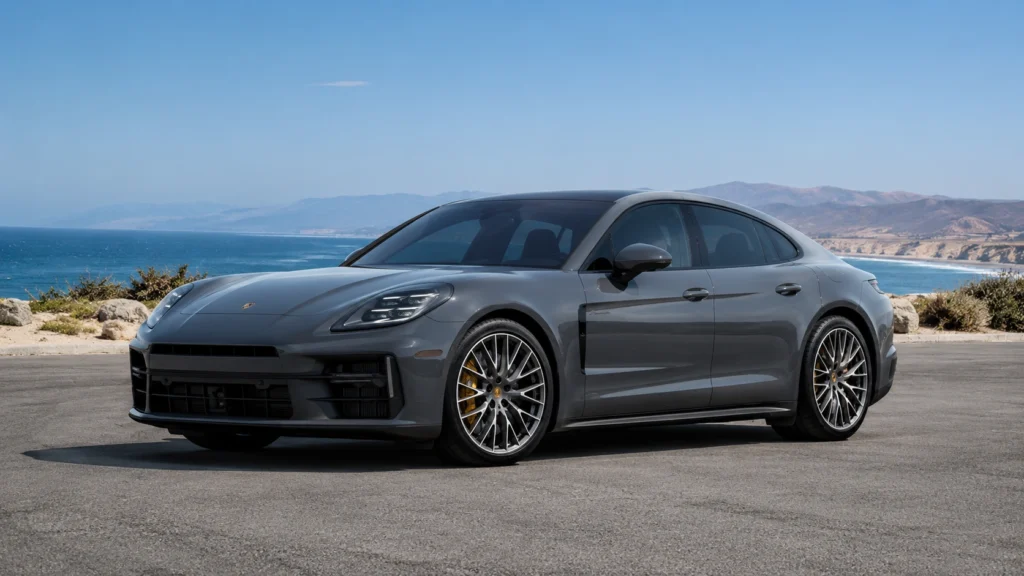
The Porsche Panamera is a full-size, four-door luxury sedan built on what Porsche itself calls a “sport sedan” body style. It’s the largest car in Porsche’s lineup that isn’t an SUV, sitting above the 911 and the smaller Taycan in terms of interior space, while still chasing the same driving feel that made those cars famous.
What separates the Porsche Panamera from a typical luxury sedan is what’s underneath it. Instead of prioritizing cabin isolation and a soft ride above all else, Porsche tunes the chassis, steering, and suspension the way it would for a sports car, then works backward to add comfort and refinement. The result is a car that seats four adults, swallows a surprising amount of luggage through its hatchback-style rear opening, and still feels genuinely eager on a twisty road.
It’s also worth noting the body style itself: rather than a conventional trunk, the Porsche Panamera uses a liftback design, similar in concept to a shooting brake. That rear hatch opens wide, and paired with 60/40 split-folding rear seats, it gives the Panamera more practical cargo flexibility than most sedans in its price range, even if outright volume trails a wagon or SUV.
History and Background
Porsche’s four-door sedan almost happened decades earlier than it did. The idea dates back to the mid-1990s, when Porsche considered a 928 successor with four seats, but the project stalled. It wasn’t until the success of the Cayenne SUV proved that Porsche buyers would accept something other than a two-door sports car that the company greenlit a proper sedan.
The first-generation Porsche Panamera arrived for the 2010 model year, aimed at buyers cross-shopping cars like the Mercedes S-Class and Maserati Quattroporte. Styling was polarizing — critics nicknamed its rear end the “hunchback” look — but the driving experience won people over. Naturally aspirated V8 power defined the early cars, with a 2014 mid-cycle refresh bringing a turbocharged V6 and sharper styling.
The second generation launched for 2017 and addressed most of the first car’s complaints. Its silhouette borrowed more visual language from the 911, the interior gained a touchscreen-centered layout, and an eight-speed dual-clutch transmission replaced the older seven-speed unit. This generation also introduced the Sport Turismo, a wagon-like variant with a more upright rear hatch, and it expanded the plug-in hybrid range significantly, culminating in a Turbo S E-Hybrid model that paired a twin-turbo V8 with an electric motor for well over 600 combined horsepower.
The current, third-generation Porsche Panamera debuted for the 2024 model year and remains the version sold today, carried into 2026 with mostly software updates. It brought a more digital cockpit, adaptive air suspension as standard equipment, and a considerably expanded plug-in hybrid lineup with a larger battery pack. The Sport Turismo body style was dropped from the U.S. lineup for this generation, and for 2026 the V8-powered GTS returned after sitting out the initial launch. Hybrid technology has become central to the car’s identity rather than a side offering: Porsche now sells four plug-in hybrid variants alongside three gas-only trims, reflecting how much electrification has reshaped what a “performance luxury sedan” is expected to deliver.
Design and Exterior
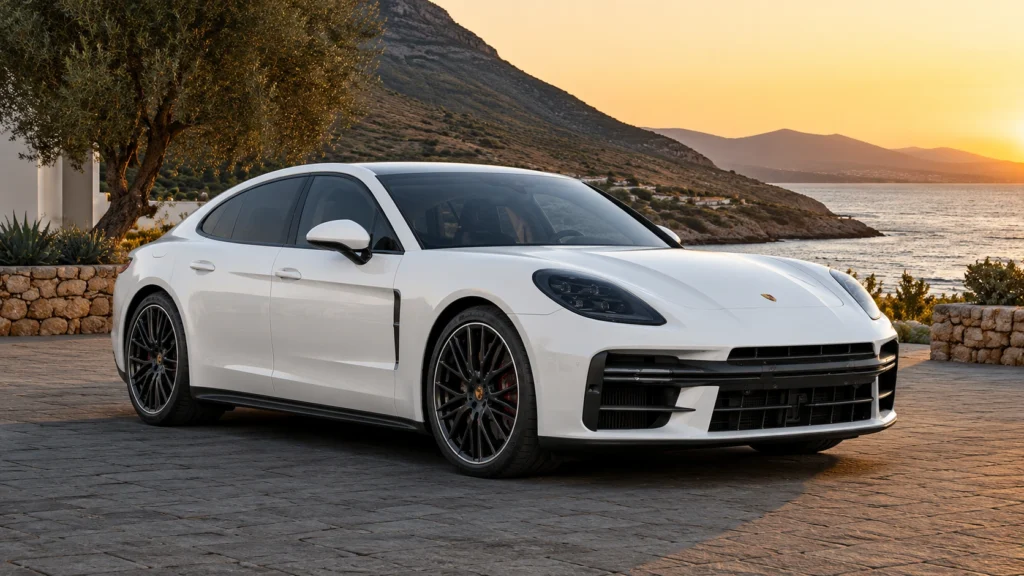
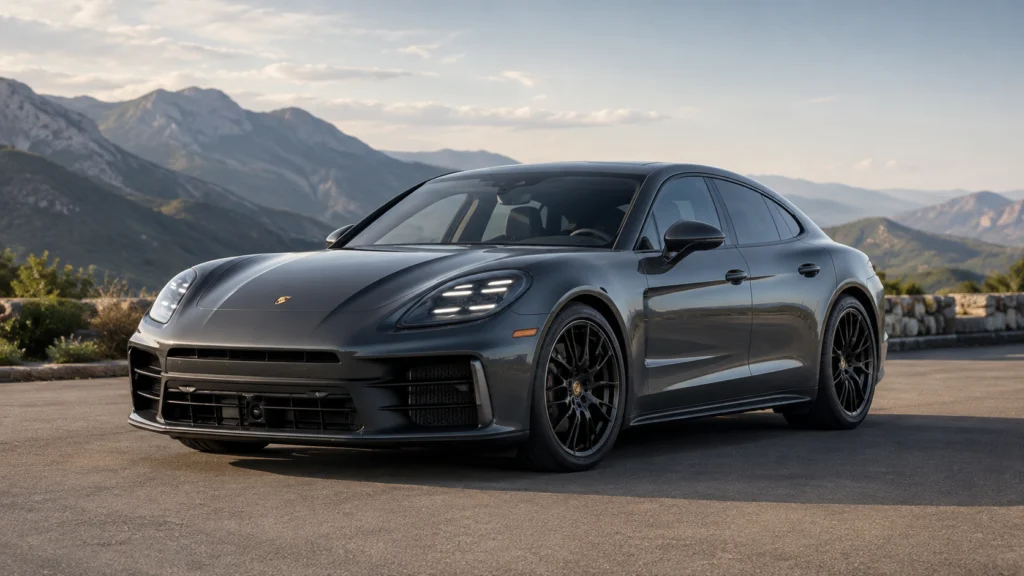
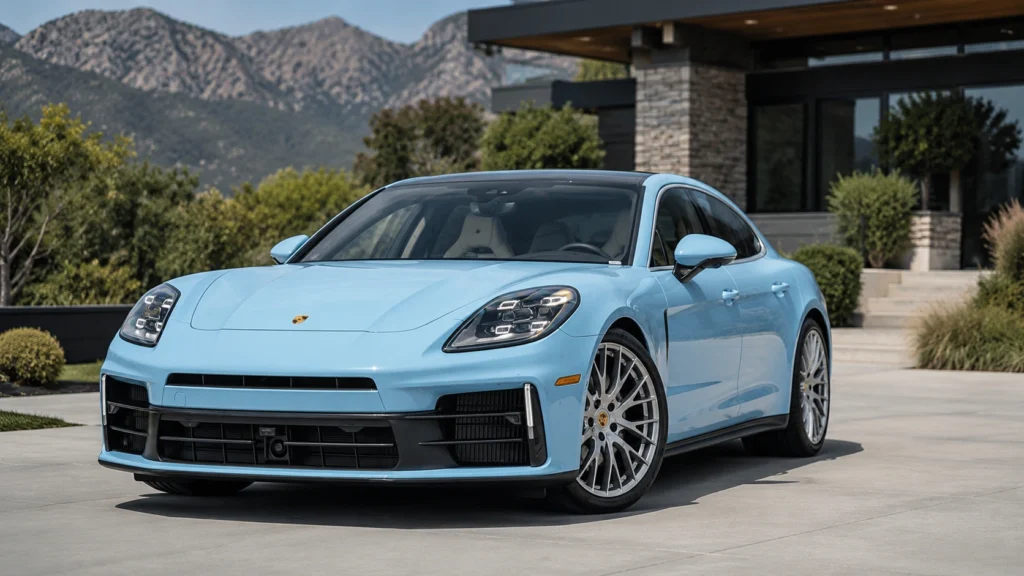
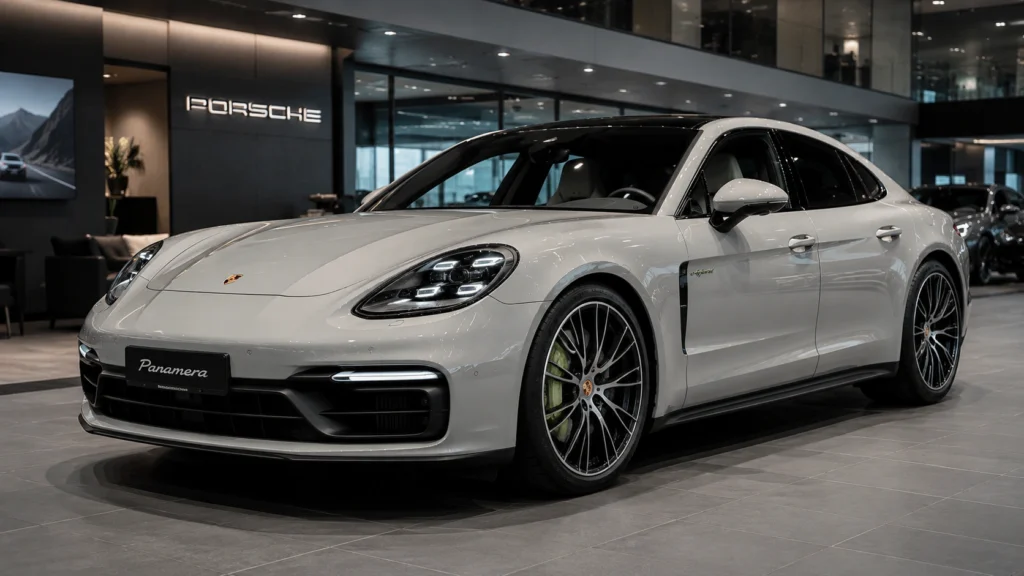
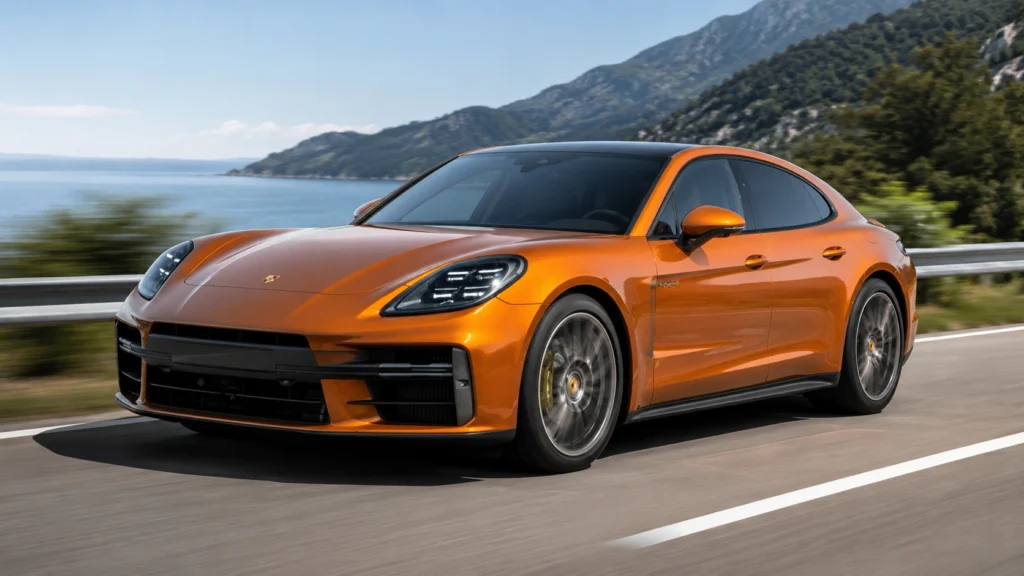
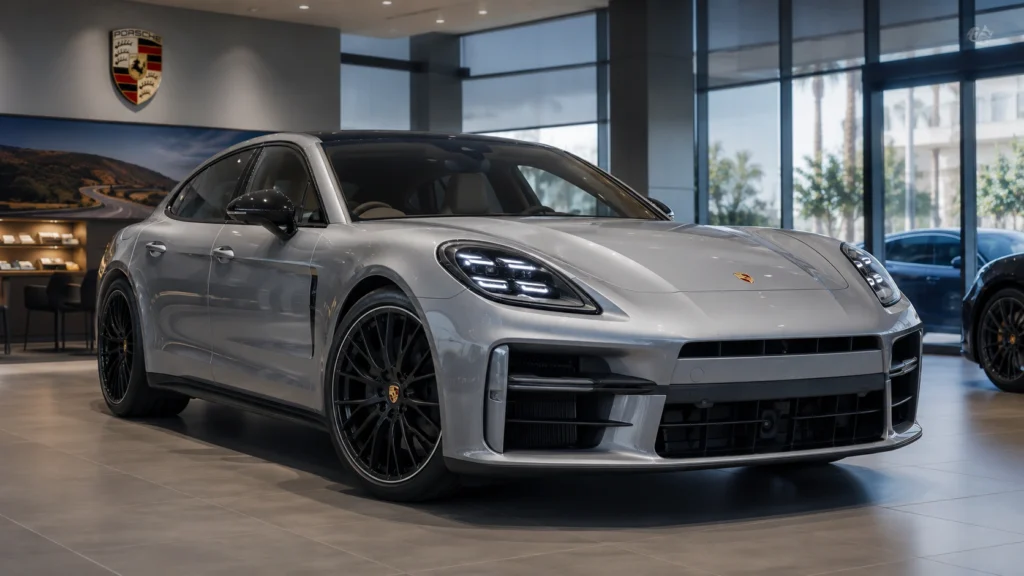
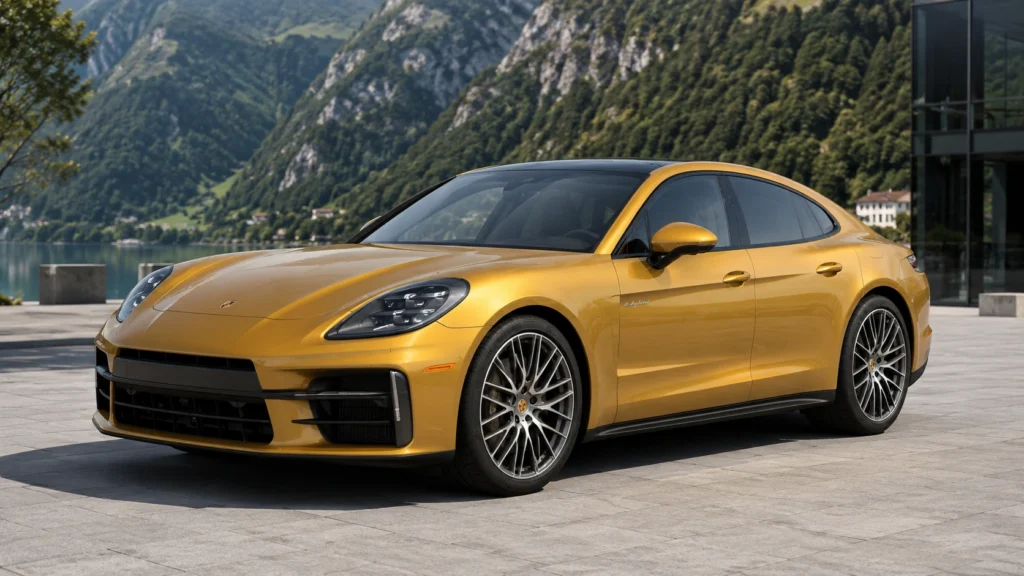
The current Porsche Panamera reads as an evolution rather than a reinvention, and that’s intentional — Porsche rarely tears up a design that’s working. The front end carries sculpted fenders and a hood that sits visually lower than the rest of the body, emphasizing width and stance over height. Matrix-design LED headlights are standard, echoing the 911’s round lighting cues without directly copying them.
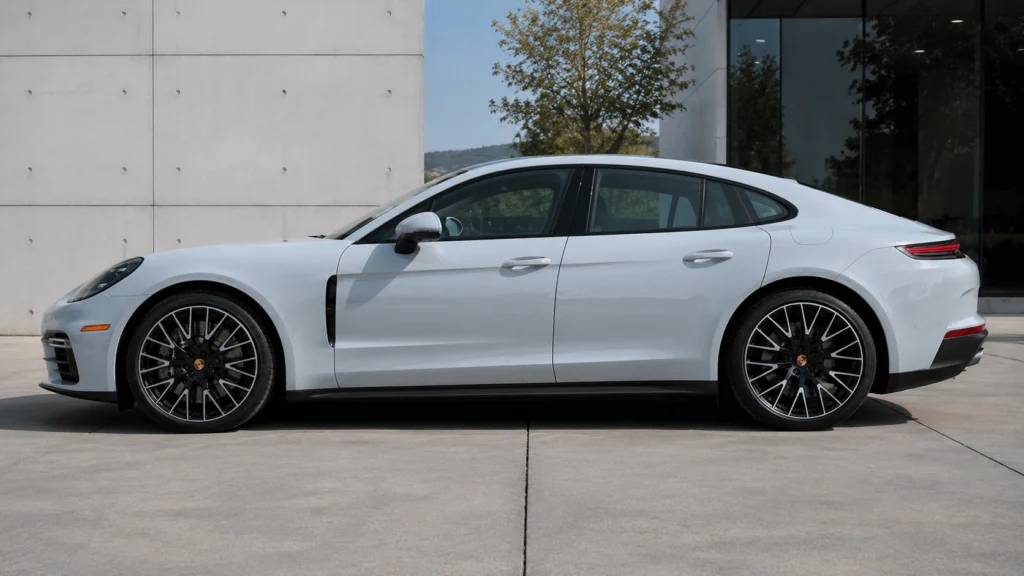
In profile, the Panamera’s most distinctive feature is its roofline. The window line rises toward the rear and kicks up sharply at the D-pillar, a cue that signals the liftback body style before you ever see the trunk open. It’s this line, more than anything else, that makes the Panamera read as a “four-door sports car” rather than a stretched executive sedan.
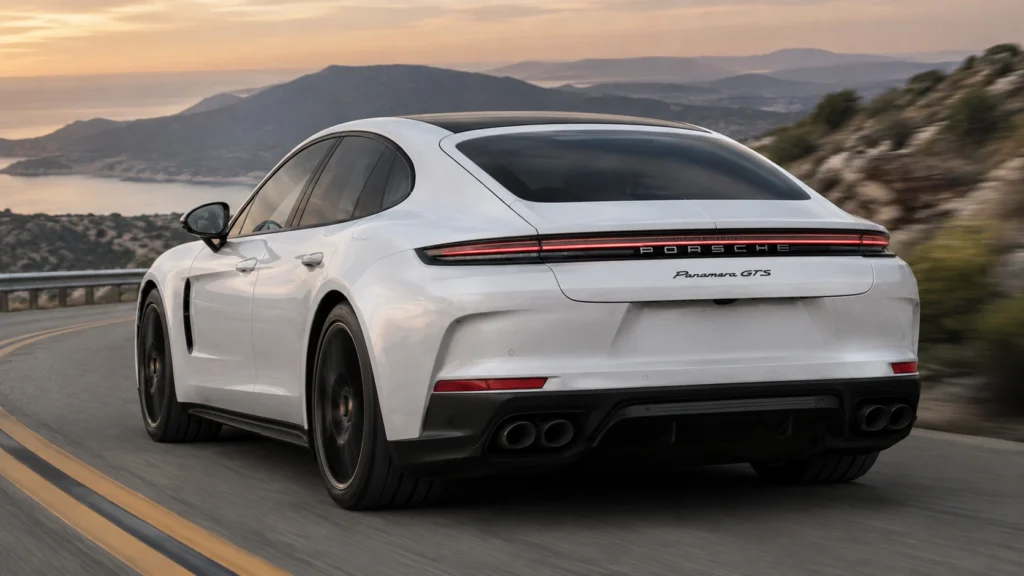
Around back, a full-width light bar connects the taillights, and higher-performance trims like the Turbo E-Hybrid and Turbo S E-Hybrid get more aggressive diffusers, twin-tube exhaust finishers, and unique accents Porsche calls Turbonite. Wheel sizes span from 19 inches on base cars up to 21-inch designs on Turbo and GTS models, with center-lock wheels available on the range-topping trims. An active rear spoiler adjusts angle based on speed and drive mode to manage high-speed stability.
The design successfully splits the difference Porsche is chasing: it doesn’t look like a shrunken SUV or an inflated 911, and it avoids the anonymous look that afflicts a lot of large luxury sedans.
Interior and Technology
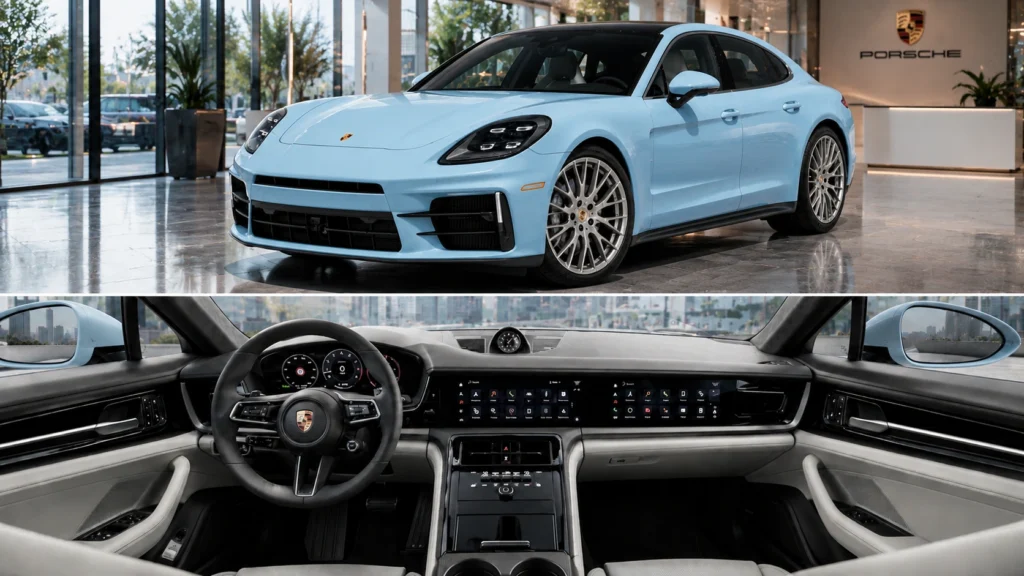
Step inside and the biggest recent change is the instrument cluster. The current Porsche Panamera uses a curved, Taycan-inspired digital display — a 12.6-inch screen paired with a 12.3-inch central touchscreen — replacing the more button-heavy layout of earlier generations. An optional 10.9-inch passenger display lets a front passenger control media and navigation without distracting the driver.
Material quality is a genuine strength here. Leather, brushed metal, and (on higher trims) carbon-fiber trim are used throughout, and fit and finish generally matches or beats rivals from BMW and Mercedes. Front seats are supportive rather than plush — more sports car than limousine — with massaging and ventilated seats available as options rather than standard fare.
The rear seat is where trade-offs show up. In the standard four-seat configuration, two individual rear buckets offer good space for adults on longer trips. Porsche also offers an optional 2+1 layout with a middle seat, but that spot is tight and best reserved for short trips or kids, not a fifth adult on a road trip.
For 2026, software updates added Amazon Alexa integration, a new native app store, and Dolby Atmos surround sound support for buyers who option the Bose or Burmester audio upgrades. Driver-assistance features include adaptive cruise control, lane-keeping assistance, and Porsche InnoDrive, a predictive cruise system that uses navigation and speed-sign data to adjust pace ahead of curves — genuinely useful on longer highway drives.
One consistent criticism from reviewers is road and wind noise, more noticeable here than in rivals tuned purely for isolation. It’s a reasonable trade-off for a car meant to feel connected to the road, but worth experiencing firsthand if a whisper-quiet cabin is a priority.
Engine and Performance
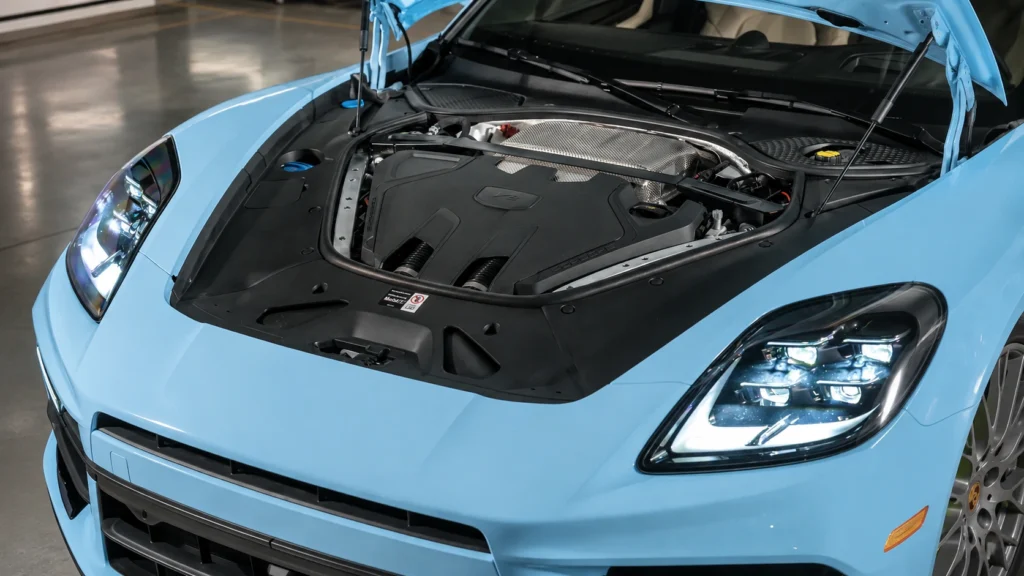
This is where the Porsche Panamera lineup gets genuinely complex — in a good way for shoppers who want options. Seven distinct powertrains are offered for 2026, spanning a gas-only V6 all the way up to a 771-horsepower plug-in hybrid V8.
The base Panamera and Panamera 4 share a 2.9-liter twin-turbo V6 producing 348 horsepower and 368 lb-ft of torque. The base car is rear-wheel drive, while the Panamera 4 adds Porsche’s all-wheel-drive system, and both use the eight-speed PDK dual-clutch transmission standard across the range.
Moving into hybrid territory, the Panamera 4 E-Hybrid pairs a detuned version of that V6 with an electric motor for a combined 463 horsepower, while the 4S E-Hybrid uses the full-strength V6 alongside a more powerful motor for 536 horsepower. Both use a larger battery than the previous generation, and Porsche says real-world electric-only range lands close to 30 miles under ideal conditions — enough for many owners to handle daily commuting on electricity alone.
For buyers who want a V8 without hybrid complexity, the Porsche Panamera GTS delivers a 4.0-liter twin-turbo V8 making 493 horsepower and 486 lb-ft of torque. Enthusiast reviewers frequently point to the GTS as the most rewarding car to drive in the lineup, thanks to reduced weight versus the hybrid Turbo models.
At the top sit the Turbo E-Hybrid and Turbo S E-Hybrid, both pairing the same 4.0-liter twin-turbo V8 with an electric motor built into the transmission housing. The Turbo E-Hybrid produces 670 horsepower and 685 lb-ft of torque, while the Turbo S E-Hybrid tops the range at 771 horsepower and 737 lb-ft — figures that put it in the same conversation as dedicated sports cars, not just luxury sedans.
| Trim | Engine | Horsepower | Torque | Drivetrain |
|---|---|---|---|---|
| Panamera | 2.9L twin-turbo V6 | 348 hp | 368 lb-ft | RWD |
| Panamera 4 | 2.9L twin-turbo V6 | 348 hp | 368 lb-ft | AWD |
| Panamera 4 E-Hybrid | V6 + electric motor | 463 hp | 479 lb-ft | AWD |
| Panamera 4S E-Hybrid | V6 + electric motor | 536 hp | 553 lb-ft | AWD |
| Panamera GTS | 4.0L twin-turbo V8 | 493 hp | 486 lb-ft | AWD |
| Panamera Turbo E-Hybrid | V8 + electric motor | 670 hp | 685 lb-ft | AWD |
| Panamera Turbo S E-Hybrid | V8 + electric motor | 771 hp | 737 lb-ft | AWD |
On the road, the character shifts noticeably by trim. Base and Porsche Panamera 4 models feel composed and confident rather than outright thrilling; the GTS is the sharpest-handling car in the range; and the Turbo models deliver genuinely startling acceleration for a car this size, aided by launch control and, on the S model, standard rear-axle steering and Porsche Active Ride suspension.
Ride quality benefits from adaptive air suspension, standard across the entire lineup for the first time in this generation. Braking is strong throughout, with Porsche Ceramic Composite Brakes optional on higher trims. Steering feel remains one of the Panamera’s calling cards — quick without being nervous, and communicative in a way few large sedans manage.
Specifications
The table below compares four representative trims across the 2026 Porsche Panamera lineup, from the most affordable model to the flagship. Figures come from official and verified sources and reflect U.S.-market cars; results may vary slightly by market and options.
| Specification | Panamera (base) | Panamera 4S E-Hybrid | Panamera GTS | Panamera Turbo S E-Hybrid |
|---|---|---|---|---|
| Engine | 2.9L twin-turbo V6 | V6 + electric motor | 4.0L twin-turbo V8 | V8 + electric motor |
| Horsepower | 348 hp | 536 hp | 493 hp | 771 hp |
| Torque | 368 lb-ft | 553 lb-ft | 486 lb-ft | 737 lb-ft |
| Transmission | 8-speed PDK | 8-speed PDK | 8-speed PDK | 8-speed PDK |
| Drivetrain | RWD | AWD | AWD | AWD |
| Seating | 4 (5 optional) | 4 (5 optional) | 4 (5 optional) | 4 (5 optional) |
| 0–60 mph | 5.0 sec | 3.5 sec | 3.6 sec | 2.8 sec |
| Top speed | 168 mph | 180 mph | Not officially disclosed | 202 mph |
| Fuel economy | ~18 city / 25 hwy mpg | Varies with charging habits | ~15 city / 22 hwy mpg (est.) | Varies with charging habits |
| Cargo capacity | Up to ~17.4 cu ft | ~14.9–15.5 cu ft (hybrid battery reduces space) | Nearly full ~17 cu ft | ~14.9–15.5 cu ft (hybrid battery reduces space) |
Top Speed and Acceleration
Acceleration figures span from a solid 5.0 seconds to 60 mph in the base car down to 2.8 seconds in the Turbo S E-Hybrid, a time that rivals dedicated performance cars costing far more. These Porsche-provided figures are typically achieved with the optional Sport Chrono Package and its launch control function, so a car without that option may be measurably slower off the line.
Top speed follows a similar pattern: 168 mph for the base RWD car, climbing to 196 mph for the Turbo E-Hybrid and 202 mph for the Turbo S E-Hybrid, both on summer performance tires. These are manufacturer-claimed figures under controlled conditions — real-world results depend on road conditions, tire choice, and, in most markets, whether you’ll ever legally have the chance to reach them.
Independent testing from Edmunds has generally validated Porsche’s claims, with a tested 4S E-Hybrid hitting 60 mph in 3.5 seconds and running the quarter-mile in 11.7 seconds — numbers that track closely with the factory-quoted figures, lending the brand’s claims real credibility.
Price
Pricing for the 2026 Porsche Panamera spans a wide range depending on trim, and that’s before you even open the options list. All figures below reflect U.S.-market MSRP including destination charges, and are subject to change based on region, dealer markup, and current incentives.
- Panamera (base, RWD): starts around $113,000
- Panamera 4S E-Hybrid: starts around $139,100
- Panamera GTS: starts around $166,900
- Panamera Turbo E-Hybrid: starts around $207,900
- Panamera Turbo S E-Hybrid: starts around $245,200
Those numbers only tell part of the story. Porsche’s options list is famously extensive, and it’s easy to add tens of thousands of dollars to a build once you start selecting items like Porsche Active Ride suspension, rear-axle steering, premium audio packages, and personalized paint finishes. A well-optioned 4S E-Hybrid can easily cross into GTS or Turbo E-Hybrid pricing territory once a few boxes are checked.
Pricing, available trims, and even model names can also differ outside the United States, where taxes, import duties, and market-specific equipment change the final number substantially. Shoppers elsewhere should confirm current pricing through their local Porsche dealer or the official Porsche Panamera page rather than relying on U.S. figures.
Pros and Cons
Pros
- Genuine sports-car handling in a full-size, four-door body
- The broadest powertrain range in its segment, from efficient V6 to 771-hp hybrid V8
- Hatchback-style trunk adds real-world cargo flexibility
- Interior materials and build quality are a clear step above mainstream luxury brands
- Plug-in hybrid models offer meaningful electric-only range without sacrificing performance
Cons
- Base price is high, and the options list can push a well-equipped car dramatically higher
- Ride is firmer, and cabin noise more noticeable, than some rivals tuned purely for comfort
- Rear middle seat in the optional 2+1 layout is cramped for adults
- Hybrid models lose some cargo space to battery packaging
- Maintenance and repair costs, typical of the segment, run higher than mainstream luxury brands
Comparison With Competitors
The Porsche Panamera doesn’t have a huge number of direct rivals left. Several traditional competitors, including various four-door coupe models from other European brands, have been discontinued or folded into other nameplates in recent years, which has actually simplified the shopping list for buyers cross-shopping this segment.
| Model | Power | 0–60 mph | Starting Price (U.S.) | Key Strength |
|---|---|---|---|---|
| Porsche Panamera | 348–771 hp | 2.8–5.0 sec | ~$113,000 | Widest powertrain range, sharpest handling |
| BMW 8 Series Gran Coupe | 335–523 hp | 3.7–4.9 sec | ~$94,500 (before destination) | Quietest, most comfort-focused cruiser |
| Audi RS7 | 621 hp | 3.3 sec | ~$133,995 | Standard quattro all-wheel-drive grip |
| Mercedes-AMG GT 4-Door Coupe | 362–831 hp | ~3.0–4.8 sec | ~$102,100 | Boldest styling, widest trim spread |
The BMW 8 Series Gran Coupe is the closest thing to a comfort-first alternative, prioritizing a quieter cabin and relaxed ride over outright agility. The Audi RS7 leans hard into all-weather usability thanks to standard quattro all-wheel drive, though it comes in just one trim. The Mercedes-AMG GT 4-Door Coupe is arguably the Panamera’s most direct rival in spirit, spanning a similarly wide range of powertrains and leaning into more dramatic styling.
None of these cars are inexpensive, and the right choice comes down to priorities: comfort-first buyers may prefer the BMW, all-weather performance shoppers may lean Audi, and those chasing outright drama might pick the Mercedes. The Panamera’s case is that it handles credibly well across all three without fully compromising on any of them, backed by a more composed everyday ride than the AMG and sharper handling than the BMW.
Who Should Buy It?
The Porsche Panamera makes the most sense for buyers who genuinely want to drive their luxury sedan, not just be driven in it. If you’ve cross-shopped a 911 but need room for a family or regular passengers, the Porsche Panamera is built to bridge that exact gap — it’s the rare large sedan that doesn’t feel like a compromise from behind the wheel.
It’s also a strong fit for buyers who want flexibility in how they use electrification. The plug-in hybrid trims let owners run daily errands and short commutes on electric power while keeping a proper gas engine for road trips, without the range anxiety of a fully electric vehicle. For buyers drawn to that combination, the official Porsche Panamera page walks through current hybrid specifications and configurator options in more detail.
Long-distance comfort is solid, if not class-leading; firmer suspension tuning and above-average road noise mean it’s not the most serene option for buyers whose primary use case is chauffeured highway miles. Families will find the standard four-seat layout comfortable for two rear passengers, though the optional middle seat is a compromise, not a full-time solution.
Buyers who prioritize a whisper-quiet cabin, maximum rear-seat space, or the lowest possible price of entry in this segment may be better served by a BMW 7 Series, Mercedes S-Class, or the BMW 8 Series Gran Coupe discussed above. The Porsche Panamera earns its price premium specifically for buyers who value handling and driver engagement as much as luxury amenities — if that’s not a priority, the value proposition weakens considerably. For a broader look at how the Porsche Panamera fits alongside the rest of the brand’s lineup, our complete Porsche guide breaks down every current model side by side.
Conclusion
The Porsche Panamera remains one of the few large luxury sedans that genuinely rewards being driven rather than just riding in. Across three generations, it’s evolved from a polarizing first attempt into a confident, technically impressive lineup that spans a fuel-efficient V6 all the way to a 771-horsepower hybrid flagship.
What hasn’t changed is the core idea: Porsche engineering applied to a car with room for four, real cargo space, and everyday usability most sports cars can’t match. The trade-offs are real — a firm ride, noticeable road noise, and a price that climbs quickly once you start adding options — but for buyers who value handling and driver engagement as much as luxury, few rivals match it.
Whether the right pick is the efficient base model, the V8-powered GTS, or the hybrid Turbo S, the Panamera’s biggest strength is choice: seven distinct personalities under one nameplate, each still recognizably a Porsche the moment you turn the wheel.
Frequently Asked Questions (FAQs)
Yes, for the right buyer. It combines genuine sports-sedan handling with practical cargo space and a high-quality interior, though it comes at a premium price and with a firmer ride than some rivals.
In the U.S., 2026 pricing starts around $113,000 for the base RWD model and climbs to roughly $245,200 for the range-topping Turbo S E-Hybrid, before options. Pricing varies by market, trim, and equipment.
Very, especially in higher trims. The Turbo S E-Hybrid reaches 60 mph in about 2.8 seconds and tops out around 202 mph, while even the base model’s 5.0-second sprint is competitive for the segment.
The lineup includes a 2.9-liter twin-turbo V6, a 4.0-liter twin-turbo V8, and plug-in hybrid versions of both, ranging from 348 horsepower to 771 horsepower.
Four adults comfortably as standard, with an optional 2+1 rear bench that adds a fifth, tighter middle seat.
Porsche generally has a solid reputation for build quality, though, like most performance luxury vehicles, maintenance and repair costs tend to run higher than mainstream brands. Checking current reliability ratings and an extended warranty option is worth doing before you buy.
Yes. Four of the seven 2026 trims are plug-in hybrids — the 4 E-Hybrid, 4S E-Hybrid, Turbo E-Hybrid, and Turbo S E-Hybrid — offering meaningful electric-only range alongside their gas engines.
It generally outhandles rivals like the BMW 8 Series Gran Coupe and offers a broader trim range than the single-spec Audi RS7, while trading some ride comfort and cabin quietness compared to more comfort-focused options.